Facebook’s marketingstrategy focuses on expanding its user base globally, leveraging the network effect, and targeting diverse demographics. It generates revenue through targeted advertising and develops engaging features to drive user retention. Privacy and data security are prioritized, while product diversification and a thriving developer ecosystem contribute to its success. Social impact and corporate responsibility initiatives further strengthen its brand.
Marketing Strategy
Description
Example
Implications
Integration
Targeted Advertising
Facebook offers advanced advertising tools that allow businesses to create highly targeted ad campaigns based on user demographics, interests, behaviors, and more. Advertisers can reach specific audiences with precision.
Advertisers use Facebook Ads Manager to create custom audiences, set demographics, interests, and behaviors for ad targeting. For example, a fitness brand may target ads at users interested in fitness and healthy living within a specific age range.
– Maximizes ad relevance and ROI through precise audience targeting. – Enables businesses to reach niche or specific demographics effectively. – Provides granular control over ad placements and budgets.
Targeted advertising is a core component of Facebook’s marketing strategy, closely integrated with Facebook Pages for business profiles. It complements data-driven advertising for personalized campaigns and aligns with analytics for tracking ad performance.
Facebook Pages
Facebook Pages serve as dedicated profiles for businesses, brands, and public figures. They provide a platform for sharing content, engaging with audiences, and building a community of followers.
Brands create Facebook Pages to establish an online presence. They share updates, posts, videos, and engage with followers by responding to comments and messages. A local bakery may use a Page to showcase its products and interact with customers.
– Facilitates brand visibility and engagement with a dedicated online presence. – Encourages community-building and customer interaction. – Provides a central hub for sharing content and updates.
Facebook Pages are an integral part of Facebook’s marketing ecosystem, closely integrated with targeted advertising for promoting Page content. They complement community engagement for fostering connections with followers and align with content marketing for sharing branded content.
Video Content
Video content is a prominent feature on Facebook, and it is prioritized in user feeds. Brands use video marketing to capture audience attention, tell stories, and convey messages effectively.
Brands create and share video content, including product demos, tutorials, behind-the-scenes footage, and storytelling videos. For example, an electronics company may create video ads showcasing the features of a new smartphone.
– Engages users with compelling visuals and storytelling. – Captures attention in a crowded social media environment. – Provides opportunities for showcasing products and brand narratives.
Video content is seamlessly integrated into Facebook’s platform, aligning with Facebook Live for live video broadcasts. It complements visual storytelling for conveying brand messages and aligns with content marketing for sharing video content.
Community Engagement
Facebook emphasizes community building, and brands use it to engage with their followers authentically. This includes responding to comments, asking questions, conducting polls, and fostering meaningful interactions.
Brands actively engage with their audience by responding to comments, asking questions, conducting polls, and encouraging users to share their thoughts and experiences. For example, a fashion brand may ask followers to vote on the next clothing collection’s theme.
– Fosters brand loyalty and trust through direct interactions. – Creates a sense of community and belonging among followers. – Encourages user-generated content and participation.
Community engagement is an integral part of Facebook’s marketing ecosystem, closely integrated with Facebook Groups for community building. It complements user-generated content for encouraging participation and aligns with visual storytelling for authentic brand interactions.
Messenger Marketing
Facebook Messenger provides a platform for brands to communicate with customers directly. Businesses use Messenger to provide customer support, answer inquiries, and send personalized messages.
Brands use Messenger for customer support, responding to inquiries, sending order updates, and providing personalized recommendations. For example, an e-commerce store may use Messenger to assist customers with product selection and order tracking.
– Enhances customer service and support through real-time messaging. – Enables personalized and direct communication with customers. – Facilitates order updates, inquiries, and recommendations.
Messenger marketing is fully integrated into Facebook’s platform, closely aligned with community engagement for direct interactions. It complements customer support strategies by offering real-time messaging and aligns with targeted advertising for sending personalized messages to customers.
Events and Promotions
Facebook Events allow businesses to create and promote events, product launches, webinars, and promotions. This feature helps brands reach a wider audience and encourage user participation.
Brands create Facebook Events to promote upcoming activities, events, webinars, or sales promotions. Users can RSVP, share the event with their network, and receive updates and reminders. For instance, a bookstore may create an event for a book signing with a popular author.
– Expands event reach and encourages user participation and attendance. – Provides a platform for event updates, RSVPs, and reminders. – Enables event promotion to a broader audience.
Events and promotions are seamlessly integrated into Facebook’s platform, closely aligned with targeted advertising for event promotion. They complement community engagement for encouraging user participation and align with content marketing for sharing event details and promotions.
Visual Storytelling
Visual content, such as images and infographics, is highly effective in capturing user attention. Brands use visual storytelling to convey messages, showcase products, and create memorable brand narratives.
Brands create visually appealing content to tell stories, showcase products, and convey brand messages. For example, a travel agency may use stunning photos to promote travel destinations and experiences.
– Captures user attention and conveys messages effectively. – Creates a memorable brand narrative and visual identity. – Showcases products and services in an engaging way.
Visual storytelling is a fundamental element of Facebook’s marketing strategy, closely integrated with targeted advertising for visual content promotion. It complements video content for conveying brand narratives and aligns with content marketing for sharing visually engaging posts.
Global Expansion:Facebook’s strategy aims to expand its user base worldwide, capitalizing on the network effect where more users attract even more users.
Demographic Diversity: The company targets a wide range of demographics to make its platform accessible to people of all ages and backgrounds.
Revenue Generation:Facebook generates significant revenue through targeted advertising, leveraging its extensive user data to provide effective advertising solutions.
User Engagement:Facebook continually develops engaging features and content to keep users active on the platform, driving user retention and prolonged interaction.
Privacy and Data Security: Privacy and data security are prioritized to maintain user trust and comply with regulations.
Product Diversification: In addition to the core Facebook platform, the company has diversified its offerings by acquiring Instagram, WhatsApp, and Oculus, expanding its reach and user base.
Developer Ecosystem: A thriving ecosystem of third-party developers creates applications and integrations for the platform, enriching the user experience.
Social Impact:Facebook engages in social impact initiatives and corporate responsibility efforts, strengthening its brand image and resonating with socially conscious users.
Mark Zuckerberg is the largest shareholder in the company. Zuckerberg retains ownership and control of the company. Like Google, Facebook has issued two common stocks, Class A and Class B. The holders of Class B common stocks are entitled to ten votes per share, and holders of our Class A common stocks are entitled to one vote per share. Mark Zuckerberg has a voting power of 61.1%; he’s the primary decision-maker. Other individual investors comprise Sheryl Sandberg, Christopher Cox, Marc Andreessen, Peter Thiel, Dustin Moskovitz, and Eduardo Saverin.
Facebook, the main product of Meta is an attention merchant. As such, its algorithms condense the attention of over 2.91 billion monthly active users as of June 2021. Meta generated $117.9 billion in revenues, in 2021, of which $114.9 billion from advertising (97.4% of the total revenues) and over $2.2 billion from Reality Labs (the augmented and virtual reality products arm).
Facebook generated most of its revenue from advertising in 2023. Indeed, the company generated $131.95B from advertising, $1.89B billion from its reality labs segment, and over a billion in other revenue.
By September 2022, Facebook’s (Meta) employee count had peaked at 87,314. Yet, as revenue slew down for the first time in years, the company announced a layoff of 13% of its workforce, bringing the headcount to 75,964. By March 2023, Meta announced another round of layoffs, dubbed “The Year of Efficiency,” which brought the headcount down to less than 66 thousand employees. By the end of 2023, Facebook reported 67,317 employees.
In 2022, post layoffs, Facebook generated $1,535,056 per employee, compared to $1,638,586 in 2021. In 2023, as Facebook (now Meta) completed its mass layoffs, the company reported nearly $135 billion in revenue and 67,317 employees, with a $2,003,981 revenue per employee.
Facebook (Meta) gained users in 2023. In fact, in 2023, Facebook had over three billion users worldwide, of which 272 million were in Canada, 408 million were in Europe, over 1.3 billion were in Asia, and over a billion were in the rest of the world.
ARPU, or average revenue per user, is a crucial metric for attention merchants like Facebook. It assesses the ability of the platform to monetize its users. For instance, by the end of 2023, Meta’s ARPU worldwide was $13.12. In the US & Canada, it was $68.44; in Europe, it was $23.14; in Asia-Pacific, $5.52; and in the rest of the world, it was $4.50.
ARPU, or average revenue per user, is a crucial metric for attention merchants like Facebook. It assesses the ability of the platform to monetize its users. For instance, by the end of 2023, Meta’s ARPU worldwide was $13.12. In the US & Canada, it was $68.44; in Europe, it was $23.14; in Asia-Pacific, $5.52; and in the rest of the world, it was $4.50.
Facebook (Meta) revenue in 2023 increased to $134.9B, compared to $116.6B in 2022. Its profitability increased to $39.1B in 2023, compared to $23.2B in 2022 and $39.37B in 2021.
Facebook is characterized by a multi-faceted matrix organizational structure. The company utilizes a flat organizational structure in combination with corporate function-based teams and product-based or geographic divisions. The flat organization structure is organized around the leadership of Mark Zuckerberg, and the key executives around him. On the other hand, the function-based teams based on the main corporate functions (like HR, productmanagement, investor relations, and so on).
Instagram makes money via visual advertising. Acquired by Facebook for a billion-dollar in 2012, today, Instagram is integrated into the overall Facebook (now rebranded as Meta) business strategy. In 2018, Instagram founders Kevin Systrom and Mike Krieger left the company as Facebook pushed toward tighter integration of the two platforms. In 2022, Instagram is the most successful product still, in Meta’s portfolio.
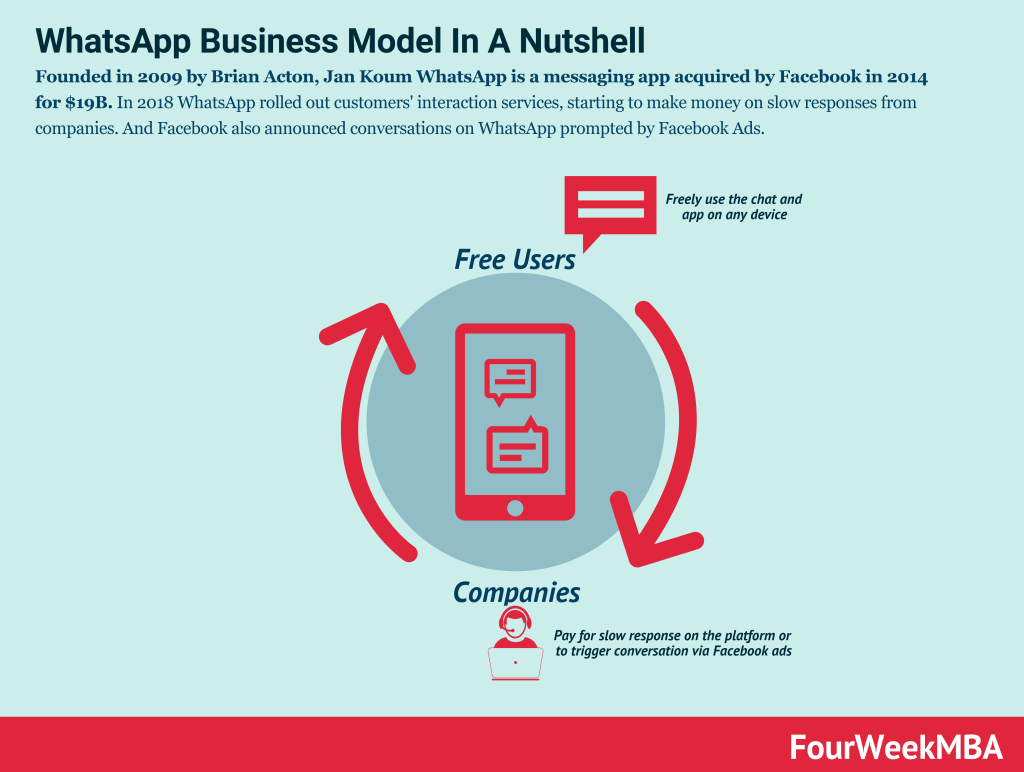
Founded in 2009 by Brian Acton, Jan Koum WhatsApp is a messaging app acquired by Facebook in 2014 for $19B. In 2018 WhatsApp rolled out customers’ interaction services, starting to make money on slow responses from companies. And Facebook also announced conversations on WhatsApp prompted by Facebook Ads.
Gennaro is the creator of FourWeekMBA, which reached about four million business people, comprising C-level executives, investors, analysts, product managers, and aspiring digital entrepreneurs in 2022 alone | He is also Director of Sales for a high-tech scaleup in the AI Industry | In 2012, Gennaro earned an International MBA with emphasis on Corporate Finance and Business Strategy.