DoorDash generated $8.63 billion in revenue in 2023, compared to over $6.5 billion in revenue in 2022, and $4.8 billion in 2021.
The revenue increased from $291 million in 2018 to $6.58 billion in 2022.
The revenuegrowth rate was high, increasing by 204% from 2018 to 2019, followed by a massive 225% increase from 2019 to 2020.
The revenue continued to grow steadily, with a 69% increase in 2021 and a 35% increase in 2022.
The revenuegrowth rate shows that the business is expanding and increasing its market share.
DoorDash generated $8.63 billion in revenue in 2023, and over $500 million in net losses for the same period, while it generated over $6.5 billion in revenue in 2022 and over $1.3 billion in net losses for the same period.
Net losses increased from $204 million in 2018 to $1.37 billion in 2022.
Net losses decreased in 2020 to $461 million, but increased again in 2021 to $468 million and further increased to $1.37 billion in 2022.
Overall if we look at the trend between revenue and net losses:
Revenue grew from $291 million in 2018 to $6.58 billion in 2022, representing a compound annual growth rate (CAGR) of approximately 155%.
Net losses increased from $204 million in 2018 to $1.37 billion in 2022, representing a CAGR of approximately 64%.
The trend between revenue and net losses shows that while revenue grew significantly, net losses also increased, indicating that the company’s expenses have grown faster than revenue.
The net loss margin, which is the ratio of net losses to revenue, increased from 70% in 2018 to 21% in 2022, indicating some improvement in the company’s profitability over time.
The significant increase in revenue suggests that the company is expanding its market share, but the increasing net losses over time.
DoorDash is a platform business model that enables restaurants to set up at no cost delivery operations. At the same time, customers get their food at home and dashers (delivery people) earn some extra money. DoorDash makes money by markup prices through delivery fees, memberships, and advertising for restaurants on the marketplace.
DoorDash generated $8.63 billion in revenue in 2023, and over $500 million in net losses for the same period, while it generated over $6.5 billion in revenue in 2022 and over $1.3 billion in net losses for the same period.
DoorDash defines its Marketplace GOV as the total dollar value of Marketplace orders completed in its local logistics platform, including taxes, tips, and any applicable consumer fees, including membership fees related to DashPass. In 2023, DoorDash GOV was nearly %67 billion, in 2022 it was over $53 billion, vs. almost $42 billion in 2021.
If we look at EBITDA, Uber Eats was a profitable segment, generating $1.5 billion in EBITDA in 2023. For the first time since its inception, Uber Eats’ EBITDA (Earnings Before Interest, Taxes, Depreciation, and Amortization) – which measures a company’s operational efficiency – turned positive for $551 million in 2022, compared to negative $348 million in 2021; negative $870 million in negative EBIDTA in 2020; and over $1.3 billion negative EBIDTA in 2019.
In 2023 Uber Eats generated $12.2 billion in revenue, compared to nearly $11 billion in 2022, $8.3 billion in revenue in 2021, and $3.9 billion in revenue in 2020.
Uber Mobility, which is the core platform of Uber, had a 28.8% take rate in 2023, and a 19.15% take rate for the delivery platform (Uber Eats) in the same period. The mobility platform had a 27% take rate in 2022, and a take rate of 19% in 2021. The take rate is the percentage Uber takes on each booking on the platform in the same year. For instance, in 2022, Uber Mobility recorded $52.6 billion in gross bookings and $14 billion in revenue.
Deliveroo is a British online food delivery company founded by Greg Orlowski and Will Shu in 2013. Shu developed the platform in response to a lack of high-quality food delivery in London.
Deliveroo makes money by collecting 25-45% of every order it facilitates. It also charges delivery fees and onboarding fees for restaurants that wish to be featured on the platform.
Deliveroo for Business is a service designed for corporate clients needing to order food in bulk. The company also charges a higher commission to businesses that utilize a network of digital kitchens to process orders.
DoorDash is a platform business model that enables restaurants to set up at-no-cost delivery operations. At the same time, customers get their food at home, and dashers (delivery people) earn some extra money. DoorDash makes money by markup prices through delivery fees, memberships, and advertising for restaurants on the marketplace.
Glovo is a Spanish on-demand courier service that purchases and delivers products ordered through a mobile app. Founded in 2015 by Oscar Pierre and Sacha Michaud as a way to “uberize” local services. Glovo makes money via delivery fees, mini-supermarkets (fulfillment centers that Glovo operates in partnership with grocery store chains), and dark kitchens (enabling restaurants to increase their capacity).
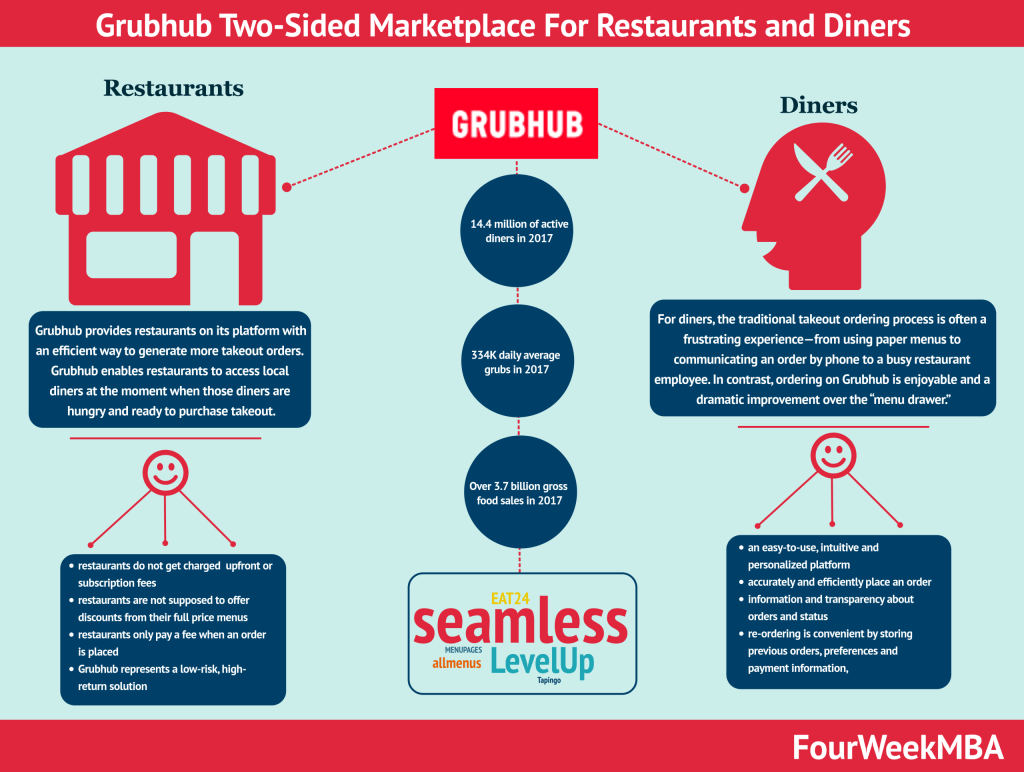
Grubhub is an online and mobile platform for restaurant pick-up and delivery orders. In 2018 the company connected 95,000 takeout restaurants in over 1,700 U.S. cities and London. The Grubhub portfolio of brands like Seamless, LevelUp, Eat24, AllMenus, MenuPages, and Tapingo. The company makes money primarily by charging restaurants a pre-order commission, and it generates revenues when diners place an order on its platform. Also, it charges restaurants that use Grubhub delivery services when diners pay for them.
Lyft is a transportation-as-a-service marketplace allowing riders to find a driver for a ride. Lyft has also expanded with a multimodal platform that gives more options like bike-sharing or electric scooters. Lyft primarily makes money by collecting fees from drivers that complete rides on the platform.
OpenTable is an American online restaurant reservation system founded by Chuck Templeton. During the late 90s, it provided one of the first automated, real-time reservation systems. The company was acquired by Booking Holding back in 2014 for $2.6 billion. Today OpenTable makes money via subscription plans, referral fees, and in-dining with its first restaurant, as an experiment in Miami, Florida.
Postmates is a food delivery service built as a last-mile delivery service platform connecting locals with shops. Postmates makes money by collecting fees (commission, delivery, service, cart, and cancellation fees). It also makes money via its subscription service (called Unlimted – $9.99/month or $99.99 annually), giving free delivery on orders of more than $12.
Uber Eats is a three-sided marketplace connecting a driver, a restaurant owner, and a customer with Uber Eats platform at the center. The three-sided marketplace moves around three players: Restaurants pay commission on the orders to Uber Eats; Customers pay small delivery charges and, at times, cancellation fees; Drivers earn through making reliable deliveries on time.
Gennaro is the creator of FourWeekMBA, which reached about four million business people, comprising C-level executives, investors, analysts, product managers, and aspiring digital entrepreneurs in 2022 alone | He is also Director of Sales for a high-tech scaleup in the AI Industry | In 2012, Gennaro earned an International MBA with emphasis on Corporate Finance and Business Strategy.