Applied Behavior Analysis (ABA) is a systematic and data-driven approach to understanding and modifying behavior. It involves the application of principles derived from the science of behavior to improve socially significant behaviors and outcomes. ABA focuses on observable behaviors and seeks to identify the environmental variables that influence behavior.
Behaviorism: ABA is rooted in the principles of behaviorism, which emphasize the importance of observable behaviors and the environmental factors that influence them.
Empiricism: ABA relies on empirical evidence and data collection to guide assessment, intervention, and decision-making.
Behavioral Assessment: ABA involves conducting thorough assessments to identify target behaviors, their antecedents (triggers), and consequences (reinforcers).
Functional Analysis: ABA utilizes functional analysis to identify the underlying function or purpose of behavior, such as seeking attention, escaping aversive situations, or obtaining tangible rewards.
Behavior Modification: ABA employs behavior modification techniques, such as reinforcement, shaping, prompting, and fading, to increase desired behaviors and decrease undesirable behaviors.
Individualized Interventions: ABA interventions are individualized to each person’s unique needs, preferences, and circumstances.
Techniques of Applied Behavior Analysis
Positive Reinforcement: ABA utilizes positive reinforcement to increase the likelihood of desired behaviors. Reinforcement involves providing rewards or incentives contingent upon the occurrence of target behaviors.
Prompting and Fading: ABA uses prompting to help individuals learn new skills by providing cues or prompts to guide their behavior. Prompting is gradually faded over time as individuals become more proficient in the target skill.
Task Analysis: ABA breaks down complex behaviors or skills into smaller, manageable steps through task analysis. This allows individuals to learn sequentially and master each component before progressing to the next.
Functional Communication Training (FCT): ABA teaches individuals alternative, socially appropriate ways to communicate their needs and desires, reducing the likelihood of problem behaviors.
Antecedent Interventions: ABA modifies environmental antecedents to alter behavior. This may involve removing triggers for problem behaviors or modifying the environment to make desired behaviors more likely.
Data Collection and Analysis: ABA relies on systematic data collection and analysis to monitor progress, evaluate intervention effectiveness, and make data-driven decisions.
Applications of Applied Behavior Analysis
Autism Spectrum Disorder (ASD): ABA is widely used in the treatment of autism spectrum disorder to teach communication, social, self-help, and academic skills, and reduce challenging behaviors.
Developmental Disabilities: ABA is effective in addressing behavioral challenges and skill deficits associated with various developmental disabilities, such as intellectual disabilities, Down syndrome, and cerebral palsy.
Education: ABA techniques are used in educational settings to support students with learning disabilities, attention deficit hyperactivity disorder (ADHD), and behavioral difficulties. It helps improve academic performance, classroom behavior, and social skills.
Parent Training: ABA provides parents and caregivers with strategies and techniques to manage challenging behaviors, promote skill development, and create supportive environments for individuals with special needs.
Organizational Behavior Management (OBM): ABA principles are applied in organizational settings to improve workplace performance, increase productivity, and enhance employee satisfaction and morale.
Healthcare: ABA is utilized in healthcare settings to promote healthy behaviors, improve medication adherence, and reduce maladaptive behaviors in individuals with medical conditions, such as chronic pain, obesity, and diabetes.
Benefits of Applied Behavior Analysis
Evidence-Based: ABA is supported by a robust body of scientific research demonstrating its effectiveness in producing meaningful behavior change across diverse populations and settings.
Individualized: ABA interventions are tailored to the unique needs, strengths, and preferences of each individual, maximizing effectiveness and relevance.
Empowering: ABA empowers individuals by teaching them functional skills, enhancing their independence, and improving their quality of life.
Versatile: ABA techniques can be applied across a wide range of behaviors, populations, and settings, making it a versatile and flexible approach to behavior change.
Long-Term Outcomes: ABA focuses on teaching skills that have lasting benefits, leading to sustained improvements in behavior, functioning, and quality of life over time.
Collaborative: ABA encourages collaboration and partnership between individuals, families, caregivers, educators, therapists, and other stakeholders to support positive behavior change and skill development.
Conclusion
Applied Behavior Analysis (ABA) is a systematic, evidence-based approach to understanding and changing behavior. By applying principles derived from the science of behavior, ABA promotes meaningful behavior change, skill development, and improved quality of life for individuals across diverse populations and settings. With its focus on individualized assessment, data-driven intervention, and positive reinforcement, ABA offers a powerful framework for addressing behavioral challenges, promoting skill acquisition, and fostering positive outcomes in education, healthcare, and beyond.
The Feynman Technique is a mental model and strategy for learning something new and committing it to memory. It is often used in exam preparation and for understanding difficult concepts. Physicist Richard Feynman elaborated this method, and it’s a powerful technique to explain anything.
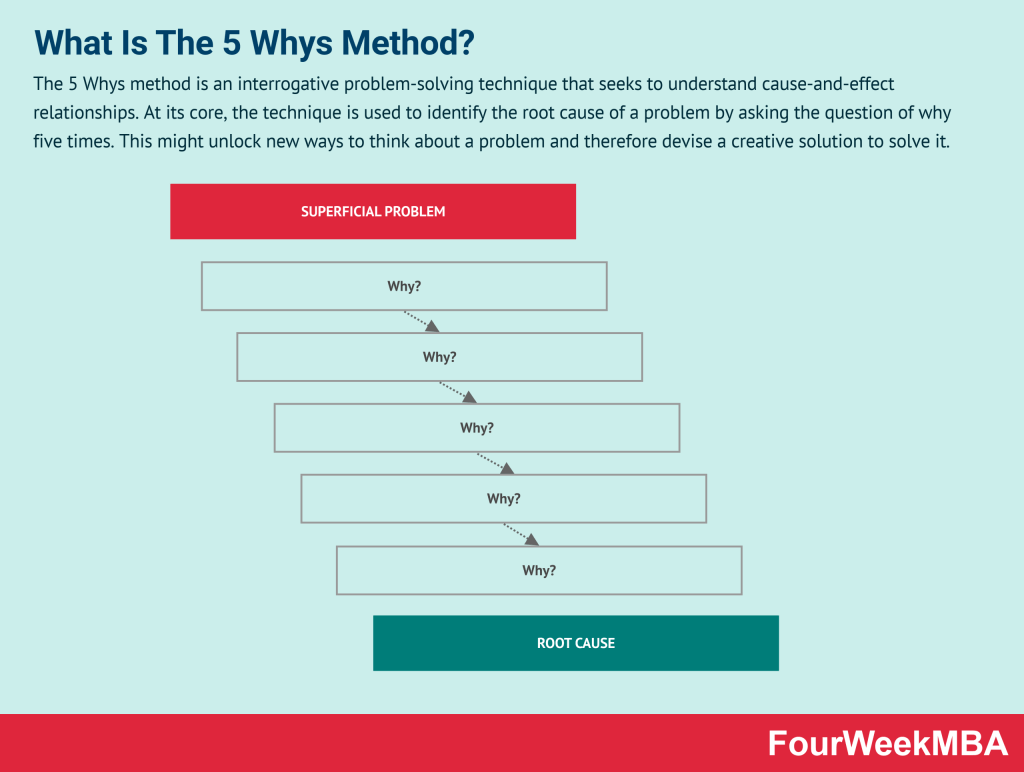
The 5 Whys method is an interrogative problem-solving technique that seeks to understand cause-and-effect relationships. At its core, the technique is used to identify the root cause of a problem by asking the question of why five times. This might unlock new ways to think about a problem and therefore devise a creative solution to solve it.
A SMART goal is any goal with a carefully planned, concise, and trackable objective. To be such a goalneeds to be specific, measurable, achievable, relevant, and time-based. Bringing structure and trackability to goal setting increases the chances goals will be achieved, and it helps align the organization around those goals.
Occam’s Razor states that one should not increase (beyond reason) the number of entities required to explain anything. All things being equal, the simplest solution is often the best one. The principle is attributed to 14th-century English theologian William of Ockham.
The inverted pyramid style is a process used in journalism which inverts the logic of the way a story is told. Rather than start from the story details, you start from a hook, which is critical to get the reader interested, thus giving it a quick pay off.
Active listening is the process of listening attentively while someone speaks and displaying understanding through verbal and non-verbal techniques. Active listening is a fundamental part of good communication, fostering a positive connection and building trust between individuals.
Active recall enables the practitioner to remember information by moving it from short-term to long-term memory, where it can be easily retrieved. The technique is also known as active retrieval or practice testing. With active recall, the process is reversed since learning occurs when the student retrieves information from the brain.
The phrase “baptism by fire” originates from the Bible in Matthew 3:11. In Christianity, the phrase was associated with personal trials and tribulations and was also used to describe the martyrdom of an individual. Many years later, it was associated with a soldier going to war for the first time. Here, the baptism was the battle itself. “Baptism by fire” is a phrase used to describe the process of an employee learning something the hard way with great difficulty.
The Dreyfus model of skill acquisition was developed by brothers Hubert and Stuart Dreyfus at the University of California, Berkeley, in 1980. The Dreyfus model of skill acquisition is a learning progression framework. It argues that as one learns a new skill via external instruction, they pass through five stages of development: novice, advanced beginner, competent, proficient, and expert.
The Kolb reflective cycle was created by American educational theorist David Kolb. In 1984, Kolb created the Experiential Learning Theory (ELT) based on the premise that learning is facilitated by direct experience. In other words, the individual learns through action. The Kolb reflective cycle is a holistic learning and development process based on the reflection of active experiences.
The Method of Loci is a mnemonic strategy for memorizing information. The Method of Loci gets its name from the word “loci”, which is the plural of locus – meaning location or place. It is a form of memorization where an individual places information they want to remember along with points of an imaginary journey. By retracing the same route through the journey, the individual can recall the information in a specific order. For this reason, many consider this memory tool a location-based mnemonic.
The Experience Curve argues that the more experience a business has in manufacturing a product, the more it can lower costs. As a company gains un know-how, it also gains in terms of labor efficiency, technology-driven learning, product efficiency, and shared experience, to reduce the cost per unit as the cumulative volume of production increases.
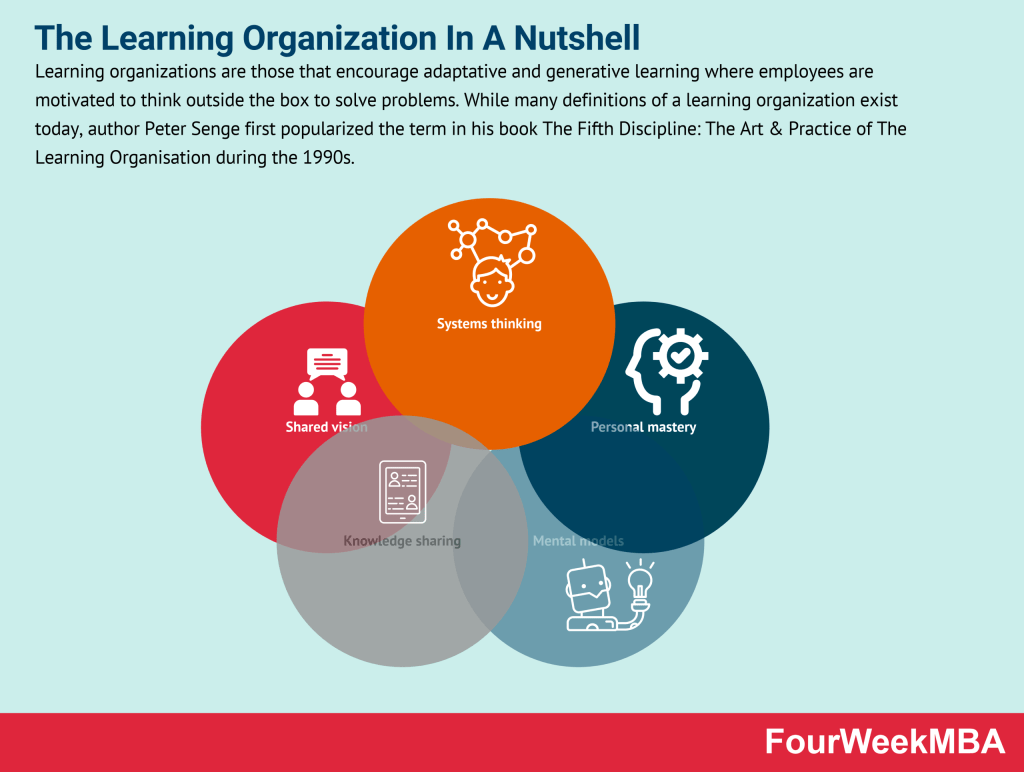
Learning organizations are those that encourage adaptative and generative learning where employees are motivated to think outside the box to solve problems. While many definitions of a learning organization exist today, author Peter Senge first popularized the term in his book The Fifth Discipline: The Art & Practice of The Learning Organisation during the 1990s.
The forgetting curve was first proposed in 1885 by Hermann Ebbinghaus, a German psychologist and pioneer of experimental research into memory. The forgetting curve illustrates the rate at which information is lost over time if the individual does not make effort to retain it.
Instructor-led training is a more traditional, top-down, teacher-oriented approach to learning that occurs in online or offline classroom environments. The approach connects instructors with students to encourage discussion and interaction in a group or individual context, with many enjoying ILT over other methods as they can seek direct clarification on a topic from the source. Instructor-led training (ILT), therefore, encompasses any form of training provided by an instructor in an online or offline classroom setting.
Single-loop learning was developed by Dr. Chris Argyris, a well-respected author and Harvard Business School professor in the area of metacognitive thinking. He defined single-loop learning as “learning that changes strategies of action (i.e. the how) in ways that leave the values of a theory of action unchanged (i.e. the why).” Single-loop learning is a learning process where people, groups, or organizations modify their actions based on the difference between expected and actual outcomes.
Spaced repetition is a technique where individuals review lessons at increasing intervals to memorize information. Spaced repetition is based on the premise that the brain learns more effectively when the individual “spaces out” the learning process. Thus, it can be used as a mnemonic technique to transform short-term memory into long-term memory.
Gennaro is the creator of FourWeekMBA, which reached about four million business people, comprising C-level executives, investors, analysts, product managers, and aspiring digital entrepreneurs in 2022 alone | He is also Director of Sales for a high-tech scaleup in the AI Industry | In 2012, Gennaro earned an International MBA with emphasis on Corporate Finance and Business Strategy.