Anthropic’s Claude Code and OpenAI’s Codex now account for $24.0 billion, or 70%, of a $34.0 billion enterprise AI coding market, Menlo Ventures estimates in 2026: The State of Enterprise AI, published on 3 November. By our arithmetic, frontier lab coding agents took about 78% of the $29.6 billion the coding market added in a year, using Menlo’s chart figures of $1.0 billion for lab agents and $4.4 billion for the whole market in 2025.
Menlo says the report draws on a survey of nearly 400 U.S. enterprise decision-makers responsible for more than $4 billion in AI spending, fielded by Morning Consult from September 8 to 26, 2026. Its dollar figures are estimates of annualized run rate from “a bottoms-up model informed by survey responses, public filings, and third-party reports”. Menlo Ventures is an investor in Anthropic and in coding companies the report names, including Factory, Lovable, Greptile and Harness.
Business Pill · Verification Cost
An evergreen Business Engineer explainer on verification cost: output that is cheap to make is not always cheap to check. It explains the general idea only and does not discuss Menlo’s report or any company in this piece.
The key insight: By our arithmetic, frontier lab coding agents took about 78% of the $29.6 billion added to enterprise AI coding spend in a year, on Menlo Ventures’ chart figures ($1.0 billion to $24.0 billion for lab agents, $4.4 billion to $34.0 billion for the market).
The coding section of the report reads: “The labs capture most of the spend. Anthropic’s Claude Code and OpenAI’s Codex combine for $24.0B, 70% of the $34.0B coding market, up from about $1B last year”.
It adds: “But independent companies are growing, too. The rest of the market grew 2.9x to $10.1B, led by coding platforms like Cursor, Cognition, and Factory, as well as AI app builders like Lovable”.
Menlo calls software development “AI’s first killer use case” and says “Enterprise code activity is up 5x year over year”. It also says “Lovable alone adds more repos in a month (+32M) than all of GitHub (+24M)”.
Menlo’s coding chart splits the market into four parts, in billions of dollars, 2025 against 2026. Frontier lab coding agents went from $1.0 billion to $24.0 billion, or 24x. Coding platforms went from $2.6 billion to $7.8 billion, or 3.0x.
AI app builders went from $0.5 billion to $1.3 billion, and DevOps and QA from $0.4 billion to $1.0 billion, 2.6x each. The total went from $4.4 billion to $34.0 billion, or 7.7x.
By our arithmetic, that is $29.6 billion of new annual coding spend, of which lab coding agents added $23.0 billion, about 78%. The independent companies still grew, by $6.6 billion together on Menlo’s numbers, but most of the new money went to the two lab products.
The chart carries a method note: “2025 is restated to $4.4B from the $4.0B published last year, mostly by adding build and deploy”. The growth rates above use the restated base.
Menlo puts coding at $34.0 billion, up 7.7x, and 44% of the $77.3 billion AI application market on its chart. Coding and chatbots together make up 76% of that market.
The report ties that to three conditions for agents: environments in which they can act, complete context they can learn from, and results they can verify. On the last point it says: “Coding is especially strong in this regard: compilers check whether code builds, and tests check whether it behaves as expected”.
The Tools Around the Code
Menlo says more code is creating demand for the software that handles it after it is written: “Pierre and East River Source Control in code storage, Greptile in code review, Harness and Blacksmith in build and deploy, and Resolve in SRE”.
As we read Menlo’s numbers, the coding market grew in two layers at different speeds: the lab products grew 24x from a small base, while the independent platforms and builders grew 2.6x to 3.0x from a larger one.
As we read the report, the ecosystem Menlo describes sits partly downstream of the code itself, in review, build, deploy and site reliability, where Menlo names Greptile, Harness, Blacksmith and Resolve.
Menlo Ventures, 2026: The State of Enterprise AI
“The labs capture most of the spend. Anthropic’s Claude Code and OpenAI’s Codex combine for $24.0B, 70% of the $34.0B coding market, up from about $1B last year”
Three Implications
FOR ANTHROPIC AND OPENAI Menlo puts their two coding products at $24.0 billion, up from about $1 billion a year earlier.
FOR INDEPENDENT CODING COMPANIES Menlo says the rest of the market grew 2.9x to $10.1 billion, led by Cursor, Cognition and Factory, and app builders such as Lovable.
FOR BUYERS Menlo’s chart shows 2025 coding spend restated to $4.4 billion, so year-on-year comparisons depend on the base used.
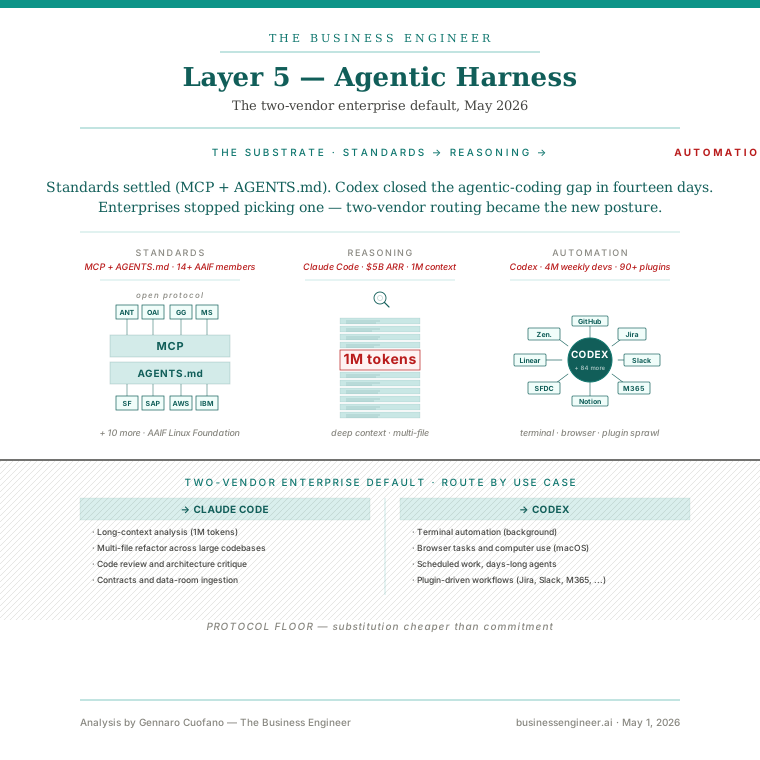
The framework argues: “The surface, not the model, governs autonomy. The agentic surface — the harness — is becoming where value pools in the entire AI stack.”
As we read it, Menlo’s coding figures show both sides of that claim: the labs’ own harnesses, Claude Code and Codex, take 70% of the spend, while independent harnesses such as Cursor, Cognition and Factory still grew 2.9x as a group. The framework is the owner’s argument and does not discuss Menlo’s report.
The dollar figures are Menlo’s estimates of annualized run rate, not revenue reported by Anthropic, OpenAI or the coding companies. The report gives Claude Code and Codex as one combined figure, so it does not show how the $24.0 billion splits between them.
Menlo restated its 2025 coding base, so the growth rates are not comparable with last year’s published $4.0 billion. Menlo invests in Anthropic and in several of the independent coding companies it names.
This Week In The AI Supercycle
Anthropic’s Reality Check, The Capital Squeeze, & The New World Order
This week’s issue: for two years the AI build-out was priced as a growthstory. This week it started being priced as a credit story.
Menlo Ventures estimates that Claude Code and Codex take $24.0 billion, or 70%, of a $34.0 billion AI coding market, while independent coding companies grew 2.9x to $10.1 billion. By our arithmetic, the two lab products took about 78% of the money the market added in a year.
A note on sourcing. The figures, chart data and quotes come from Menlo Ventures’ report 2026: The State of Enterprise AI, published on 3 November 2026, and the charts shown are Menlo’s own. Menlo Ventures is an investor in Anthropic and in several companies named here. The one figure labelled our arithmetic is calculated from Menlo’s numbers. We did not contact Menlo or the companies named.
Gennaro Cuofano is a CRO and tech executive who has worked in AI since late 2015, starting with bringing NLP, natural-language generation, voice and chatbot products to the marketing industry. His background is in law and finance: he holds a Master's degree in Law and an International MBA with an emphasis on corporate finance (LUISS Business School and the University of San Diego, 2012), and worked as a financial analyst at a real-estate investment firm in San Diego and as an assistant controller. His work focuses on business model strategy, business engineering and, more broadly, structural analysis: how companies make money, read from their own filings. He created FourWeekMBA and leads research there and at The Business Engineer, his newsletter on AI and business strategy, with over 95,000 subscribers and more than 1,000 published analyses. His writing has also appeared on Entrepreneur (for example, How to Digitize a Family Business in Europe) and HackerNoon. Find him on LinkedIn and Substack. See how we source.