Notion just launched Ship OS — a pre-built agentic workflow that takes a software team from raw customer feedback to a merged pull request, entirely inside Notion. The pitch is connective tissue, not code. The strategic bet is much larger.
Notion’s Agent-Native Pivot — Key Moments
2013 — Foundation
Notion launches as a docs-and-wiki tool. Human context — feedback, specs, decisions — begins accumulating in the workspace.
May 2026 — Developer Platform
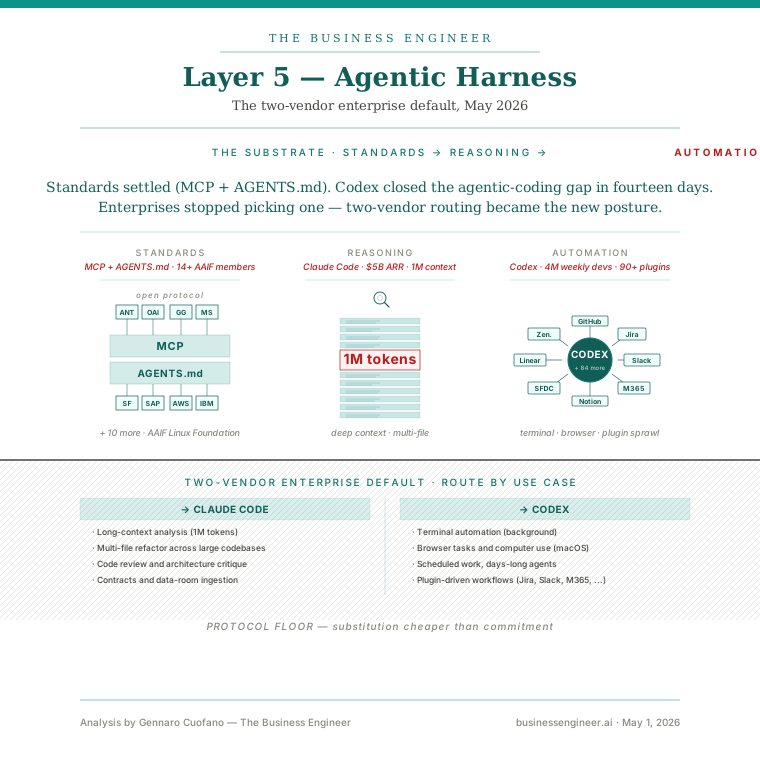
Notion ships Workers hosted runtime, a live database-sync layer, and an External Agents API — letting outside agents (Claude Code, Cursor, Codex) act as visible participants inside the workspace.
May–June 2026 — Native Agent Access
Claude Code, Cursor, and Codex gain native access to operate inside Notion workspaces — blurring the line between doc layer and dev environment.
July 2026 — Ship OS Launch
Notion announces Ship OS: a configured agent-native workflow running the full product cycle — customer feedback intake to merged pull request — with agents handling routing and humans keeping judgment.
Notion announced Ship OS in July 2026, framing it as “the agent-native way to ship software.” It is a pre-configured system of agents, docs, and databases that orchestrates an entire product-development cycle inside Notion — starting from raw customer feedback and ending at a merged pull request. The division of labor is the entire pitch: agents handle triaging, routing, and summarizing; the team handles judgment calls. Notion is not trying to write your code. It is trying to own everything that happens before and around the code.
Ship OS sits on top of a broader agent-native infrastructure Notion has been building since its May 2026 Developer Platform — which introduced a Workers hosted runtime, a live database-sync layer, and an External Agents API that lets outside agents participate visibly inside the workspace. That platform was the foundation. Ship OS is the first vertical workflow built on it, and the most commercially legible one Notion has released.
One important precision: Ship OS is a configured template and orchestration workflow, not a coding agent and not a GitHub replacement. The actual code generation still happens in Cursor, Codex, or Claude Code. What Notion is claiming is the connective tissue — intake to spec to routing to PR — the layer that sits between messy human context and the tools that execute on it. That distinction matters enormously for how you read the competitive picture.
The key insight: Notion already holds the context agents need most — the customer feedback, the specs, the decisions, the institutional memory. Ship OS is Notion’s move to make that context the mandatory entry point for every agentic action a software team takes. Control the context layer, and you control the workflow surface. Control the workflow surface, and switching costs compound invisibly.
The Structural Read
The agentic harness war started at the individual layer — the coding editor. Cursor versus Windsurf versus Claude Code versus Copilot. Every one of those products is fighting to be the surface where a single developer does agentic work, because whoever owns that surface owns the workflow loop, the data, and the switching cost. That fight is already expensive and increasingly commoditized at the model level.
Notion is making a different bet: the next front in the harness war is the team layer. A software team is not a solo developer. It generates cross-functional context — customer signals, prioritization decisions, architectural tradeoffs, stakeholder sign-offs — that a coding editor never sees. Notion has been absorbing that context for years. Ship OS is the move to make that accumulated context an active agentic input, not a passive archive.
The structural logic is the same one that made Salesforce valuable before anyone called it a platform: the company that owns the system of record for the messy, human, judgment-heavy parts of a workflow ends up owning the workflow. Notion is running that playbook at the inflection point where agents make the system of record actionable for the first time.
Harness Theory — Team Layer
The harness moves up the stack
In the agentic era, the company that wins is not the one that builds the most powerful model — it’s the one that owns the surface where humans and agents do work together. At the individual layer, that surface is the coding editor. At the team layer, that surface is wherever the human context lives: feedback, specs, decisions. Notion has been building that surface for a decade without knowing it was building a harness. Ship OS is the moment it becomes intentional.
The risk is real and worth naming precisely. Notion is, at this stage, an orchestration layer that routes work to other companies’ agents — Claude Code (Anthropic), Cursor (independent), Codex (OpenAI). That makes it valuable connective tissue. It also means Notion’s strategic position depends on those agent-makers continuing to want a neutral orchestration surface rather than deciding to own the workflow themselves. Anthropic already has Projects. OpenAI already has Canvas. The moment any of those players decides to absorb the team-context layer, Notion’s moat narrows fast. The make-versus-integrate tension is not theoretical — it is live, and it will resolve in the next 18 months.
Where Notion Sits in the Stack — Right Now
Context & Workflow Surface
STRONGER
A decade of human context — feedback, specs, decisions — already lives here. Ship OS makes it agentic. Hard to replicate fast.
Orchestration / Routing Layer
MIXED
Ship OS routes tasks to Cursor, Codex, Claude Code. Valuable today. Exposed if those players vertically integrate upward.
Code Execution Layer
NOT CLAIMED
Notion has no coding agent. Cursor, Codex, and Claude Code still own this. Ship OS explicitly delegates downward here — by design, for now.
Three Implications
IMPLICATION 1 — THE INTERFACE IS THE MOAT
Notion’s strategic move is not a product launch — it is a moat-building exercise disguised as a workflow template. Every team that runs Ship OS deepens Notion’s grip on their product context. That context compounds: the longer a team uses it, the richer the workspace becomes, and the more irreplaceable the orchestration surface gets. Switching costs in enterpriseSaaS rarely come from features. They come from embedded data and embedded habits. Ship OS is designed to generate both simultaneously.
IMPLICATION 2 — THE VERTICALIZATION PRESSURE INTENSIFIES
Anthropic, OpenAI, and the coding-editor players now face a cleaner version of the classic platform question: do you let a neutral orchestrator own the team context layer above you, or do you absorb it yourself? If Notion succeeds in making Ship OS a standard, these players will have strong incentives to build upward — their own project-context layers, their own feedback-to-spec pipelines. The verticalization thesis predicts they will try. The question is whether Notion’s distribution and data head-start is large enough to hold the position when that pressure arrives.
IMPLICATION 3 — THE HUMAN-JUDGMENT DESIGN IS A DELIBERATE WEDGE
The “agents do routing, humans do judgment” split is not a technical limitation — it is a positioning choice. It lets Notion enter without triggering the autonomy-risk objections that slow enterprise AI adoption. It also future-proofs the dependency: even as agents get more capable, Notion stays in the loop because the human judgment calls are explicitly routed through the workspace. That is a smart wedge strategy. It gets Notion into the team workflow now, before the capability debate has resolved, and ensures it is structurally embedded by the time it does.
Business Engineer Framework
The Agentic Harness War & The Map of AI Redrawn
Ship OS is a live case study in Harness Theory at the team layer — and in exactly where a company sits when the Map of AI gets redrawn around agent-native workflows. The full framework maps 200+ companies across 9 layers of the stack. Understanding where Notion is positioned — and where the pressure comes from — starts with seeing the full map.
Notion is not building a coding agent and it is not trying to replace GitHub — and that precision is exactly what makes Ship OS interesting. It is claiming the one layer of the product development cycle that nobody else has cleanly owned: the human-context layer, where customer feedback becomes a spec, a spec becomes a routed task, and a routed task becomes a pull request. That layer has always existed; it has just been chaos. Notion is betting that the team willing to make that chaos agentic, structured, and persistent inside a single surface will become the operating system for how software teams work — and that whoever owns that surface owns the workflow, the data, and the switching cost for the next decade. The hedge is real: this only holds if Anthropic, OpenAI, and the coding editors decide not to climb the stack themselves. Watch that line carefully. The agentic harness war just opened its most consequential front.
Gennaro Cuofano is a CRO and tech executive who has worked in AI since late 2015, starting with bringing NLP, natural-language generation, voice and chatbot products to the marketing industry. His background is in law and finance: he holds a Master's degree in Law and an International MBA with an emphasis on corporate finance (LUISS Business School and the University of San Diego, 2012), and worked as a financial analyst at a real-estate investment firm in San Diego and as an assistant controller. His work focuses on business model strategy, business engineering and, more broadly, structural analysis: how companies make money, read from their own filings. He created FourWeekMBA and leads research there and at The Business Engineer, his newsletter on AI and business strategy, with over 95,000 subscribers and more than 1,000 published analyses. His writing has also appeared on Entrepreneur, HackerNoon and Search Engine People. Find him on LinkedIn and Substack. See how we source.
Scroll to Top
Discover more from FourWeekMBA
Subscribe now to keep reading and get access to the full archive.