Claude Code vs Codex vs Gemini CLI: Why Running All Three Is the Only Architecture That Works
The enterprise AI landscape just crystallized into three distinct agent philosophies, and most teams are betting everything on one horse. That’s the strategic mistake that separates AI users from AI builders.
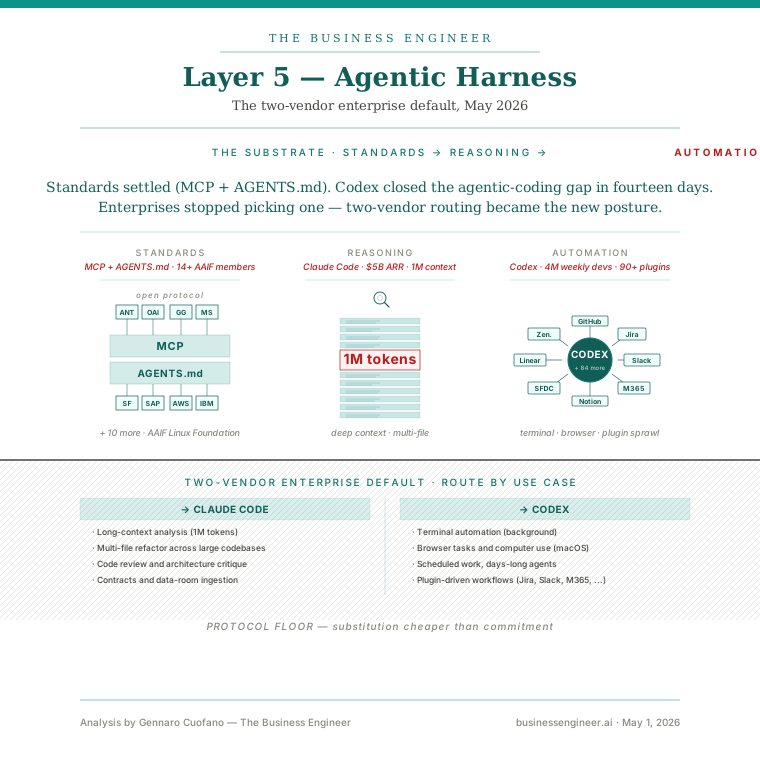
Claude Code operates like a fortress—deep autonomy with reinforced boundaries. When you deploy Claude Code, you’re investing in systems that think vertically, drilling down through complex problems with surgical precision. The architecture favors sustained reasoning over rapid iteration. Your codebase becomes a cathedral: fewer moving parts, but each component engineered for permanence.
Codex flows like a waterfall—massive throughput across horizontal surfaces. GitHub Copilot and its derivatives excel at pattern matching across enormous codebases, surfacing solutions through statistical momentum rather than logical depth. The competitive advantage lives in scale: the more code you feed it, the more sophisticated the output becomes. Your development cycle accelerates, but the intelligence remains distributed.
Gemini CLI rises like a pagoda—layered tiers of specialized competencies. Google’s architecture compartmentalizes different reasoning modes across distinct operational layers. Multi-modal processing sits alongside code generation, which interfaces with data analysis, creating vertical integration through horizontal modularity. The system adapts by reconfiguring layers rather than rebuilding foundations.
Here’s why single-agent strategies fail: each philosophy optimizes for different competitive dynamics. Claude Code dominates when problem complexity exceeds human cognitive capacity. Codex wins when velocity matters more than perfection. Gemini CLI captures value when integration complexity becomes the primary bottleneck.
The professionals building durable competitive advantages run all three simultaneously. They architect agent harnesses that route different problem types to their optimal processing environments. Customer support automation flows through Claude Code’s reasoning engine. Rapid prototyping cycles leverage Codex’s pattern recognition. Cross-platform integration challenges get routed through Gemini’s layered architecture.
This isn’t about tool preference—it’s about business model evolution. Companies that standardize on single agents optimize for today’s workflow while surrendering tomorrow’s optionality. The market is rewarding architectural flexibility over operational efficiency.
The practical implementation requires understanding five architectural layers: the foundation layer (where each agent connects to your existing systems), the routing layer (how problems get distributed across agents), the integration layer (how outputs get synthesized), the feedback layer (how performance gets measured and optimized), and the orchestration layer (how the entire system scales).
Most teams never progress beyond the foundation layer because they confuse using AI with building AI systems. Using AI means prompting individual models for isolated tasks. Building AI systems means creating sustainable competitive advantages through architectural leverage.
The Business Engineer’s Agent OS Crash Course maps this transition through four lessons that decode the BIA Framework’s five layers, 16 core concepts, 110 mental models, and 100+ battle-tested prompts. The workshop component demonstrates practical implementation across all three agent philosophies.
The strategic insight driving this architecture: AI competitive advantage doesn’t compound through individual modelperformance—it compounds through system-level orchestration. Claude Code’s fortress mentality, Codex’s waterfall scalability, and Gemini’s pagoda modularity each capture different value pools in the emerging AI economy.
The crash course is free because the real value lives in implementation, not information. Two hours of structured learning that transforms AI from cost center to profit multiplier. The gap between using AI and building with AI is architectural thinking—and that gap is where sustainable competitive advantages get built.
FREE NEWSLETTER
Get AI Strategy Intelligence Daily
Join 90,000+ strategists. Business modelanalysis, AI maps, and earnings deep dives — free.
Gennaro Cuofano is a CRO and tech executive who has worked in AI since late 2015, starting with bringing NLP, natural-language generation, voice and chatbot products to the marketing industry. His background is in law and finance: he holds a Master's degree in Law and an International MBA with an emphasis on corporate finance (LUISS Business School and the University of San Diego, 2012), and worked as a financial analyst at a real-estate investment firm in San Diego and as an assistant controller. His work focuses on business model strategy, business engineering and, more broadly, structural analysis: how companies make money, read from their own filings. He created FourWeekMBA and leads research there and at The Business Engineer, his newsletter on AI and business strategy, with over 95,000 subscribers and more than 1,000 published analyses. His writing has also appeared on Entrepreneur (for example, How to Digitize a Family Business in Europe) and HackerNoon. Find him on LinkedIn and Substack. See how we source.
Scroll to Top
Discover more from FourWeekMBA
Subscribe now to keep reading and get access to the full archive.