OpenAI’s Multi-Tier Strategy Reshapes AI Competition as GPT-5.5 Instant Becomes Default
OpenAI’s release of GPT-5.5 Instant as ChatGPT — as explored in the intelligence factory race between AI labs — ‘s new default model represents a fundamental shift in competitive strategy that could redefine how AI companies position their products in an increasingly crowded market. This move signals OpenAI’s embrace of a tiered approach that directly challenges Anthropic’s premium positioning while creating new pressure points for Google, Microsoft, and emerging players.
The strategic brilliance of GPT-5.5 Instant lies in its positioning as a “fast and cheap” solution for routine tasks, while reserving more powerful models for complex work. This bifurcation strategy allows OpenAI to serve the 80% of use cases that don’t require maximum reasoning capability at significantly lower costs—potentially reducing inference costs by 60-70% compared to their flagship models. For businesses processing millions of routine queries, this cost optimization could translate to savings exceeding $100,000 monthly for enterprise customers.
Anthropic’s counter with Claude Opus 4.7’s superior reasoning capabilities reveals a fundamentally different strategic bet. While OpenAI pursues market breadth through tiered offerings, Anthropic continues doubling down on qualityleadership, betting that the 20% of complex use cases will drive premium pricing. This creates an interesting dynamic where Anthropic potentially captures higher per-interaction value while OpenAI pursues volume across the broader market.
The implications extend beyond these two companies. Google’s Gemini strategy now faces pressure on two fronts: competing against OpenAI’s cost-effective tier and Anthropic’s reasoning superiority. Microsoft, despite its OpenAI partnership, must navigate how this affects Azure’s AI services pricing and positioning. Smaller players like Mistral and Cohere find themselves squeezed between OpenAI’s aggressive pricing and Anthropic’s quality differentiation.
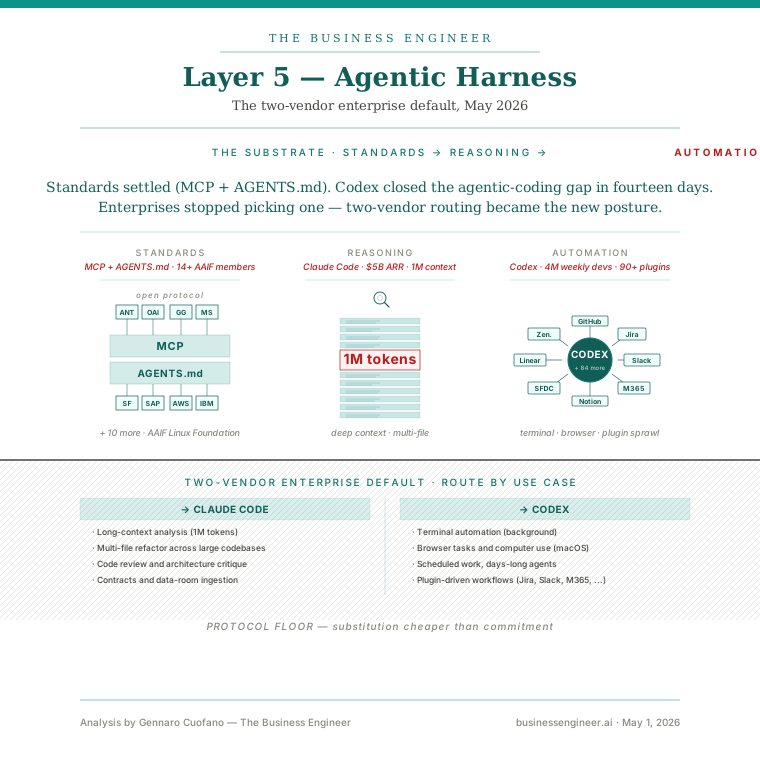
The Codex versus Claude dynamic particularly highlights how coding use cases are becoming the battlefield for AI supremacy. With GPT-5.5 Instant handling routine coding tasks 3-4x faster than previous models, developers can iterate more rapidly on standard functions while escalating complex architectural decisions to premium models. This workflow optimization could increase developer productivity by 40-50% for typical software projects.
From a business model perspective, this bifurcation mirrors successful enterprisesoftware strategies. As The Business Engineer framework suggests, successful technology companies often win by creating clear value tiers that capture different customer segments while defending against commoditization. OpenAI’s approach creates barriers to entry for pure-cost competitors while maintaining premium positioning against quality leaders.
The competitive response cycle is accelerating. Expect Anthropic to announce Claude Fast within 6 months, targeting OpenAI’s efficiency gains while maintaining reasoning advantages. Google will likely restructure Gemini pricing to better compete on cost-per-token metrics. The next 18 months will see API pricing wars intensify, potentially driving costs down 75% from current levels.
Bold prediction: By Q4 2025, this bifurcation will force a fundamental industry restructuring. OpenAI will dominate volume use cases with sub-$0.01 per 1,000 tokens pricing, while Anthropic captures 60% of premium reasoning market share. Google will exit consumer AI chat to focus on enterprise search, and Microsoft will launch a competing reasoning model to reduce OpenAI dependence.
The ultimate winner won’t be determined by model capabilities alone, but by execution of integrated strategies spanning cost optimization, reasoning advancement, and ecosystem development. OpenAI’s multi-tier approach represents sophisticated market positioning that forces every competitor to reconsider their strategic assumptions about AI market dynamics.
FREE NEWSLETTER
Get AI Strategy Intelligence Daily
Join 90,000+ strategists. Business modelanalysis, AI maps, and earnings deep dives — free.
Gennaro is the creator of FourWeekMBA, which reached about four million business people, comprising C-level executives, investors, analysts, product managers, and aspiring digital entrepreneurs in 2022 alone | He is also Director of Sales for a high-tech scaleup in the AI Industry | In 2012, Gennaro earned an International MBA with emphasis on Corporate Finance and Business Strategy.
Scroll to Top
Discover more from FourWeekMBA
Subscribe now to keep reading and get access to the full archive.