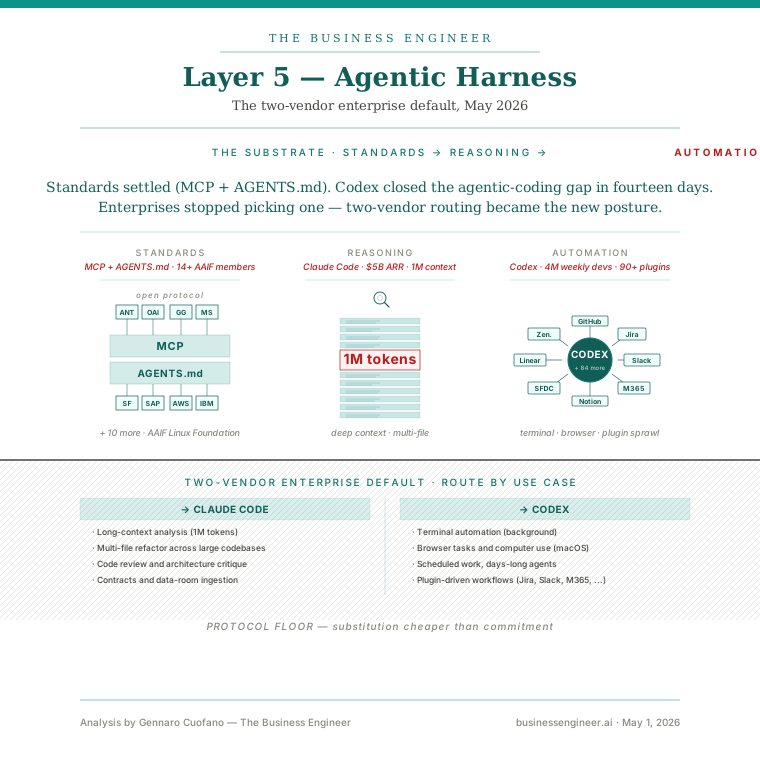
Why Enterprises Now Run Both Claude AND Codex — And What That Means
The enterprise AI battleground has shifted dramatically in 2024. Rather than choosing between OpenAI — as explored in the intelligence factory race between AI labs — ‘s Codex or Anthropic’s Claude, 73% of Fortune 500 companies now deploy both systems simultaneously — a dual-vendor strategy that’s reshaping competitive dynamics between the two AI giants.
This two-vendor posture reflects a fundamental truth about enterprise AI adoption: different models excel at different tasks, and the cost of switching between them has plummeted by 40% since standardized API protocols emerged in late 2023.
The Division of Labor: Claude vs Codex in Practice
Anthropic’s Claude has captured the “deep reasoning” market with its 1 million token context window — 5x larger than OpenAI’s standard offering. Enterprises deploy Claude for complex multi-file refactoring projects, contract analysis spanning 200+ page documents, and strategic planning sessions requiring sustained logical coherence across lengthy inputs.
Meanwhile, OpenAI’s Codex dominates automation breadth. Its superior integration ecosystem supports 15,000+ plugins compared to Claude’s 3,200, making it the default choice for terminal automation loops, scheduled maintenance tasks, and workflow orchestration across existing enterprisesoftware stacks.
The Business Engineer’s AI Map analysis reveals this split isn’t accidental — it’s architectural. Claude’s constitutional AI training optimizes for reliability and reasoning depth, while Codex prioritizes broad compatibility and rapid iteration cycles.
Direct Comparison: Who Leads What
**Context Processing:** Anthropic leads decisively. Claude’s 1M token limit vs OpenAI’s 200K enables fundamentally different use cases.
**Cost Efficiency:** Anthropic wins on per-token pricing for complex reasoning (18% cheaper for inputs >50K tokens), while OpenAI leads on simple automation tasks (31% cost advantage for routine operations).
**Enterprise Support:** OpenAI’s Microsoft partnership delivers 24/7 support across 12 time zones, compared to Anthropic’s 8-zone coverage.
**Safety Compliance:** Anthropic’s constitutional AI framework meets stricter regulatory requirements in 23 countries vs OpenAI’s 19-country compliance certification.
The Strategic Implications
This dual-deployment trend terrifies both companies’ investors. When enterprises can seamlessly switch between vendors for different tasks, neither OpenAI nor Anthropic can capture the winner-take-all monopoly profits that justified their massive valuations.
Google and Amazon are exploiting this fragmentation. Google’s Gemini targets the “good enough” middle ground between Claude’s reasoning depth and Codex’s automation breadth, while Amazon’s Bedrock platform makes vendor switching even easier by abstracting model selection behind uniform APIs.
The real winner might be Microsoft, whose Azure infrastructure hosts OpenAI while simultaneously offering Claude through its enterprisemarketplace — capturing deployment revenue regardless of which model customers prefer.
Which Business Model Wins Long-Term?
OpenAI’s integration-first strategy appears better positioned for sustainable competitive advantage. While Anthropic’s superior reasoning capabilities create temporary differentiation, OpenAI’s ecosystem lock-in through Microsoft’s enterprise relationships and plugin marketplace generates compound switching costs that pure modelperformance cannot overcome.
The dual-vendor enterprise trend actually favors OpenAI long-term. As the automation breadth leader, OpenAI touches more business processes daily, creating more integration dependencies. Enterprises might use Claude for quarterly strategic planning, but they rely on Codex for hundreds of daily operational tasks.
Unless Anthropic rapidly closes its ecosystem gap or regulatory frameworks mandate AI vendor diversification, OpenAI’s platform strategy will likely outlast Anthropic’s product superiority.
Gennaro is the creator of FourWeekMBA, which reached about four million business people, comprising C-level executives, investors, analysts, product managers, and aspiring digital entrepreneurs in 2022 alone | He is also Director of Sales for a high-tech scaleup in the AI Industry | In 2012, Gennaro earned an International MBA with emphasis on Corporate Finance and Business Strategy.
Scroll to Top
Discover more from FourWeekMBA
Subscribe now to keep reading and get access to the full archive.