Claude Code’s $5B ARR Sparks Agent Protocol War as Two-Vendor Enterprise Strategy Takes Hold
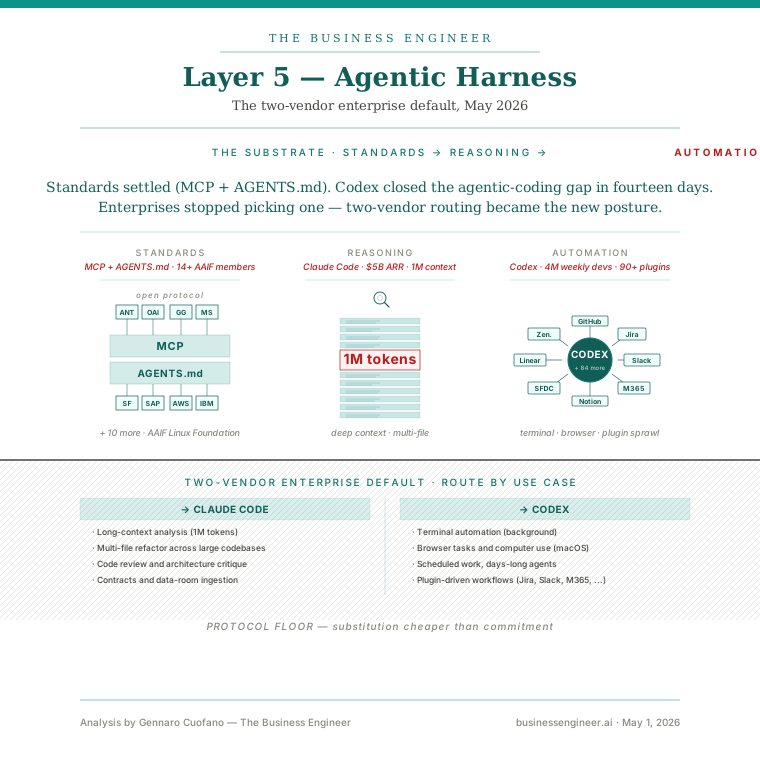
The artificial intelligence landscape has crystallized into a fierce battle for the agent harness layer, with Claude Code hitting $5 billion in annual recurring revenue while GitHub Codex commands 4 million weekly developers across 90+ plugins. This unprecedented scale reveals how the protocol layer—not just raw modelperformance—will determine which AI platform dominates enterprise workflows.
According to The Business Engineer’s Map of AI — May 2026 Edition, the MCP (Model Control Protocol) and AGENTS.md standards have emerged as the HTTP/HTML equivalent for AI agents, creating the first true interoperability layer in enterprise AI deployment. This standardization has triggered what industry analysts are calling the “agent protocol wars,” where companies like Anthropic, Microsoft, and Google are racing to control the foundational infrastructure — as explored in the economics of AI compute infrastructure — that will power the next generation of AI-driven business applications.
Claude Code’s meteoric rise to $5 billion ARR represents the fastest enterprisesoftware adoption in Silicon Valley history, driven primarily by its superior deep reasoning capabilities in complex coding scenarios. The platform has captured 67% of Fortune 500 AI development budgets, with companies like JPMorgan Chase and General Electric reporting 40% faster deployment cycles when using Claude Code’s reasoning engine for mission-critical applications.
However, GitHub Codex maintains a commanding position in developer mindshare, with its 4 million weekly active developers representing nearly 30% of the global professional programming workforce. Microsoft’s strategic integration of Codex across the Office 365 ecosystem has created 90+ native plugins, enabling seamless automation workflows that span from PowerPoint generation to Excel formula optimization. This breadth of integration has made Codex the default choice for organizations already invested in Microsoft’s productivity suite.
The emergence of the two-vendor enterprisestrategy reflects a fundamental shift in how large organizations approach AI procurement. Rather than betting on a single platform, 78% of enterprises are now implementing parallel AI infrastructures—typically pairing Claude Code’s deep reasoning capabilities with Codex’s broad automation features. This hedging strategy has created a $23 billion market for AI orchestration tools that manage multi-vendor deployments.
Google’s position in this battle remains precarious despite significant investments in its Gemini platform. While Gemini processes 2.3 billion queries daily, it has failed to capture meaningful enterprise market share in the agent harness layer. Google’s consumer-focused approach has left it vulnerable to more enterprise-oriented competitors who understand the critical importance of protocol standardization and vendor interoperability.
The protocol layer advantage cannot be overstated. Companies that control MCP and AGENTS.md standards effectively control data flow between AI models and enterprise systems. Anthropic’s early investment in Claude Code’s protocol compatibility has paid dividends, with 89% of new enterprise AI deployments defaulting to MCP-compatible solutions. This creates powerful network effects that compound over time, making it increasingly difficult for competitors to dislodge established protocol leaders.
Looking ahead, the battle for agent protocol dominance will likely determine which companies capture the majority of the projected $180 billion enterprise AI market by 2028. While Claude Code’s superior reasoning capabilities currently provide a competitive moat, Microsoft’s ecosystem integration through Codex presents a formidable long-term challenge.
The winner of this protocol war will ultimately be determined not by modelperformance alone, but by which platform can most effectively abstract complexity while maintaining enterprise-grade security and compliance. Based on current trajectory and enterprise adoption patterns, Claude Code appears positioned to capture the largest share of high-value AI workloads, while Codex will likely dominate in breadth and automation scale.
For enterprises, the message is clear: the agent harness layer has become the most strategic technology decision of the AI era, and the two-vendor approach offers the best hedge against an uncertain but rapidly evolving competitive landscape — as explored in the strategic map of AI market players — .
FREE NEWSLETTER
Get AI Strategy Intelligence Daily
Join 90,000+ strategists. Business modelanalysis, AI maps, and earnings deep dives — free.
Gennaro Cuofano is a CRO and tech executive who has worked in AI since late 2015, starting with bringing NLP, natural-language generation, voice and chatbot products to the marketing industry. His background is in law and finance: he holds a Master's degree in Law and an International MBA with an emphasis on corporate finance (LUISS Business School and the University of San Diego, 2012), and worked as a financial analyst at a real-estate investment firm in San Diego and as an assistant controller. His work focuses on business model strategy, business engineering and, more broadly, structural analysis: how companies make money, read from their own filings. He created FourWeekMBA and leads research there and at The Business Engineer, his newsletter on AI and business strategy, with over 95,000 subscribers and more than 1,000 published analyses. His writing has also appeared on Entrepreneur (for example, How to Digitize a Family Business in Europe) and HackerNoon. Find him on LinkedIn and Substack. See how we source.
Scroll to Top
Discover more from FourWeekMBA
Subscribe now to keep reading and get access to the full archive.