The $100B AI Code War: OpenAI’s Codex Army vs Anthropic’s $5B Enterprise Fortress
The AI coding assistant battlefield has crystallized into a two-horse race between OpenAI — as explored in the intelligence factory race between AI labs — ‘s developer-first Codex ecosystem and Anthropic’s enterprise-focused Claude Code platform. With OpenAI commanding 4 million weekly developers and Anthropic claiming $5 billion in annual recurring revenue, this isn’t just about who writes better code—it’s about who controls the infrastructure of AI-powered development.
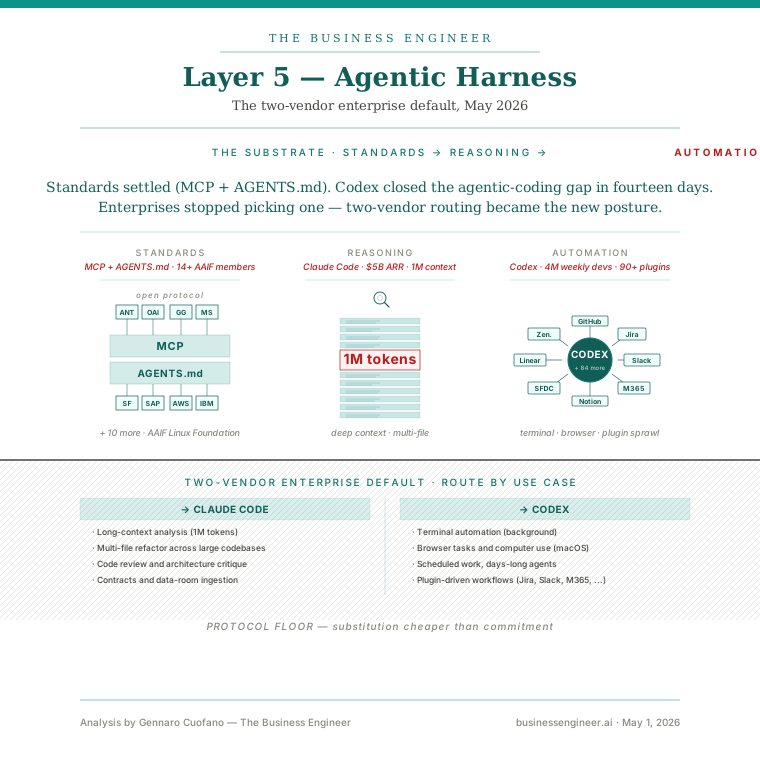
OpenAI’s Codex has built the larger developer army. The platform serves 4 million weekly active developers across 90+ plugins, with integrations spanning from Visual Studio Code to GitHub Copilot. The upcoming GPT-5.5 promises enhanced coding capabilities, while OpenAI’s new automation features and background agents position Codex as more than a coding tool—it’s becoming a development operating system.
Anthropic’s Claude Code takes a different approach, targeting enterprise customers with deeper reasoning capabilities and the industry’s largest 1 million token context window. The $5 billion ARR figure represents not just coding revenue but Anthropic’s entire enterprise AI suite, where Claude Code serves as the technical foundation for complex business logic and enterprise-grade applications.
Protocol Wars: AGENTS.md vs MCP
The real battle isn’t just about coding—it’s about agent infrastructure. OpenAI’s AGENTS.md specification and Anthropic’s Model Context Protocol (MCP) represent competing visions for how AI agents will interact across systems. According to The Business Engineer’s AI Map analysis, these protocols could become the “HTTP/HTML of agents,” defining how autonomous AI systems communicate across platforms.
OpenAI’s approach favors simplicity and developer adoption, building on their existing 4 million developer base. Anthropic’s MCP emphasizes enterprise security and complex reasoning chains, better suited for the $5 billion enterprise market they’ve captured.
Head-to-Head Comparison
OpenAI leads in: Developer adoption (4M weekly users), ecosystem breadth (90+ plugins), consumer market penetration, and integration simplicity. Microsoft’s $13 billion OpenAI investment has accelerated enterprise adoption through Azure and GitHub.
Anthropic leads in: Enterprise revenue ($5B ARR), context length (1M tokens vs OpenAI’s 128K), safety-first positioning, and complex reasoning tasks. Amazon’s partnership and Google’s competing Bard push have validated the enterprise-first approach.
Microsoft GitHub Copilot, powered by OpenAI, claims over 1.8 million paid subscribers at $10-19 monthly, generating approximately $216 million annually. Amazon’s CodeWhisperer and Google’s Bard code features remain distant third and fourth players, with estimated combined market share under 15%.
The Enterprise Default Dilemma
Large enterprises increasingly adopt a “two-vendor default” strategy—OpenAI for developer productivity and rapid prototyping, Anthropic for mission-critical applications requiring deep reasoning. This bifurcation means both companies can win, but in different contexts.
OpenAI’s strength lies in bottom-up adoption. When 4 million developers use Codex weekly, enterprise adoption follows naturally. Anthropic’s top-down enterprise sales motion, evidenced by their $5 billion ARR, creates stickier but slower-growing revenue streams.
Winner: OpenAI’s Developer Flywheel
OpenAI is better positioned long-term because developers choose platforms, not procurement departments. The 4 million weekly developers using Codex represent future CTOs and engineering leaders who will influence enterprise buying decisions. While Anthropic’s $5 billion ARR is impressive, it’s built on today’s enterpriseneeds, not tomorrow’s development workflows.
The winner won’t be determined by current revenue or reasoning capabilities, but by which platform becomes indispensable to how software gets built. OpenAI’s developer-first model, amplified by Microsoft’s distribution and the coming GPT-5.5 capabilities, positions them to own the foundational layer of AI-powered development.
Which business model wins long-term? The one that makes switching costs highest—and that’s the platform where millions of developers build their daily workflows, not where enterprises sign annual contracts.
FREE NEWSLETTER
Get AI Strategy Intelligence Daily
Join 90,000+ strategists. Business modelanalysis, AI maps, and earnings deep dives — free.
Gennaro is the creator of FourWeekMBA, which reached about four million business people, comprising C-level executives, investors, analysts, product managers, and aspiring digital entrepreneurs in 2022 alone | He is also Director of Sales for a high-tech scaleup in the AI Industry | In 2012, Gennaro earned an International MBA with emphasis on Corporate Finance and Business Strategy.
Scroll to Top
Discover more from FourWeekMBA
Subscribe now to keep reading and get access to the full archive.