Aswath Damodaran wrote on 8 October 2026 that the trillions of dollars going into AI capital expenditure are showing up across the financialstatements of US companies. Aggregate net income at US publicly traded companies rose from $576 billion to $904 billion between the second quarter of 2025 and the second quarter of 2026, a growth rate of 57%, he writes, while the cash returned to shareholders grew far more slowly.
He set out the analysis in a post on his blog, Musings on Markets, titled “Stock Prices, Earnings and Cashflows: The AI Effect plays through!”. Sharing it on X, he said he looks at how the spending has percolated through financialstatements, “distorting book capital, earnings and cash flows”. The figures below are his, for all US publicly traded companies.
Damodaran splits the market in two. The builders of the architecture are the hyperscalers, which he names as Meta, Alphabet, Amazon and Microsoft, and their spending, he writes, will cause lower earnings “at least until the cap ex starts paying off”, as well as a hit to their free cash flows.
The same money becomes revenue for the suppliers. He lists chip makers, with Nvidia and TSMC leading the way, network equipment makers, power plant builders and data center real estate developers. He notes gray zones: Amazon spends on AI cap ex but also benefits from its cloud, and Nvidia, while selling the chips, is also investing directly or indirectly into data centers.
Cap ex in the second quarter of 2026 was up $133.4 billion from the second quarter of 2025, an increase of almost 36%, he writes. He says the top ten hyperscalers account for more than $2 trillion of the AI cap ex, and that technology, communication services and consumer discretionary each grew cap ex by more than 50% in the quarter-to-quarter comparison.
Aggregate net income of US publicly traded companies, as stated by Aswath Damodaran: $511 billion to $692 billion in the first quarter and $576 billion to $904 billion in the second quarter, 2025 to 2026.
Business Pill · CAPEX AND DEPRECIATION
A one-minute explainer of the idea behind this story: how capital spending turns into depreciation, and why the schedule chosen changes reported profit. It teaches the concept, not this story’s figures.
The key insight: As we read it, Damodaran’s point is about where AI spending lands in the accounts: as cost and lower free cash flow at the builders, and as revenue and earnings at the suppliers. The gap he draws attention to is between earnings, up 57% in the second quarter on his figures, and dividends and buybacks, up about 5% and about 9%.
Bigger Balance Sheets
Accounting puts cap ex on the balance sheet as assets and raises the book value of whatever funded it, Damodaran explains. Across all US stocks, book equity increased almost 13% between the second quarter of 2025 and the second quarter of 2026, and total debt is up almost 8%, he writes.
In dollars, he puts the increase at $1.8 trillion in book equity and $1.9 trillion in book debt over the same period. In technology, book equity rose almost 30% and total debt about 18.8%, by his figures.
One Company’s Cap Ex Is Another’s Earnings
The spending lifts earnings for a simple reason, Damodaran argues: money spent on cap ex by a company building AI architecture “will become revenues (and earnings) for other companies that supply the building blocks for the architecture”. He calls Nvidia the biggest beneficiary of the AI cap ex boom so far.
There should be higher amortization at the builders, he writes, but “the longer amortization schedules being used by many of them is reducing the current hit to earnings at these companies”.
His figures: aggregate earnings rose from $511 billion to $692 billion in the first quarter of 2026, a growth rate of 35%, and from $576 billion to $904 billion in the second quarter, a growth rate of 57%. More than half of all companies reported declines in net income, he notes. Technology, financials and communication services saw the biggest increases; health care, utilities and real estate lagged.
Changes as stated by Aswath Damodaran, for all US publicly traded companies. Earnings, cap ex and book values compare a 2026 quarter with the same quarter of 2025 (Q1 for one earnings bar, Q2 for the rest); dividends and buybacks compare the last twelve months with calendar 2025, so the bars are not one series.
Cash Returned Has Not Kept Up
Damodaran writes that the “higher earnings across firms will be partially or even fully offset by capital expenditures across firms”, so free cash flows grow more slowly than earnings, and those free cash flows fund dividends and buybacks.
Dividends in the last twelve months are up about $43.3 billion, or about 5%, from the 2025 calendar year, and stock buybacks are up about $106.7 billion, or about 9%, he writes. Those step-ups “clearly have not kept up with the earnings growth in 2026”.
For much of the last two decades, he says, US companies returned 80% or more of their earnings to shareholders. In his words, “in the last twelve months leading into 2026, the companies in the S&P 500 returned 63% of their earnings to shareholders”, which he calls “a low not seen since 2004”.
The Market Backdrop
The ten-year Treasury rate rose from 4.75% to 5.29% during September 2026, Damodaran writes, a move that would put it in the top ten percent of 770 monthly rate changes between 1962 and 2026. The market still added $2.5 trillion in market capitalization in September, and almost $1.5 trillion of that came from technology, he says.
His implied equity risk premium at the start of October 2026 was 3.70% over the ten-year Treasury rate, for an expected return on equities of 8.99%. He writes that the premium dropped below 4% for the first time this year.
If AI Disappoints
In his best case, AI investors earn returns on their cap ex above their cost of capital, lenders are made whole, and the companies emerge “more capital intensive than they used to be”. In his worst case, accountants write off large portions of the AI cap ex and companies that leaned on debt face defaults and distress.
His expectation is that “the market will lead in this process and accounting will follow”. In his words, “waiting to act until accountants write off AI cap ex to sell your AI company implies that you waited too long”.
He also discloses his own position. He holds five of the Mag Seven, all except Tesla and Nvidia, and says new money added to his portfolio in the last year or two has gone mostly into cash.
The Structural Read
On his numbers, aggregate net income rose 35% and 57% in the first two quarters of 2026, while dividends rose about 5% and buybacks about 9% over the last twelve months. The periods differ, so we read the comparison as directional rather than one-for-one.
His balance-sheet figures show how the spending was funded: book equity up $1.8 trillion and book debt up $1.9 trillion in a year, and in technology total debt up about 18.8%.
His own caveat is that joint ventures and off-balance sheet vehicles sit outside these numbers, and that private AI companies are not in his data at all. On his account, the aggregates are a floor on the effect, not the full picture.
Aswath Damodaran, Musings on Markets (October 2026)
“In effect, the only point on which you have a consensus on is that companies have collectively invested a huge amount in AI cap ex”
Three Implications
AI BUILDERS Damodaran writes that the hyperscalers’ cap ex will cause lower earnings until it starts paying off, and a hit to their free cash flows, which are after cap ex.
AI SUPPLIERS In his account the same spending becomes revenue for chip makers, network equipment makers, power plant builders and data center developers, with Nvidia the biggest beneficiary so far.
SHAREHOLDERS He writes that S&P 500 companies returned 63% of their earnings in the last twelve months, against 80% or more for much of the last two decades.
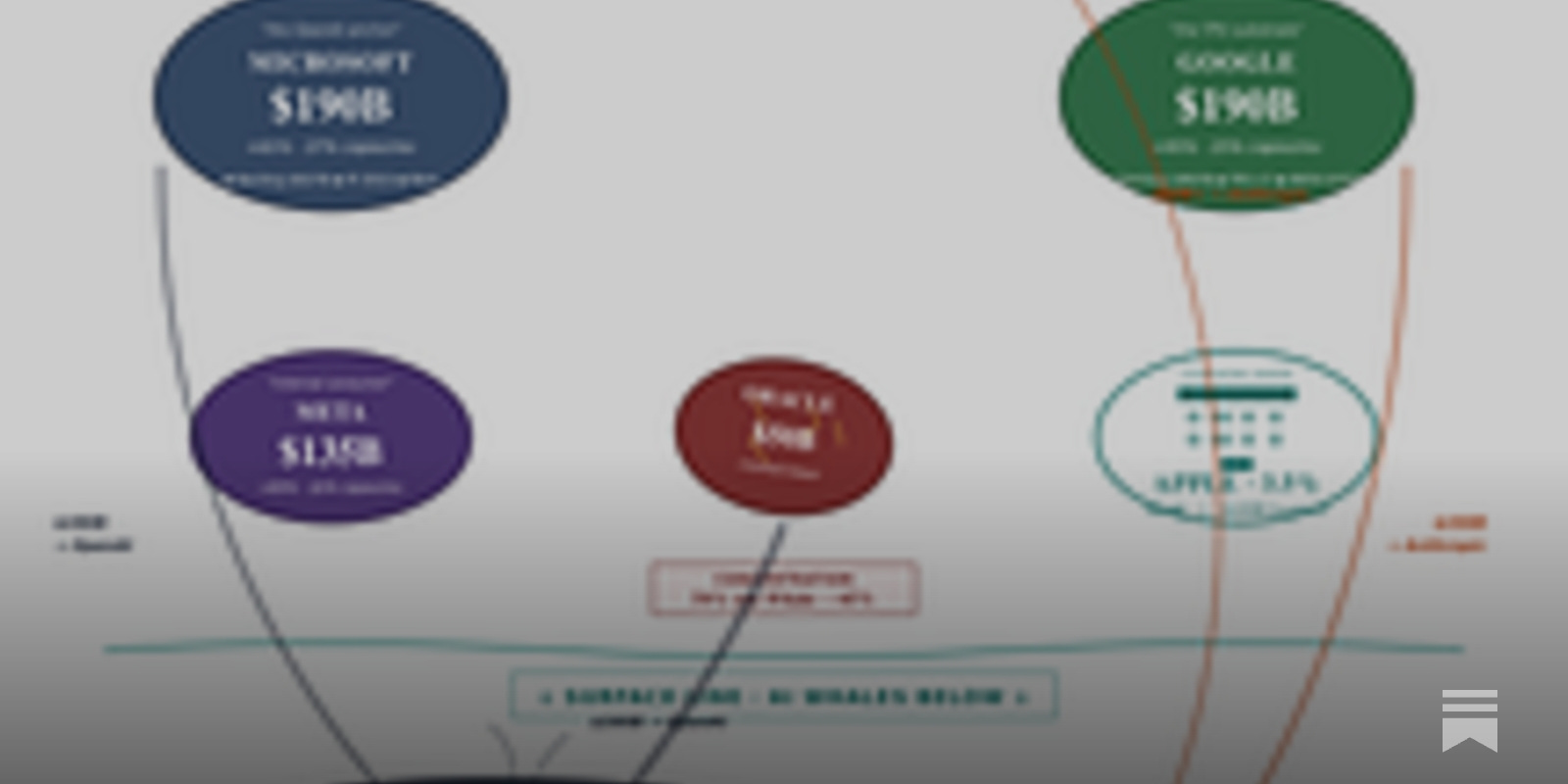
The map puts it this way: “the capex race is no longer a corporate spending cycle. It is a sovereign-scale financing problem dressed in tech-company clothing — and the financial architecture is starting to invert.”
As we read it, Damodaran’s aggregates show that financing story from the accounting side: $1.9 trillion more book debt in a year, and cash returned to shareholders falling to 63% of earnings on his S&P 500 figure.
What Is Not Established
Damodaran flags two limits himself. His figures are “data from publicly traded companies”, so private AI companies, including Anthropic and OpenAI, are missing. And because some AI cap ex sits in joint ventures and off-balance sheet entities, “the numbers you see in the public company financials will understate the full effect across all businesses”.
The text of the post does not put a single number on how much of the 2026 earnings increase comes from AI spending; his sector tables are images, and we have used only the figures he states in his text. His figures are aggregates across companies, not a ruling on any one company’s accounts.
Business Engineer Framework
The AI Capex Map & The State of AI Hyperscalers
A Business Engineer map of who is spending on AI infrastructure, how it is financed and where the cycle could crack.
Aswath Damodaran’s 8 October 2026 post traces AI capital spending through US company accounts: cap ex up almost 36% in the second quarter, book equity up $1.8 trillion and book debt up $1.9 trillion in a year, and aggregate net income up 57% in the second quarter, while dividends and buybacks rose about 5% and about 9%. He writes that S&P 500 companies returned 63% of their earnings in the last twelve months, the lowest since 2004.
94,000+ executives read Business Engineer for the AI strategy frameworks cited by ChatGPT, Claude, and Perplexity.
A note on sourcing. We read Aswath Damodaran’s blog post in full and his X post of 8 October 2026 on 11 October 2026. Every figure here is one he states in the text of his post, for US publicly traded companies; his sector tables are images and we did not transcribe them. The analysis and the scenarios are his. Nothing here is a forecast, and nothing here is financial or investment advice.
Gennaro Cuofano is a CRO and tech executive who has worked in AI since late 2015, starting with bringing NLP, natural-language generation, voice and chatbot products to the marketing industry. His background is in law and finance: he holds a Master's degree in Law and an International MBA with an emphasis on corporate finance (LUISS Business School and the University of San Diego, 2012), and worked as a financial analyst at a real-estate investment firm in San Diego and as an assistant controller. His work focuses on business model strategy, business engineering and, more broadly, structural analysis: how companies make money, read from their own filings. He created FourWeekMBA and leads research there and at The Business Engineer, his newsletter on AI and business strategy, with over 95,000 subscribers and more than 1,000 published analyses. His writing has also appeared on Entrepreneur, HackerNoon and Search Engine People. Find him on LinkedIn and Substack. See how we source.
Scroll to Top
Discover more from FourWeekMBA
Subscribe now to keep reading and get access to the full archive.