– A set of principles and practices for iterative and incremental software development. The Agile Framework emphasizes customer collaboration, adaptability, and
Scrum Framework
– An Agile project management framework that emphasizes iterative development, self-organization, and collaboration. The Scrum Framework helps teams deliver val
Kanban Method
– A visual management approach for organizing work and workflows, visualizing progress, and limiting work in progress (WIP). The Kanban Method helps teams impro
Lean Startup
– A methodology for developing businesses and products that aims to shorten product development cycles, validate assumptions, and learn from customer feedback q
Scaled Agile Framework (SAFe)
– A framework for scaling Agile practices across large enterprises, enabling alignment, collaboration, and delivery at scale. SAFe provides guidance on organizi
Holacracy
– A self-management practice that distributes authority and decision-making across an organization, emphasizing roles, circles, and transparent processes. Holac
DevOps Culture
– A culture and set of practices that emphasize collaboration, communication, and integration between development (Dev) and operations (Ops) teams to deliver hi
– A set of practices and principles for automating software delivery processes, including continuous integration (CI), continuous delivery (CD), and continuous
The Spotify Squad Model is a revolutionary approach to organizational design and management that has gained widespread recognition and adoption in the tech industry and beyond. Developed by Spotify, a leading music streaming service, this model offers a unique way to balance agility, innovation, and scalability within a large organization.
Understanding the Spotify Squad Model
The Essence of the Spotify Squad Model
At its core, the Spotify Squad Model is an agile organizational framework that combines elements from various agile methodologies, such as Scrum and Kanban, to create a flexible and adaptive structure. The model is characterized by several key features:
Squads: Squads are small, cross-functional teams typically consisting of 6 to 12 members. Each squad is responsible for a specific area of functionality or feature development.
Tribes: Squads are organized into tribes, which are larger groups of squads that share a common mission or product area. Tribes are led by Tribe Leads who provide high-level guidance and alignment.
Chapters: Chapters are groups of individuals with similar skills or roles, regardless of their squad or tribe affiliation. Members of a chapter meet regularly to share knowledge and expertise.
Guilds: Guilds are informal communities of practice where individuals with similar interests or skills can network, learn, and share best practices across the organization.
Spotify Model Roles: The model introduces several roles, including Squad Leads, Chapter Leads, Tribe Leads, and Guild Coordinators, to provide structure and support within the organization.
Origins of the Spotify Squad Model
The Spotify Squad Model was developed by Henrik Kniberg and Anders Ivarsson, two agile coaches at Spotify, to address the challenges of scaling agility in a rapidly growing organization. It was first introduced to the public through a series of blog posts and presentations by Henrik Kniberg.
Key factors that contributed to the development of this model include:
The need to maintain a high level of innovation and agility as Spotify scaled.
The desire to empower autonomous teams to take ownership of their work.
A commitment to fostering a culture of continuous learning and improvement.
Key Concepts in the Spotify Squad Model
1. Squads:
Squads are the foundational unit of the Spotify model, representing small, cross-functional teams responsible for delivering specific functionality or features.
2. Tribes:
Tribes consist of multiple squads that share a common mission or product area. Tribes are designed to foster alignment and collaboration among squads.
3. Chapters:
Chapters are groups of individuals with similar skills or roles, providing a platform for knowledge sharing and skill development.
4. Guilds:
Guilds are informal communities of practice that encourage cross-functional learning and collaboration.
5. Spotify Model Roles:
Various roles are introduced to support the model, including Squad Leads, Chapter Leads, Tribe Leads, and Guild Coordinators.
Implementation Strategies
Implementing the Spotify Squad Model requires a deliberate approach:
1. Start Small:
Begin by piloting the model in a specific area or department before scaling it across the entire organization.
2. Define Missions:
Clearly define the missions of tribes to provide focus and direction for squads.
3. Autonomous Squads:
Empower squads to make decisions autonomously and take ownership of their work.
4. Encourage Learning:
Create a culture of continuous learning and improvement through chapters and guilds.
5. Effective Communication:
Ensure that communication flows effectively both horizontally and vertically within the organization.
Benefits of the Spotify Squad Model
Organizations that adopt the Spotify Squad Model often experience several benefits:
1. Enhanced Agility:
The model enables organizations to maintain a high level of agility and responsiveness to market changes.
2. Improved Innovation:
Cross-functional squads promote innovation by bringing together diverse perspectives and skills.
3. Scalability:
The model is designed to scale as the organization grows, allowing for the addition of new tribes and squads.
4. Employee Empowerment:
Squads have a high degree of autonomy, empowering team members to make decisions and take ownership of their work.
5. Knowledge Sharing:
Chapters and guilds facilitate knowledge sharing and skill development, leading to increased expertise and collaboration.
6. Alignment:
Tribes provide a mechanism for aligning squads with common missions and objectives.
Challenges of the Spotify Squad Model
While the Spotify Squad Model offers many advantages, it also presents some challenges:
1. Complexity:
The model can become complex as the organization scales, making it challenging to maintain clear lines of communication and alignment.
2. Cultural Shift:
Adopting the model often requires a cultural shift towards greater autonomy and collaboration, which can be met with resistance.
3. Skill Development:
Ensuring that chapters and guilds effectively support skill development and knowledge sharing can be a challenge.
4. Overhead:
The model introduces new roles and structures that can create overhead if not managed effectively.
Impact and Adoption
The Spotify Squad Model has had a significant impact on the way organizations approach agile and scalable team structures. It has been adopted not only by technology companies but also by organizations in various industries seeking to embrace agility and innovation.
Some notable examples of organizations that have adopted or adapted the model include:
1. LEGO:
The iconic toy manufacturer implemented a version of the Spotify model to support its digital transformation efforts.
2. ING Bank:
ING Bank, a global financial institution, adopted the model to promote agility and innovation within its organization.
3. Adobe:
Adobe Systems, a multinational software company, used the Spotify model to reorganize its teams and improve collaboration.
4. Zappos:
The online shoe and clothing retailer experimented with elements of the model to foster a culture of self-organization.
Broader Implications
The Spotify Squad Model has broader implications for the future of organizational design and management:
1. Agile Transformation:
Organizations across industries are looking to agile frameworks like the Spotify model as a way to adapt to the fast-paced and ever-changing business landscape.
2. Team Autonomy:
The model highlights the importance of giving teams a high degree of autonomy, which can lead to greater employee satisfaction and innovation.
3. Continuous Learning:
Chapters and guilds promote a culture of continuous learning and skill development, which is increasingly important in the knowledge economy.
4. Scalability:
The model offers a scalable approach to team organization, making it applicable to organizations of varying sizes.
Conclusion
The Spotify Squad Model has emerged as a game-changer in organizational design and management, offering a flexible and agile approach that balances innovation with scalability. By reimagining the way teams are structured and organized, organizations can empower their employees, foster innovation, and navigate the complexities of today’s rapidly changing business landscape. As the model continues to inspire and influence organizations worldwide, it serves as a testament to the power of rethinking traditional management practices in the pursuit of greater agility and success.
Related Frameworks
Description
When to Apply
Agile Framework
– A set of principles and practices for iterative and incremental software development. The Agile Framework emphasizes customer collaboration, adaptability, and delivering value in short cycles.
– When developing software or products in a fast-paced and uncertain environment that requires flexibility, adaptability, and customer focus effectively. – Applying Agile Framework principles and practices to foster collaboration, adaptability, and continuous improvement in software development.
Scrum Framework
– An Agile project management framework that emphasizes iterative development, self-organization, and collaboration. The Scrum Framework helps teams deliver value incrementally and adapt to changing requirements.
– When managing complex projects or initiatives in an Agile environment, focusing on delivering value incrementally, adapting to change, and prioritizing tasks effectively. – Implementing the Scrum Framework to organize work into sprints, prioritize tasks, and deliver value iteratively.
Kanban Method
– A visual management approach for organizing work and workflows, visualizing progress, and limiting work in progress (WIP). The Kanban Method helps teams improve flow, reduce lead time, and increase efficiency.
– When seeking to optimize workflow, visualize progress, and limit work in progress effectively to improve efficiency and productivity. – Implementing the Kanban Method to manage work and workflows visually, reduce lead time, and enhance team collaboration.
Lean Startup
– A methodology for developing businesses and products that aims to shorten product development cycles, validate assumptions, and learn from customer feedback quickly. The Lean Startup emphasizes experimentation, iteration, and validated learning.
– When launching new products or ventures in a fast-changing market, focusing on rapid experimentation, customer validation, and iterative development effectively. – Applying Lean Startup principles to minimize waste, validate assumptions, and accelerate learning in product development.
Scaled Agile Framework (SAFe)
– A framework for scaling Agile practices across large enterprises, enabling alignment, collaboration, and delivery at scale. SAFe provides guidance on organizing teams, coordinating work, and delivering value in complex environments.
– When scaling Agile practices across large organizations or multiple teams, focusing on alignment, collaboration, and value delivery effectively. – Implementing SAFe to enable coordination, synchronization, and delivery at scale while maintaining Agile principles and practices.
Holacracy
– A self-management practice that distributes authority and decision-making across an organization, emphasizing roles, circles, and transparent processes. Holacracy enables autonomy, agility, and adaptability in organizational structure and governance.
– When seeking to distribute authority, foster autonomy, and enable adaptability in organizational structure and decision-making effectively. – Implementing Holacracy to promote self-management, agility, and transparency in organizational governance and operations.
DevOps Culture
– A culture and set of practices that emphasize collaboration, communication, and integration between development (Dev) and operations (Ops) teams to deliver high-quality software rapidly and reliably.
– When aiming to improve collaboration, communication, and integration between development and operations teams to accelerate software delivery and enhance product quality effectively. – Fostering a DevOps Culture to promote collaboration, automation, and continuous delivery in software development and operations.
– A set of practices and principles for automating software delivery processes, including continuous integration (CI), continuous delivery (CD), and continuous deployment. CI/CD enables teams to deliver code changes more frequently, reliably, and efficiently.
– When seeking to automate software delivery processes, increase deployment frequency, and improve code quality and reliability effectively. – Implementing CI/CD practices to automate testing, integration, and deployment processes and enable faster and more reliable software delivery.
Lean Management
– A management approach focused on eliminating waste, optimizing processes, and delivering value to customers efficiently. Lean Management principles include identifying value, mapping value streams, creating flow, establishing pull, and pursuing perfection.
– When aiming to improve efficiency, reduce waste, and optimize processes by focusing on delivering value to customers effectively. – Implementing Lean Management principles to streamline operations, eliminate waste, and enhance customer satisfaction through continuous improvement.
Tribal Leadership
– A leadership model that focuses on the stages of tribal culture within organizations and how leaders can foster higher levels of collaboration, innovation, and performance. Tribal Leadership identifies five stages of tribal culture and provides strategies for leadership development.
– When seeking to understand and improve organizational culture, leadership effectiveness, and team dynamics to foster collaboration, innovation, and high performance effectively. – Applying Tribal Leadership principles to assess organizational culture, develop leadership capabilities, and promote collaboration and innovation within teams and across the organization.
The multi-billion music streaming company Spotify is primarily owned by its founders, Daniel Ek and Martin Lorentzon. As of 2023, Daniel Ek has 15.3% ownership of ordinary shares and 30.5% of the voting power. Martin Lorentzon has 10.9% of ordinary shares and 42.7% of the voting power. Another key shareholder is Baillie Gifford & Co, a Scottish-based money management firm (12% ownership ), followed by Tencent (8.4% ownership).
Spotify is a two-sided marketplace, running a free ad-supported service and a paid membership. Founded in 2008 with the belief that music should be universally accessible, it generated €13.25 billion in 2023. Of these revenues, 87.3%, or €11.56 billion, came from premium memberships, while over 12.6%, or €1.68 billion, came from ad-supported members. By 2023, Spotify had over 600 million users, of which 236 million were premium members and 379 million weread-supported users.
Spotify Audience Network is the underlying advertising infrastructure that supports its ad-supported user base. The Spotify Audience Network was born as the result of the acquisitions of Anchor and Megaphone. By 2023, Spotify had 379 million ad-supported users.
Spotify licensing deals affect its business model. The company runs on both a free service, which is ad-supported and a subscription premium service. They have different economics.
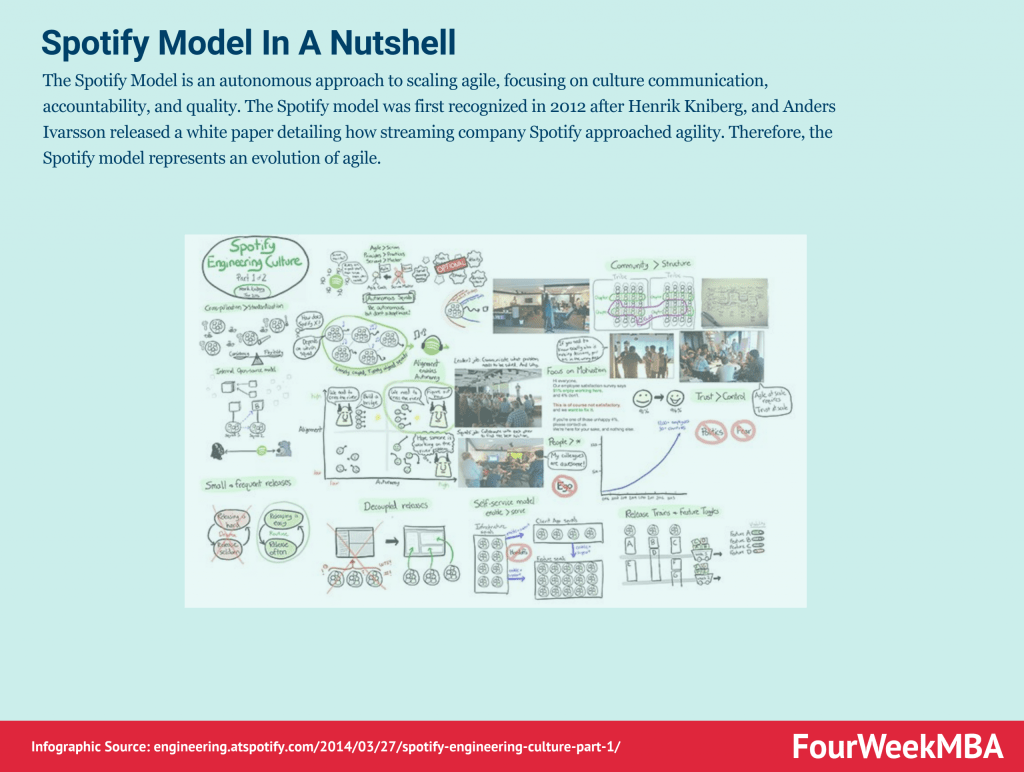
The ad-supported business had a 10% gross margin in 2021, compared to 29% of the subscription-based business. That’s because the more the content gets streamed on the platform, the more that increases royalty costs for Spotify. That is also why the company invested in developing its content. Thus, in part transitioning from platform to brand.The Spotify Model is an autonomous approach to scaling agile, focusing on culture communication, accountability, and quality. The Spotify model was first recognized in 2012 after Henrik Kniberg, and Anders Ivarsson released a white paper detailing how streaming company Spotify approached agility. Therefore, the Spotify model represents an evolution of agile.
Spotify generated €11.56 billion from premium members and €1.68 billion from ad-supported members. The premium membership revenue cost was €8.23 billion and €1.62B billion for the ad-supported segment. Thus, premium members generated a profit of €3.33B billion for Spotify in 2023. Meanwhile, the ad-supported segment generated a €62 million gross profit in 2023. The ad-supported segment, which is run almost at a loss, is critical for Spotify as it enables it to build a sustainable self-serving funnel to convert free users into paid subscribers!
In a functional organizational structure, groups and teams are organized based on function. Therefore, this organization follows a top-down structure, where most decision flows from top management to bottom. Thus, the bottom of the organization mostly follows the strategy detailed by the top of the organization.
In a flat organizational structure, there is little to no middle management between employees and executives. Therefore it reduces the space between employees and executives to enable an effective communication flow within the organization, thus being faster and leaner.
Project portfolio management (PPM) is a systematic approach to selecting and managing a collection of projects aligned with organizational objectives. That is a business process of managing multiple projects which can be identified, prioritized, and managed within the organization. PPM helps organizations optimize their investments by allocating resources efficiently across all initiatives.
Harvard Business School professor Dr. John Kotter has been a thought-leader on organizational change, and he developed Kotter’s 8-step change model, which helps business managers deal with organizational change. Kotter created the 8-step model to drive organizational transformation.
The Nadler-Tushman Congruence Model was created by David Nadler and Michael Tushman at Columbia University. The Nadler-Tushman Congruence Model is a diagnostic tool that identifies problem areas within a company. In the context of business, congruence occurs when the goals of different people or interest groups coincide.
McKinsey’s Seven Degrees of Freedom for Growth is a strategy tool. Developed by partners at McKinsey and Company, the tool helps businesses understand which opportunities will contribute to expansion, and therefore it helps to prioritize those initiatives.
Mintzberg’s 5Ps of Strategy is a strategy development model that examines five different perspectives (plan, ploy, pattern, position, perspective) to develop a successful business strategy. A sixth perspective has been developed over the years, called Practice, which was created to help businesses execute their strategies.
The COSO framework is a means of designing, implementing, and evaluating control within an organization. The COSO framework’s five components are control environment, risk assessment, control activities, information and communication, and monitoring activities. As a fraud risk management tool, businesses can design, implement, and evaluate internal control procedures.
The TOWS Matrix is an acronym for Threats, Opportunities, Weaknesses, and Strengths. The matrix is a variation on the SWOT Analysis, and it seeks to address criticisms of the SWOT Analysis regarding its inability to show relationships between the various categories.
Lewin’s change management model helps businesses manage the uncertainty and resistance associated with change. Kurt Lewin, one of the first academics to focus his research on group dynamics, developed a three-stage model. He proposed that the behavior of individuals happened as a function of group behavior.
OpenAI is an artificial intelligence research laboratory that transitioned into a for-profit organization in 2019. The corporate structure is organized around two entities: OpenAI, Inc., which is a single-member Delaware LLC controlled by OpenAI non-profit, And OpenAI LP, which is a capped, for-profit organization. The OpenAI LP is governed by the board of OpenAI, Inc (the foundation), which acts as a General Partner. At the same time, Limited Partners comprise employees of the LP, some of the board members, and other investors like Reid Hoffman’s charitable foundation, Khosla Ventures, and Microsoft, the leading investor in the LP.
Airbnb follows a holacracy model, or a sort of flat organizational structure, where teams are organized for projects, to move quickly and iterate fast, thus keeping a lean and flexible approach. Airbnb also moved to a hybrid model where employees can work from anywhere and meet on a quarterly basis to plan ahead, and connect to each other.
The Amazon organizational structure is predominantly hierarchical with elements of function-based structure and geographic divisions. While Amazon started as a lean, flat organization in its early years, it transitioned into a hierarchical organization with its jobs and functions clearly defined as it scaled.
The Coca-Cola Company has a somewhat complex matrix organizational structure with geographic divisions, product divisions, business-type units, and functional groups.
Costco has a matrix organizational structure, which can simply be defined as any structure that combines two or more different types. In this case, a predominant functional structure exists with a more secondary divisional structure.
Costco’s geographic divisions reflect its strong presence in the United States combined with its expanding global presence. There are six divisions in the country alone to reflect its standing as the source of most company revenue.
Compared to competitor Walmart, for example, Costco takes more a decentralized approach to management, decision-making, and autonomy. This allows the company’s stores and divisions to more flexibly respond to local market conditions.
Dell has a functional organizational structure with some degree of decentralization. This means functional departments share information, contribute ideas to the success of the organization and have some degree of decision-making power.
eBay was until recently a multi-divisional (M-form) organization with semi-autonomous units grouped according to the services they provided. Today, eBay has a single division called Marketplace, which includes eBay and its international iterations.
Facebook is characterized by a multi-faceted matrix organizational structure. The company utilizes a flat organizational structure in combination with corporate function-based teams and product-based or geographic divisions. The flat organization structure is organized around the leadership of Mark Zuckerberg, and the key executives around him. On the other hand, the function-based teams are based on the main corporate functions (like HR, product management, investor relations, and so on).
Goldman Sachs has a hierarchical structure with a clear chain of command and defined career advancement process. The structure is also underpinned by business-type divisions and function-based groups.
Google (Alphabet) has a cross-functional (team-based) organizational structure known as a matrix structure with some degree of flatness. Over the years, as the company scaled and it became a tech giant, its organizational structure is morphing more into a centralized organization.
IBM has an organizational structure characterized by product-based divisions, enabling its strategy to develop innovative and competitive products in multiple markets. IBM is also characterized by function-based segments that support product development and innovation for each product-based division, which include Global Markets, Integrated Supply Chain, Research, Development, and Intellectual Property.
McDonald’s has a divisional organizational structure where each division – based on geographical location – is assigned operational responsibilities and strategic objectives. The main geographical divisions are the US, internationally operated markets, and international developmental licensed markets. And on the other hand, the hierarchical leadership structure is organized around regional and functional divisions.
McKinsey & Company has a decentralized organizational structure with mostly self-managing offices, committees, and employees. There are also functional groups and geographic divisions with proprietary names.
Microsoft has a product-type divisional organizational structure based on functions and engineering groups. As the company scaled over time it also became more hierarchical, however still keeping its hybrid approach between functions, engineering groups, and management.
Nestlé has a geographical divisional structure with operations segmented into five key regions. For many years, Swiss multinational food and drink company Nestlé had a complex and decentralized matrix organizational structure where its numerous brands and subsidiaries were free to operate autonomously.
Nike has a matrix organizational structure incorporating geographic divisions. Nike’s matrix structure is also present at the regional and sub-regional levels. Managerial responsibility is segmented according to business unit (apparel, footwear, and equipment) and function (human resources, finance, marketing, sales, and operations).
Patagonia has a particular organizational structure, where its founder, Chouinard, disposed of the company’s ownership in the hands of two non-profits. The Patagonia Purpose Trust, holding 100% of the voting stocks, is in charge of defining the company’s strategic direction. And the Holdfast Collective, a non-profit, holds 100% of non-voting stocks, aiming to re-invest the brand’s dividends into environmental causes.
Samsung has a product-type divisional organizational structure where products determine how resources and business operations are categorized. The main resources around which Samsung’s corporate structure is organized are consumer electronics, IT, and device solutions. In addition, Samsung leadership functions are organized around a few career levels grades, based on experience (assistant, professional, senior professional, and principal professional).
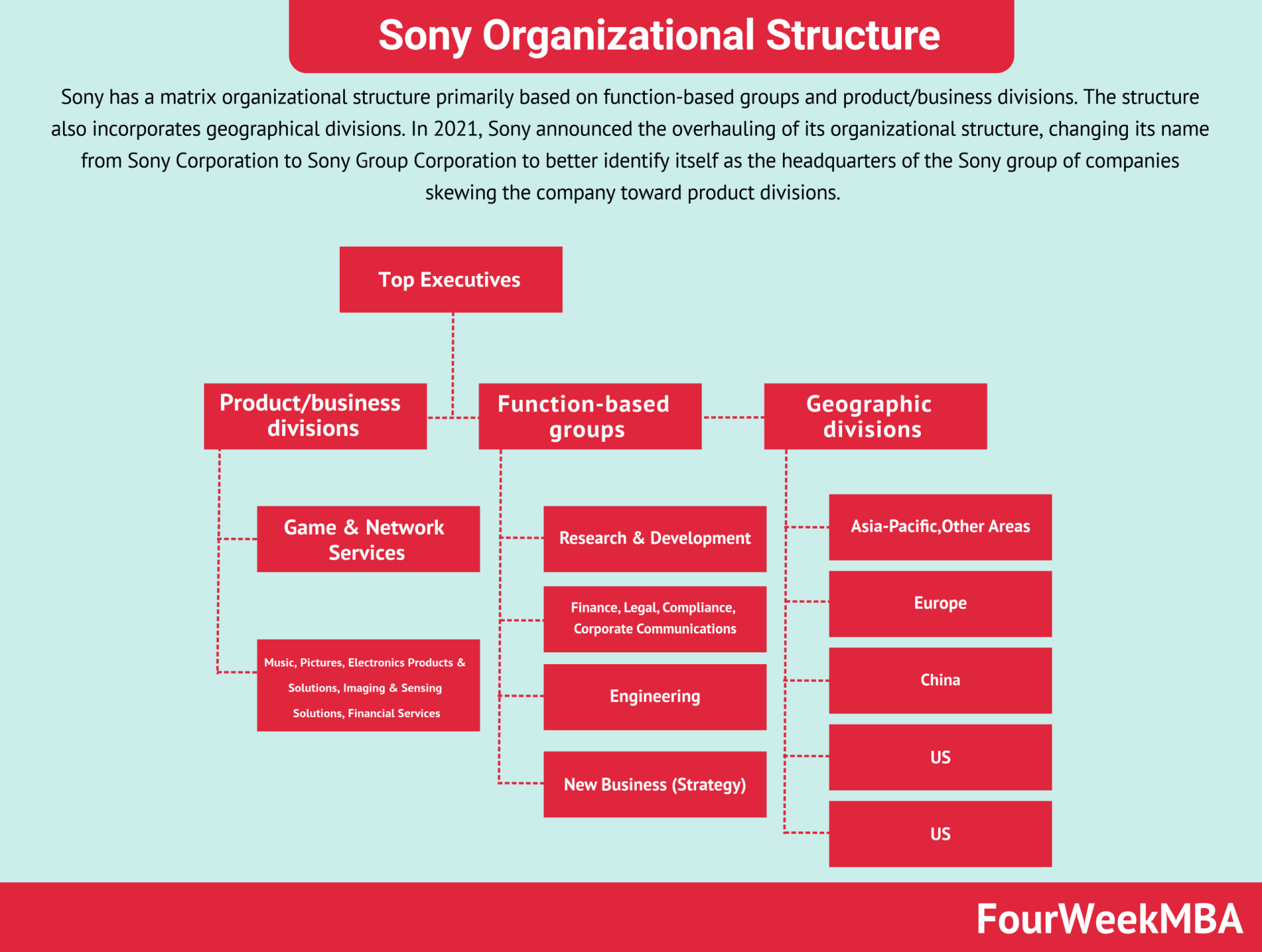
Sony has a matrix organizational structure primarily based on function-based groups and product/business divisions. The structure also incorporates geographical divisions. In 2021, Sony announced the overhauling of its organizational structure, changing its name from Sony Corporation to Sony Group Corporation to better identify itself as the headquarters of the Sony group of companies skewing the company toward product divisions.
Starbucks follows a matrix organizational structure with a combination of vertical and horizontal structures. It is characterized by multiple, overlapping chains of command and divisions.
Tesla is characterized by a functional organizational structure with aspects of a hierarchical structure. Tesla does employ functional centers that cover all business activities, including finance, sales, marketing, technology, engineering, design, and the offices of the CEO and chairperson. Tesla’s headquarters in Austin, Texas, decide the strategic direction of the company, with international operations given little autonomy.
Toyota has a divisional organizational structure where business operations are centered around the market, product, and geographic groups. Therefore, Toyota organizes its corporate structure around global hierarchies (most strategic decisions come from Japan’s headquarter), product-based divisions (where the organization is broken down, based on each product line), and geographical divisions (according to the geographical areas under management).
Walmart has a hybrid hierarchical-functional organizational structure, otherwise referred to as a matrix structure that combines multiple approaches. On the one hand, Walmart follows a hierarchical structure, where the current CEO Doug McMillon is the only employee without a direct superior, and directives are sent from top-level management. On the other hand, the function-based structure of Walmart is used to categorize employees according to their particular skills and experience.
Gennaro is the creator of FourWeekMBA, which reached about four million business people, comprising C-level executives, investors, analysts, product managers, and aspiring digital entrepreneurs in 2022 alone | He is also Director of Sales for a high-tech scaleup in the AI Industry | In 2012, Gennaro earned an International MBA with emphasis on Corporate Finance and Business Strategy.