The Self-Serving Funnel is a business model employed by platforms like Spotify, where users are guided through a funnel of self-service actions to achieve speci
User Engagement
Focuses on engaging users by providing a seamless and personalized experience, often starting with a free or low-cost entry point.
Multiple Service Tiers
Offers multiple service tiers, including free, premium, and family plans, allowing users to choose the level of service that suits their needs.
Free Access with Ads
Provides free access to content or services with the inclusion of ads, encouraging users to experience the platform without a financial commitment.
Premium Subscriptions
Offers premium subscriptions with enhanced features, such as ad-free listening, offline downloads, and higher audio quality, attracting users willing to pay for
Freemium Model
Utilizes a freemium model, where users can upgrade from free to premium services, often prompted by the desire for an improved experience or additional features
Data-Driven Personalization
Leverages user data and preferences to deliver personalized content recommendations, playlists, and advertisements, enhancing user engagement.
User-Generated Content
Incorporates user-generated content, playlists, and contributions, fostering a sense of community and co-creation among users.
A product strategy represents a set of steps, tactics, and a long-term direction a company undertakes through the launch, growth, and maintenance of a product or set of products to reach a defined audience.
Aspect
Self-Serving Funnel (a la Spotify)
Overview
The Self-Serving Funnel is a business model employed by platforms like Spotify, where users are guided through a funnel of self-service actions to achieve specific outcomes, benefitting both the platform and the users.
User Engagement
Focuses on engaging users by providing a seamless and personalized experience, often starting with a free or low-cost entry point.
Multiple Service Tiers
Offers multiple service tiers, including free, premium, and family plans, allowing users to choose the level of service that suits their needs.
Free Access with Ads
Provides free access to content or services with the inclusion of ads, encouraging users to experience the platform without a financial commitment.
Premium Subscriptions
Offers premium subscriptions with enhanced features, such as ad-free listening, offline downloads, and higher audio quality, attracting users willing to pay for these benefits.
Freemium Model
Utilizes a freemium model, where users can upgrade from free to premium services, often prompted by the desire for an improved experience or additional features.
Data-Driven Personalization
Leverages user data and preferences to deliver personalized content recommendations, playlists, and advertisements, enhancing user engagement.
User-Generated Content
Incorporates user-generated content, playlists, and contributions, fostering a sense of community and co-creation among users.
Retention and Loyalty Programs
Implements retention strategies, such as loyalty programs, discounts, or bundled offerings, to keep users subscribed and engaged.
Artist and Creator Monetization
Supports artists and creators by providing opportunities for monetization through streaming royalties, playlist placements, and promotional tools.
Data Monetization
Monetizes user data through targeted advertising and insights for advertisers and partners, contributing to revenue generation.
Collaborations and Partnerships
Collaborates with artists, record labels, and content creators to offer exclusive releases and partnerships, enhancing the platform’s content library.
Expansion into Podcasts and Original Content
Expands offerings to include podcasts, original content, and exclusive shows, attracting a wider audience and keeping users engaged.
Global Reach and Localization
Offers a global reach with localization efforts, ensuring content and user experience cater to diverse markets and languages.
Continuous User Feedback and Improvement
Encourages user feedback and iterates on the platform’s features and functionality to meet evolving user preferences.
Key Success Metrics
Key metrics include user acquisition, retention, conversion from free to premium tiers, ad revenue, premium subscriptions, user engagement, and content consumption.
In his book, Crossing the Chasm, Geoffrey A. Moore shows a model that dissects and represents the stages of adoption of high-tech products. The model goes through five stages based on the psychographic features of customers at each stage: innovators, early adopters, early majority, late majority, and laggard.
Tim Brown, Executive Chair of IDEO, defined design thinking as “a human-centered approach to innovation that draws from the designer’s toolkit to integrate the needs of people, the possibilities of technology, and the requirements for business success.” Therefore, desirability, feasibility, and viability are balanced to solve critical problems.
Customer obsession goes beyond quantitative and qualitative data about customers, and it moves around customers’ feedback to gather valuable insights. Those insights start by the entrepreneur’s wandering process, driven by hunch, gut, intuition, curiosity, and a builder mindset. The product discovery moves around a building, reworking, experimenting, and iterating loop.
DevSecOps is a set of disciplines combining development, security, and operations. It is a philosophy that helps software development businesses deliver innovative products quickly without sacrificing security. This allows potential security issues to be identified during the development process – and not after the product has been released in line with the emergence of continuous software development practices.
The Value Disciplines Model was developed by authors Michael Treacy and Fred Wiersema. In their model, the authors use the term value discipline to represent any method a business may use to differentiate itself. The Value Disciplines Model argues that for a business to be viable, it must be successful in three key areas: customer intimacy, product leadership, and operational excellence.
Marketing consultant Philip Kotler developed the Five Product Levels model. He asserted that a product was not just a physical object but also something that satisfied a wide range of consumer needs. According to that Kotler identified five types of products: core product, generic product, expected product, augmented product, and potential product.
Bowman’s Strategy Clock is a marketingmodel concerned with strategic positioning. The model was developed by economists Cliff Bowman and David Faulkner, who argued that a company or brand had several ways of positioning a product based on price and perceived value. Bowman’s Strategy Clock seeks to illustrate graphically that product positioning is based on the dimensions of price and perceived value.
Product development, known as the new product development process comprises a set of steps that go from idea generation to post-launch review, which helps companies analyze the various aspects of launching new products and bringing them to market. It comprises idea generation, screening, testing; business case analysis, product development, test marketing, commercialization, and post-launch review.
You can use the Ansoff Matrix as a strategic framework to understand what growthstrategy is more suited based on the market context. Developed by mathematician and business manager Igor Ansoff, it assumes a growthstrategy can be derived by whether the market is new or existing, and the product is new or existing.
In the 1970s, Bruce D. Henderson, founder of the Boston Consulting Group, came up with The Product Portfolio (aka BCG Matrix, or Growth-share Matrix), which would look at a successful business product portfolio based on potential growth and market shares. It divided products into four main categories: cash cows, pets (dogs), question marks, and stars.
Customer segmentation is a marketing method that divides the customers into sub-groups, that share similar characteristics. Thus, product, marketing, and engineering teams can center the strategy from go-to-market to product development and communication around each sub-group. Customer segments can be broken down in several ways, such as demographics, geography, psychographics, and more.
Scrum is a methodology co-created by Ken Schwaber and Jeff Sutherland for effective team collaboration on complex products. Scrum was primarily thought for software development projects to deliver new software capability every 2-4 weeks. It is a sub-group of agile also used in project management to improve startups’ productivity.
Key Concepts Touched In The Research
Technology Adoption Curve: This model by Geoffrey A. Moore identifies five stages of product adoption – innovators, early adopters, early majority, late majority, and laggards – based on customers’ psychographic features. It helps businesses understand their target audience and tailor their strategies accordingly.
Design Thinking: Design thinking is a human-centered approach to innovation that integrates people’s needs, technological possibilities, and business requirements to solve critical problems. It balances desirability, feasibility, and viability in product development.
Customer Obsession: Customer obsession emphasizes gathering valuable insights from customer feedback and using them to iterate and improve the product. It involves a builder mindset, experimentation, and continuous improvement.
DevSecOps: DevSecOps combines development, security, and operations to deliver innovative products quickly without compromising on security. It identifies potential security issues during the development process, promoting continuous software development practices.
Value Disciplines: Michael Treacy and Fred Wiersema’s Value Disciplines Model highlights three key areas for a business to succeed: customer intimacy, product leadership, and operational excellence. Businesses must excel in these areas to differentiate themselves effectively.
Five Product Levels: Philip Kotler’s model identifies five types of products: core product, generic product, expected product, augmented product, and potential product. It emphasizes that a product satisfies various consumer needs beyond its physical form.
Bowman’s Strategy Clock: This marketingmodel, developed by Cliff Bowman and David Faulkner, helps businesses understand strategic positioning based on price and perceived value. It offers various ways of positioning a product in the market.
New Product Development: The new product development process encompasses the steps from idea generation to post-launch review, helping companies analyze aspects of launching new products. It includes idea screening, business case analysis, product development, test marketing, commercialization, and post-launch review.
Ansoff Matrix: Igor Ansoff’s matrix helps identify growth strategies based on whether the market and the product are new or existing. It assists in understanding which strategy suits the market context.
BCG Matrix: Bruce D. Henderson’s Product Portfolio Matrix categorizes products based on potential growth and market shares. It divides products into cash cows, pets (dogs), question marks, and stars, helping businesses manage their product portfolio effectively.
Customer Segmentation: Customer segmentation divides customers into sub-groups with similar characteristics. Businesses use this method to tailor their strategies and communication for each sub-group based on demographics, geography, psychographics, etc.
Scrum: Scrum is a methodology for effective team collaboration on complex products. It helps deliver new software capability every 2-4 weeks and improves productivity in software development projects and project management for startups.
A Blockchain Business Model according to the FourWeekMBA framework is made of four main components: Value Model (Core Philosophy, Core Values and Value Propositions for the key stakeholders), Blockchain Model (Protocol Rules, Network Shape and Applications Layer/Ecosystem), Distribution Model (the key channels amplifying the protocol and its communities), and the Economic Model (the dynamics/incentives through which protocol players make money). Those elements coming together can serve as the basis to build and analyze a solid Blockchain Business Model.
In an asymmetric business model, the organization doesn’t monetize the user directly, but it leverages the data users provide coupled with technology, thus have a key customer pay to sustain the core asset. For example, Google makes money by leveraging users’ data, combined with its algorithms sold to advertisers for visibility.
In a business world driven by technology and digitalization, competition is much more fluid, as innovation becomes a bottom-up approach that can come from anywhere. Thus, making it much harder to define the boundaries of existing markets. Therefore, a proper business competition analysis looks at customer, technology, distribution, and financial model overlaps. While at the same time looking at future potential intersections among industries that in the short-term seem unrelated.
Technological modeling is a discipline to provide the basis for companies to sustain innovation, thus developing incremental products. While also looking at breakthrough innovative products that can pave the way for long-term success. In a sort of Barbell Strategy, technological modeling suggests having a two-sided approach, on the one hand, to keep sustaining continuous innovation as a core part of the business model. On the other hand, it places bets on future developments that have the potential to break through and take a leap forward.
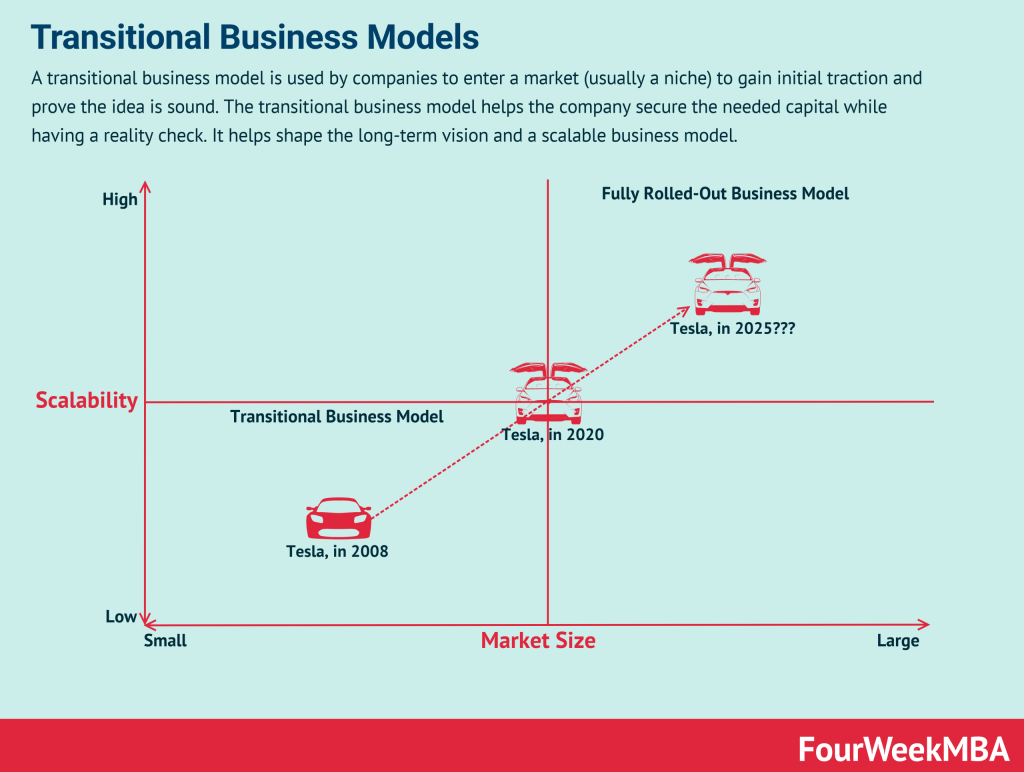
A transitional business model is used by companies to enter a market (usually a niche) to gain initial traction and prove the idea is sound. The transitional business model helps the company secure the needed capital while having a reality check. It helps shape the long-term vision and a scalable business model.
The minimum viable audience (MVA) represents the smallest possible audience that can sustain your business as you get it started from a microniche (the smallest subset of a market). The main aspect of the MVA is to zoom into existing markets to find those people which needs are unmet by existing players.
Business scaling is the process of transformation of a business as the product is validated by wider and wider market segments. Business scaling is about creating traction for a product that fits a small market segment. As the product is validated it becomes critical to build a viable business model. And as the product is offered at wider and wider market segments, it’s important to align product, business model, and organizational design, to enable wider and wider scale.
The market expansion consists in providing a product or service to a broader portion of an existing market or perhaps expanding that market. Or yet, market expansions can be about creating a whole new market. At each step, as a result, a company scales together with the market covered.
In the FourWeekMBA growth matrix, you can apply growth for existing customers by tackling the same problems (gain mode). Or by tackling existing problems, for new customers (expand mode). Or by tackling new problems for existing customers (extend mode). Or perhaps by tackling whole new problems for new customers (reinvent mode).
In the FourWeekMBA Revenue Streams Matrix, revenue streams are classified according to the kind of interactions the business has with its key customers. The first dimension is the “Frequency” of interaction with the key customer. As the second dimension, there is the “Ownership” of the interaction with the key customer.
Revenue model patterns are a way for companies to monetize their business models. A revenue model pattern is a crucial building block of a business model because it informs how the company will generate short-term financial resources to invest back into the business. Thus, the way a company makes money will also influence its overall business model.
A pricing strategy or model helps companies find the pricing formula in fit with their business models. Thus aligning the customer needs with the product type while trying to enable profitability for the company. A good pricing strategy aligns the customer with the company’s long term financial sustainability to build a solid business model.
Gennaro is the creator of FourWeekMBA, which reached about four million business people, comprising C-level executives, investors, analysts, product managers, and aspiring digital entrepreneurs in 2022 alone | He is also Director of Sales for a high-tech scaleup in the AI Industry | In 2012, Gennaro earned an International MBA with emphasis on Corporate Finance and Business Strategy.