FOURWEEKMBA EXPLAINER · FROM COMPANY DOCUMENTS · UPDATED 18 NOVEMBER 2026
Free to share with a link to this page. Figures from Google’s own posts; Google counts listings, not distinct products. The 71% rise is our arithmetic.
The short version: An AI shopping agent can only buy what it can read: names, prices, stock and specs. That product data passes through six layers before a purchase: the brand’s own site and feeds, marketplace catalogs such as Amazon’s, search graphs such as Google’s, checkout protocols, payment credentials, and the agent itself. Each layer has a different owner and a different way of making money.
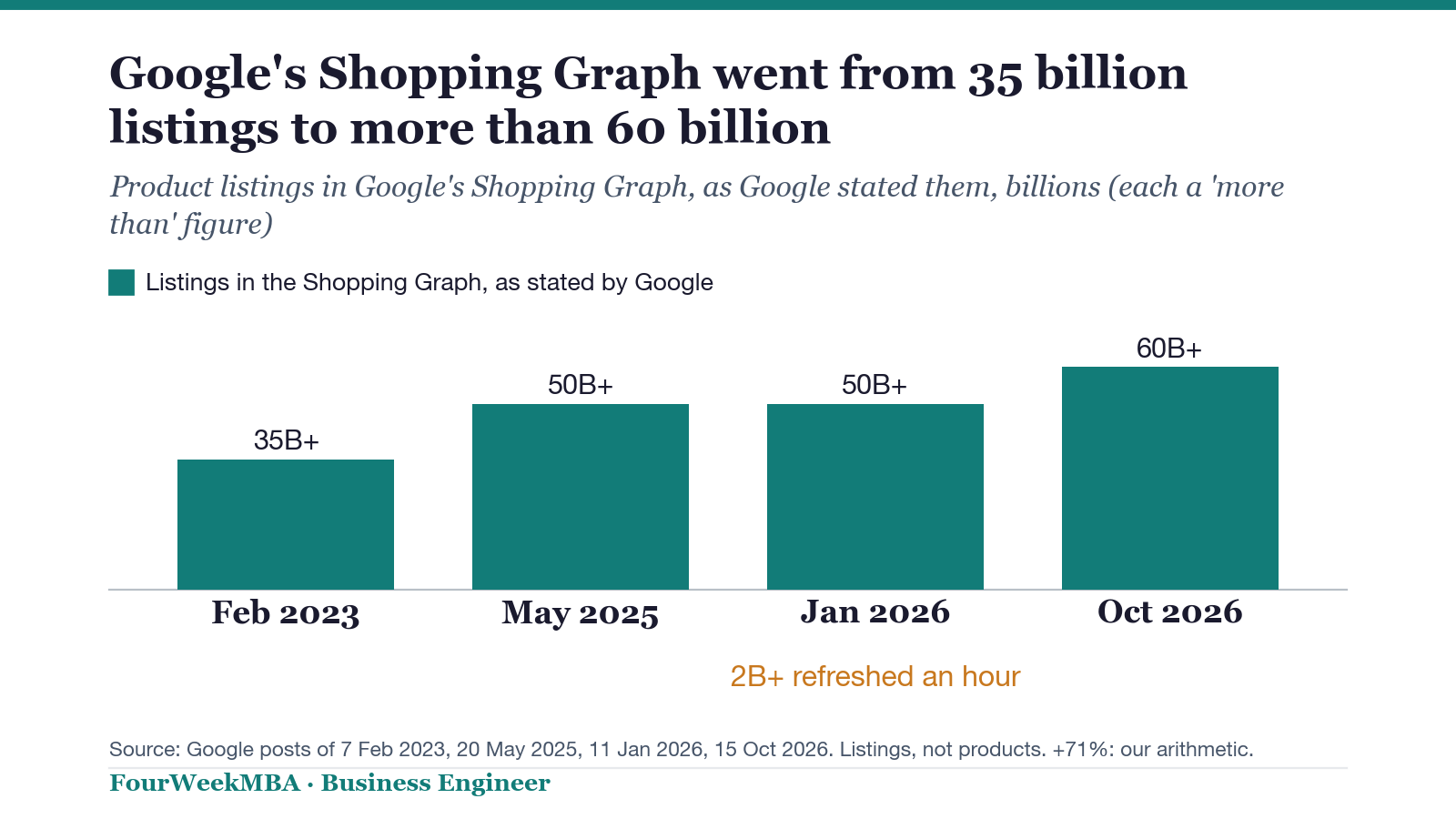
The biggest stated store of the data is Google’s: its Shopping Graph holds “60+ billion continually refreshed product listings”, Google said on 15 October 2026. Amazon charges sellers referral fees on its catalog; OpenAI said in 2025 that “Merchants pay a small fee on completed purchases”. And Forter, which tracks agent orders on its merchant network, says agents that drive a store’s own pages “can shop anywhere, while the protocols can only reach those stores that have integrated them.”
product data for AI shopping agents, from the agent at the top to brand data at the bottom">
6
The agentChatGPT, Gemini, Meta’s Muse, Amazon’s Rufus, PerplexityTalks to the shopper and picks the product. Reaches stores through a protocol, or by browsing the store’s own pages.
5
Payment credentialsVisa Intelligent Commerce, Mastercard Agent Pay, AP2 mandatesProve the shopper authorised the agent to pay, and for what.
4
Checkout protocolsOpenAI and Stripe’s ACP, Google’s UCPCarry the order from agent to merchant. The merchant stays the merchant of record.
3
Search shopping graphsGoogle Shopping Graph, 60B+ listingsMerge offers from many sellers. Google says more than 2 billion listings are refreshed every hour.
2
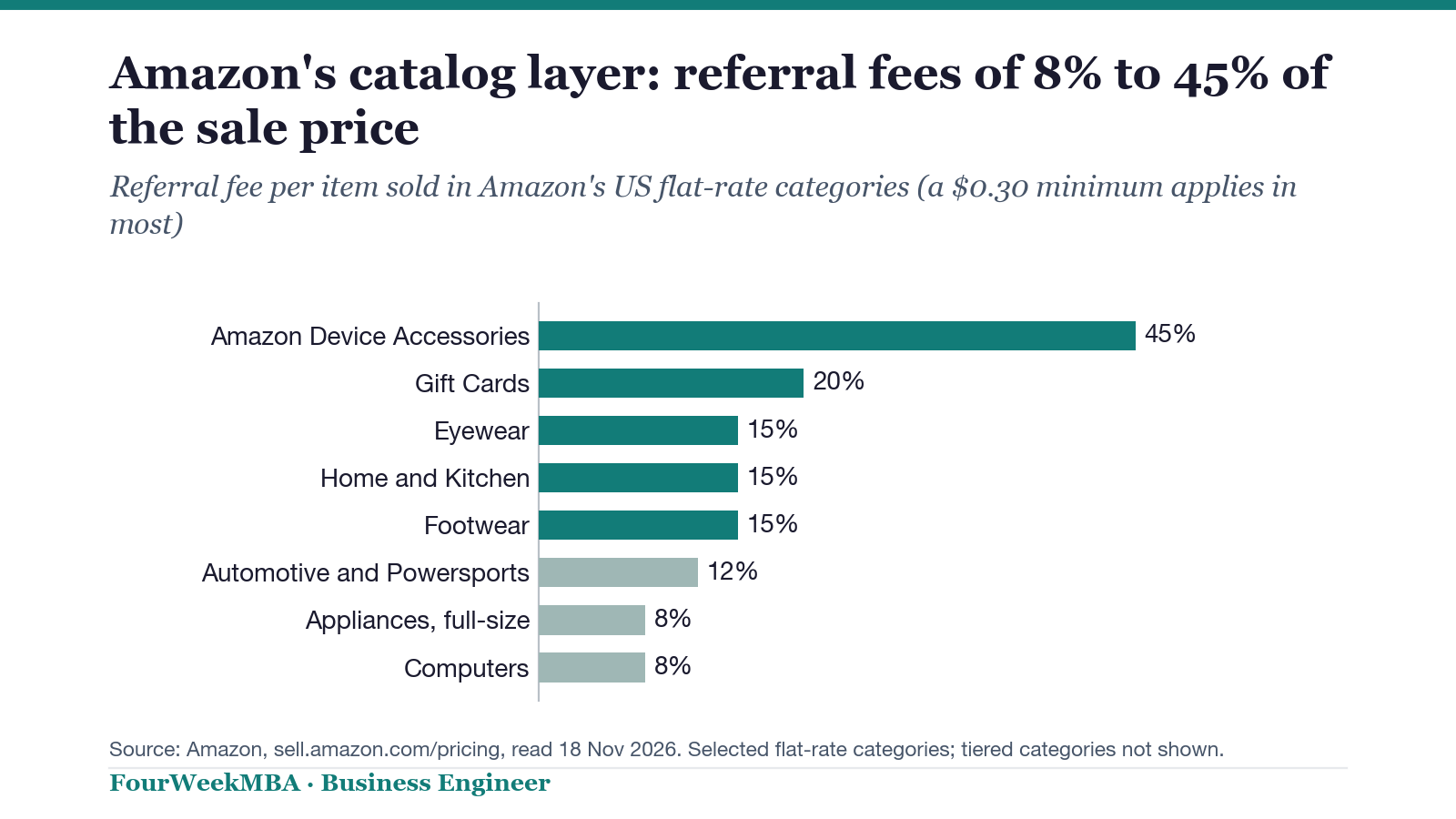
Marketplace catalogsAmazon’s catalog and Shop DirectA catalog the marketplace controls. Money: referral fees of 8% to 45% in Amazon’s flat-rate categories.
1
Brand and merchant databrand websites, product feedsThe source. Everyone above asks for it: OpenAI and Amazon take product feeds; Amazon’s plan, as Reuters reported it, starts from brand websites.
Our framing of the layers; each owner and figure is from the company’s own page or from the reporting named below.
Layer 1: brands still hold the source
Every layer above starts from the brand’s own data. OpenAI’s merchant docs, read on 18 November 2026, say ChatGPT “can use information from the public web, private API integrations, and, for retail, merchant product feeds”; they add that “The feed does not update a cart or confirm a purchase. Your live website or plugin still checks the current offer when a customer acts.” Amazon’s March 2026 post says it is “enabling third-party product feeds” for Shop Direct.
Amazon’s next step, as Reuters reported on 13 November 2026 from an internal document: a World Product Graph that “depends on discovering how brands organize their products on their own websites”. The document says Coca-Cola and Bayer, among others, have signed up to contribute data, according to Reuters.
Layer 2: the marketplace catalog
Amazon’s catalog is the classic owned layer. Sellers pay $0.99 per item sold or $39.99 a month, plus a referral fee on every item: “a percentage of the total price or a minimum amount, whichever is greater”, in Amazon’s words. The chart shows the flat-rate categories; others are tiered by price.
Amazon also lists products it does not sell. “Shop Direct now includes over 100 million products from more than 400,000 merchants”, Amazon said on 11 March 2026, “with tens of millions of products available to purchase through the AI-powered Buy for Me feature”. Google’s 60 billion listings are about 600 times that count, by our arithmetic, though the two companies count different things.
Why Amazon wants more, in the internal document’s words as Reuters reported them: “Amazon cannot be the go-destination for every shopping mission if customers must leave to research product relationships on Google, brand websites, and review sites”. Amazon told Reuters that usage figures in the document are significantly outdated.
Layer 3: the search engine’s shopping graph
Google has given the size of its Shopping Graph four times: more than 35 billion listings in February 2023, more than 50 billion in May 2025 and in Sundar Pichai’s January 2026 NRF remarks, and 60+ billion in October 2026. Its freshness claim: “More than 2 billion of those listings are refreshed every single hour.” On the January pair that is about 4% of the graph an hour, or the whole graph every 25 hours, by our arithmetic.
Where shoppers start matters too. A 2025 Morgan Stanley report, as Reuters cited it, found 57% of online shoppers start product research on Google against 16% on Amazon.
Layer 4: checkout protocols
ACP: OpenAI and Stripe, 29 Sep 2025OpenAI launched Instant Checkout “powered by the Agentic Commerce Protocol, built with Stripe” and open-sourced the protocol. It said “Product results are organic and unsponsored”, that “Merchants pay a small fee on completed purchases”, and that merchants stay “the merchant of record”. It did not state the fee.
UCP: Google, 11 Jan 2026Pichai’s NRF remarks introduced the Universal Commerce Protocol, “built together with industry leaders Shopify, Etsy, Wayfair, Target and Walmart, and endorsed by 20+ more”, and compatible with Agent2Agent, AP2 and the Model Context Protocol.
OpenAI’s merchant documentation now describes a wider route: after comparing options “The journey moves to browser use or a plugin”, with ChatGPT Wallet for payment on the merchant’s existing website (docs as read on 18 November 2026). In OpenAI’s 2025 post, ChatGPT weighed “availability, price, quality, whether a merchant is the primary seller, and whether Instant Checkout is enabled” when several merchants sell the same product: the data layer feeds the ranking.
Layer 5: payment credentials
Card networks moved first. Mastercard announced Agent Pay and “Mastercard Agentic Tokens” on 29 April 2025, working with Microsoft. Visa followed on 30 April with Intelligent Commerce, naming Anthropic, IBM, Microsoft, Mistral AI, OpenAI, Perplexity, Samsung and Stripe; its chief product and strategy officer Jack Forestell said: “These agents will need to be trusted with payments, not only by users, but by banks and sellers as well.”
Google’s Agent Payments Protocol (AP2), announced on 16 September 2025 with “more than 60 organizations”, sets out the proof: “Proving that a user gave an agent the specific authority to make a particular purchase.” A shopper’s request becomes a signed Intent Mandate; approving the basket signs a Cart Mandate, “a secure, unchangeable record of the exact items and price”.
Layer 6: the agent, and why protocols reach few stores
Agents do not have to wait for merchants to integrate. Forter, a fraud-prevention company, publishes order data from its own merchant network. In its 16 November 2026 update it says that “Throughout August, OpenAI placed 80% to 92% of agentic orders every week”, that it began detecting Meta’s Muse on 21 September, and that Muse placed 49% of agentic orders in the week of 2 November.
Protocol agentsCheck out through an integrated protocol. Forter: they “hand the merchant structured, verified order data”. Reach: only stores that integrated.
Scraping agentsDrive the store’s own pages like a shopper. Forter: “They can shop anywhere”, but “Merchants cannot easily tell a legitimate agent from a bot, or see who the real buyer is.”
Forter puts the average agentic order in November so far at $204, 2.3 times a human’s $89. The figures cover Forter’s network only. Access is contested: Amazon blocked Muse from its site in September and is in court with Perplexity over similar access, Reuters reported.
Where the money sits (our reading)
Catalog owners charge per sale. Amazon’s referral fees are public and category-specific; that is the clearest price on product data in the stack.
Protocol owners charge little or nothing, so far. OpenAI’s fee is “small” and unstated; Google’s AP2 post sets no fee. The protocols are distribution for the agent, not the profit centre.
The graph owner holds the start of the journey.Google has the largest stated count and, on the Morgan Stanley figures Reuters cited, the most first searches.
Every route needs current data. Whether an agent uses a protocol or a browser, it reads prices and stock from layers 1 to 3. Whoever keeps that data fresh decides what the agent can find.
FAQ
Who owns product data for AI shopping agents?
Nobody owns all of it. Brands own the source; Amazon controls its own catalog; Google holds the largest stated index, 60+ billion listings; OpenAI, Google, Visa and Mastercard own the rails that carry orders and payments; the agent owns the conversation with the shopper.
How big is Google’s Shopping Graph?
More than 60 billion product listings, Google said on 15 October 2026, up from more than 35 billion in February 2023. Google said in January 2026 that more than 2 billion listings are refreshed every hour.
What is the Agentic Commerce Protocol?
An open standard OpenAI built with Stripe and launched with Instant Checkout on 29 September 2025. It sends an order from ChatGPT to the merchant’s backend; the merchant accepts or declines it and stays the merchant of record.
What is the difference between UCP and AP2?
Both are Google-led. AP2 (September 2025) covers payment authorisation through signed mandates; UCP (January 2026) covers the wider commerce journey and, Google says, is compatible with AP2.
Do merchants pay to sell through AI agents?
Depends on the route. OpenAI said merchants pay “a small fee on completed purchases” for Instant Checkout; Amazon charges referral fees on its marketplace; a scraping agent that buys on the store’s own site pays the merchant like any shopper.
Can a store block shopping agents?
Yes. Amazon blocked Meta’s Muse in September 2026, Reuters reported. OpenAI’s docs ask merchants to check that their firewall does not block “verified ChatGPT browser visits”.
What to watch
Google’s next Shopping Graph count and whether it restates the hourly refresh.
Amazon’s World Product Graph: any official statement, and new brand partners beyond those Reuters named.
A stated ACP or UCP fee. Neither is public in the documents we read.
Forter’s next update on protocol versus scraping agents, and merchants’ bot-blocking response.
Built on 18 November 2026 from each company’s own pages: Google’s Shopping Graph posts (2023-2026), Pichai’s NRF 2026 remarks and the AP2 announcement; Amazon’s seller pricing page and Shop Direct post; OpenAI’s Instant Checkout announcement and current merchant docs; Visa’s and Mastercard’s releases; Forter’s order data for its own network. The World Product Graph and Morgan Stanley figures are as reported by Reuters on 13 November 2026; we did not see the documents. Each quarter, or when a company publishes a new count or fee, we re-read these pages and update the figures and dates. The six layer names and all ratios are our own.
Gennaro Cuofano is a CRO and tech executive who has worked in AI since late 2015, starting with bringing NLP, natural-language generation, voice and chatbot products to the marketing industry. His background is in law and finance: he holds a Master's degree in Law and an International MBA with an emphasis on corporate finance (LUISS Business School and the University of San Diego, 2012), and worked as a financial analyst at a real-estate investment firm in San Diego and as an assistant controller. His work focuses on business model strategy, business engineering and, more broadly, structural analysis: how companies make money, read from their own filings. He created FourWeekMBA and leads research there and at The Business Engineer, his newsletter on AI and business strategy, with over 95,000 subscribers and more than 1,000 published analyses. His writing has also appeared on Entrepreneur (for example, How to Digitize a Family Business in Europe) and HackerNoon. Find him on LinkedIn and Substack. See how we source.