FOURWEEKMBA EXPLAINER · FROM THE PRIMARY POSTS · UPDATED 18 NOVEMBER 2026
Free to share with a link to this page. Dates are those of the posts we cite, not first-ever uses of each term; the day counts are our arithmetic.
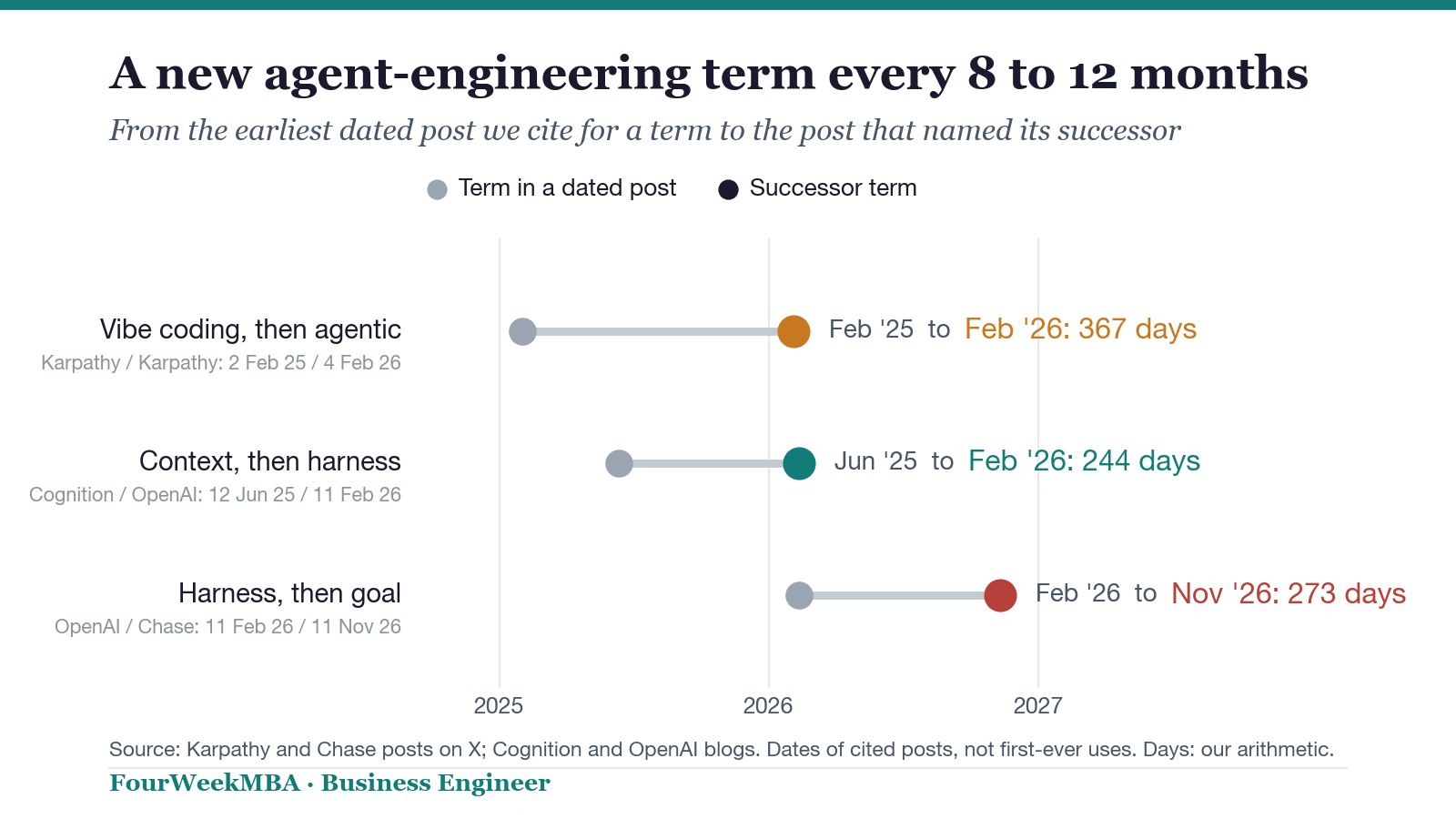
The short version: In about 17 months the vocabulary for building with AI models moved from prompt engineering to context engineering (June 2025), to harness engineering (named in an OpenAI post of 11 February 2026), to goal engineering (a three-line post by LangChain’s chief executive Harrison Chase on 11 November 2026). A parallel track on the coding side went from Andrej Karpathy’s vibe coding (2 February 2025) to his agentic engineering (4 February 2026).
Each new term widens what the engineer is responsible for: the words of one request, then everything the model sees, then the software system around the model, then the outcome the agent works towards. That reading is ours; the definitions below are the authors’ own, quoted from the dated posts.
goal engineering contains harness engineering, which contains context engineering, which contains prompt engineering">
Goal engineeringHarrison Chase, 11 Nov 2026 · not yet defined by its authorWhat the agent works towards over time. Chase’s 2 Nov post: “Agents are moving from doing tasks to working towards goals”.
Harness engineeringOpenAI, 11 Feb 2026The system around the model. Engineers “design environments, specify intent, and build feedback loops that allow Codex agents to do reliable work”.
Context engineeringCognition, Lütke, LangChain, Karpathy, June 2025Everything that lands in the context window: “the delicate art and science of filling the context window with just the right information for the next step” (Karpathy).
Prompt engineeringthe starting pointWriting the request well. Anthropic: “methods for writing and organizing LLM instructions for optimal outcomes”.
Our diagram. Each layer’s wording is quoted from the post named in it; the nesting is our reading, not a claim made by any of the authors.
The dated timeline
Fourteen dated posts, each read on its own page. Where a term appeared earlier somewhere else, the earliest post here is simply the earliest we could date and read.
“vibe coding”“There’s a new kind of coding I call “vibe coding”, where you fully give in to the vibes, embrace exponentials, and forget that the code even exists.” Post
“Context engineering” as the next level of promptingIn “Don’t Build Multi-Agents”, after prompt engineering, context engineering “is the next level of this. It is about doing this automatically in a dynamic system.” Post
“I really like the term “context engineering” over prompt engineering.”Shopify’s chief executive: “the art of providing all the context for the task to be plausibly solvable by the LLM”. Post
A definition“Context engineering is building dynamic systems to provide the right information and tools in the right format such that the LLM can plausibly accomplish the task.” Chase credits Lütke, Ankur Goyal and Walden Yan. Post
“+1 for “context engineering” over “prompt engineering”.”He adds that “The term “ChatGPT wrapper” is tired and really, really wrong.” Post
A lab adopts the term“At Anthropic, we view context engineering as the natural progression of prompt engineering.” The post also names “context rot”: as tokens in the window increase, the model’s ability to recall from it decreases. Post
“the agent harness that powers Claude Code”Announcing the rename of the Claude Code SDK to the Claude Agent SDK, Anthropic wrote that this harness “can power many other types of agents, too”. Post
“Effective harnesses for long-running agents”Calls the Claude Agent SDK “a powerful, general-purpose agent harness adept at coding”. In its example an initializer agent wrote over 200 features, all marked “failing” at the start. Post
“agentic engineering”A year after vibe coding: “personally my current favorite “agentic engineering””, because “you are not writing the code directly 99% of the time, you are orchestrating agents who do and acting as oversight”. Post
“Harness engineering: leveraging Codex in an agent-first world”A team that shipped with “0 lines of manually-written code”. Its summary: “Humans steer. Agents execute.” Post
“Harness design for long-running application development”“every component in a harness encodes an assumption about what the model can’t do on its own”. Post
“Goal Tracking” listed as a new challenge“Agents are moving from doing tasks to working towards goals”. Post
“goal engineering”Three lines: “context engineering” and “harness engineering”, both struck through, and “goal engineering” left standing. No definition. Post
“From tasks to goals”“As agents become more powerful, we’re moving from giving them tasks to giving them goals.” Post
Prompt engineering: where the line starts
Every post in the context-engineering wave defines itself against prompting. Anthropic describes prompt engineering as “methods for writing and organizing LLM instructions for optimal outcomes”, and says that “as we move towards engineering more capable agents that operate over multiple turns of inference and longer time horizons”, the job becomes managing the whole context state. For the basics, see our explainer on prompt engineering.
Context engineering: June 2025
The term arrived in a cluster. Cognition’s 12 June post called it “the next level” of prompt engineering and “effectively the #1 job of engineers building AI agents”. A week later Shopify’s Tobi Lütke said he preferred it; on 23 June Chase’s LangChain post gave the definition most often repeated since; on 25 June Karpathy backed it, listing what goes into the window: “task descriptions and explanations, few shot examples, RAG, related (possibly multimodal) data, tools, state and history, compacting”.
Anthropic adopted the term on 29 September 2025. From Cognition’s post to Anthropic’s is 109 days, by our arithmetic. We explain the practice in Context Engineering Explained.
Harness engineering: late 2025 to early 2026
“Harness” is the software around the model: the loop, tools, memory, checks and environment that turn a model into an agent. Anthropic used the word for its own SDK in September and November 2025. OpenAI turned it into a discipline on 11 February 2026: over five months, a team built and shipped an internal beta with no hand-written code, which it estimates took “about 1/10th the time it would have taken to write the code by hand”, ending up at “a million lines of code”. The job of the humans, it said, was to “design environments, specify intent, and build feedback loops”.
From Cognition’s context-engineering post to OpenAI’s harness-engineering post is 244 days by our arithmetic (237 days counting from Lütke’s post, the figure in our newsroom piece). Anthropic’s 24 March 2026 post adds the warning that harness parts go stale “as models improve”. Our explainer: The Model and the Harness.
Agentic engineering: the coding-side name
Karpathy coined “vibe coding” on 2 February 2025 for throwaway projects. On 4 February 2026, 367 days later by our arithmetic, he wrote that “programming via LLM agents is increasingly becoming a default workflow for professionals, except with more oversight and scrutiny”, and offered “agentic engineering” as the name: “agentic” because the engineer orchestrates agents, “engineering” because “there is an art & science and expertise to it”. It sits beside harness engineering rather than after it: one names the developer’s role, the other the system being built.
Goal engineering: November 2026
Chase’s 11 November post has no definition, and the LangChain posts we read do not use the phrase. The nearest thing is his 2 November post, which lists “Goal Tracking” and “Alignment” as open problems: “Goal design is hard by itself. It will be very hard for users to design goals that agents can not cheat”, with the example ““get rid of all bugs in codebase” → deletes codebase entirely (no code = no bugs)”. His 16 November post sets out two shifts: “From specifying an action to specifying an outcome” and “From a bounded assignment to an ongoing responsibility”. Harness engineering took 273 days to be struck through, by our arithmetic.
Why the vocabulary keeps moving (our reading)
The unit of work keeps growing. A prompt is one request; context is one model call; a harness is a whole agent run; a goal is many runs over weeks. Each name tracks the size of what is handed to the model.
The coiners sell the next layer. Cognition (Devin), LangChain (Deep Agents, LangSmith), Anthropic (Claude Agent SDK) and OpenAI (Codex) each named a practice their own product addresses. That does not make the terms wrong; it is a reason to read the posts, not the slogans.
Old terms do not disappear. Chase’s 2 November post still calls memory, async work and goal tracking “context engineering challenges”. The layers stack; the newest name describes the outer one.
FAQ
Who coined “context engineering”?
No single person, on the record we read. The earliest dated post we found is Cognition’s of 12 June 2025 by Walden Yan; Tobi Lütke (19 June), Harrison Chase (23 June) and Andrej Karpathy (25 June) popularised it within two weeks. Chase’s own post credits Lütke, Ankur Goyal and Yan.
What is harness engineering?
Designing the system around a model so agents do reliable work: environments, tools, feedback loops and checks. The phrase is the title of OpenAI’s 11 February 2026 post; Anthropic had called its Agent SDK an “agent harness” in 2025.
What is goal engineering?
As of November 2026, a term without a definition: Harrison Chase posted it on 11 November. His posts of 2 and 16 November describe the problem it points at: agents that pursue outcomes over long periods without gaming the goal.
Is agentic engineering the same as harness engineering?
No. Karpathy’s “agentic engineering” names how a professional works with coding agents, under oversight; “harness engineering” names building the environment those agents run in. They overlap in practice.
Is prompt engineering dead?
No. Every later term contains it: Anthropic calls context engineering “the natural progression of prompt engineering”, and system prompts remain part of every harness.
What to watch
A definition of goal engineering from Chase or LangChain, or the term in a lab’s engineering post.
The next lab post. Context engineering took 109 days to reach Anthropic’s blog by our arithmetic; whether goal engineering does the same.
Products named for the layer. Harness engineering came with Codex and the Claude Agent SDK; goal tracking has no named LangChain product in the posts we read.
Built from the 14 posts linked in the timeline, each read on its own page on 18 November 2026 (posts on X through their public text and timestamps). Dates are the posts’ own; they are not claims about the first-ever use of any term. When a lab, a lab leader or a framework company uses a new agent-engineering term in a dated post, or defines goal engineering, we add the point with its date and quote. Day counts and the nesting diagram are our own.
Gennaro Cuofano is a CRO and tech executive who has worked in AI since late 2015, starting with bringing NLP, natural-language generation, voice and chatbot products to the marketing industry. His background is in law and finance: he holds a Master's degree in Law and an International MBA with an emphasis on corporate finance (LUISS Business School and the University of San Diego, 2012), and worked as a financial analyst at a real-estate investment firm in San Diego and as an assistant controller. His work focuses on business model strategy, business engineering and, more broadly, structural analysis: how companies make money, read from their own filings. He created FourWeekMBA and leads research there and at The Business Engineer, his newsletter on AI and business strategy, with over 95,000 subscribers and more than 1,000 published analyses. His writing has also appeared on Entrepreneur (for example, How to Digitize a Family Business in Europe) and HackerNoon. Find him on LinkedIn and Substack. See how we source.