The Method of Loci is a mnemonic strategy for memorizing information. The Method of Loci gets its name from the word “loci”, which is the plural of locus – meaning location or place. It is a form of memorization where an individual places information they want to remember along with points of an imaginary journey. By retracing the same route through the journey, the individual can recall the information in a specific order. For this reason, many consider this memory tool a location-based mnemonic.
The Feynman Technique is a mental model and strategy for learning something new and committing it to memory. It is often used in exam preparation and for understanding difficult concepts. Physicist Richard Feynman elaborated this method, and it’s a powerful technique to explain anything.
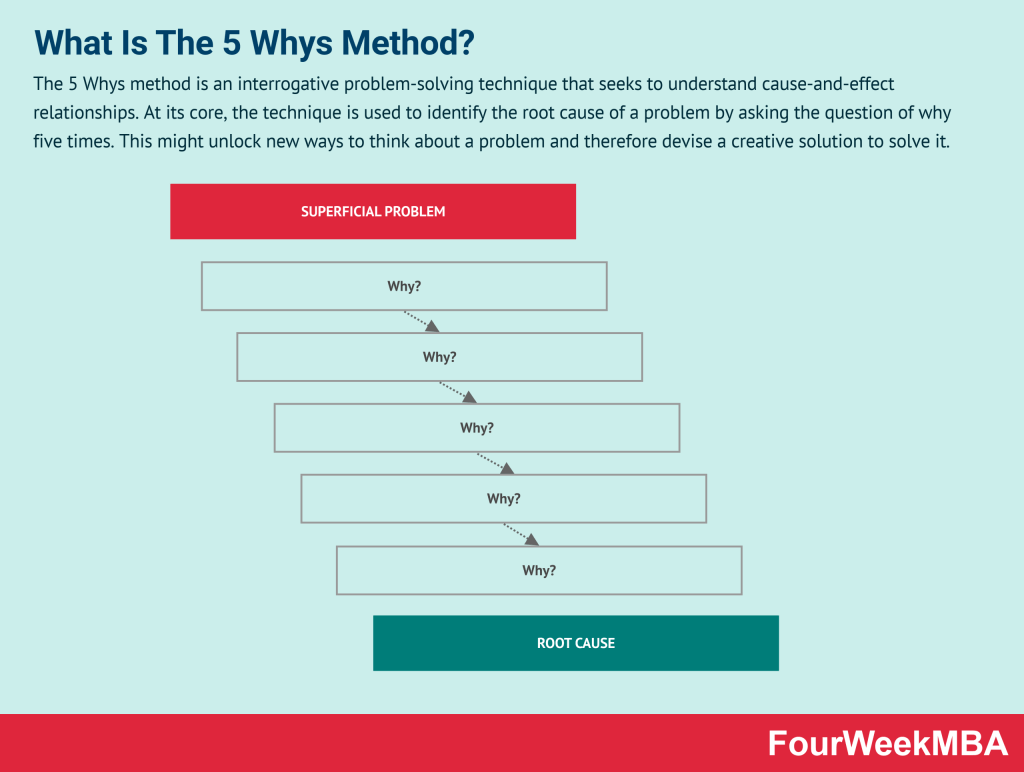
The 5 Whys method is an interrogative problem-solving technique that seeks to understand cause-and-effect relationships. At its core, the technique is used to identify the root cause of a problem by asking the question of why five times. This might unlock new ways to think about a problem and therefore devise a creative solution to solve it.
Active recall enables the practitioner to remember information by moving it from short-term to long-term memory, where it can be easily retrieved. The technique is also known as active retrieval or practice testing. With active recall, the process is reversed since learning occurs when the student retrieves information from the brain.
The forgetting curve was first proposed in 1885 by Hermann Ebbinghaus, a German psychologist and pioneer of experimental research into memory. The forgetting curve illustrates the rate at which information is lost over time if the individual does not make effort to retain it.
Cognitive load theory (CLT) argues that instructional designquality is increased when consideration is given to the role and limitations of working memory. The theory is based on the premise that since the brain can only do so many things at once, the individual should be selective about what they ask it to process.
Spaced repetition is a technique where individuals review lessons at increasing intervals to memorize information. Spaced repetition is based on the premise that the brain learns more effectively when the individual “spaces out” the learning process. Thus, it can be used as a mnemonic technique to transform short-term memory into long-term memory.
Memory and Understanding Enhancement Techniques
Method of Loci:
How it works: Create a mental journey with specific locations or landmarks. Associate the information you want to remember with each location. When you need to recall the information, mentally walk through the journey to retrieve it.
Benefits: Enhances memory by connecting information to spatial cues. Effective for lists, sequences, and ordered data.
Feynman Technique:
How it works: Choose a concept or topic you want to understand. Explain it as if you were teaching it to someone else, using simple language and examples. Identify gaps in your knowledge and revise until you can explain it clearly.
Benefits: Deepens understanding, exposes areas of weakness, and simplifies complex ideas.
5 Whys Method:
How it works: When faced with a problem or issue, ask “why” five times in succession to uncover the root cause. Each “why” leads to a deeper level of analysis.
How it works: Instead of simply rereading or reviewing material, actively test your memory by recalling information from memory. This practice strengthens memory retention.
Benefits: Improves long-term retention, reinforces learning, and enhances recall during exams or presentations.
Forgetting Curve:
How it works: The forgetting curve illustrates the decline in memory retention over time without active review or rehearsal. To combat this curve, schedule periodic reviews of material.
Benefits: Maximizes memory retention and minimizes the loss of learned information over time.
Cognitive Load Theory:
How it works: Recognize the limits of working memory and design learning materials or presentations that minimize cognitive overload. Simplify complex content and focus on key concepts.
Benefits: Enhances comprehension and learning efficiency by reducing cognitive strain on the brain.
Spaced Repetition:
How it works: Space out review sessions over increasing intervals. Start with frequent reviews and gradually extend the time between them. This technique leverages the psychological spacing effect to improve long-term retention.
Benefits: Maximizes the transfer of information from short-term to long-term memory, leading to better recall and understanding.
Chunking:
How it works: Break down complex information into smaller, manageable chunks or groups. Organize related items into meaningful clusters.
Benefits: Simplifies the processing of large amounts of information, making it easier to remember and understand.
Mind Mapping:
How it works: Create visual representations of information by connecting related concepts or ideas using branches and nodes. Mind maps are effective for organizing thoughts and grasping complex subjects.
Benefits: Enhances understanding, stimulates creativity, and aids in brainstorming and problem-solving.
Visualization:
How it works: Create mental images or visual representations of concepts, facts, or processes you want to remember. Visualization engages the brain’s visual memory.
Benefits: Improves memory recall by associating information with vivid mental images.
Mnemonic Devices:
How they work: Mnemonics are memory aids, such as acronyms, rhymes, or associations, used to remember specific information or sequences.
Benefits: Facilitates recall by providing memorable cues or patterns.
Dual Coding:
How it works: Combine verbal and visual information when learning. For example, read text and create visual diagrams or drawings related to the content.
Benefits: Enhances memory by encoding information through multiple channels (verbal and visual).
Gennaro is the creator of FourWeekMBA, which reached about four million business people, comprising C-level executives, investors, analysts, product managers, and aspiring digital entrepreneurs in 2022 alone | He is also Director of Sales for a high-tech scaleup in the AI Industry | In 2012, Gennaro earned an International MBA with emphasis on Corporate Finance and Business Strategy.