Coffee enthusiasts, individuals, professionals, students
Both target individuals and families.
McDonald’s focuses on a wide range of fast-food customers, including families and children. Starbucks primarily targets coffee enthusiasts and individuals seeking premium coffee experiences.
Wide customer base and reach (McDonald’s). Coffee-centric and premium customer base (Starbucks).
Both provide value through convenience and quality.
McDonald’s emphasizes fast and affordable food offerings. Starbucks offers premium coffee and beverages, a comfortable atmosphere, and a focus on quality.
Large scale and convenience (McDonald’s). Coffee expertise and ambiance (Starbucks).
Channels
Restaurants, drive-thrus, delivery apps, mobile ordering
Coffee shops, drive-thrus, mobile app, Starbucks Rewards
Both utilize physical locations and mobile apps.
McDonald’s relies on a network of fast-food restaurants and drive-thrus. Starbucks operates coffee shops with a focus on a welcoming environment. Starbucks also has a strong mobile app presence, including the Starbucks Rewards program.
Extensive restaurant network (McDonald’s). Coffee shop ambiance and mobile app engagement (Starbucks).
Both aim to build customer loyalty through consistency and advertising.
McDonald’s focuses on efficient and quick service, offering consistency in its menu. Starbucks focuses on personalized interactions, loyalty programs, and creating a sense of community among its customers.
Fast and consistent service (McDonald’s). Personalized and community-building approach (Starbucks).
Coffee roasting, store management, menu innovation
Both involve food and beverage preparation, supply chain management, and franchising.
McDonald’s core activities revolve around food preparation, supply chain logistics, and franchising its brand. Starbucks’ key activities include coffee roasting, store management, and continuous menu innovation to cater to evolving customer preferences.
Highly efficient supply chain (McDonald’s). Coffee expertise and menu innovation (Starbucks).
Key Resources
Real estate, franchised locations, food suppliers
Coffee beans, store locations, baristas
Both rely on real estate, locations, and suppliers.
McDonald’s key resources include a vast real estate portfolio, franchised locations, and a network of food suppliers. Starbucks depends on its coffee bean sources, strategically located stores, and skilled baristas to deliver a premium coffee experience.
Extensive real estate and franchising network (McDonald’s). Coffee sourcing and skilled baristas (Starbucks).
Key Partnerships
Franchisees, food suppliers, equipment providers
Coffee bean suppliers, store landlords, technology partners
Both collaborate with franchisees and suppliers.
McDonald’s partners with franchisees and food suppliers to maintain consistency. Starbucks collaborates with coffee bean suppliers, store landlords, and technology companies to enhance its customer experience.
Strong partnerships for consistent quality (McDonald’s). Coffee supply chain and technology enhancements (Starbucks).
Revenue Streams
Food sales, franchising fees, royalties
Beverage and food sales, merchandise, licensing
Both generate revenue from food and beverage sales.
McDonald’s revenue primarily comes from food sales, franchising fees, and royalties from franchisees. Starbucks generates revenue from coffee and food sales, merchandise sales, and licensing its brand for products such as coffee beans and ready-to-drink beverages.
Diverse revenue streams within food and beverage categories (both).
Cost Structure
Food and labor costs, marketing, franchise support
Coffee bean procurement, labor, store operations
Both incur costs related to food, labor, and marketing.
McDonald’s cost structure includes expenses related to food and labor, marketing, and providing support to franchisees. Starbucks incurs costs related to procuring coffee beans, labor, and store operations, with a focus on creating a unique in-store experience for customers.
Operational efficiency and support for franchisees (McDonald’s). Coffee bean sourcing and in-store experience (Starbucks).
McDonald’s and Starbucks are examples of the kind of business models that can space between chained and franchised.
Indeed, McDonald’s has found a sweet spot in its franchising operations, reaching 95% of the total operations.
Of over $23 billion in revenue in 2022, $8.74 came from company-operated stores, while $14.1 billion came from franchised restaurants. Of over $23 billion in revenue in 2021, McDonald’s generated almost ten billion dollars from company-operated restaurants, while it generated $13 billion from franchised restaurants.
On the other hand, Starbucks, while still transitioning most of its stores as company-operated, in reality, that’s where most of the revenue is generated.
Starbucks follows a chain business model strategy, where most of its revenue comes from its owned stores. For instance, in 2022, with over $32.2 billion in revenue, most of the revenue came from owned stores ($26.57 billion) compared to franchised stores ($3.65 billion) and other revenue sources ($2 billion). Yet owned stores have higher operational costs compared to franchised stores.
Business Model Spectrum: McDonald’s and Starbucks represent opposite ends of the retail business model spectrum. McDonald’s primarily follows a heavily franchised model, while Starbucks employs a more heavily chained approach.
Chained vs. Franchised: The distinction lies in how they operate their stores. McDonald’s heavily relies on franchisees who independently operate most of their locations, while Starbucks retains more control over its stores, owning and operating a larger portion of them directly.
McDonald’s Franchising: McDonald’s has achieved success in its franchising strategy, with approximately 95% of its total operations being run by franchisees. This has contributed significantly to its business and revenue.
Revenue Breakdown (McDonald’s):
In 2022, McDonald’s generated over $23 billion in revenue.
Of this, around $8.74 billion came from company-operated stores.
Approximately $14.1 billion came from franchised restaurants.
In 2021, the revenue was over $23 billion, with almost $10 billion from company-operated stores and $13 billion from franchised restaurants.
Starbucks Chain Model:
Starbucks employs a chain business model strategy, focusing on company-owned stores.
In 2022, Starbucks reported revenue of over $32.2 billion.
The majority of the revenue, around $26.57 billion, came from owned stores.
Franchised stores contributed $3.65 billion, and other revenue sources accounted for $2 billion.
Operational Costs: While Starbucks’ strategy of owning its stores generates more revenue, it also entails higher operational costs compared to the franchise model adopted by McDonald’s.
The major institutional shareholders comprise The Vanguard Group (8.83%) and BlackRock (7.1%). Major individual shareholders include Kevin Ozan (Executive Vice President and Chief Financial Officer), Stephen Easterbrook (President and CEO), and John Rogers, Jr., an investor, philanthropist, and Ariel Capital Management founder. And a few other individual shareholders.
McDonald’s is a heavily franchised businessmodel. In 2023, 61% of the total revenues came from franchised restaurants. The company’s long-term goal is to transition toward 95% of franchised restaurants (by 2023, franchised restaurants were 94.9% of the total restaurants). The company generated over $25 billion in revenues in 2023, of which $9.74 billion was from owned restaurants and $15.43 billion from franchised restaurants.
Of over $25 billion in revenues for 2023, $9.74 billion came from company-operated stores, while $15.43 billion came from franchised restaurants compared to $23 billion in revenue in 2022, of which $8.74 came from company-operated stores, while $14.1 billion came from franchised restaurants. And over $23 billion in revenue in 2021, McDonald’s generated almost ten billion dollars from company-operated restaurants, while it generated $13 billion from franchised restaurants.
In 2023, McDonald’s generated $8.47 billion in net profits compared to $6.18 billion in net profits for 2022, and $7.54 billion in 2021. The company runs a heavily franchised businessmodel, where it has reached its target of nearly 95% franchised restaurants worldwide.
In 2023, McDonald’s generated $8.47 billion in net profits compared to $6.18 billion in net profits for 2022, and $7.54 billion in 2021. The company runs a heavily franchised businessmodel, where it has reached its target of nearly 95% franchised restaurants worldwide.
McDonald’s had 150,000 employees in 2023, compared to 150,000 employees in 2022, 200,000 employees in 2021, and the same in 2020. The company runs a heavily franchised businessmodel, where most stores are franchised restaurants vs. owned ones. In 2022, McDonald’s franchised locations employed over two million individuals.
McDonald’s runs a heavy franchise businessmodel, where it has been substantially increasing its franchised restaurants while reducing its company-operated ones. For instance, by 2023, McDonald’s had 39,680 franchised restaurants vs. 2,142 owned and operated ones.
McDonald’s runs a heavily franchised businessmodel, where most of its margins come from franchised restaurants vs. operated ones. For instance, in 2023, $1.52 billion came from owned restaurants whereas $12.96 came from franchised restaurants.
Burger King is an American multinational chain of fast-food restaurants that is headquartered in Miami, Florida. The first Burger King restaurant, then known as Insta-Burger King, was opened in Jacksonville, Florida, in 1953 by Keith Cramer and his stepfather Matthew Burns. Burger King Worldwide merged with the Canadian coffee chain Tim Hortons in 2014. This precipitated the formation of parent company Restaurant Brands International, which is part-owned by former Burger King owner 3G Capital.
McDonald’s has a divisional organizational structure where each division – based on geographical location – is assigned operational responsibilities and strategic objectives. The main geographical divisions are the US, internationally operated markets, and international developmental licensed markets. And on the other hand, the hierarchical leadership structure is organized around regional and functional divisions.
Franchising is a business model where the owner (franchisor) of a product, service, or method utilizes the distribution services of an affiliated dealer (franchisee). Usually, the franchisee pays a royalty to the franchisor to be using the brand, process, and product. And the franchisor instead supports the franchisee in starting up the activity and providing a set of services as part of the franchising agreement. Franchising models can be heavy-franchised, heavy-chained, or hybrid (franchained).
Coca-Cola follows a business strategy (implemented since 2006) where through its operating arm – the Bottling Investment Group – it invests initially in bottling partners operations. As they take off, Coca-Cola divests its equity stakes, and it establishes a franchising model, as long-term growth and distributionstrategy.
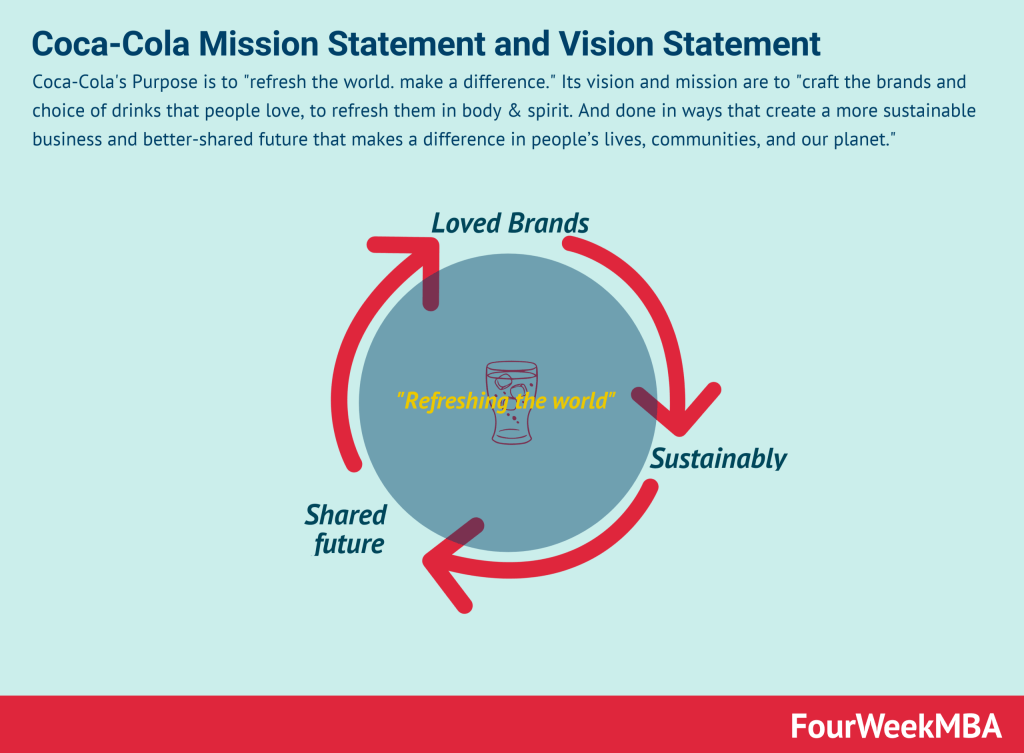
Coca-Cola’s Purpose is to “refresh the world. make a difference.” Its vision and mission are to “craft the brands and choice of drinks that people love, to refresh them in body & spirit. And done in ways that create a more sustainable business and better-shared future that makes a difference in people’s lives, communities, and our planet.”
Starbucks’ main individual shareholder is Howard Schultz, the founder of Starbucks. Major institutional shareholders comprise BlackRock, with 7.18%, and The Vanguard Group, with 8.6% ownership. Starbucks follows a heavy-chained business model, where the company-operated stores play a critical role in the company’s long-term strategy, compared to McDonald’s heavy-franchised business model, where the long-term plan is to have over 95% of the stores as franchising.
Starbucks is a retail company that sells beverages (primarily consisting of coffee-related drinks) and food. In 2023, Starbucks had 44% of company-operated stores vs. 56% of licensed stores which might make you think Starbucks is a franchise business, when in reality most of its revenue (nearly 82% in 2023) came from company-operated stores, thus making Starbucks a chain business model.
Starbucks follows a chain business model strategy, where most of its revenue comes from its owned stores. For instance, in 2023, with nearly $36 billion in revenue, most of the revenue came from owned stores ($29.46 billion) compared to franchised stores ($4.51 billion) and other revenue sources ($2 billion). Yet owned stores have higher operational costs compared to franchised stores.
Starbucks follows a chain business model, building its brand through its owned stores. And its owned stores are also where most of the revenue is generated. In addition, the owned stores are a great asset to keep experimenting with new products while maintaining tight control over the customer experience.
In 2023, Starbucks operated 19,592vs. 18,253 licensed stores. Starbucks leverages primarily company-operated stores to keep tight control over product development, branding, distribution, and customer experience. It also leverages licensed stores for better amplification of brand, revenue, and profits.
Starbucks made 60% of its revenue, in 2023, from beverages, followed by other revenue, which accounted for 22% of the total revenue (that comprises packaged and single-serve coffees and teas, plus royalty and licensing revenues, beverage-related ingredients, serve ware, and ready-to-drink beverages, among other items.) and food, which accounted for 18% of the total sales in 2023.
Starbucks’s mission is “to inspire and nurture the human spirit – one person, one cup and one neighborhood at a time.” And its vision is to “treat people like family, and they will be loyal and give their all.”
Starbucks is a multinational coffee chain headquartered in Seattle, Washington. It was founded by Jerry Baldwin, Zev Siegl, and Gordon Bowker in 1971. From a single and very humble bean roasting store in Pike Place Market, the company is now a global giant operating over 37,711 stores around the world. This large global footprint obviously increases the competition for Starbucks in many different markets. The coffee industry itself is also highly competitive, with established players including McDonald’s and Dunkin’ Donuts.
Starbucks follows a matrix organizational structure with a combination of vertical and horizontal structures. It is characterized by multiple overlapping chains of command and divisions.
McDonald’s and Starbucks sit in the opposite spectrum of retail business models. Indeed, whereas McDonald’s follows a heavily franchised business model, Starbucks follows a heavy-chained one.
Starbucks highlights its mission as “to inspire and nurture the human spirit – one person, one cup and one neighborhood at a time.” And its vision is to “treat people like family, and they will be loyal and give their all.”
Starbucks is a global consumer brand with direct distribution, recognized brands, and products that make it a viable business. Its reliance on the Americas as a primary operating segment makes it a weakness. At the same time, Starbucks faces risks related to coffee beans price volatility. Yet the company still has global expansion opportunities.
Gennaro is the creator of FourWeekMBA, which reached about four million business people, comprising C-level executives, investors, analysts, product managers, and aspiring digital entrepreneurs in 2022 alone | He is also Director of Sales for a high-tech scaleup in the AI Industry | In 2012, Gennaro earned an International MBA with emphasis on Corporate Finance and Business Strategy.