– Market Penetration is a growthstrategy employed by businesses to increase their market share by selling more of their existing products or services to their
Key Objectives
– The primary objectives of Market Penetration are to: 1. Increase Sales Volume: By selling more of the existing products or services to the current customer ba
Strategies
– Businesses can employ various strategies to achieve Market Penetration: 1. Price Adjustment: Offering discounts, promotions, or lowering prices to attract mor
Competitive Advantage
– Achieving Market Penetration can provide a competitive advantage: 1. Economies of Scale: Increased sales volume can lead to cost savings through economies of
Challenges and Risks
– Market Penetration may face challenges and risks: 1. Price Wars: Aggressive price competition with competitors may erode profitability. 2. Market Saturation:
Market Segmentation
– Market Penetration often involves considering market segmentation, where businesses tailor their strategies to specific customer segments. This approach helps
Customer Relationship
– Building and maintaining strong customer relationships are critical in Market Penetration. Customer retention programs, personalized marketing, and excellent
Data and Analytics
– Data-driven strategies are increasingly important in Market Penetration. Businesses use customer analytics to identify trends, preferences, and opportunities
Market penetration is a measure of product or service utilization by customers compared to the total market size for that product or service. However, market penetration can also be defined as the act of entering a market with a product and taking market share from competitors.
Aspect
Explanation
Concept Overview
– Market Penetration is a growth strategy employed by businesses to increase their market share by selling more of their existing products or services to their current customer base or by capturing a larger share of the current market. It is one of the four primary growth strategies outlined in the Ansoff Matrix, along with Market Development, Product Development, and Diversification. The goal is to achieve growth within existing markets and among existing customers.
Key Objectives
– The primary objectives of Market Penetration are to: 1. Increase Sales Volume: By selling more of the existing products or services to the current customer base. 2. Gain Market Share: By capturing a larger portion of the market compared to competitors. 3. Build Brand Loyalty: By strengthening relationships with existing customers and encouraging repeat purchases.
Strategies
– Businesses can employ various strategies to achieve Market Penetration: 1. Price Adjustment: Offering discounts, promotions, or lowering prices to attract more customers. 2. Marketing and Advertising: Increasing marketing efforts, advertising, and promotional campaigns to reach a wider audience. 3. Product Bundling: Offering product bundles or packages to encourage customers to buy more. 4. Improved Distribution: Expanding distribution channels to make products more accessible.
Competitive Advantage
– Achieving Market Penetration can provide a competitive advantage: 1. Economies of Scale: Increased sales volume can lead to cost savings through economies of scale. 2. Customer Base: A larger customer base can lead to increased brand loyalty and opportunities for cross-selling or upselling. 3. Market Dominance: Higher market share can enhance a company’s competitive position and influence in the industry.
Challenges and Risks
– Market Penetration may face challenges and risks: 1. Price Wars: Aggressive price competition with competitors may erode profitability. 2. Market Saturation: In mature markets, achieving further penetration can be difficult due to saturation. 3. Brand Dilution: Overreliance on price-based strategies may dilute brand value. 4. Customer Resistance: Existing customers may resist changes or perceive lower product quality due to price reductions.
Market Segmentation
– Market Penetration often involves considering market segmentation, where businesses tailor their strategies to specific customer segments. This approach helps focus efforts on the most receptive customer groups and ensures that marketing and promotional efforts resonate effectively.
Customer Relationship
– Building and maintaining strong customer relationships are critical in Market Penetration. Customer retention programs, personalized marketing, and excellent customer service contribute to retaining existing customers and encouraging repeat purchases.
Data and Analytics
– Data-driven strategies are increasingly important in Market Penetration. Businesses use customer analytics to identify trends, preferences, and opportunities for upselling or cross-selling. This data helps in developing targeted marketing and promotional campaigns.
Global Market
– Market Penetration strategies can be applied in domestic as well as international markets. Businesses seek to penetrate new regions and countries, adapting their strategies to suit local consumer preferences and market dynamics. Entering new global markets is often part of broader expansion efforts.
Sustainability
– Sustainable Market Penetration involves considering environmental and social factors. Businesses are increasingly conscious of sustainability, and strategies may include reducing waste, using eco-friendly materials, and addressing social responsibility concerns to appeal to environmentally and socially conscious consumers.
Measurement of Success
– The success of Market Penetration is measured through key performance indicators (KPIs) such as sales growth, market share increase, customer acquisition rates, and customer retention rates. Regular evaluation and adjustment of strategies are essential for achieving and sustaining market growth.
Understanding market penetration as a measure
When we talk about market penetration as a measure, we are talking about how much of a product or service is sold relative to its total estimated market.
This is expressed as a percentage such that the market penetration rate is equal to the number of customers divided by the total addressable market (TAM) multiplied by 100.
A total addressable market or TAM is the available market for a product or service. That is a metric usually leveraged by startups to understand the business potential of an industry. Typically, a large addressable market is appealing to venture capitalists willing to back startups with extensive growth potential.
Determining the size of a market can be difficult and depends on the nature of the product. What’s more, “acceptable” market penetration rates vary from one industry to the next.
SaaS companies would do well to earn 10% of the TAM, while tech leaders such as Apple have a penetration rate of around 19% in the smartphone industry.
For smaller competitors such as Oppo and Xiaomi (7%), there exist opportunities to steal market share from others.
This brings us to the next definition of market penetration.
Understanding market penetration as an activity
When we talk about market penetration as an activity, we are referencing a strategy first mentioned in the Ansoff Matrix developed by Igor Ansoff in 1957.
Unlike market development – where a company enters a new market with existing products – market penetration involves the company selling more of an existing product in an existing market to increase market share.
Market penetration is also the least risky of Ansoff’s four strategies because management is already familiar with the market, owns the necessary infrastructure, and enjoys existing relationships with suppliers, customers, and other key stakeholders.
You can use the Ansoff Matrix as a strategic framework to understand what growthstrategy is more suited based on the market context. Developed by mathematician and business manager Igor Ansoff, it assumes a growthstrategy can be derived by whether the market is new or existing, and the product is new or existing.
Some market penetration strategies
1 – Utilizing more distribution channels
Companies looking to increase market share can revamp their marketing strategies to consider the various traditional and digital channels available to them.
While it’s important to only use channels that make sense for the brand, it is worth considering whether a direct, indirect, or dual-channel approach is more effective.
Distribution represents the set of tactics, deals, and strategies that enable a company to make a product and service easily reachable and reached by its potential customers. It also serves as the bridge between product and marketing to create a controlled journey of how potential customers perceive a product before buying it.
2 – Mergers and acquisitions
Mergers and acquisitions are one of the most effective (and expensive) market penetration strategies.
Some firms prefer to retain the names of acquired brands, while others may choose to incorporate all products under a single brand.
3 – Price adjustments
For a company that wants to increase market share with an existing product, two choices immediately spring to mind: either raise product quality or adjust prices.
Note that adjusting prices does not necessarily mean lowering them. For example, a university that sells an expensive online course may offer a payment plan to appeal to students with less disposable income.
Key takeaways
Market penetration is a measure of product or service utilization by customers compared to the total market size for that product or service. However, it also describes the act of entering a market with a product and taking market share from competitors.
Unlike market development – where a company enters a new market with existing products – market penetration involves the company selling more of an existing product in an existing market to increase market share.
There are various strategies available to companies that want to increase market share with an existing product. Those with deep pockets may find mergers and acquisitions the most effective. For others, price adjustments and utilizing different marketing channels may be more realistic.
Key Highlights
Market Penetration as a Measure:
Market penetration measures the utilization of a product or service by customers in relation to the total market size.
It is expressed as a percentage, calculated by dividing the number of customers by the total addressable market (TAM) and multiplying by 100.
TAM represents the potential market size for a product or service, and it’s essential for startups and investors to understand growth potential.
Acceptable Market Penetration Rates:
Acceptable market penetration rates vary across industries.
For consumer products, the average rate ranges from 2-6%, while in business sectors, rates of 10-40% are more common.
Examples include SaaS companies aiming for 10% TAM penetration and smartphone industry leaders like Apple with around 19% penetration.
Market Penetration as a Strategy:
Market penetration as a strategy is mentioned in the Ansoff Matrix by Igor Ansoff (1957).
This strategy involves increasing market share by selling more of an existing product in an existing market.
It’s considered the least risky of Ansoff’s strategies as the company is already familiar with the market and its stakeholders.
Ansoff Matrix for Growth Strategy:
The Ansoff Matrix is a strategic framework based on whether the market and product are new or existing.
It helps determine suitable growth strategies based on the market context.
Market Penetration Strategies:
Utilizing More Distribution Channels: Companies can explore traditional and digital distribution channels to increase market share. Direct, indirect, or dual-channel approaches can be considered.
Mergers and Acquisitions: Mergers and acquisitions can effectively increase market penetration, but they can be costly. Brands may retain or consolidate product names.
Price Adjustments: Adjusting product prices or quality can help increase market share. Price adjustments don’t necessarily mean lowering prices; options like payment plans can be considered.
Key Takeaways:
Market penetration involves both measuring product usage relative to the total market and employing a strategy to increase market share.
It contrasts with market development, which involves entering new markets with existing products.
Companies can use various strategies for market penetration, such as distribution channel optimization, mergers and acquisitions, and price adjustments.
Related Frameworks
Description
When to Apply
Market Segmentation
– The process of dividing a market into distinct groups of consumers with similar needs, characteristics, or behaviors. Market Segmentation enables targeted marketing strategies and personalized offerings to different customer segments.
– When identifying and targeting specific customer segments. – Applying Market Segmentation to analyze customer needs, preferences, and behaviors, and develop tailored marketing campaigns and product offerings effectively.
Competitive Analysis
– The evaluation of competitors’ strengths, weaknesses, strategies, and market positions to inform business decisions and competitive positioning. Competitive Analysis helps identify opportunities and threats in the market landscape.
– When assessing competitive dynamics and market opportunities. – Conducting Competitive Analysis to benchmark against competitors, identify market gaps, and develop strategies to differentiate and gain competitive advantage effectively.
Product Differentiation
– The process of distinguishing a product or service from competitors’ offerings through unique features, benefits, or branding. Product Differentiation enhances perceived value and competitiveness in the market.
– When developing and positioning products or services in the market. – Employing Product Differentiation strategies to create unique value propositions, differentiate offerings, and attract customers effectively.
Brand Positioning
– The perception of a brand in the minds of consumers relative to competitors. Brand Positioning communicates the unique value, attributes, and benefits of a brand to target customers.
– When defining and communicating the unique value proposition of a brand. – Establishing Brand Positioning to differentiate the brand, resonate with target customers, and build brand loyalty and preference effectively.
Pricing Strategies
– The approaches and tactics used to set and adjust prices for products or services in the market. Pricing Strategies influence customer perceptions, demand, and profitability.
– When determining the optimal pricing strategy for products or services. – Implementing Pricing Strategies such as penetration pricing, skimming pricing, or value-based pricing to maximize market penetration, revenue, and profitability effectively.
Sales Promotion
– Marketing activities or incentives aimed at stimulating immediate sales or generating interest in a product or service. Sales Promotion tactics include discounts, coupons, contests, and limited-time offers.
– When driving short-term sales or creating urgency in the market. – Deploying Sales Promotion tactics to incentivize purchases, attract new customers, and increase market share effectively.
Distribution Channels
– The routes or pathways through which products or services are delivered from the manufacturer to the end customer. Distribution Channels impact accessibility, reach, and availability in the market.
– When expanding market reach and accessibility for products or services. – Selecting and optimizing Distribution Channels such as direct sales, retailers, wholesalers, or e-commerce platforms to penetrate new markets and increase sales effectively.
Market Expansion Strategies
– Approaches and initiatives aimed at entering new markets or expanding market share in existing markets. Market Expansion Strategies include geographic expansion, product diversification, or acquisition.
– When seeking growth opportunities and market expansion. – Formulating and executing Market Expansion Strategies to enter new markets, target new customer segments, or expand product offerings, driving market penetration and revenue growth effectively.
Customer Acquisition Tactics
– Methods and activities aimed at acquiring new customers or clients for products or services. Customer Acquisition Tactics include advertising, lead generation, direct marketing, and referrals.
– When attracting and acquiring new customers to increase market share. – Implementing Customer Acquisition Tactics to generate leads, engage prospects, and convert them into paying customers effectively.
Market Research and Insights
– The systematic gathering, analysis, and interpretation of data and information about markets, customers, and competitors. Market Research and Insights inform strategic decision-making and marketing efforts.
– When understanding market trends, customer preferences, and competitive dynamics. – Conducting Market Research and Insights to identify market opportunities, assess demand, and develop targeted marketing strategies and campaigns effectively.
A total addressable market or TAM is the available market for a product or service. That is a metric usually leveraged by startups to understand the business potential of an industry. Typically, a large addressable market is appealing to venture capitalists willing to back startups with extensive growth potential.
A microniche is a subset of potential customers within a niche. In the era of dominating digital super-platforms, identifying a microniche can kick off the strategy of digital businesses to prevent competition against large platforms. As the microniche becomes a niche, then a market, scale becomes an option.
In simple terms, market validation is the process of showing a concept to a prospective buyer and collecting feedback to determine whether it is worth persisting with. To that end, market validation requires the business to conduct multiple customer interviews before it has made a significant investment of time or money. A transitional business model is an example of market validation that helps the company secure the needed capital while having a market reality check. It helps shape the long-term vision and a scalable businessmodel.
Market orientation is an approach to business where the company focuses more on the behaviors, wants, and needs of customers in its market. A company will first target a niche market to prove a commercial use case. And from there, it will create options to scale.
In a tech-driven business world, companies can move toward market expansion by creating options to scale via niches. Thus leveraging transitional business models to scale further and take advantage of non-linear competition, where today’s niches become tomorrow’s legacy players.
Digital and tech business models can be classified according to four levels of transformation into digitally-enabled, digitally-enhanced, tech or platform business models, and business platforms/ecosystems.
A platform business model generates value by enabling interactions between people, groups, and users by leveraging network effects. Platform business models usually comprise two sides: supply and demand. Kicking off the interactions between those two sides is one of the crucial elements for a platform business model success.
Business scaling is the process of transformation of a business as the product is validated by wider and wider market segments. Business scaling is about creating traction for a product that fits a small market segment. As the product is validated it becomes critical to build a viable business model. And as the product is offered at wider and wider market segments, it’s important to align product, business model, and organizational design, to enable wider and wider scale.
Developing a successful business strategy is about finding the proper niche, where to launch an initial version of your product to create a feedback loop and improve fast while making sure not to run out of money. And from there create options to scale to adjacent niches.
A Blockchain Business Model according to the FourWeekMBA framework is made of four main components: Value Model (Core Philosophy, Core Values and Value Propositions for the key stakeholders), Blockchain Model (Protocol Rules, Network Shape and Applications Layer/Ecosystem), Distribution Model (the key channels amplifying the protocol and its communities), and the Economic Model (the dynamics/incentives through which protocol players make money). Those elements coming together can serve as the basis to build and analyze a solid Blockchain Business Model.
In an asymmetric business model, the organization doesn’t monetize the user directly, but it leverages the data users provide coupled with technology, thus have a key customer pay to sustain the core asset. For example, Google makes money by leveraging users’ data, combined with its algorithms sold to advertisers for visibility.
In a business world driven by technology and digitalization, competition is much more fluid, as innovation becomes a bottom-up approach that can come from anywhere. Thus, making it much harder to define the boundaries of existing markets. Therefore, a proper business competition analysis looks at customer, technology, distribution, and financial model overlaps. While at the same time looking at future potential intersections among industries that in the short-term seem unrelated.
Technological modeling is a discipline to provide the basis for companies to sustain innovation, thus developing incremental products. While also looking at breakthrough innovative products that can pave the way for long-term success. In a sort of Barbell Strategy, technological modeling suggests having a two-sided approach, on the one hand, to keep sustaining continuous innovation as a core part of the business model. On the other hand, it places bets on future developments that have the potential to break through and take a leap forward.
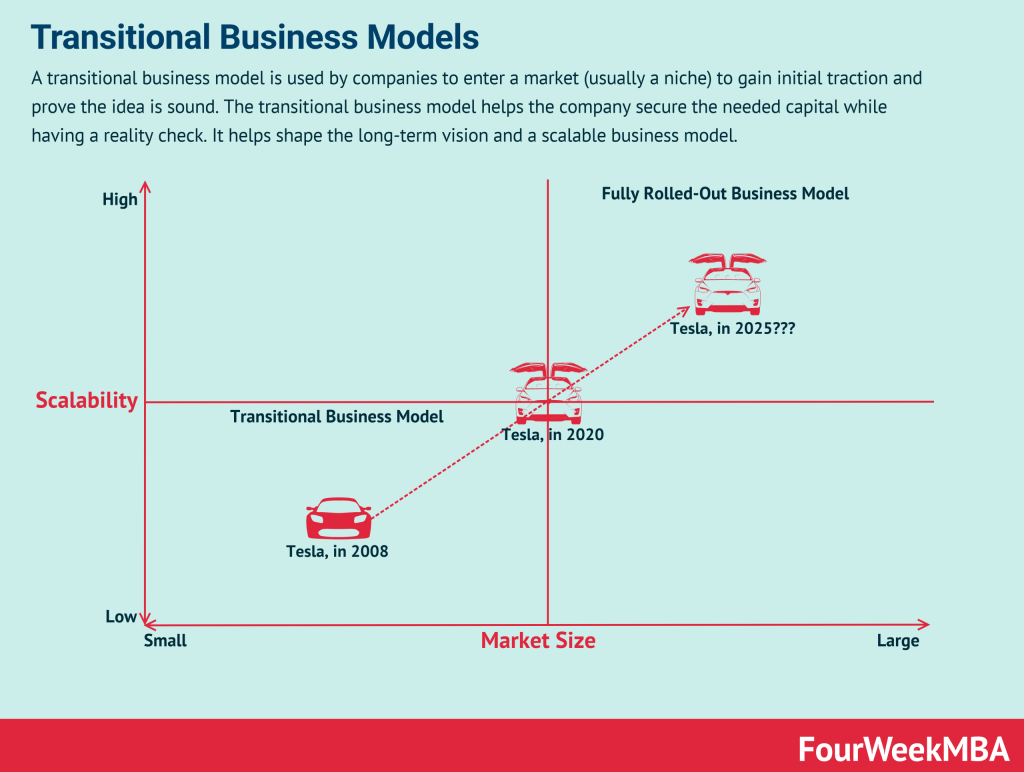
A transitional business model is used by companies to enter a market (usually a niche) to gain initial traction and prove the idea is sound. The transitional business model helps the company secure the needed capital while having a reality check. It helps shape the long-term vision and a scalable business model.
The minimum viable audience (MVA) represents the smallest possible audience that can sustain your business as you get it started from a microniche (the smallest subset of a market). The main aspect of the MVA is to zoom into existing markets to find those people which needs are unmet by existing players.
Business scaling is the process of transformation of a business as the product is validated by wider and wider market segments. Business scaling is about creating traction for a product that fits a small market segment. As the product is validated it becomes critical to build a viable business model. And as the product is offered at wider and wider market segments, it’s important to align product, business model, and organizational design, to enable wider and wider scale.
The market expansion consists in providing a product or service to a broader portion of an existing market or perhaps expanding that market. Or yet, market expansions can be about creating a whole new market. At each step, as a result, a company scales together with the market covered.
In the FourWeekMBA growth matrix, you can apply growth for existing customers by tackling the same problems (gain mode). Or by tackling existing problems, for new customers (expand mode). Or by tackling new problems for existing customers (extend mode). Or perhaps by tackling whole new problems for new customers (reinvent mode).
In the FourWeekMBA Revenue Streams Matrix, revenue streams are classified according to the kind of interactions the business has with its key customers. The first dimension is the “Frequency” of interaction with the key customer. As the second dimension, there is the “Ownership” of the interaction with the key customer.
Revenue model patterns are a way for companies to monetize their business models. A revenue model pattern is a crucial building block of a business model because it informs how the company will generate short-term financial resources to invest back into the business. Thus, the way a company makes money will also influence its overall business model.
A pricing strategy or model helps companies find the pricing formula in fit with their business models. Thus aligning the customer needs with the product type while trying to enable profitability for the company. A good pricing strategy aligns the customer with the company’s long term financial sustainability to build a solid business model.
Gennaro is the creator of FourWeekMBA, which reached about four million business people, comprising C-level executives, investors, analysts, product managers, and aspiring digital entrepreneurs in 2022 alone | He is also Director of Sales for a high-tech scaleup in the AI Industry | In 2012, Gennaro earned an International MBA with emphasis on Corporate Finance and Business Strategy.