The Fast Follower Strategy is a business approach where a company observes the innovations and successes of a pioneering competitor and quickly emulates or adop
Key Concept
The primary concept is that fast followers aim to reduce risk and uncertainty by learning from the experiences and investments of early innovators, allowing the
Timing and Agility
Successful fast followers are characterized by their agility in identifying emerging trends, quick decision-making, and swift execution to capitalize on opportu
Benefits
The strategy allows companies to leverage the lessons learned by pioneers, potentially avoid costly mistakes, and enter markets with established demand. Fast fo
Risks and Challenges
Risks include the possibility of missed opportunities if not executed quickly, competition from other fast followers, and the need to balance imitation with dif
Examples
Notable examples of the Fast Follower Strategy include companies like Samsung, which closely follows innovations by Apple, and Microsoft, which adopted the fast
Market Dynamics
The success of fast followers often depends on the pace of innovation in the industry, the degree of market saturation, and the effectiveness of their execution
Intellectual Property
Fast followers must be cautious to respect intellectual property rights, avoiding patent infringements and legal challenges. Licensing agreements or partnership
A fast follower is an organization that waits for a competitor to successfully innovate before imitating it with a similar product.
Understanding fast followers
Most people are familiar with the term “first mover advantage”, but might there also be an advantage to moving second?
In a landmark 1993 study of 500 businesses across 50 product categories, researchers from the University of Southern California found that just 53% of first movers built a successful business.
Fast followers are organizations that wait for competitors to release pioneering innovations before releasing their own products.
This strategy is particularly effective in industries where standards and technology are dynamic and evolve frequently.
The fast-follower strategy relies on a company releasing an imitation product rapidly to secure vital market share before the competition.
A failure to imitate with speed increases the likelihood of the pioneering company building an advantage or moat of some kind.
When successful, however, the fast follower can avoid the risks inherent to innovation. According to Peter Gillett, CEO of mobile lead capture platform Zuant:
“The pioneers have all the costs for R&D, the failures and the time involved. The fast follower can just cherrypick the best technology that emerges.”
Fast followers can also learn from another company’s mistakes and release a product that better satisfies consumer needs.
Fast following vs. the first mover
In a first mover scenario, a player gets at a very early stage in the development of a market, or actually, it manages to build that market from scratch.
In the business world, it is usually believed that the first to market will retain a long-term advantage due to branding recognition, economies of scale, and switching costs. However, business history shows examples of tech companies that took over markets even though they were not first-mover, but the latecomers (see Google and Facebook as reference).
In the tech industry, being a first-mover can be a great advantage.
However, we learned over time that it might be quickly lost if you can translate that first-mover advantage into a first-scaler advantage.
In short, in order to win in the long term, you got to be able to consolidate the market dominance, as otherwise, other new entrants will capitalize on the expensive lessons of the first mover.
Indeed, the most expensive and challenging part for any business is opening up and developing a new market.
You have to help shape the habits of thousands or millions of customers.
When at that stage, scale is what gives a key advantage.
Thus, it’s common, especially in tech, to see new entrants quickly dominating developing new industries, as first-movers cannot scale successfully and maintain their dominant position.
This strategy works if you can execute extremely fast on what has already proven to work from the first mover and twist it to make it scale faster.
This either happens thanks to the ability to execute faster or thanks to the ability to distribute faster.
Or from a combination of both.
Strong distribution, and fast execution, can help organizations become dominant players when entering markets dominated by other players.
How to consolidate fast following into a competitive moat
When employing a fast-following strategy is critical to, over time, transform that into a competitive moat by uniquely positioning your brand.
In other words, while following fast work, initially to gain market shares quickly.
Over time you want to innovate and be the one who leads the market forward to build a competitive moat.
Take the case of Zara, in the fashion industry, and how it started with a fast following.
Now, Zara produces great collections, which (in some areas) can be comparable to those of established fashion brands.
With over €27 billion in sales in 2021, the Spanish Fast Fashion Empire, Inditex, which comprises eight sister brands, has grown thanks to a strategy of expanding its flagship stores in exclusive locations around the globe. Its largest brand, Zara, contributed over 70% of the group’s revenue. The country that contributed the most to the fast fashion Empire sales was Spain, with over 15% of its revenues.
If you take the case today of SHEIN, the company uses a powerful combination of the fast following (through social media like TikTok); and trend-setting (using emerging influencers to launch new product lines).
SHEIN is an international B2C fast fashion eCommerce platform founded in 2008 by Chris Xu. The company improved on the ultra-fast fashion model by leveraging real-time retail, which quickly turned fashion trends in clothes’ collections through its strong digital presence and successful branding campaigns.
Fast follower examples
Let’s take a look at a few examples to solidify the fast-follower concept.
Google
Google (now Alphabet) primarily makes money through advertising. The Google search engine, while free, is monetized with paid advertising. In 2021 Google’s advertising generated over $209 billion (beyond Google Search, this comprises YouTube Ads and the Network Members Sites) compared to $257 billion in net sales. Advertising represented over 81% of net sales, followed by Google Cloud ($19 billion) and Google’s other revenue streams (Google Play, Pixel phones, and YouTube Premium).
Google’s PPC search engine is the undisputed leader in its industry, and many assume that the company came up with the concept.
However, the pay-per-click advertising model was actually developed by Goto.com (Overture) in 2001.
History will show that Overture failed for multiple reasons. One of the more relevant was that it failed to scale the business by marketing the platform to end users.
Overture instead used its own PPC model to advertise on websites such as Yahoo and AOL, which meant that much of its advertising revenue was paid to partners.
Google was able to improve on this innovation by subsidizing non-commercial keywords with advertising associated with commercial search terms.
This enabled Google to supplement its paid ad revenue via supplementation and become the dominant force.
Apple
Apple’s made over $365.8 billion in revenues in 2021, of which over $191.9 billion or over 52% of its total revenues came from the iPhone. Yet, the iPhone isn’t just a hardware product; it’s a business platform that combines hardware (iPhone), operating system (iOS), and a marketplace (the App Store). Thus, the company still makes most of its money around a single product which powers up an entrepreneurial ecosystem.
Apple has been a fast follower on several occasions. The iPod was not the first music player. The iMac was not the first personal computer.
The iPhone was certainly not the first smartphone.
In each case, the company waited until a rival identified a real consumer need, entered the market, and defined the product category.
It then observed the market to identify product weaknesses and set about developing a solution that addressed those weaknesses.
When these products were paired with Apple’s brand equity and effective marketing team, the company was able to attain a dominant market share.
In most cases, Apple added useful ecosystem features to its products instead of superficial, low-value improvements.
BlackBerry and the iPhone
Let’s consider the Blackberry, a revolutionary product in its own right which was successful for a few short years.
While the Blackberry was a mainstay of the corporate world, Steve Jobs envisioned that the biggest smartphone market would be ordinary consumers and he designed the first iPhone accordingly.
The Blackberry featured a clunky plastic keyboard and a non-ergonomic design that could not be carried in one’s pocket comfortably.
Their popularity among corporate executives also made them uncool with younger consumers and the device was tied to a single network that was subject to security concerns.
When Jobs made an impassioned speech on January 9, 2007, he shared Apple’s vision for three new products: a widescreen iPod with a touch screen, a breakthrough in internet communication, and a revolutionary mobile phone.
He then stunned an enraptured crowd by exclaiming “Are you getting it yet? These are not three separate devices. This is one device. And we’re calling it the iPhone.”
Taking a less than subtle swipe at BlackBerry, Jobs later noted that:
“The most advanced phones are called ‘smartphones’… so they say. They combine a phone and some email capability… and all have these little plastic keyboards on them. The problem is that they’re not so smart and they’re not that easy to use.”
Case Studies
Samsung (Fast Follower in Electronics):
Samsung is a renowned example of a company that excels at fast-following in the electronics industry. They often observe innovations by competitors like Apple and release their own similar products with improvements. For instance, Samsung’s Galaxy series of smartphones, which closely followed the iPhone’s success, became a significant competitor in the smartphone market.
Microsoft (Fast Follower in Software):
Microsoft has a history of fast-following in the software industry. For instance, while they weren’t the pioneers in web search, they developed Bing to compete with Google. Microsoft also entered the gaming console market with the Xbox, challenging Sony’s PlayStation.
Facebook (Fast Follower in Social Media):
Facebook, now Meta Platforms, has employed the fast-follower strategy in the realm of social media. After the success of platforms like Friendster and MySpace, Facebook entered the scene and rapidly became the dominant social media platform.
Toyota (Fast Follower in Automobiles):
Toyota is known for adopting the fast-follower approach in the automobile industry. They observed innovations by American automakers and then developed their own vehicles, like the Toyota Prius hybrid, which gained immense popularity and market share.
Samsung (Fast Follower in Consumer Electronics):
Samsung is also a notable fast follower in the consumer electronics industry. They’ve released various consumer electronics products, such as smart TVs and tablets, following the success of similar innovations by competitors like Apple and Sony.
Instagram (Fast Follower in Social Media):
Instagram is an example of a company that successfully followed the trend of photo-sharing social media apps. It entered the market after the likes of Flickr and Picasa and quickly gained a large user base, eventually being acquired by Facebook.
Netflix (Fast Follower in Streaming):
Netflix originally started as a DVD rental service but quickly adapted to the changing media landscape by becoming a fast follower in the streaming industry. They observed the potential of streaming and transitioned into a dominant player in online streaming entertainment.
Airbnb (Fast Follower in Accommodations):
Airbnb is another fast follower example. It recognized the sharing economy trend, where individuals could rent their homes to travelers. Airbnb successfully entered this market and disrupted the traditional hotel industry.
Microsoft Azure (Fast Follower in Cloud Computing):
Microsoft Azure is a testament to the fast-follower strategy in cloud computing. While Amazon Web Services (AWS) was a pioneer in the cloud space, Microsoft Azure entered later but managed to become a major player by quickly expanding its offerings and customer base.
Alibaba (Fast Follower in E-commerce):
Alibaba, often compared to Amazon, followed a similar fast-follower strategy in the e-commerce industry. It recognized the potential of e-commerce in China and rapidly expanded its services, including online marketplaces and digital payment solution
Key takeaways:
A fast follower is an organization that waits for a competitor to successfully innovate before imitating it with a similar product.
The fast follower strategy relies on a company releasing an imitation product in rapid time to secure vital market share before the competition. When successful, the fast follower can avoid the financial and reputational risks inherent to innovation.
Examples of fast followers include Google, who improved Overture’s PPC advertising model, and Apple, who can attribute the success of many of their most famous products to the strategy.
Key Highlights of the Fast Follower Strategy:
Fast Follower Definition: A fast follower is a company that observes a competitor’s successful innovation and quickly imitates it by releasing a similar product.
Alternative Advantage: While the “first mover advantage” is well-known, being a fast follower also offers advantages, especially in dynamic industries with evolving standards and technology.
Research Findings: A 1993 study of 500 businesses across 50 product categories found that 53% of first movers were successful, while fast followers entering the market within 13 years of the first mover’s entry were successful in 92% of cases.
Effective in Dynamic Industries: The fast follower strategy works well in industries where technological standards frequently change, allowing the follower to refine the innovation and avoid pitfalls faced by the first mover.
Rapid Market Entry: Fast followers release imitation products swiftly to capture significant market share before competitors can establish a dominant position.
Risk Mitigation: The fast follower strategy minimizes risks associated with innovation, as the follower can learn from the pioneering company’s mistakes and release a better product.
Reducing R&D Costs: Fast followers avoid the costs and time associated with R&D and innovation, capitalizing on proven technologies.
Branding and Scale: While pioneers invest in R&D, the fast follower can focus on execution and scaling, which are key components of long-term success.
Maintaining Dominance: Pioneers might lose their first-mover advantage if they fail to consolidate their position into a scalable, dominant market presence.
Consolidating Market Position: A fast follower strategy should eventually transform into a competitive moat by innovating and leading the market to secure long-term success.
Zara and SHEIN: Examples from the fashion industry, like Zara’s evolution from fast following to creating competitive collections, showcase how this strategy can be employed.
Google’s PPC Model: Google improved on the pay-per-click advertising model developed by Overture, leading to the dominance of Google’s PPC search engine.
Apple’s Success: Apple is a prime example of a company that employed fast following strategies successfully, waiting for rivals to identify consumer needs before entering and dominating the market.
iPhone’s Impact: Apple’s iPhone disrupted the smartphone industry by identifying consumer needs and weaknesses in competitors’ products, leading to a revolutionary product.
BlackBerry and iPhone: The BlackBerry was successful in corporate circles but had limitations that the iPhone addressed, showcasing the effectiveness of the fast follower strategy.
Strategic Imitation: Successful fast followers combine rapid imitation with strategic enhancements, leveraging branding, marketing, and ecosystem features.
Balancing Innovation and Execution: The fast follower strategy requires quick execution of proven innovations while balancing innovation for long-term market dominance.
Dynamic Industries: The fast follower strategy is particularly beneficial in industries where technology evolves rapidly, allowing followers to refine and scale innovations.
Aspect
Explanation
Fast Follower Strategy
The Fast Follower Strategy is a business approach where a company observes the innovations and successes of a pioneering competitor and quickly emulates or adopts similar strategies and products to capitalize on the market without being the first mover.
Key Concept
The primary concept is that fast followers aim to reduce risk and uncertainty by learning from the experiences and investments of early innovators, allowing them to make more informed decisions and potentially enter markets with less initial investment.
Timing and Agility
Successful fast followers are characterized by their agility in identifying emerging trends, quick decision-making, and swift execution to capitalize on opportunities before the market matures.
Benefits
The strategy allows companies to leverage the lessons learned by pioneers, potentially avoid costly mistakes, and enter markets with established demand. Fast followers may also benefit from improvements on the original innovation.
Risks and Challenges
Risks include the possibility of missed opportunities if not executed quickly, competition from other fast followers, and the need to balance imitation with differentiation to stand out in the market.
Examples
Notable examples of the Fast Follower Strategy include companies like Samsung, which closely follows innovations by Apple, and Microsoft, which adopted the fast follower approach in the cloud computing market.
Market Dynamics
The success of fast followers often depends on the pace of innovation in the industry, the degree of market saturation, and the effectiveness of their execution in catching up to or surpassing the pioneering competitor.
Intellectual Property
Fast followers must be cautious to respect intellectual property rights, avoiding patent infringements and legal challenges. Licensing agreements or partnerships may be options for accessing proprietary technology.
Balancing Act
A key challenge is striking a balance between imitation and innovation. Fast followers must identify areas where they can add value or differentiate from the pioneer’s offering to attract customers and gain a competitive edge.
Customer Considerations
Customers benefit from fast followers by having multiple choices, potentially lower prices, and access to improved versions of products or services. However, they should also evaluate whether the fast follower offers comparable quality and value.
A Blockchain Business Model according to the FourWeekMBA framework is made of four main components: Value Model (Core Philosophy, Core Values and Value Propositions for the key stakeholders), Blockchain Model (Protocol Rules, Network Shape and Applications Layer/Ecosystem), Distribution Model (the key channels amplifying the protocol and its communities), and the Economic Model (the dynamics/incentives through which protocol players make money). Those elements coming together can serve as the basis to build and analyze a solid Blockchain Business Model.
In a business world driven by technology and digitalization, competition is much more fluid, as innovation becomes a bottom-up approach that can come from anywhere. Thus, making it much harder to define the boundaries of existing markets. Therefore, a proper business competition analysis looks at customer, technology, distribution, and financial model overlaps. While at the same time looking at future potential intersections among industries that in the short-term seem unrelated.
Technological modeling is a discipline to provide the basis for companies to sustain innovation, thus developing incremental products. While also looking at breakthrough innovative products that can pave the way for long-term success. In a sort of Barbell Strategy, technological modeling suggests having a two-sided approach, on the one hand, to keep sustaining continuous innovation as a core part of the business model. On the other hand, it places bets on future developments that have the potential to break through and take a leap forward.
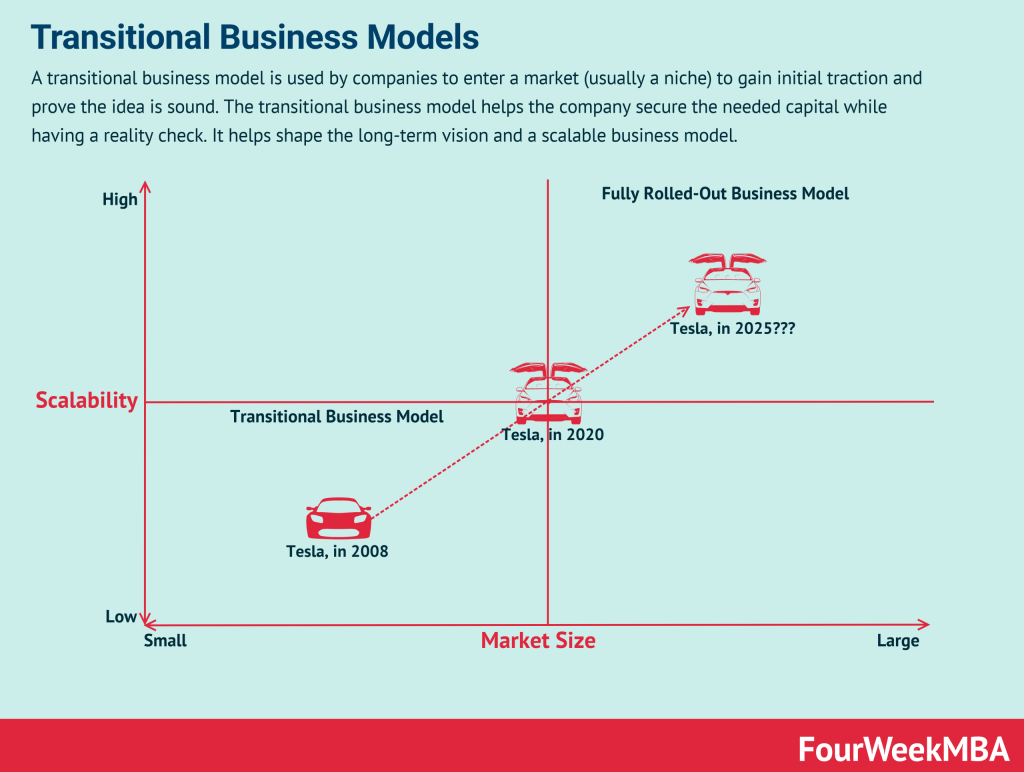
A transitional business model is used by companies to enter a market (usually a niche) to gain initial traction and prove the idea is sound. The transitional business model helps the company secure the needed capital while having a reality check. It helps shape the long-term vision and a scalable business model.
The minimum viable audience (MVA) represents the smallest possible audience that can sustain your business as you get it started from a microniche (the smallest subset of a market). The main aspect of the MVA is to zoom into existing markets to find those people which needs are unmet by existing players.
Business scaling is the process of transformation of a business as the product is validated by wider and wider market segments. Business scaling is about creating traction for a product that fits a small market segment. As the product is validated it becomes critical to build a viable business model. And as the product is offered at wider and wider market segments, it’s important to align product, business model, and organizational design, to enable wider and wider scale.
The market expansion consists in providing a product or service to a broader portion of an existing market or perhaps expanding that market. Or yet, market expansions can be about creating a whole new market. At each step, as a result, a company scales together with the market covered.
In the FourWeekMBA growth matrix, you can apply growth for existing customers by tackling the same problems (gain mode). Or by tackling existing problems, for new customers (expand mode). Or by tackling new problems for existing customers (extend mode). Or perhaps by tackling whole new problems for new customers (reinvent mode).
In the FourWeekMBA Revenue Streams Matrix, revenue streams are classified according to the kind of interactions the business has with its key customers. The first dimension is the “Frequency” of interaction with the key customer. As the second dimension, there is the “Ownership” of the interaction with the key customer.
Revenue model patterns are a way for companies to monetize their business models. A revenue model pattern is a crucial building block of a business model because it informs how the company will generate short-term financial resources to invest back into the business. Thus, the way a company makes money will also influence its overall business model.
Gennaro is the creator of FourWeekMBA, which reached about four million business people, comprising C-level executives, investors, analysts, product managers, and aspiring digital entrepreneurs in 2022 alone | He is also Director of Sales for a high-tech scaleup in the AI Industry | In 2012, Gennaro earned an International MBA with emphasis on Corporate Finance and Business Strategy.