Reality Labs (primarily sales of Oculus, now called Meta Quest)
$1.89B
Other revenue (payments and fees)
$1.06B
FourWeekMBA Intelligence Analysis
For most of its life, Facebook relied on advertising revenues to power up its businessmodel.
In the last couple of years, though, the company has been trying to pivot toward the Metaverse.
In October 2021, Facebook rebranded to Meta, showing its interest in developing the Metaverse infrastructure.
Why did it do that?
Multiple reasons. However, let’s see the three main ones:
Business modelthreat given by Apple’s privacy changes: in the last couple of years, Apple has been intensifying its privacy policies on the App Store. The latest move was the new opt-in mechanism for users to enable third-party tracking. This dismantled the whole Facebook advertising machine. This forced Facebook to move much more quickly toward its vision for the Metaverse.
Lack of vertical integration: Unlike Apple or Google, Facebook lacks vertical integration. Indeed, Facebook’s advertising machine primarily relied on third-party tracking over Apple and Android devices to fuel its businessmodel. This has made Facebook prone to attacks from these companies that control the mobile pipelines, which is where most of Facebook’s business relies on. Indeed, today most of Meta’s revenues come from mobile and Instagram. And a simple change in policy by Apple threatened the whole business model of Facebook.
New entrants: the social media space, which has been dominated by Facebook and Instagram in the last decade, suddenly has seen the rise of new entrants in the previous few years. Among these, TikTok is the one that successfully gained traction and reached over a billion users! This created further pressure on Facebook to move quickly in a new direction, where it could develop a new business ecosystem that it controls to sell its ads.
2021 vs. 2020
N. of ads delivered growth rate
10%
Price per ad increase
24%
Geography
US & Canada
51,541
43.71%
Europe (includes Russia, Turkey)
29,057
24.64%
Asia-Pacific
26,739
22.67%
Rest of the World (includes Africa, Latin America, and the Middle East)
10,592
8.98%
Total
117,929
Key Facts
Founders
Mark Zuckerberg, Andrew McCollum, Dustin Moskovitz, Eduardo Saverin, Chris Hughes
Year Founded
February 2004, Cambridge, MA
Year of IPO
May 18, 2012
IPO Price
$38.00
Market Cap at IPO
$104 Billion
Total Revenues at IPO
$3.7 Billion by 2011, prior to the IPO
Total Revenues in 2021
$117.9 Billion
Changed name
Meta, in October 2021
Employees
71,970 employees, globally, as of December 31, 2021
Revenues per Employee
$1,642,693.97
Who owns Meta?
Mark Zuckerberg is the primary individual shareholder, with 81.7% of Class B shares, and 52.9% of the total voting power
Founded in February 2004, in Cambridge, MA, by Mark Zuckerberg, Andrew McCollum, Dustin Moskovitz, Eduardo Saverin, and Chris Hughes, Facebook IPOed on May 18, 2012, at a price of $38 per share, and a market cap of $104 billion and total revenues for $3.7 billion in 2011, prior to the IPO. In 2021, Facebook generated over $117 billion in revenues, and it changed its name in October 2021, to Meta. With 71,970 employees, Meta generated $1,642,694 per employee. Mark Zuckerberg is the primary individual shareholder, with 81.7% of Class B shares, and 52.9% of the total voting power
Mark Zuckerberg is the largest shareholder in the company. Zuckerberg retains ownership and control of the company. Like Google, Facebook has issued two common stocks, Class A and Class B. The holders of Class B common stocks are entitled to ten votes per share, and holders of our Class A common stocks are entitled to one vote per share. Mark Zuckerberg has a voting power of 61.1%; he’s the primary decision-maker. Other individual investors comprise Sheryl Sandberg, Christopher Cox, Marc Andreessen, Peter Thiel, Dustin Moskovitz, and Eduardo Saverin.
Facebook, the main product of Meta is an attention merchant. As such, its algorithms condense the attention of over 2.91 billion monthly active users as of June 2021. Meta generated $117.9 billion in revenues, in 2021, of which $114.9 billion from advertising (97.4% of the total revenues) and over $2.2 billion from Reality Labs (the augmented and virtual reality products arm).
Facebook generated most of its revenue from advertising in 2023. Indeed, the company generated $131.95B from advertising, $1.89B billion from its reality labs segment, and over a billion in other revenue.
By September 2022, Facebook’s (Meta) employee count had peaked at 87,314. Yet, as revenue slew down for the first time in years, the company announced a layoff of 13% of its workforce, bringing the headcount to 75,964. By March 2023, Meta announced another round of layoffs, dubbed “The Year of Efficiency,” which brought the headcount down to less than 66 thousand employees. By the end of 2023, Facebook reported 67,317 employees.
In 2022, post layoffs, Facebook generated $1,535,056 per employee, compared to $1,638,586 in 2021. In 2023, as Facebook (now Meta) completed its mass layoffs, the company reported nearly $135 billion in revenue and 67,317 employees, with a $2,003,981 revenue per employee.
Facebook (Meta) gained users in 2023. In fact, in 2023, Facebook had over three billion users worldwide, of which 272 million were in Canada, 408 million were in Europe, over 1.3 billion were in Asia, and over a billion were in the rest of the world.
ARPU, or average revenue per user, is a crucial metric for attention merchants like Facebook. It assesses the ability of the platform to monetize its users. For instance, by the end of 2023, Meta’s ARPU worldwide was $13.12. In the US & Canada, it was $68.44; in Europe, it was $23.14; in Asia-Pacific, $5.52; and in the rest of the world, it was $4.50.
ARPU, or average revenue per user, is a crucial metric for attention merchants like Facebook. It assesses the ability of the platform to monetize its users. For instance, by the end of 2023, Meta’s ARPU worldwide was $13.12. In the US & Canada, it was $68.44; in Europe, it was $23.14; in Asia-Pacific, $5.52; and in the rest of the world, it was $4.50.
Facebook (Meta) revenue in 2023 increased to $134.9B, compared to $116.6B in 2022. Its profitability increased to $39.1B in 2023, compared to $23.2B in 2022 and $39.37B in 2021.
Facebook is characterized by a multi-faceted matrix organizational structure. The company utilizes a flat organizational structure in combination with corporate function-based teams and product-based or geographic divisions. The flat organization structure is organized around the leadership of Mark Zuckerberg, and the key executives around him. On the other hand, the function-based teams based on the main corporate functions (like HR, productmanagement, investor relations, and so on).
Instagram makes money via visual advertising. Acquired by Facebook for a billion-dollar in 2012, today, Instagram is integrated into the overall Facebook (now rebranded as Meta) business strategy. In 2018, Instagram founders Kevin Systrom and Mike Krieger left the company as Facebook pushed toward tighter integration of the two platforms. In 2022, Instagram is the most successful product still, in Meta’s portfolio.
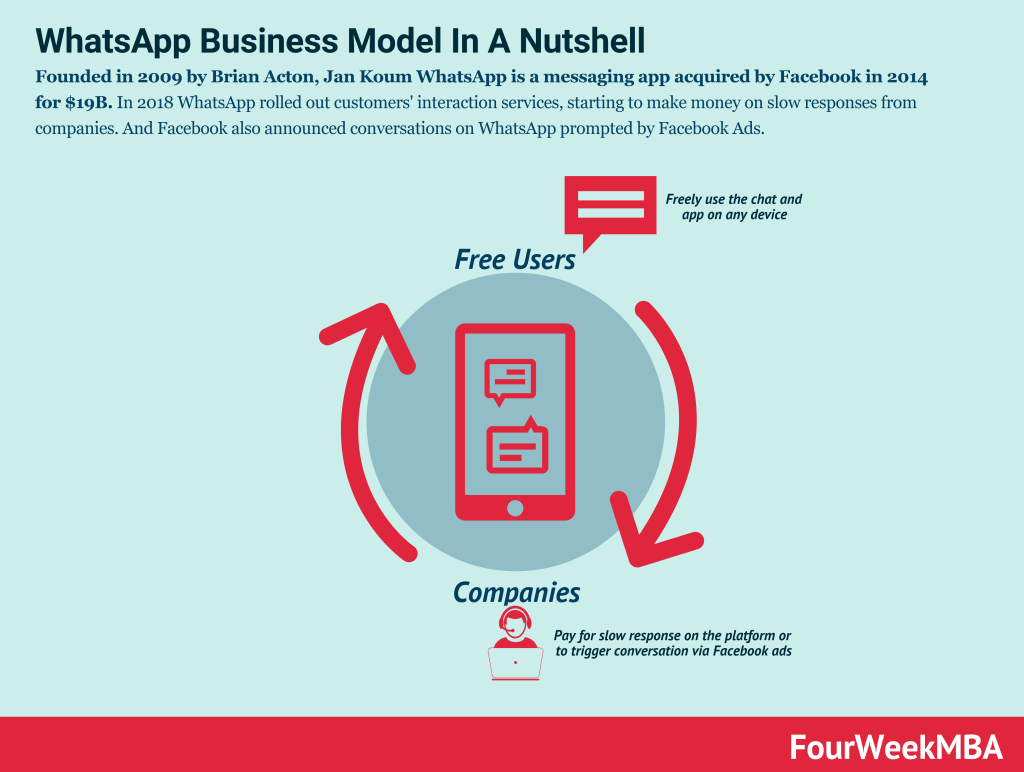
Founded in 2009 by Brian Acton, Jan Koum WhatsApp is a messaging app acquired by Facebook in 2014 for $19B. In 2018 WhatsApp rolled out customers’ interaction services, starting to make money on slow responses from companies. And Facebook also announced conversations on WhatsApp prompted by Facebook Ads.
Gennaro is the creator of FourWeekMBA, which reached about four million business people, comprising C-level executives, investors, analysts, product managers, and aspiring digital entrepreneurs in 2022 alone | He is also Director of Sales for a high-tech scaleup in the AI Industry | In 2012, Gennaro earned an International MBA with emphasis on Corporate Finance and Business Strategy.