Bottom-up market sizing is a market research methodology that involves estimating market potential by analyzing individual customer segments, geographic regions, or product categories and aggregating the data to derive a comprehensive market estimate. This approach contrasts with top-down market sizing, which relies on industry averages or macroeconomic indicators to extrapolate market size.
Related Frameworks, Models, or Concepts
Description
When to Apply
Total Addressable Market (TAM)
Total Addressable Market (TAM) represents the entire potential market demand for a product or service, assuming ideal market conditions and no competition. While TAM provides a broad estimate of market opportunity, Serviceable Addressable Market (SAM) refines this by considering factors such as geographical constraints, customer segments, and market maturity.
Use TAM analysis to understand the overall market size and potential demand for a product or service. Apply it during market research and strategic planning to assess the scalability and revenue potential of a business opportunity.
Serviceable Obtainable Market (SOM)
Serviceable Obtainable Market (SOM) represents the portion of the addressable market that a company can realistically serve and capture within a specific timeframe or under current market conditions. While SOM focuses on the market segments that a company can effectively reach and serve, SAM provides a broader view by considering the total addressable market within the company’s reach.
Utilize SOM analysis to assess the company’s current market penetration and competitive positioning. Apply it to set realistic targets and allocate resources effectively to capture market share and drive business growth.
Bottom-Up Market Sizing
Bottom-Up Market Sizing involves estimating market demand based on specific customer segments, product offerings, and pricing strategies. It contrasts with Top-Down Market Sizing, which extrapolates market size from macroeconomic data or industry averages. Serviceable Addressable Market (SAM) analysis often incorporates Bottom-Up approaches to provide granular insights into market segmentation and customer preferences.
Apply Bottom-Up Market Sizing to analyze customer demographics, behavior, and preferences. Use it to tailor marketing strategies, product features, and pricing models to specific market segments and optimize market penetration and revenue generation.
Market Segmentation
Market Segmentation involves dividing the market into distinct groups of customers with similar needs, characteristics, or behaviors. Serviceable Addressable Market (SAM) analysis leverages market segmentation to identify target customer segments and tailor products, messaging, and distribution channels to meet their specific needs and preferences.
Utilize Market Segmentation to identify high-potential customer segments and prioritize resources and efforts to address their needs effectively. Apply it to develop targeted marketing campaigns, product features, and customer experiences that resonate with specific market segments and drive demand and loyalty.
Geographical Expansion Strategies
Geographical Expansion Strategies involve entering new markets or expanding operations into different regions or countries. Serviceable Addressable Market (SAM) analysis helps companies assess market potential, competitive dynamics, and regulatory considerations when expanding geographically.
Use Geographical Expansion Strategies to identify and prioritize target markets with significant growth opportunities and favorable business environments. Apply it to develop market entry strategies, distribution networks, and localized marketing efforts to penetrate new markets and increase market share and revenue.
Market Penetration Tactics
Market Penetration Tactics involve strategies to increase market share within existing markets or customer segments. Serviceable Addressable Market (SAM) analysis informs market penetration tactics by identifying untapped opportunities, competitive threats, and barriers to entry or expansion.
Utilize Market Penetration Tactics such as pricing strategies, promotional campaigns, and product differentiation to gain a competitive edge and capture a larger share of the serviceable addressable market. Apply it to address customer needs, overcome resistance, and build brand loyalty to drive sustainable growth and profitability.
Competitive Analysis
Competitive Analysis involves assessing competitors’ strengths, weaknesses, strategies, and market positions to inform strategic decision-making. Serviceable Addressable Market (SAM) analysis incorporates competitive analysis to understand the competitive landscape, identify market gaps, and differentiate offerings effectively.
Conduct Competitive Analysis to benchmark against competitors, identify market trends, and capitalize on competitive advantages. Apply it to refine value propositions, positioning strategies, and go-to-market plans to outperform competitors and capture market share within the serviceable addressable market.
Customer Acquisition Cost (CAC)
Customer Acquisition Cost (CAC) represents the cost incurred by a company to acquire a new customer. Serviceable Addressable Market (SAM) analysis considers CAC alongside customer lifetime value (CLV) to evaluate the scalability and profitability of customer acquisition strategies.
Calculate Customer Acquisition Cost (CAC) to assess the efficiency and effectiveness of marketing and sales initiatives in reaching and converting target customers. Apply it to optimize marketing channels, customer acquisition tactics, and resource allocation to maximize returns and expand market share within the serviceable addressable market.
Regulatory Compliance and Market Entry Barriers
Regulatory Compliance and Market Entry Barriers refer to legal, regulatory, or operational hurdles that companies must navigate when entering or operating within a market. Serviceable Addressable Market (SAM) analysis evaluates regulatory compliance requirements, market entry barriers, and competitive risks to assess market viability and expansion opportunities.
Identify Regulatory Compliance and Market Entry Barriers to assess market attractiveness, assess risks, and develop mitigation strategies. Apply it to navigate regulatory complexities, establish compliance frameworks, and mitigate legal or operational risks when expanding into new markets or segments within the serviceable addressable market.
Bottom-up market sizing begins with customer segmentation, where businesses categorize their target market into distinct groups based on demographic, psychographic, or behavioral characteristics. By understanding the unique needs and preferences of each segment, businesses can tailor their market sizing efforts and marketing strategies accordingly.
Data Collection and Analysis
Businesses collect and analyze data from various sources, including internal sales data, market research reports, customer surveys, and industry databases. By gathering granular data on customer demographics, purchasing behavior, competitive landscape, and market trends, businesses can identify growth opportunities and assess market demand.
Sales Projections and Forecasts
Using historical sales data and market trends, businesses develop sales projections and forecasts for each customer segment or geographic region. By extrapolating future sales based on past performance, market dynamics, and growth drivers, businesses can estimate market size and growth potential with greater accuracy.
Market Penetration Analysis
Bottom-up market sizing includes a market penetration analysis, where businesses assess their current market share and identify opportunities for growth. By comparing their sales performance to industry benchmarks and competitors’ market share, businesses can identify areas for improvement and strategic expansion.
Scenario Planning and Sensitivity Analysis
To account for uncertainties and variations in market conditions, businesses conduct scenario planning and sensitivity analysis. By simulating different market scenarios and assessing their potential impact on market size and growth, businesses can develop robust and adaptable market sizing models to inform strategic decision-making.
Strategies for Conducting Bottom-Up Market Sizing
Define Target Market Segments
Identify and define target market segments based on demographic, psychographic, or behavioral criteria. Segmenting the market allows businesses to focus their market sizing efforts and resources on specific customer groups with distinct needs and preferences.
Collect Comprehensive Data
Gather comprehensive data from multiple sources, including internal sales data, customer surveys, industry reports, and market research studies. Collecting data from diverse sources ensures a holistic understanding of market dynamics and customer behavior.
Utilize Data Analytics Tools
Use data analytics tools and software to analyze and visualize market data effectively. Data analytics tools enable businesses to identify patterns, trends, and correlations in large datasets, facilitating informed decision-making and strategic planning.
Validate Assumptions and Projections
Validate assumptions and sales projections through market research, customer feedback, and expert interviews. By soliciting input from stakeholders and industry experts, businesses can ensure the accuracy and reliability of their market sizing estimates.
Iterate and Refine Models
Iterate and refine market sizing models based on feedback, new data, and changing market conditions. Continuous improvement and refinement of market sizing models ensure that businesses stay aligned with evolving customer needs and market trends.
Benefits of Bottom-Up Market Sizing
Granular Insights
Bottom-up market sizing provides granular insights into market dynamics, customer behavior, and competitive landscape. By analyzing individual customer segments or geographic regions, businesses gain a deeper understanding of market opportunities and challenges.
Accurate Forecasts
Bottom-up market sizing results in more accurate market forecasts compared to top-down approaches. By leveraging detailed data and sales projections, businesses can develop precise estimates of market size, growth potential, and revenue opportunities.
Targeted Strategies
Bottom-up market sizing enables businesses to develop targeted marketing strategies and sales initiatives tailored to specific customer segments or geographic markets. By aligning their efforts with market needs and preferences, businesses can maximize their impact and return on investment.
Resource Optimization
By accurately assessing market demand and growth potential, businesses can optimize resource allocation and investment decisions. Bottom-up market sizing helps businesses prioritize opportunities with the highest revenue potential and strategic value, minimizing risk and maximizing returns.
Challenges of Bottom-Up Market Sizing
Data Availability and Quality
Bottom-up market sizing relies on the availability and quality of data from multiple sources. Limited access to data or data inaccuracies can compromise the accuracy and reliability of market sizing estimates, leading to suboptimal decision-making.
Complexity and Time Requirements
Bottom-up market sizing can be complex and time-consuming, requiring extensive data collection, analysis, and validation efforts. Businesses must invest resources and expertise in developing robust market sizing models that capture the nuances of customer behavior and market dynamics.
Assumptions and Uncertainties
Market sizing estimates are inherently based on assumptions and uncertainties about future market conditions and competitive dynamics. Businesses must acknowledge and mitigate these uncertainties through scenario planning and sensitivity analysis to ensure the robustness of their market sizing models.
Competitive Landscape Changes
Market dynamics and competitive landscape changes may affect the accuracy of bottom-up market sizing estimates over time. Businesses must continuously monitor market trends, competitor activities, and customer preferences to adjust their market sizing models and strategies accordingly.
Implications of Bottom-Up Market Sizing
Strategic Planning and Decision-Making
Bottom-up market sizing informs strategic planning and decision-making by providing actionable insights into market opportunities and growth potential. Businesses can use market sizing estimates to allocate resources, set performance targets, and prioritize initiatives aligned with their growth objectives.
Product Development and Innovation
Bottom-up market sizing guides product development and innovation efforts by identifying unmet customer needs and emerging market trends. By understanding market demand and preferences, businesses can develop products and services that address customer pain points and capitalize on market opportunities.
Market Entry and Expansion
Bottom-up market sizing facilitates market entry and expansion strategies by identifying target customer segments and geographic markets with the highest growth potential. Businesses can use market sizing estimates to prioritize market entry opportunities, allocate sales and marketing resources, and develop market penetration strategies.
Competitive Differentiation
Bottom-up market sizing enables businesses to differentiate themselves from competitors by targeting underserved or niche market segments. By focusing on specific customer needs and preferences, businesses can carve out a unique value proposition and establish a competitive advantage in the marketplace.
Conclusion
Bottom-up market sizing is a data-driven approach used by businesses to estimate market potential by aggregating data from individual customer segments or geographic regions.
Key components of bottom-up market sizing include customer segmentation, data collection and analysis, sales projections and forecasts, market penetration analysis, and scenario planning and sensitivity analysis.
Strategies for conducting bottom-up market sizing include defining target market segments, collecting comprehensive data, utilizing data analytics tools, validating assumptions and projections, and iterating and refining models.
Bottom-up market sizing offers benefits such as granular insights, accurate forecasts, targeted strategies, and resource optimization, but businesses may encounter challenges such as data availability and quality, complexity and time requirements, assumptions and uncertainties, and changes in the competitive landscape.
Implementing bottom-up market sizing has implications for strategic planning and decision-making, product development and innovation, market entry and expansion, and competitive differentiation, shaping businesses’ market entry and growth strategies in dynamic and competitive markets.
A total addressable market or TAM is the available market for a product or service. That is a metric usually leveraged by startups to understand the business potential of an industry. Typically, a large addressable market is appealing to venture capitalists willing to back startups with extensive growth potential.
A microniche is a subset of potential customers within a niche. In the era of dominating digital super-platforms, identifying a microniche can kick off the strategy of digital businesses to prevent competition against large platforms. As the microniche becomes a niche, then a market, scale becomes an option.
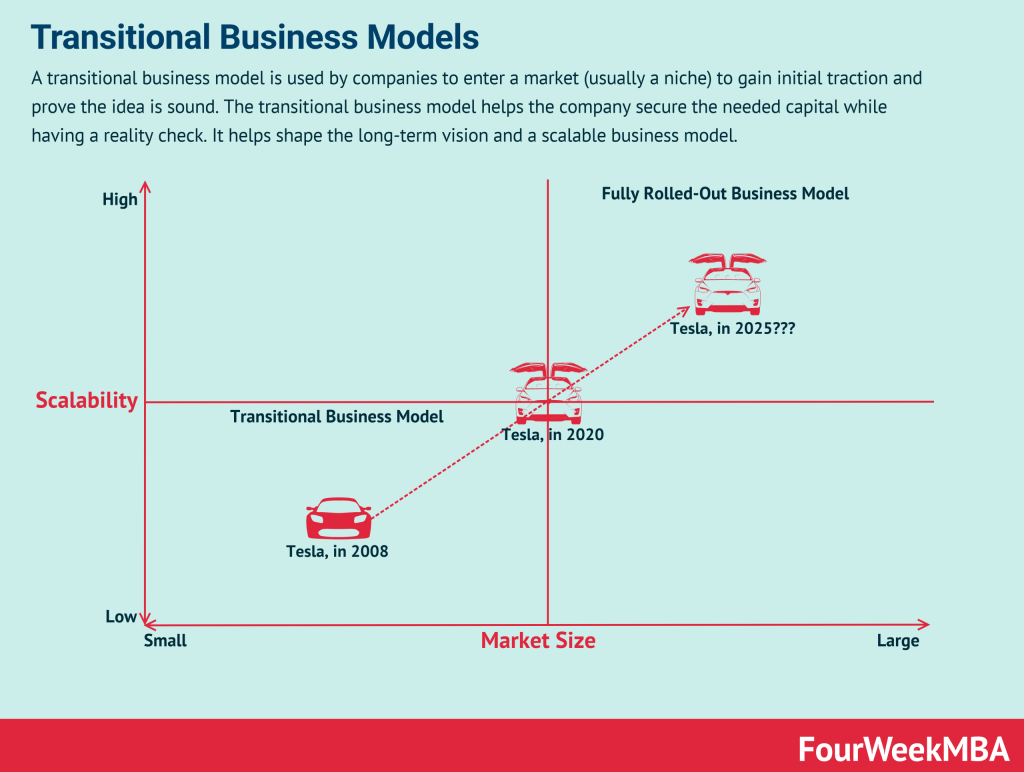
In simple terms, market validation is the process of showing a concept to a prospective buyer and collecting feedback to determine whether it is worth persisting with. To that end, market validation requires the business to conduct multiple customer interviews before it has made a significant investment of time or money. A transitional business model is an example of market validation that helps the company secure the needed capital while having a market reality check. It helps shape the long-term vision and a scalable business model.
Market orientation is an approach to business where the company focuses more on the behaviors, wants, and needs of customers in its market. A company will first target a niche market to prove a commercial use case. And from there, it will create options to scale.
In a tech-driven business world, companies can move toward market expansion by creating options to scale via niches. Thus leveraging transitional business models to scale further and take advantage of non-linear competition, where today’s niches become tomorrow’s legacy players.
Digital and tech business models can be classified according to four levels of transformation into digitally-enabled, digitally-enhanced, tech or platform business models, and business platforms/ecosystems.
A platform business model generates value by enabling interactions between people, groups, and users by leveraging network effects. Platform business models usually comprise two sides: supply and demand. Kicking off the interactions between those two sides is one of the crucial elements for a platform business model success.
Business scaling is the process of transformation of a business as the product is validated by wider and wider market segments. Business scaling is about creating traction for a product that fits a small market segment. As the product is validated it becomes critical to build a viable business model. And as the product is offered at wider and wider market segments, it’s important to align product, business model, and organizational design, to enable wider and wider scale.
Developing a successful business strategy is about finding the proper niche, where to launch an initial version of your product to create a feedback loop and improve fast while making sure not to run out of money. And from there create options to scale to adjacent niches.
A Blockchain Business Model according to the FourWeekMBA framework is made of four main components: Value Model (Core Philosophy, Core Values and Value Propositions for the key stakeholders), Blockchain Model (Protocol Rules, Network Shape and Applications Layer/Ecosystem), Distribution Model (the key channels amplifying the protocol and its communities), and the Economic Model (the dynamics/incentives through which protocol players make money). Those elements coming together can serve as the basis to build and analyze a solid Blockchain Business Model.
In an asymmetric business model, the organization doesn’t monetize the user directly, but it leverages the data users provide coupled with technology, thus have a key customer pay to sustain the core asset. For example, Google makes money by leveraging users’ data, combined with its algorithms sold to advertisers for visibility.
In a business world driven by technology and digitalization, competition is much more fluid, as innovation becomes a bottom-up approach that can come from anywhere. Thus, making it much harder to define the boundaries of existing markets. Therefore, a proper business competition analysis looks at customer, technology, distribution, and financial model overlaps. While at the same time looking at future potential intersections among industries that in the short-term seem unrelated.
Technological modeling is a discipline to provide the basis for companies to sustain innovation, thus developing incremental products. While also looking at breakthrough innovative products that can pave the way for long-term success. In a sort of Barbell Strategy, technological modeling suggests having a two-sided approach, on the one hand, to keep sustaining continuous innovation as a core part of the business model. On the other hand, it places bets on future developments that have the potential to break through and take a leap forward.
A transitional business model is used by companies to enter a market (usually a niche) to gain initial traction and prove the idea is sound. The transitional business model helps the company secure the needed capital while having a reality check. It helps shape the long-term vision and a scalable business model.
The minimum viable audience (MVA) represents the smallest possible audience that can sustain your business as you get it started from a microniche (the smallest subset of a market). The main aspect of the MVA is to zoom into existing markets to find those people which needs are unmet by existing players.
Business scaling is the process of transformation of a business as the product is validated by wider and wider market segments. Business scaling is about creating traction for a product that fits a small market segment. As the product is validated it becomes critical to build a viable business model. And as the product is offered at wider and wider market segments, it’s important to align product, business model, and organizational design, to enable wider and wider scale.
The market expansion consists in providing a product or service to a broader portion of an existing market or perhaps expanding that market. Or yet, market expansions can be about creating a whole new market. At each step, as a result, a company scales together with the market covered.
In the FourWeekMBA growth matrix, you can apply growth for existing customers by tackling the same problems (gain mode). Or by tackling existing problems, for new customers (expand mode). Or by tackling new problems for existing customers (extend mode). Or perhaps by tackling whole new problems for new customers (reinvent mode).
In the FourWeekMBA Revenue Streams Matrix, revenue streams are classified according to the kind of interactions the business has with its key customers. The first dimension is the “Frequency” of interaction with the key customer. As the second dimension, there is the “Ownership” of the interaction with the key customer.
Revenue model patterns are a way for companies to monetize their business models. A revenue model pattern is a crucial building block of a business model because it informs how the company will generate short-term financial resources to invest back into the business. Thus, the way a company makes money will also influence its overall business model.
A pricing strategy or model helps companies find the pricing formula in fit with their business models. Thus aligning the customer needs with the product type while trying to enable profitability for the company. A good pricing strategy aligns the customer with the company’s long term financial sustainability to build a solid business model.
Gennaro is the creator of FourWeekMBA, which reached about four million business people, comprising C-level executives, investors, analysts, product managers, and aspiring digital entrepreneurs in 2022 alone | He is also Director of Sales for a high-tech scaleup in the AI Industry | In 2012, Gennaro earned an International MBA with emphasis on Corporate Finance and Business Strategy.