Vitamin Water is owned by Coca-Cola, which finalized its acquisition in 2007. It bought Glacéau (the holding company of Vitamin Water, called Energy Brands, doing business as Glacéau) for $4.2 billion in cash. Today Vitamin Water is a subsidiary of the Coca-Cola Company, which owns many brands. Coca-Cola generated $45.7 billion in revenue in 2023 and $10.7 billion in profits.
Detail
Description
Brand
Vitamin Water
Ownership Structure
Wholly owned subsidiary
Parent Company
The Coca-Cola Company
Acquisition Date
May 2007
Founding Date
1996
Founders
J. Darius Bikoff
Headquarters
Whitestone, New York, USA
Primary Business
Producing and marketing enhanced water beverages
Strategic Goals
Expanding market share in the beverage industry, innovating product offerings with new flavors and health benefits, targeting health-conscious consumers
Corporate Structure and Ownership: Vitamin Water is a wholly owned subsidiary of The Coca-Cola Company. Coca-Cola acquired Vitamin Water, along with other brands under the Glaceau umbrella (including Smartwater and Fruitwater), for $4.1 billion in May 2007. This acquisition allowed Coca-Cola to enter the fast-growing market of enhanced water beverages, diversifying its product portfolio beyond traditional carbonated drinks.
History and Brand Development: Vitamin Water was founded in 1996 by J. Darius Bikoff in New York City. The brand quickly gained popularity due to its innovative concept of flavored water enhanced with vitamins and minerals, appealing to health-conscious consumers seeking alternatives to sugary sodas. Bikoff’s initial inspiration came from a combination of wanting a healthier beverage option and observing trends in consumer preferences towards functional beverages.
Corporate Strategy and Market Positioning: Vitamin Water’s business model revolves around offering a variety of flavored waters with added vitamins and minerals, targeting consumers interested in health and wellness. The brand positions itself as a lifestyle product that combines hydration with functional benefits, such as vitamins C and B, electrolytes, and antioxidants. Vitamin Water’s marketingstrategy emphasizes its health benefits, vibrant flavors, and trendy packaging, appealing to a young, active demographic.
Product Innovation and Flavors: Vitamin Water is known for its diverse range of flavors and functional formulations. The brand continuously innovates by introducing new flavors and limited-edition offerings to keep consumers engaged and expand its market reach. Some popular flavors include XXX (Acai-Blueberry-Pomegranate), Focus (Kiwi-Strawberry), and Revive (Fruit Punch). The brand also offers sugar-free options under its Vitamin Water Zero line, catering to those seeking low-calorie alternatives.
Market Expansion and Distribution: Since its acquisition by Coca-Cola, Vitamin Water has benefited from Coca-Cola’s extensive distributionnetwork, which has enabled the brand to expand its presence globally. The brand is available in supermarkets, convenience stores, gyms, and vending machines worldwide, reaching a broad audience. Coca-Cola’s resources have also allowed Vitamin Water to explore new markets and adapt its offerings to suit regional preferences.
Advertising and Branding: Vitamin Water’s advertising campaigns often feature celebrities and athletes, aligning the brand with an active and healthy lifestyle. Notable endorsements have included personalities like 50 Cent, who was not only a spokesperson but also had a stake in the company before its acquisition by Coca-Cola. Vitamin Water’s brandingstrategy focuses on colorful packaging, witty labels, and engaging marketing content that resonates with its target audience.
Competitive Landscape: Vitamin Water competes in the enhanced water and functional beverage category, facing competition from brands like PepsiCo’s Propel, PepsiCo’s LIFEWTR, and independent brands like Hint and Bai. The brand differentiates itself through its extensive flavor variety and association with Coca-Cola’s reputation and resources. Vitamin Water’s ability to innovate and adapt to consumer trends helps it maintain a competitive edge in the beverage market.
Aspect
Description
Analysis
Examples
Products and Services
Vitamin Water is a brand of flavored and enhanced water beverages that contain added vitamins and electrolytes. They offer a variety of flavors and formulations, each with specific health benefits.
Vitamin Water focuses on providing a functional and flavored hydration option, targeting health-conscious consumers.
Vitamin Water’s “XXX” with antioxidants, “Revive” with electrolytes and vitamins.
Revenue Streams
Vitamin Water generates revenue primarily through the sale of its beverages. This includes sales through various distribution channels, including retail stores, vending machines, and e-commerce.
Sales of flavored and enhanced water are the core revenue source. Distribution through multiple channels enhances accessibility.
Sales through retail stores, vending machines, online sales.
Customer Segments
Vitamin Water targets health-conscious consumers, athletes, fitness enthusiasts, and individuals looking for a tasty and functional hydration option. They cater to individuals of various age groups.
A diverse customer base allows Vitamin Water to address different health and lifestyle needs, expanding market reach.
Health-conscious individuals, athletes, fitness enthusiasts, people seeking vitamin-enriched beverages.
Distribution Channels
Vitamin Water distributes its products through a network of retail stores, convenience stores, vending machines, gyms, and online e-commerce platforms.
A combination of physical stores, convenience locations, and online platforms ensures wide accessibility and convenience for customers.
Vitamin Water collaborates with fitness influencers, athletes, and health experts for marketing campaigns and product endorsements. They also partner with retailers and distributors for widespread product availability.
Collaborations with influencers and athletes enhance brand credibility and reach a health-conscious audience. Retail partnerships increase product visibility.
Partnerships with fitness influencers for marketing campaigns, distribution agreements with major retailers.
Key Resources
Vitamin Water’s key resources include its product formulations, marketing and branding, supply chain, and a loyal customer base.
Unique product formulations and branding are essential for product differentiation. An efficient supply chain ensures product availability. A loyal customer base contributes to brand loyalty.
Vitamin Water incurs costs in product development, marketing and advertising, production, distribution, employee salaries, and packaging materials.
Investment in product development and marketing is essential for staying competitive. Production and distribution costs are significant due to the beverage industry’s scale.
Developing new formulations, advertising campaigns, production of beverage bottles.
Competitive Advantage
Vitamin Water’s competitive advantage lies in its focus on functional hydration, the addition of vitamins and electrolytes, and its appeal to health-conscious consumers. Unique flavors and collaborations also set it apart in the beverage market.
Offering both hydration and functional benefits sets Vitamin Water apart from regular water and sugary drinks. Collaborations and flavor variety enhance brand recognition.
Functional hydration beverages with added vitamins and electrolytes, collaborations with athletes like LeBron James.
Value Proposition
Vitamin Water offers a flavorful and functional hydration solution with added vitamins and electrolytes, allowing customers to quench their thirst while meeting specific health and wellness goals.
Vitamin Water’s value proposition centers on providing a tasty and health-conscious hydration option that helps customers stay refreshed and meet their nutritional needs.
Staying hydrated with Vitamin Water “Defense” for added vitamins, and “Energy” for an energy boost.
Background and Ownership of Vitamin Water:
Founding and Growth
Vitamin Water is a brand of flavored water that was developed and launched by Energy Brands Inc., doing business as Glacéau.
The company was founded in 1996 by J. Darius Bikoff, and its product, Vitamin Water, quickly gained popularity for its enhanced water formulations and unique flavors.
Acquisition by Coca-Cola
In 2007, Coca-Cola recognized the growing demand for enhanced water beverages and saw an opportunity to expand its product portfolio.
As a result, Coca-Cola finalized its acquisition of Glacéau, the holding company of Vitamin Water, for a substantial sum of $4.2 billion in cash.
Integration into Coca-Cola’s Portfolio
Following the acquisition, Vitamin Water became a subsidiary of the Coca-Cola Company.
The brand’s unique position in the flavored water market allowed Coca-Cola to diversify its offerings and tap into the growing consumer interest in healthier and functional beverages.
Current Status
Today, Vitamin Water continues to be part of the Coca-Cola Company’s extensive portfolio of brands.
The Coca-Cola Company is one of the world’s largest beverage companies, with a wide range of products that includes carbonated soft drinks, juices, teas, and waters.
Revenue and Scale
In 2022, the Coca-Cola Company generated a substantial $43 billion in revenue, reflecting its strong market presence and global reach.
With the addition of Vitamin Water, the Coca-Cola Company has further strengthened its position in the non-carbonated beverage segment.
Vitamin Water’s Unique Selling Proposition
Vitamin Water distinguishes itself by offering a variety of flavored waters infused with vitamins and electrolytes.
The brand’s appeal lies in its ability to provide a more flavorful and nutritious alternative to plain water, catering to health-conscious consumers seeking hydration with added benefits.
Brand Synergy
As part of Coca-Cola’s beverage portfolio, Vitamin Water benefits from the company’s extensive distributionnetwork and marketing capabilities.
This allows the brand to reach a wide range of consumers and continue its growth trajectory within the non-carbonated beverage segment.
Continued Innovation
In a competitive beverage market, Vitamin Water continues to innovate by introducing new flavors and formulations to meet evolving consumer preferences.
The brand’s commitment to offering a diverse range of options helps it stay relevant and appealing to a broad audience.
Key Highlights: Vitamin Water and its Role within The Coca-Cola Company
Origins:
Vitamin Water was introduced by Energy Brands Inc., operating under the name Glacéau.
Founded in 1996 by J. Darius Bikoff, Vitamin Water rapidly carved a niche for itself in the market with its enhanced water formulations.
Coca-Cola’s Acquisition:
In 2007, The Coca-Cola Company acquired Glacéau, the parent company of Vitamin Water, for $4.2 billion in cash.
This move was strategic, enabling Coca-Cola to diversify its product range, targeting health-conscious consumers.
Position within Coca-Cola:
After the acquisition, Vitamin Water became an integral part of Coca-Cola’s diverse beverage portfolio.
Being under Coca-Cola’s umbrella offers Vitamin Water extensive distribution and significant marketing advantages.
Financial Overview:
In 2022, The Coca-Cola Company reported a massive revenue of $43 billion.
Brands like Vitamin Water contribute to this figure, emphasizing the company’s dominance in the beverage sector.
Unique Product Offerings:
Vitamin Water stands out in the beverage market with its flavored waters enriched with vitamins and electrolytes.
Catering to a health-conscious demographic, it offers a tasteful and nutritious hydration alternative.
Benefits of Being with Coca-Cola:
Being a subsidiary of The Coca-Cola Company, Vitamin Water leverages the company’s expansive distribution channels and marketing prowess.
This association allows Vitamin Water to reach global markets effectively.
Innovative Approach:
To stay competitive, Vitamin Water continually introduces new flavors and formulations.
Their dedication to evolving with consumer tastes ensures the brand remains attractive to a diverse consumer base.
Conclusion:
Vitamin Water’s acquisition by The Coca-Cola Company illustrates the latter’s commitment to diversifying its product range and catering to emerging consumer preferences. With its unique product offerings and the backing of a beverage giant, Vitamin Water continues to thrive in the global market.
Coca-Cola follows a business strategy (implemented since 2006) where through its operating arm – the Bottling Investment Group – it invests initially in bottling partners operations. As they take off, Coca-Cola divests its equity stakes, and it establishes a franchising model, as long-term growth and distributionstrategy.
Coca-Cola’s top investors include Warren Buffet’s company, Berkshire Hathaway, with 9.25% of shares, and other mutual funds like The Vanguard Group, holding 8.51% of shares, and BlackRock owning over 7.19% of shares of the company. Other individual investors like Herbert A. Allen, director of The Coca-Cola Company since 1982, and Barry Diller, Chairman of the Coca-Cola board since 2002. And former CEO Muhtar Kent.
Coca-Cola generated $45.75 billion in revenue in 2023, compared to over $43 billion in revenue in 2022, and $10.7 billion in profits in 2023, compared to over $9.5 billion in net profits in 2022.
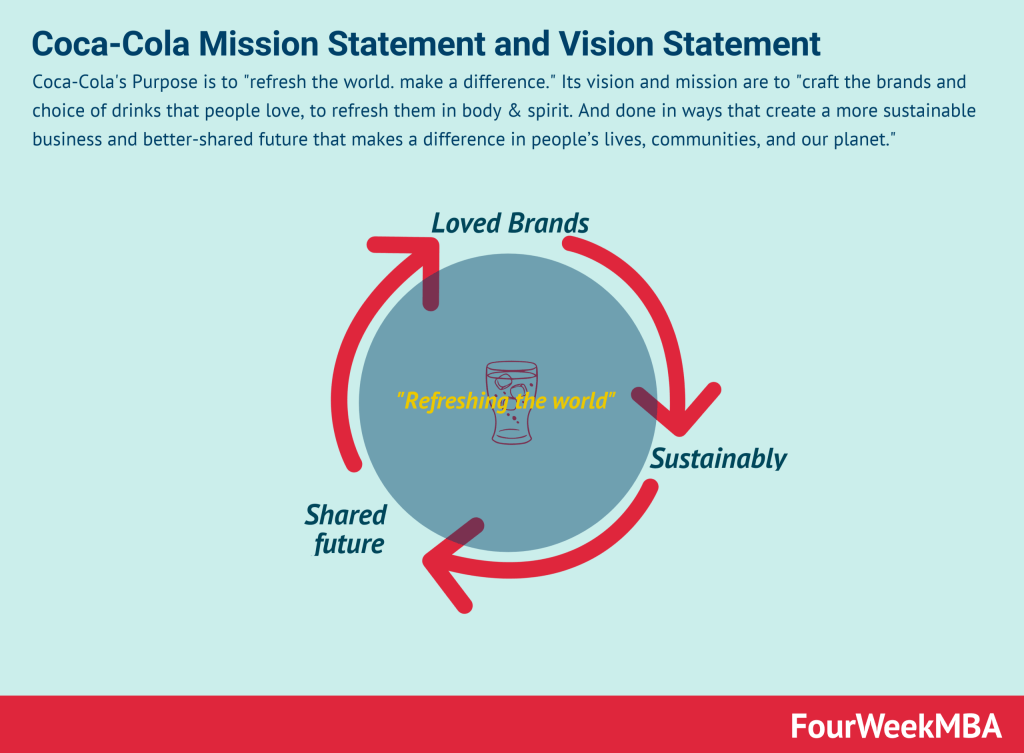
Coca-Cola’s Purpose is to “refresh the world. make a difference.” Its vision and mission are to “craft the brands and choice of drinks that people love, to refresh them in body & spirit. And done in ways that create a more sustainable business and better-shared future that makes a difference in people’s lives, communities, and our planet.”
Coca-Cola is the market leader of the soft drink industry. It is also the most widely recognized brand, with a Business Insider study revealing that a staggering 94% of the world population recognizes the red and white logo. However, Coca-Cola faces significant challenges with increasingly health-conscious consumers and less access to water resources.
The Coca-Cola Company is an American multinational beverage corporation founded in 1892 by pharmacist Asa Griggs Candler. Many consumers associate the company with its signature soda in a red can or bottle. In truth, however, The Coca-Cola Company owns a plethora of soft drink, juice, tea, coffee, and other beverage brands.
The Coca-Cola Company has 21 different billion-dollar brands or brands that generate more than $1 billion or more in revenue each year. The company also sells its products in nearly every country in the world, with Cuba and North Korea the only two countries where it is not sold officially. What’s more, the Coca-Cola brand is worth $87.6 billion, making it one of the most valuable among all companies. Though these figures allow Coca-Cola to enjoy market dominance in many countries, the company is nevertheless subject to intense competition.
Pepsi is owned by PepsiCo, the holding company which owns many brands spanning from drinks to food & snacks and more. PepsiCo generated $91.47 billion in revenue in 2023, and $9.07 billion in profits for the same period. PepsiCo is primarily owned by institutional investors like The Vanguard Group (8.9%) and BlackRock (7.6%). Top individual investors comprise Robert Pohlad, the company’s board member; and the company’s CEO, Ramon Laguarta.
PepsiCo was founded in 1902 by American pharmacist and businessman Caleb Bradham as the Pepsi-Cola Company. Bradham, who hoped to emulate the success of Coca-Cola, marketed the beverage from his pharmacy and registered a patent for its recipe the following year. Today, Pepsi is a global company with a portfolio of 23 billion-dollar brands, or brands earning more than $1 billion in annual revenue. Sixteen of these brands are beverage-related, while the remaining seven are associated with snacks and other food products.
In 1965, PepsiCo acquired Frito-Lay in what the chairmen of both companies called a “marriage made in heaven”. The resultant company transformed PepsiCo from a soft drink organization and set it on a path to becoming one of the world’s leading food and beverage companies. Today, PepsiCo claims to operate in more than 200 countries and territories around the world with seven distinct divisions and many successful brands.
PepsiCo generated $91.47 billion in revenue in 2023, over $86 billion in revenue in 2022, over $79 billion in revenue in 2021, and over $70 billion in 2020.
PepsiCo generated $9.07 billion in profits in 2023, compared to nearly $9 billion in profits in 2022, over $7.6 billion in profits in 2021 and over $7 billion in 2020.
Gennaro is the creator of FourWeekMBA, which reached about four million business people, comprising C-level executives, investors, analysts, product managers, and aspiring digital entrepreneurs in 2022 alone | He is also Director of Sales for a high-tech scaleup in the AI Industry | In 2012, Gennaro earned an International MBA with emphasis on Corporate Finance and Business Strategy.