When you wreck off the walls between branding and distribution, there is no more trade-off between marketing and sales.
What do I mean? In Q2, Spotify generated €2.86 billion in revenues.
Of which over €2.5 billion from premium subscriptions.
And only €360 million from the ad-supported version.
Not only that.
The ad-supported version only generated $4 million in gross profits!
While the premium subscriptions generated €700 million in gross profits.
But if the ad-supported version only generated €360 million (or 12.5% of the revenues for the quarter) and it only made €4 million of gross profits (less than 1% of gross profits for the quarter!!), why bother?
That’s the thing.
The ad-supported version generates revenues only as a side effect.
In short, the ad-supported version is not about making profits. If at all the fact that it covers the costs is great.
Instead, that is one of the most effective self-serving funnels (branding + distribution).
Let me explain. The ad-supported version serves so far 252 million monthly active users.
Compared to the paid version, which serves 182 million monthly active users.
Not only the ad-supported version makes the platform accessible to way more people than the paid platform could ever serve (branding).
Most of the paid members have been free members first.
As Shopify explained in the past, more than 60% of the premium members were upgraded from the free, ad-supported plan.
Through prompts and additional features, Spotify knows that one in two free users will convert into premium members over time.
And showing ads is a great way to provide a linear value proposition to users (“you switch to paid and get no ads”).
That is what it means to build a funnel that amplifies your product (branding) while building your customer base (distribution/sales).
Building self-serving funnels are not easy.
But when you master them, as Spotify has, it’s a goldmine.
Key highlights of Spotify’s self-serving funnel and business model:
Spotify generated €2.86 billion in revenues in Q2, with over €2.5 billion from premium subscriptions and only €360 million from the ad-supported version.
The ad-supported version only generated €4 million in gross profits, while the premium subscriptions generated €700 million in gross profits.
The ad-supported version serves 252 million monthly active users, compared to the paid version serving 182 million monthly active users.
The ad-supported version acts as a powerful self-serving funnel, serving as both branding and distribution.
The ad-supported version makes the platform accessible to a larger audience and acts as a branding tool.
Many paid members were initially free users, with over 60% of premium members upgrading from the free, ad-supported plan.
Spotify uses prompts and additional features to encourage free users to convert into premium subscribers over time.
Showing ads provides a linear value proposition to users, incentivizing them to switch to the paid version and enjoy an ad-free experience.
Spotify’s self-serving funnel and business model have proven to be a successful barbell strategy, simultaneously growing the brand and customer base.
Case Studies
Company: Amazon
Aspect
Amazon
Overview
Multinational e-commerce and tech giant with a focus on online retail, cloud computing, digital streaming, and artificial intelligence.
Business Model
Diverse business model encompassing e-commerce, Amazon Web Services (AWS), Amazon Prime, Amazon Marketplace, and Amazon devices.
Key Features
Extensive product selection, fast and reliable delivery, AWS cloud services, Amazon Prime subscription with benefits, third-party seller marketplace.
Revenue Streams
Online retail sales, AWS cloud services, Prime subscriptions, advertising, third-party seller fees, device sales, and content streaming.
Data Utilization
Leverages customer data for personalized recommendations, targeted advertising, supply chain optimization, and enhancing user experience.
Market Expansion Strategies
Global expansion through acquisitions (e.g., Whole Foods), marketplace growth, and continuous innovation in services and technology.
Key Success Metrics
Gross merchandise sales, AWS revenue, Prime membership growth, customer satisfaction, and market share in various sectors.
Company: Apple
Aspect
Apple
Overview
Renowned tech company known for hardware products (iPhone, Mac), software (iOS, macOS), services (Apple Music, App Store), and wearables.
Business Model
Integrates hardware, software, and services to create a cohesive ecosystem, driving customer loyalty and cross-product usage.
Key Features
User-friendly devices, App Store with third-party apps, iCloud storage, Apple Music, premium hardware quality, and privacy-focused approach.
Revenue Streams
iPhone and device sales, App Store purchases, Apple Music subscriptions, iCloud storage, AppleCare, and services like Apple Pay.
Data Utilization
Focuses on privacy and encryption while using user data to improve services, user experience, and Siri’s AI capabilities.
Market Expansion Strategies
Product diversification, expanding into wearables (Apple Watch), services like Apple TV+, and international market penetration.
Key Success Metrics
iPhone sales, customer loyalty, App Store revenue, services growth, ecosystem engagement, and brand reputation.
Company: Netflix
Aspect
Netflix
Overview
Leading subscription-based streaming service offering a vast library of TV shows, movies, and original content globally.
Business Model
Subscription-based model with tiered pricing, focusing on original content production, licensing, and personalized recommendations.
Key Features
Extensive content library, personalized user profiles, original content (Netflix Originals), ad-free streaming, and global availability.
Revenue Streams
Monthly subscription fees, revenue from licensing content to other platforms, and international expansion.
Data Utilization
Utilizes user data for content recommendations, production decisions, and content customization based on regional preferences.
Market Expansion Strategies
Global expansion by producing region-specific content, investment in original content, and adapting to local content regulations.
Key Success Metrics
Subscriber growth, content quality, user retention, international market penetration, and revenue from content licensing.
Company: Facebook
Aspect
Facebook
Overview
Social media and tech conglomerate offering platforms like Facebook, Instagram, WhatsApp, Oculus VR, and advertising services.
Business Model
Advertising-driven business model, providing social networking services, messaging, and virtual reality products.
Key Features
Social networking, photo sharing (Instagram), messaging (WhatsApp), virtual reality (Oculus), targeted advertising, and user engagement.
Revenue Streams
Advertising revenue from businesses, sponsored content, and potential future monetization of messaging services like WhatsApp.
Data Utilization
Utilizes user data for personalized ad targeting, content curation, improving user experience, and measuring advertising effectiveness.
Market Expansion Strategies
Acquisitions (Instagram, WhatsApp, Oculus), expansion into virtual reality, and exploring monetization options for messaging services.
Key Success Metrics
Monthly active users, advertising revenue, user engagement, virtual reality adoption, and successful acquisitions’ integration.
Company: Uber
Aspect
Uber
Overview
Transportation network company offering ride-hailing, food delivery (Uber Eats), and other mobility services globally.
Business Model
On-demand service model connecting drivers and riders, expanding into food delivery, and exploring autonomous vehicles.
Key Features
Ride-hailing app, cashless payments, driver-partner network, food delivery service (Uber Eats), and expansion into electric bikes and scooters.
Revenue Streams
Commission from drivers’ fares, Uber Eats fees, surge pricing, advertising, and potential future earnings from autonomous vehicle services.
Data Utilization
Utilizes data for dynamic pricing, route optimization, driver-rider matching, and enhancing the overall user experience.
Market Expansion Strategies
Global market expansion, diversification into delivery services (Uber Eats), and investment in autonomous vehicle technology.
Key Success Metrics
Gross bookings, active drivers and riders, Uber Eats growth, expansion into new markets, and autonomous vehicle development progress.
The multi-billion music streaming company Spotify is primarily owned by its founders, Daniel Ek and Martin Lorentzon. As of 2023, Daniel Ek has 15.3% ownership of ordinary shares and 30.5% of the voting power. Martin Lorentzon has 10.9% of ordinary shares and 42.7% of the voting power. Another key shareholder is Baillie Gifford & Co, a Scottish-based money management firm (12% ownership ), followed by Tencent (8.4% ownership).
Spotify is a two-sided marketplace, running a free ad-supported service and a paid membership. Founded in 2008 with the belief that music should be universally accessible, it generated €13.25 billion in 2023. Of these revenues, 87.3%, or €11.56 billion, came from premium memberships, while over 12.6%, or €1.68 billion, came from ad-supported members. By 2023, Spotify had over 600 million users, of which 236 million were premium members and 379 million weread-supported users.
Spotify Audience Network is the underlying advertising infrastructure that supports its ad-supported user base. The Spotify Audience Network was born as the result of the acquisitions of Anchor and Megaphone. By 2023, Spotify had 379 million ad-supported users.
Spotify licensing deals affect its businessmodel. The company runs on both a free service, which is ad-supported and a subscription premium service. They have different economics.
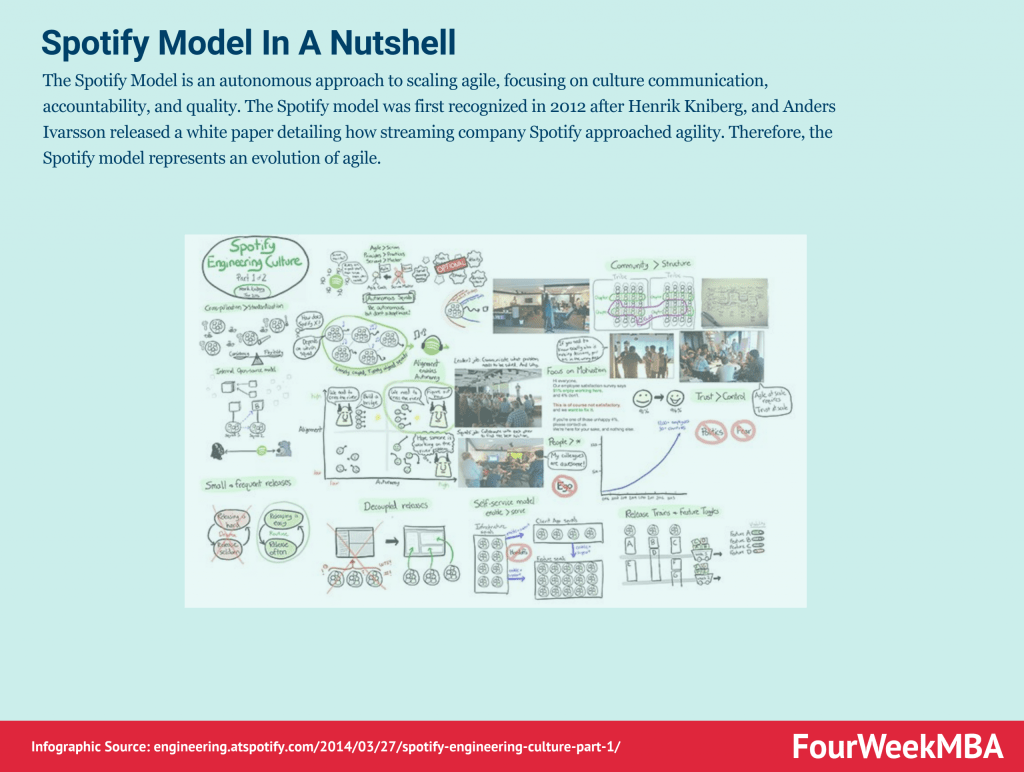
The ad-supported business had a 10% gross margin in 2021, compared to 29% of the subscription-based business. That’s because the more the content gets streamed on the platform, the more that increases royalty costs for Spotify. That is also why the company invested in developing its content. Thus, in part transitioning from platform to brand.The Spotify Model is an autonomous approach to scaling agile, focusing on culture communication, accountability, and quality. The Spotify model was first recognized in 2012 after Henrik Kniberg, and Anders Ivarsson released a white paper detailing how streaming company Spotify approached agility. Therefore, the Spotify model represents an evolution of agile.
Spotify generated €11.56 billion from premium members and €1.68 billion from ad-supported members. The premium membership revenuecost was €8.23 billion and €1.62B billion for the ad-supported segment. Thus, premium members generated a profit of €3.33B billion for Spotify in 2023. Meanwhile, the ad-supported segment generated a €62 million gross profit in 2023. The ad-supported segment, which is run almost at a loss, is critical for Spotify as it enables it to build a sustainable self-serving funnel to convert free users into paid subscribers!
Gennaro is the creator of FourWeekMBA, which reached about four million business people, comprising C-level executives, investors, analysts, product managers, and aspiring digital entrepreneurs in 2022 alone | He is also Director of Sales for a high-tech scaleup in the AI Industry | In 2012, Gennaro earned an International MBA with emphasis on Corporate Finance and Business Strategy.