The scalar principle (or scalar chain) says an organisation needs an unbroken line of authority from the top to the lowest rank, and that formal communication travels along it. It is one of the fourteen principles of management set out by the French management pioneer Henri Fayol in Administration industrielle et générale (1916). Fayol also added the fix: a “gang plank” that lets peers deal directly, as long as their superiors approve and are kept informed.
Fayol described the scalar chain as the chain of superiors from the ultimate authority to the lowest ranks. Communications to or from the top travel via every link, in line with unity of command.
02
Notice the cost
Fayol warned that the route is not always the swiftest and can be “disastrously lengthy” in large organisations, especially in government. In his example, a question settled in a few hours by direct contact could take twenty transmissions and weeks via the chain.
03
Build a gang plank
Two employees in different branches may deal directly if their managers have authorised it and they report back what they agreed. When they disagree or approval stops, the formal chain takes over again.
04
Use the chain for accountability
The chain still decides who is answerable for a decision. The gang plank speeds up the work without blurring that answer.
Where you see it today
Big Tech cutting layers
Mark Zuckerberg’s 2023 ‘Year of Efficiency’ note said every layer of a hierarchy adds latency and risk aversion, and Meta would remove multiple layers of management. Amazon’s CEO asked each senior team in September 2024 to raise the ratio of individual contributors to managers by at least 15% by the first quarter of 2025.
Gang planks as software
Slack channels, shared documents and cross-team tickets are today’s version of Fayol’s gang plank: peers solve problems directly while managers see the trail. The scalar chain survives as the approval path for budgets, hiring and risk.
AI agents need a chain of authority
When software agents act for a company, someone must own each action. The EU AI Act (Article 14) requires high-risk AI systems to be designed so that people can effectively oversee them while they are in use, which puts a human link back into automated chains.
Escalation paths in AI-heavy teams
Many teams now let AI tools draft, triage and route work while people approve the steps that carry risk. That is the scalar principle applied to a mixed workforce: direct paths for routine work, a clear chain for exceptions.
Scalar principle and related ideas
Scalar chain
What it saysAn unbroken line of authority from top to bottom
Where it bitesWho signs off and who answers for results
Gang plank
What it saysPeers may deal directly with their bosses' approval
Where it bitesSpeed across departments
Unity of command
What it saysEach person takes orders from one superior
Where it bitesAvoiding conflicting instructions
Span of control
What it saysHow many people one manager can lead well
Where it bitesHow many layers the chain needs
Flat structure
What it saysFew layers between top and front line
Where it bitesFaster decisions, heavier load on each manager
How to use it
Draw your real chain of authority for one decision type and count the links it passes through.
Name the gang planks: which peer-to-peer decisions can happen without escalation, and who must be told afterwards.
Keep the formal chain for money, people and risk; take routine coordination off it.
Give every AI agent or automation a human owner in the chain, with a clear point where a person approves.
Review layers yearly: if a manager only relays information, the layer is probably adding delay, not control.
The Business Engineer lens
AI makes information cheap to move, so the scalar chain’s job shifts from carrying messages to assigning accountability. The Business Engineer view is to design organisations where agents and people share direct paths for routine work, while a short, explicit chain owns the decisions that carry risk.
It is the idea that an organisation needs an unbroken chain of authority from the top to the lowest rank, through which formal communication flows. Henri Fayol set it out as one of his fourteen principles of management.
What is Fayol's gang plank?
A direct line between two employees in different branches, allowed when their superiors approve and are informed, so they avoid sending every message up and down the chain.
Is the scalar principle still relevant?
Yes, for accountability. Companies such as Meta and Amazon have removed layers to move faster, but they still need a clear chain for who decides and who answers for results.
How does the scalar principle apply to AI agents?
Each automated action needs a human owner and an approval point; the EU AI Act requires effective human oversight of high-risk AI systems.
The complete explainer, cleaned up and reformatted for mobile.
The scalar principle, also known as the scalar chain or scalar process, is a fundamental concept in organizational management. It underscores the necessity of a structured and hierarchical order within an organization. At its core, the scalar principle dictates that communication and authority should flow through a defined chain of command, from the highest level of management to the lowest.
Scalar chain refers to the unbroken line of authority that extends from the highest level of management to the lowest level in an organization. This hierarchical communication channel ensures clear command flow, accountability, and coordination across all organizational levels, enabling efficient decision-making and information transmission throughout the entire management structure.
The primary objectives of the scalar principle are as follows
Hierarchy Establishment: To establish a clear hierarchy and structure within an organization, outlining levels of authority.
Decision-Making Clarity: To ensure that decision-making processes are clear, efficient, and aligned with the organizational hierarchy.
Accountability Definition: To define roles and responsibilities, making it clear who is responsible for specific tasks and outcomes.
Communication Flow: To facilitate the smooth flow of communication and information through the organization.
Core Concepts of the Scalar Principle
To understand the scalar principle fully, it is essential to delve into its core concepts:
1. Chain of Command
Definition: The chain of command represents the formal hierarchical structure within an organization, specifying the reporting relationships from top to bottom.
Characteristics: The scalar principle is a fundamental element in maintaining a clear and unbroken chain of command.
2. Top-Down Communication
Definition: The scalar principle dictates that communication should flow from the highest level of management down to the lowest, following the hierarchy.
Characteristics: This top-down communication ensures that directives, instructions, and feedback are delivered consistently.
3. Authority and Responsibility Alignment
Definition: The scalar principle aligns authority with responsibility, ensuring that individuals with authority are also responsible for outcomes.
Characteristics: This alignment helps prevent conflicts and ensures that decision-makers remain accountable.
4. Decision-Making Efficiency
Definition: The scalar principle streamlines decision-making processes by clearly defining who has the authority to make specific decisions.
Characteristics: Decision-making is more efficient as it is guided by the organizational hierarchy, reducing delays and ambiguity.
5. Span of Control
Definition: The span of control refers to the number of subordinates or teams that report directly to a manager or supervisor.
Characteristics: The scalar principle influences the determination of an appropriate span of control for managers, balancing efficiency and supervision.
Significance of the Scalar Principle
The scalar principle holds significant importance in several contexts:
For Organizational Clarity
Hierarchy Structure: The scalar principle establishes a clear hierarchy, ensuring that employees understand their positions within the organization.
Authority and Responsibility: It aligns authority with responsibility, making it evident who is accountable for specific tasks.
For Communication
Consistency: Communication is consistent as it follows the predefined chain of command, ensuring that directives are delivered uniformly.
Clarity: Clarity is maintained in communication, as employees know where to seek guidance and feedback.
For Decision-Making
Efficiency: Decision-making processes are more efficient and timely, as decisions align with the established organizational hierarchy.
Responsibility: Individuals with decision-making authority are held responsible for the outcomes, fostering accountability.
For Accountability
Performance Measurement: The scalar principle enables straightforward performance measurement and evaluation based on defined roles.
Outcome Responsibility: Employees are accountable for their outcomes, as authority and responsibility are aligned.
Practical Applications of the Scalar Principle
The scalar principle offers practical applications for organizations seeking to optimize their hierarchical structures, decision-making processes, and communication flows:
For Organizational Structure
Hierarchy Establishment: Establish a clear and well-defined hierarchy, specifying reporting relationships and levels of authority.
Span of Control: Determine an appropriate span of control for managers, considering the balance between efficiency and supervision.
Decision Authority: Clearly define who has decision-making authority at each level of the hierarchy, specifying the scope of decision-making.
Decision Review: Implement processes for reviewing and approving decisions, ensuring alignment with the scalar principle.
Communication Channels: Establish formal communication channels and protocols to ensure that information flows through the appropriate channels.
Feedback Mechanisms: Create feedback mechanisms for employees to seek guidance and clarification within the scalar hierarchy.
Performance Metrics: Define performance metrics and accountability mechanisms that align with the scalar principle and hierarchical roles.
Performance Reviews: Conduct regular performance reviews that consider the scalar hierarchy when evaluating employees.
Challenges and Considerations
While the scalar principle offers numerous benefits, there are challenges and considerations to keep in mind:
Rigidity: In rapidly changing environments, a strict adherence to the scalar principle may lead to rigidity and slow adaptation.
Complex Organizations: In large and complex organizations, maintaining a strict scalar chain can be challenging due to the need for flexibility and cross-functional collaboration.
Communication Overload: Managers with a narrow span of control may become overwhelmed with the volume of communication and decision-making.
Coordination Across Departments: In organizations with multiple departments or divisions, coordination across different hierarchical structures may be necessary.
Future Directions in the Scalar Principle
As organizations continue to adapt to changing work dynamics, technological advancements, and global connectivity, the scalar principle may evolve in the following directions:
Digital Integration: Organizations may integrate digital tools and platforms for seamless communication and decision-making within the scalar hierarchy.
Matrix Structures: Matrix structures may become more prevalent, requiring clear guidelines on how the scalar principle applies within complex reporting relationships.
Leadership Development: Emphasis on leadership development to ensure that supervisors and managers are equipped to implement the scalar principle effectively.
Cross-Functional Collaboration: Strategies for balancing the scalar principle with the need for cross-functional teams and interdisciplinary collaboration.
Conclusion
The scalar principle is a fundamental concept in organizational management that emphasizes the establishment of a clear hierarchy and hierarchical order within an organization. It plays a critical role in ensuring clarity in reporting, reducing confusion, and enhancing accountability. As organizations continue to evolve and adapt to changing conditions, effective application of the scalar principle remains essential for maintaining efficiency, transparency, and clarity in modern organizational hierarchies.
Key Highlights
Introduction to the Scalar Principle: It emphasizes structured and hierarchical order in organizations, ensuring communication and authority flow through a defined chain of command.
Objectives:
Hierarchy Establishment: Establish a clear hierarchy outlining levels of authority.
Decision-Making Clarity: Ensure clear and efficient decision-making aligned with the hierarchy.
Accountability Definition: Define roles and responsibilities to establish accountability.
Communication Flow: Facilitate smooth communication through the organization.
Core Concepts:
Chain of Command: Specifies formal reporting relationships from top to bottom.
Top-Down Communication: Ensures communication flows from higher to lower levels.
Authority and Responsibility Alignment: Aligns authority with responsibility.
Decision-Making Efficiency: Streamlines decision-making processes guided by hierarchy.
Span of Control: Determines the number of subordinates reporting to a manager.
Significance:
Establishes clarity in reporting relationships and accountability.
Maintains consistency and clarity in communication.
Facilitates efficient decision-making aligned with the hierarchy.
Practical Applications:
Establish clear hierarchies and reporting relationships.
Define decision authority and implement review processes.
Establish formal communication channels and feedback mechanisms.
Challenges and Considerations:
Rigidity in rapidly changing environments.
Difficulty in maintaining strict scalar chains in complex organizations.
Communication overload for managers with narrow spans of control.
Coordination challenges across departments with different hierarchical structures.
Future Directions:
Integration of digital tools for communication and decision-making.
Guidelines for applying the scalar principle in matrix structures.
Emphasis on leadership development for effective implementation.
Balancing scalar principle with cross-functional collaboration.
Conclusion: The scalar principle ensures structured hierarchy, clarity in communication, and efficient decision-making. It remains essential for maintaining efficiency and transparency in modern organizational hierarchies as organizations evolve and adapt to changing conditions.
In a functional organizational structure, groups and teams are organized based on function. Therefore, this organization follows a top-down structure, where most decision flows from top management to bottom. Thus, the bottom of the organization mostly follows the strategy detailed by the top of the organization.
In a flat organizational structure, there is little to no middle management between employees and executives. Therefore it reduces the space between employees and executives to enable an effective communication flow within the organization, thus being faster and leaner.
McKinsey & Company has a decentralized organizational structure with mostly self-managing offices, committees, and employees. There are also functional groups and geographic divisions with proprietary names.
Microsoft has a product-type divisional organizational structure based on functions and engineering groups. As the company scaled over time it also became more hierarchical, however still keeping its hybrid approach between functions, engineering groups, and management.
Nestlé has a geographical divisional structure with operations segmented into five key regions. For many years, Swiss multinational food and drink company Nestlé had a complex and decentralized matrix organizational structure where its numerous brands and subsidiaries were free to operate autonomously.
Nike has a matrix organizational structure incorporating geographic divisions. Nike’s matrix structure is also present at the regional and sub-regional levels. Managerial responsibility is segmented according to business unit (apparel, footwear, and equipment) and function (human resources, finance, marketing, sales, and operations).
Patagonia has a particular organizational structure, where its founder, Chouinard, disposed of the company’s ownership in the hands of two non-profits. The Patagonia Purpose Trust, holding 100% of the voting stocks, is in charge of defining the company’s strategic direction. And the Holdfast Collective, a non-profit, holds 100% of non-voting stocks, aiming to re-invest the brand’s dividends into environmental causes.
Samsung has a product-type divisional organizational structure where products determine how resources and business operations are categorized. The main resources around which Samsung’s corporate structure is organized are consumer electronics, IT, and device solutions. In addition, Samsung leadership functions are organized around a few career levels grades, based on experience (assistant, professional, senior professional, and principal professional).
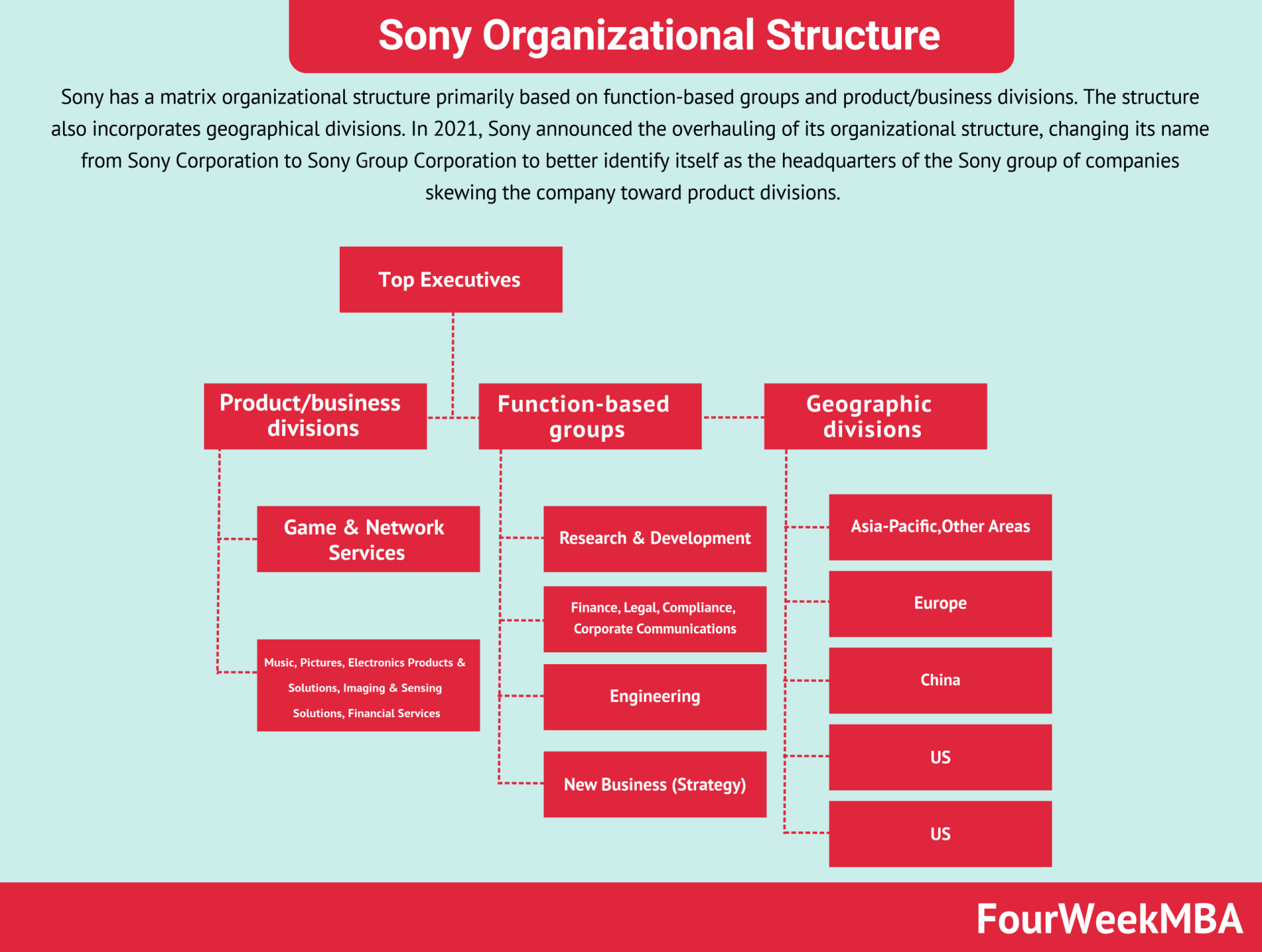
Sony has a matrix organizational structure primarily based on function-based groups and product/business divisions. The structure also incorporates geographical divisions. In 2021, Sony announced the overhauling of its organizational structure, changing its name from Sony Corporation to Sony Group Corporation to better identify itself as the headquarters of the Sony group of companies skewing the company toward product divisions.
Starbucks follows a matrix organizational structure with a combination of vertical and horizontal structures. It is characterized by multiple, overlapping chains of command and divisions.
Tesla is characterized by a functional organizational structure with aspects of a hierarchical structure. Tesla does employ functional centers that cover all business activities, including finance, sales, marketing, technology, engineering, design, and the offices of the CEO and chairperson. Tesla’s headquarters in Austin, Texas, decide the strategic direction of the company, with international operations given little autonomy.
Toyota has a divisional organizational structure where business operations are centered around the market, product, and geographic groups. Therefore, Toyota organizes its corporate structure around global hierarchies (most strategic decisions come from Japan’s headquarter), product-based divisions (where the organization is broken down, based on each product line), and geographical divisions (according to the geographical areas under management).
Walmart has a hybrid hierarchical-functional organizational structure, otherwise referred to as a matrix structure that combines multiple approaches. On the one hand, Walmart follows a hierarchical structure, where the current CEO Doug McMillon is the only employee without a direct superior, and directives are sent from top-level management. On the other hand, the function-based structure of Walmart is used to categorize employees according to their particular skills and experience.
Gennaro Cuofano is a CRO and tech executive who has worked in AI since late 2015, starting with bringing NLP, natural-language generation, voice and chatbot products to the marketing industry. His background is in law and finance: he holds a Master's degree in Law and an International MBA with an emphasis on corporate finance (LUISS Business School and the University of San Diego, 2012), and worked as a financial analyst at a real-estate investment firm in San Diego and as an assistant controller. His work focuses on business model strategy, business engineering and, more broadly, structural analysis: how companies make money, read from their own filings. He created FourWeekMBA and leads research there and at The Business Engineer, his newsletter on AI and business strategy, with over 95,000 subscribers and more than 1,000 published analyses. His writing has also appeared on Entrepreneur (for example, How to Digitize a Family Business in Europe) and HackerNoon. Find him on LinkedIn and Substack. See how we source.
Scroll to Top
Discover more from FourWeekMBA
Subscribe now to keep reading and get access to the full archive.