The Principal-Agent Problem (PAP) represents conflicts between those delegating tasks (principals) and those performing them (agents). PAP is found in corporate governance, healthcare, and government. Solutions involve monitoring, aligning incentives, and contracts to balance interests. Successful resolution enhances trust and efficiency, addressing this pervasive challenge across diverse industries.
The Principal-Agent Problem (PAP) is a fundamental issue in economics and businessmanagement that arises when one party, known as the principal, delegates authority and tasks to another party, known as the agent.
This problem is pervasive in various organizational settings and can have significant implications for decision-making, performance, and the achievement of organizational objectives.
Principal:
The principal is the entity or individual who delegates responsibilities to an agent. Principals can be individuals, organizations, shareholders, or government bodies.
They have specific objectives or goals that they want the agent to achieve on their behalf. These objectives often align with the overall interests of the principal.
For example, in a corporation, the shareholders are the principals who delegate authority to the company’s executives (the agents) to manage the company’s operations and make decisions that maximize shareholder value.
The principal’s objective is to ensure that the agent acts in a manner that benefits the shareholders.
Agent:
The agent is the individual or entity to whom tasks and decision-making authority are delegated. Agents are responsible for carrying out the delegated tasks and acting on behalf of the principal.
Agents can take various forms, including employees, managers, executives, or service providers. Their role is to execute the tasks in a manner that aligns with the principal’s objectives.
In the corporate context, executives and managers are agents who carry out the day-to-day operations of the company on behalf of the shareholders (the principals).
The executives are entrusted with making decisions that advance the company’s goals and maximize shareholder wealth.
Conflict of Interest:
The Principal-Agent Problem revolves around conflicts of interest between principals and agents. These conflicts arise due to differences in objectives, information, and motivations between the two parties.
The primary challenge is ensuring that agents act in the best interests of the principal, even when those interests may not perfectly align.
For instance, consider a scenario where a manager is responsible for making decisions on behalf of the shareholders.
While the shareholders aim to maximize profits and shareholder value, the manager may have personal interests or biases that influence their decision-making.
This misalignment of interests can result in conflicts where the manager’s actions deviate from what is in the best interest of the shareholders.
Challenges and Conflicts in the Principal-Agent Problem:
The Principal-Agent Problem can manifest in various ways, leading to a range of challenges and conflicts:
Moral Hazard: One significant challenge is the potential for moral hazard. Moral hazard occurs when agents take risks or act in their self-interest due to information asymmetry. When agents are not fully aligned with the principal’s objectives, they may engage in behaviors that maximize their own utility, even if it comes at the expense of the principal.
For example, if a sales manager is incentivized solely based on the volume of sales, they may push for aggressive sales tactics that may not align with the company’s long-term sustainability or customer satisfaction.
This creates a moral hazard where the manager prioritizes their own performance metrics over the broader interests of the organization.
Adverse Selection: Another challenge is adverse selection. Adverse selection occurs when principals select agents based on incomplete or imperfect information, leading to the unintentional choice of agents with hidden adverse qualities or behaviors. This can result in agents who do not act in the best interests of the principal, creating a conflict of interest.
For instance, in the hiring process, if a principal is unable to accurately assess an employee’s true skills or work ethic during the hiring process, they may inadvertently select an agent who is not fully committed to the organization’s goals or who lacks the necessary qualifications.
This can lead to performance issues and conflicts between the principal and agent.
Addressing the Principal-Agent Problem requires careful consideration of incentives, monitoring mechanisms, and contractual arrangements. Principals must design systems that align the interests of agents with their own objectives while minimizing conflicts of interest.
This may involve performance-based incentives, transparency in information sharing, and effective monitoring and oversight mechanisms.
In the corporate world, solutions to the Principal-Agent Problem often include performance-based compensation packages for executives, the use of independent boards of directors to oversee management, and shareholder activism as a means for shareholders to hold agents (executives) accountable for their actions.
Benefits of Addressing the Principal-Agent Problem:
Effectively addressing the Principal-Agent Problem can yield several benefits:
Enhanced Trust: When principals are confident that agents are acting in their best interests, trust between the two parties is strengthened. This trust is vital for the smooth functioning of organizations and for productive relationships between stakeholders.
Improved Performance: When agents are incentivized to act in alignment with the principal’s objectives, it often results in improved performance and better outcomes. Agents are more likely to make decisions that benefit the organization as a whole.
Accountability: Addressing the Principal-Agent Problem promotes accountability within organizations. Agents are held accountable for their actions and decisions, which reduces the risk of unethical behavior or self-serving actions.
Effective Governance: In the context of corporate governance, addressing the Principal-Agent Problem is essential for effective oversight and governance of corporations. Shareholders and boards of directors play a critical role in ensuring that executives act in the best interests of shareholders.
Drawbacks and Challenges in Addressing the Principal-Agent Problem:
However, there are also challenges and potential drawbacks in addressing the Principal-Agent Problem:
Complexity: Dealing with the Principal-Agent Problem can be complex, especially in large organizations with multiple layers of management and diverse stakeholders. Designing effective incentive structures and monitoring mechanisms requires careful consideration.
Costs: Implementing solutions to the Principal-Agent Problem can incur costs. For example, providing performance-based incentives to agents can be expensive, and monitoring mechanisms may require dedicated resources.
Unforeseen Consequences: In some cases, efforts to align the interests of principals and agents may have unforeseen consequences. For example, performance-based incentives may lead to short-term thinking at the expense of long-term sustainability.
Resistance to Change: Agents may resist changes to their compensation or oversight mechanisms, as these changes may be perceived as a threat to their autonomy or financial interests.
Solutions to PAP:
Employed to mitigate conflicts:
Monitoring: Regular oversight and performance evaluation of agents’ actions.
Incentive Alignment: Aligning agent incentives with principal goals to encourage desired behavior.
Contracts: Formal agreements specifying agent responsibilities and consequences for non-compliance.
Real-World Applications:
Encountered in various sectors and decision-making scenarios:
Corporate Governance: Shareholders (principals) delegate authority to executives (agents) in corporations.
Healthcare: Patients (principals) entrust doctors (agents) with medical decisions.
Government: Elected officials (principals) delegate public policies to bureaucrats (agents).
Key Challenge:
Balancing agent autonomy with principal goals.
Ensuring that agents act in the best interests of principals.
Implications:
Successfully addressing PAP leads to enhanced trust, efficiency, and effective decision-making.
Results in better alignment between principals’ objectives and agents’ actions.
Use Cases:
Pervasive issue observed in numerous real-world scenarios.
Demonstrates widespread relevance in diverse industries and contexts.
Case Studies
Corporate Governance:
Shareholders (Principals) vs. Executives (Agents): Shareholders delegate authority to corporate executives to manage the company. Conflicts arise when executives prioritize their interests over shareholders’ wealth maximization.
Healthcare:
Patients (Principals) vs. Doctors (Agents): Patients rely on doctors to provide medical advice and treatment. Conflicts may occur if doctors recommend unnecessary procedures for financial gain.
Financial Services:
Investors (Principals) vs. Fund Managers (Agents): Investors entrust their funds to professional fund managers. Conflicts can arise if fund managers prioritize their fees over investors’ returns.
Government:
Elected Officials (Principals) vs. Bureaucrats (Agents): Elected officials delegate the implementation of public policies to government bureaucrats. Conflicts may arise if bureaucrats pursue their agendas or fail to execute policies effectively.
Legal Representation:
Clients (Principals) vs. Attorneys (Agents): Clients hire attorneys to represent them in legal matters. Conflicts can occur if attorneys prioritize their fees over their clients’ best interests.
Education:
Students (Principals) vs. Teachers (Agents): Students depend on teachers for education. Conflicts may arise if teachers neglect their duties or engage in unethical behavior.
Insurance:
Policyholders (Principals) vs. Insurance Agents/Companies (Agents): Policyholders trust insurance agents and companies to provide coverage. Conflicts can occur if agents misrepresent policies or insurance companies deny legitimate claims.
Nonprofit Organizations:
Donors (Principals) vs. Nonprofit Executives (Agents): Donors entrust nonprofit executives to use their contributions for the intended charitable purposes. Conflicts may arise if executives misuse funds for personal gain.
Real Estate:
Homebuyers/Sellers (Principals) vs. Real Estate Agents (Agents): Homebuyers and sellers rely on real estate agents for property transactions. Conflicts can occur if agents prioritize commissions over clients’ interests.
Information Technology:
Clients (Principals) vs. IT Service Providers (Agents): Clients hire IT service providers to manage their technology needs. Conflicts can arise if providers recommend unnecessary upgrades or services.
Key Highlights
Fundamental Concept: PAP is a foundational concept in economics and businessmanagement, addressing conflicts of interest in delegated decision-making.
Principal and Agent: It involves two key roles—the principal, who delegates tasks, and the agent, who carries out the tasks on behalf of the principal.
Conflict of Interest: PAP arises due to divergent interests, information asymmetry, and motivations between principals and agents.
Challenges: Common challenges include moral hazard (agent taking undue risks) and adverse selection (principal selecting agents with hidden adverse qualities).
Solutions: Strategies to mitigate conflicts include monitoring, aligning incentives, and formal contracts.
Real-World Applications: PAP is pervasive, found in corporate governance, healthcare, government, finance, legal services, education, insurance, nonprofits, and more.
Balancing Act: A key challenge is striking the right balance between agent autonomy and achieving the principal’s goals.
Implications: Successfully addressing PAP enhances trust, efficiency, and effective decision-making in various sectors.
Use Cases: Numerous real-world examples demonstrate the relevance of PAP in diverse industries and contexts, emphasizing its importance in modern governance and management.
A Blockchain Business Model according to the FourWeekMBA framework is made of four main components: Value Model (Core Philosophy, Core Values and Value Propositions for the key stakeholders), Blockchain Model (Protocol Rules, Network Shape and Applications Layer/Ecosystem), Distribution Model (the key channels amplifying the protocol and its communities), and the Economic Model (the dynamics/incentives through which protocol players make money). Those elements coming together can serve as the basis to build and analyze a solid Blockchain Business Model.
In an asymmetric businessmodel, the organization doesn’t monetize the user directly, but it leverages the data users provide coupled with technology, thus have a key customer pay to sustain the core asset. For example, Google makes money by leveraging users’ data, combined with its algorithms sold to advertisers for visibility.
In a business world driven by technology and digitalization, competition is much more fluid, as innovation becomes a bottom-up approach that can come from anywhere. Thus, making it much harder to define the boundaries of existing markets. Therefore, a proper business competition analysis looks at customer, technology, distribution, and financialmodel overlaps. While at the same time looking at future potential intersections among industries that in the short-term seem unrelated.
Technological modeling is a discipline to provide the basis for companies to sustain innovation, thus developing incremental products. While also looking at breakthrough innovative products that can pave the way for long-term success. In a sort of Barbell Strategy, technological modeling suggests having a two-sided approach, on the one hand, to keep sustaining continuous innovation as a core part of the businessmodel. On the other hand, it places bets on future developments that have the potential to break through and take a leap forward.
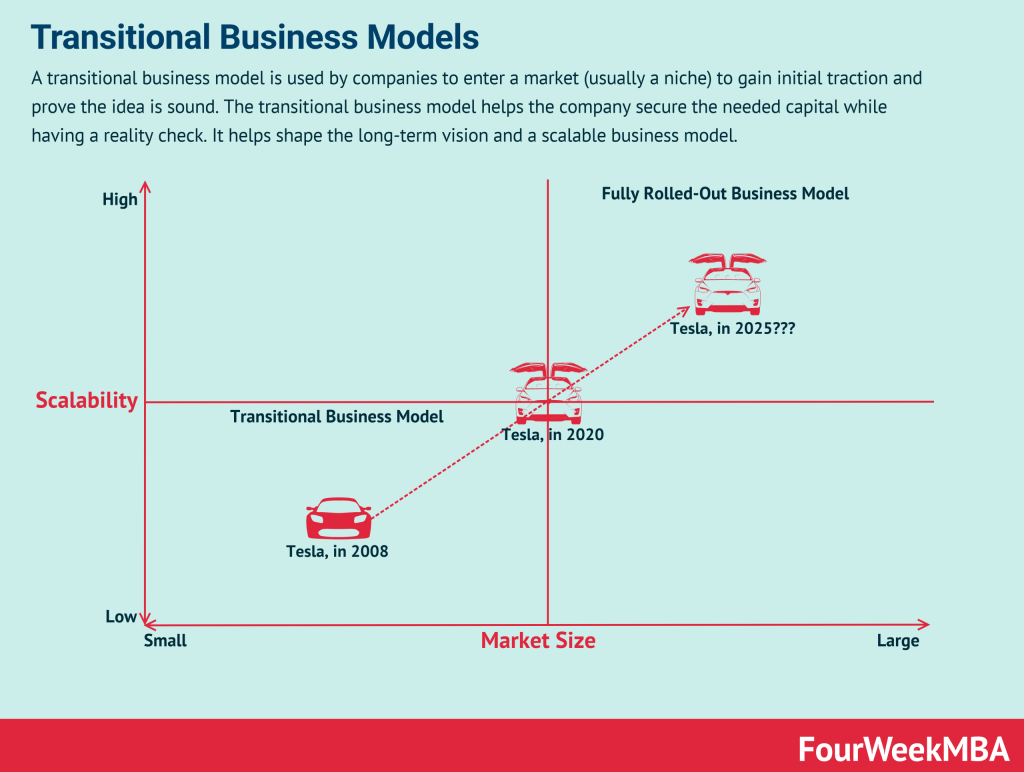
A transitional business model is used by companies to enter a market (usually a niche) to gain initial traction and prove the idea is sound. The transitional business model helps the company secure the needed capital while having a reality check. It helps shape the long-term vision and a scalable businessmodel.
The minimum viable audience (MVA) represents the smallest possible audience that can sustain your business as you get it started from a microniche (the smallest subset of a market). The main aspect of the MVA is to zoom into existing markets to find those people which needs are unmet by existing players.
Business scaling is the process of transformation of a business as the product is validated by wider and wider market segments. Business scaling is about creating traction for a product that fits a small market segment. As the product is validated it becomes critical to build a viable businessmodel. And as the product is offered at wider and wider market segments, it’s important to align product, businessmodel, and organizational design, to enable wider and wider scale.
The market expansion consists in providing a product or service to a broader portion of an existing market or perhaps expanding that market. Or yet, market expansions can be about creating a whole new market. At each step, as a result, a company scales together with the market covered.
In the FourWeekMBA growth matrix, you can apply growth for existing customers by tackling the same problems (gain mode). Or by tackling existing problems, for new customers (expand mode). Or by tackling new problems for existing customers (extend mode). Or perhaps by tackling whole new problems for new customers (reinvent mode).
In the FourWeekMBA Revenue Streams Matrix, revenue streams are classified according to the kind of interactions the business has with its key customers. The first dimension is the “Frequency” of interaction with the key customer. As the second dimension, there is the “Ownership” of the interaction with the key customer.
Revenue model patterns are a way for companies to monetize their business models. A revenue model pattern is a crucial building block of a business model because it informs how the company will generate short-term financial resources to invest back into the business. Thus, the way a company makes money will also influence its overall businessmodel.
A pricingstrategy or model helps companies find the pricing formula in fit with their business models. Thus aligning the customer needs with the product type while trying to enable profitability for the company. A good pricingstrategy aligns the customer with the company’s long term financial sustainability to build a solid businessmodel.
Gennaro is the creator of FourWeekMBA, which reached about four million business people, comprising C-level executives, investors, analysts, product managers, and aspiring digital entrepreneurs in 2022 alone | He is also Director of Sales for a high-tech scaleup in the AI Industry | In 2012, Gennaro earned an International MBA with emphasis on Corporate Finance and Business Strategy.