The path-goal theory was first introduced by organizational behavior expert Martin G. Evans in 1970. Evans based his work on Victor Vroom’s expectancy theory, which suggests individuals are motivated to perform if they know their performance will be recognized and rewarded. Path-goal theory argues leadership is responsible for providing subordinates with the information and support required to achieve their goals.
Aspect
Explanation
Concept Overview
Path-Goal Theory is a leadership theory developed by American psychologist Robert J. House in the 1970s. It proposes that leaders can enhance the motivation, satisfaction, and performance of their followers by clarifying the path to achieving goals and removing obstacles along the way. This theory emphasizes that effective leaders should adapt their leadership styles to meet the unique needs and expectations of their followers and the situation at hand.
Key Principles
Path-Goal Theory is built on several key principles: 1. Goal Clarity: Leaders should provide clear and specific goals to their followers, making the path to success understandable. 2. Support and Direction: Leaders should offer guidance and support to help followers achieve their goals. 3. Adaptation: Leadership style should be adapted to the individual needs and characteristics of followers. 4. Obstacle Removal: Leaders should identify and remove obstacles that hinder progress. 5. Motivation: Effective leaders motivate their followers by linking rewards to goal achievement.
Leadership Styles
The theory identifies several leadership styles that leaders can adopt based on the needs of their followers and the context: 1. Directive Leadership: Providing clear instructions and guidance to followers. 2. Supportive Leadership: Offering emotional support and creating a positive work environment. 3. Participative Leadership: Involving followers in decision-making and goal-setting. 4. Achievement-Oriented Leadership: Setting challenging goals and high performance standards.
Follower Characteristics
Path-Goal Theory recognizes that different followers have distinct characteristics and needs, such as locus of control, experience, and expectancy. Effective leaders assess these characteristics and adapt their leadership style accordingly to provide the right level of support and direction.
Applications
Path-Goal Theory is applicable in various leadership contexts, including business, education, healthcare, and nonprofit organizations. It helps leaders improve follower motivation, satisfaction, and performance by aligning leadership behaviors with the specific goals and needs of the group.
Benefits and Critiques
Benefits of Path-Goal Theory include improved employee satisfaction, enhanced performance, and greater leader flexibility. Critics argue that it can be overly complex and that its effectiveness may depend on the leader’s ability to accurately assess follower needs.
The path-goal theory states that the behavior of a leader is related to the satisfaction, motivation, and performance of his or her subordinates.
The theory was later revised to include a stipulation that the leader must also act in a way that complements subordinate abilities and compensates subordinate deficiencies.
While the leader must exhibit different types of leadership behavior depending on the situation, they must always assist employees in achieving their goals.
Perhaps most importantly of all, the leader must ensure employee goals are aligned with organizational goals.
Path-goal theory leadership behavior
Evans identified four types of leadership behavior a senior staff member must display:
Directive path-goal clarifying leader behavior
Describing any instance where the leader verbalizes to subordinates what is expected of them and how to complete their tasks.
This form of leadership behavior is intrinsically rewarding for the subordinate when there is a degree of ambiguity around their role and task demands.
Achievement-oriented leader behavior
Where a leader sets high standards for subordinates and encourages these standards to be met by showing faith in their ability.
This type of behavior is prevalent in sales, engineering, science, entrepreneurship, and some technical jobs.
Participative leader behavior
These leaders are characterized by a preference to use a collaborative style of decision-making.
That is, they actively solicit the opinions and ideas of the subordinates and incorporate them into strategy.
Supportive leader behavior
Supportive leaders are friendly, approachable, and attend to the well-being of subordinates with empathy and understanding.
In so doing, they consider those ranked beneath them to be equals.
Path-goal theory follower behavior
Follower (or subordinate) behavior describes how followers interpret the behavior of their leader in a work context.
In turn, these characteristics determine whether each subordinate considers their leadership satisfying or as a way to reach future satisfaction.
Communication and leadership consultant Peter G. Northouse subsequently defined four follower behaviors:
Need for affiliation
Followers with a strong preference for affiliation prefer friendly and supportive leaders characterized by the fourth type of leadership behavior mentioned earlier.
Preference for structure
Followers who work in uncertain situations naturally prefer leaders who remove that uncertainty with direction, structure, and task clarity.
These so-called directive leaders also set clear, unambiguous goals.
Desire for control
This may be characterized by an internal locus of control where the follower believes they are in control of their own life.
But it may also describe an external locus of control, where the individual believes external events or influences largely dictate what happens to them.
Followers with an internal locus prefer participative leaders since they prefer to feel in control of decision-making.
Followers with an external locus prefer the actions of a directive leader because that style of leadership reinforces their beliefs about how the world operates.
Self-perceived level of task ability
According to Northouse, the extent to which an individual believes they can complete a task is negatively correlated with directive leadership.
In theory, this makes sense, because followers who are given the freedom and autonomy to complete a task do not require a controlling, assertive leader.
Key takeaways
Path-goal theory argues leadership is responsible for providing subordinates with the information and support required to achieve their goals. The theory was developed by Martin G. Evans, who based it on Vroom’s expectancy theory.
Path-goal theory argues leaders must compensate for employee deficiencies and complement employee abilities depending on the situation. This adaptiveness is facilitated by leadership exhibiting four different styles: directive, participative, supportive, and achievement-oriented.
Path-goal theory also defines four styles of subordinate behavior which determine the degree to which a follower is satisfied with their superior. These include a need for affiliation, preference for structure, desire for control, and self-perceived level of task ability.
Key Highlights – Path-Goal Theory of Leadership:
Introduction and Foundation: The Path-Goal Theory of Leadership was introduced by Martin G. Evans in 1970, building on Victor Vroom’s Expectancy Theory. This theory suggests that individuals are motivated when they believe their performance will be recognized and rewarded.
Central Idea: Path-Goal Theory asserts that leadership’s role is to provide subordinates with the necessary guidance and support to achieve their goals, leading to increased satisfaction, motivation, and performance.
Alignment with Subordinate Abilities: The theory evolved to emphasize that leaders should adapt their behavior to complement the abilities of their subordinates and address their deficiencies. Effective leadership styles vary based on the situation.
Leader’s Role in Goal Achievement: The leader’s primary duty is to assist employees in reaching their goals. A crucial aspect is aligning employee objectives with the broader organizational goals.
Four Leadership Behaviors:
Directive Path-Goal Clarifying: Leaders clearly communicate tasks and expectations to subordinates, suitable for ambiguous situations.
Achievement-Oriented: Leaders set high standards and show confidence in subordinates’ capabilities, often found in technical or goal-oriented roles.
Participative: Leaders involve subordinates in decision-making, fostering a collaborative environment.
Supportive: Leaders are approachable, empathetic, and attentive to the well-being of subordinates, treating them as equals.
Subordinate Behavior:
Need for Affiliation: Followers seek friendly and supportive leaders who prioritize their well-being.
Preference for Structure: Followers in uncertain situations prefer leaders who provide clear direction and task clarity.
Desire for Control: Internal control seekers prefer participative leaders, while external control seekers prefer directive leaders.
Self-Perceived Task Ability: Followers with high confidence in their abilities are more comfortable with autonomy and less directive leadership.
Key Takeaways:
Path-Goal Theory emphasizes that leadership involves guiding and supporting subordinates to achieve their goals.
The theory identifies four leadership behaviors: directive, achievement-oriented, participative, and supportive.
Subordinate behaviors impact their perception of leadership effectiveness, including the need for affiliation, preference for structure, desire for control, and self-perceived task ability.
Related Concepts
Description
When to Apply
Path-Goal Theory
Path-Goal Theory is a leadership theory that suggests effective leaders clarify the path to goal achievement, provide support and guidance to followers, and adjust their leadership style to align with follower needs and situational demands. It emphasizes the importance of leaders in removing obstacles, providing direction, and offering rewards to enhance follower motivation, satisfaction, and performance towards achieving shared objectives.
– When discussing leadership styles and employee motivation. – Particularly in understanding how leaders influence follower behavior, attitudes, and performance through supportive, directive, participative, or achievement-oriented leadership behaviors, and in exploring techniques to adapt leadership approaches to varying follower needs and situational contingencies.
Transformational Leadership
Transformational leadership is a leadership style that involves inspiring and empowering followers to transcend self-interests and achieve higher-order goals or collective visions. It focuses on fostering trust, vision, and commitment among followers through charismatic, inspirational, intellectual stimulation, and individualized consideration behaviors, driving organizational change, innovation, and performance excellence.
– When discussing change management and organizational culture. – Particularly in understanding how leaders inspire and mobilize followers to embrace change, challenge the status quo, and pursue shared aspirations, and in exploring techniques to develop transformational leadership qualities, build trust, and cultivate a culture of innovation and continuous improvement.
Situational Leadership
Situational leadership is a leadership model that emphasizes adapting leadership styles to match the readiness or maturity level of followers in a given situation. It involves assessing follower competence and commitment and selecting the appropriate leadership approach, ranging from directing, coaching, supporting, to delegating, to effectively guide and develop followers towards goal attainment and self-reliance.
– When discussing leadership development and team dynamics. – Particularly in understanding how leaders adjust their behaviors and decision-making based on follower capabilities and situational demands, and in exploring techniques to diagnose follower readiness, provide tailored support, and foster leadership flexibility and effectiveness in diverse contexts.
Leader-Member Exchange (LMX)
Leader-Member Exchange (LMX) is a leadership theory that focuses on the unique exchange relationships between leaders and individual followers within a team or organization. It suggests that leaders develop differentiated, high-quality relationships (in-group) with some followers, based on mutual trust, respect, and reciprocity, while maintaining transactional, low-quality exchanges (out-group) with others, leading to differential treatment and performance outcomes.
– When discussing team dynamics and interpersonal relationships. – Particularly in understanding how leaders form and maintain relationships with followers, allocate resources, and influence performance outcomes, and in exploring techniques to enhance leader-member exchanges, foster trust, and mitigate biases or inequities in leader-follower relationships.
Transactional Leadership
Transactional leadership is a leadership style that focuses on the exchange relationship between leaders and followers, emphasizing contingent rewards and corrective actions to motivate and manage follower behavior. It involves setting clear expectations, providing rewards or punishments based on performance, and monitoring compliance with established standards, rules, or procedures to ensure goal attainment and organizational effectiveness.
– When discussing performance management and goal-setting. – Particularly in understanding how leaders clarify performance expectations, provide incentives, and monitor follower performance to achieve desired outcomes, and in exploring techniques to reinforce desired behaviors, provide constructive feedback, and maintain accountability and performance standards.
Charismatic Leadership
Charismatic leadership is a leadership style that involves inspiring and influencing followers through the personal charisma, charm, and vision of the leader. It entails articulating a compelling vision, exhibiting confidence and enthusiasm, and creating emotional connections with followers to motivate and mobilize them towards shared goals or ideals. Charismatic leaders often inspire loyalty, commitment, and collective action through their charisma and persuasive communication.
– When discussing visionary leadership and organizational culture. – Particularly in understanding how leaders inspire followers through vision casting, storytelling, and emotional appeals, and in exploring techniques to cultivate charismatic leadership qualities, build rapport, and communicate effectively to engage and align followers with organizational goals and values.
Servant Leadership
Servant leadership is a leadership philosophy that emphasizes serving the needs of others, putting followers’ interests first, and facilitating their growth, development, and success. It involves humility, empathy, and stewardship, as leaders prioritize the welfare and empowerment of followers, fostering a culture of trust, collaboration, and mutual support that enables individuals and teams to thrive and achieve their full potential.
– When discussing ethical leadership and employee empowerment. – Particularly in understanding how leaders cultivate a culture of service, empathy, and collaboration, and in exploring techniques to practice servant leadership behaviors, build high-trust relationships, and empower followers to take ownership and initiative in pursuing collective goals and shared values.
Adaptive Leadership
Adaptive leadership is a leadership framework that focuses on leading change and navigating complex challenges or adaptive problems that require innovative solutions and adaptive responses. It involves diagnosing the nature of challenges, mobilizing stakeholders, and experimenting with new approaches to address emergent issues, fostering organizational learning, resilience, and agility in the face of uncertainty and change.
– When discussing change management and crisis leadership. – Particularly in understanding how leaders navigate uncertainty, ambiguity, and resistance to change, and in exploring techniques to foster adaptive leadership capabilities, promote organizational agility, and build capacity for continuous learning, innovation, and problem-solving in dynamic environments.
Distributed Leadership
Distributed leadership is a leadership model that views leadership as a shared responsibility distributed across multiple individuals or roles within an organization or team. It involves decentralizing decision-making, empowering team members, and fostering collective leadership capabilities to address complex challenges, promote innovation, and enhance organizational effectiveness through collaboration, diversity, and inclusion.
– When discussing team-based leadership and collaborative culture. – Particularly in understanding how leadership can be distributed across teams, departments, or hierarchical levels, and in exploring techniques to foster shared leadership behaviors, promote knowledge sharing, and leverage diverse perspectives and expertise to drive organizational performance and adaptability.
Transactional Leadership
Transactional leadership is a leadership style that focuses on the exchange relationship between leaders and followers, emphasizing contingent rewards and corrective actions to motivate and manage follower behavior. It involves setting clear expectations, providing rewards or punishments based on performance, and monitoring compliance with established standards, rules, or procedures to ensure goal attainment and organizational effectiveness.
– When discussing performance management and goal-setting. – Particularly in understanding how leaders clarify performance expectations, provide incentives, and monitor follower performance to achieve desired outcomes, and in exploring techniques to reinforce desired behaviors, provide constructive feedback, and maintain accountability and performance standards.
Agile leadership is the embodiment of agile manifesto principles by a manager or management team. Agile leadership impacts two important levels of a business. The structural level defines the roles, responsibilities, and key performance indicators. The behavioral level describes the actions leaders exhibit to others based on agile principles.
Adaptive leadership is a model used by leaders to help individuals adapt to complex or rapidly changing environments. Adaptive leadership is defined by three core components (precious or expendable, experimentation and smart risks, disciplined assessment). Growth occurs when an organization discards ineffective ways of operating. Then, active leaders implement new initiatives and monitor their impact.
Developed by business consultants Kenneth Blanchard and Paul Hersey in the 1960s, delegative leadership is a leadership style where authority figures empower subordinates to exercise autonomy. For this reason, it is also called laissez-faire leadership. In some cases, this type of leadership can lead to increases in work quality and decision-making. In a few other cases, this type of leadershipneeds to be balanced out to prevent a lack of direction and cohesiveness of the team.
Distributed leadership is based on the premise that leadership responsibilities and accountability are shared by those with the relevant skills or expertise so that the shared responsibility and accountability of multiple individuals within a workplace, bulds up as a fluid and emergent property (not controlled or held by one individual). Distributed leadership is based on eight hallmarks, or principles: shared responsibility, shared power, synergy, leadership capacity, organizational learning, equitable and ethical climate, democratic and investigative culture, and macro-community engagement.
Micromanagement is about tightly controlling or observing employees’ work. Although in some cases, this management style might be understood, especially for small-scale projects, generally speaking, micromanagement has a negative connotation mainly because it shows a lack of trust and freedom in the workplace, which leads to adverse outcomes.
Maslow’s Hierarchy of Needs was developed by American psychologist Abraham Maslow. His hierarchy, often depicted in the shape of a pyramid, helped explain his research on basic human needs and desires. In marketing, the hierarchy (and its basis in psychology) can be used to market to specific groups of people based on their similarly specific needs, desires, and resultant actions.
The Eisenhower Matrix is a tool that helps businesses prioritize tasks based on their urgency and importance, named after Dwight D. Eisenhower, President of the United States from 1953 to 1961, the matrix helps businesses and individuals differentiate between the urgent and important to prevent urgent things (seemingly useful in the short-term) cannibalize important things (critical for long-term success).
Moonshot thinking is an approach to innovation, and it can be applied to business or any other discipline where you target at least 10X goals. That shifts the mindset, and it empowers a team of people to look for unconventional solutions, thus starting from first principles, by leveraging on fast-paced experimentation.
The theory was developed by psychologist Edwin Locke who also has a background in motivation and leadership research. Locke’s goal-setting theory of motivation provides a framework for setting effective and motivating goals. Locke was able to demonstrate that goal setting was linked to performance.
Herzberg’s two-factor theory argues that certain workplace factors cause job satisfaction while others cause job dissatisfaction. The theory was developed by American psychologist and businessmanagement analyst Frederick Herzberg. Until his death in 2000, Herzberg was widely regarded as a pioneering thinker in motivational theory.
The term lessons learned refers to the various experiences project team members have while participating in a project. Lessons are shared in a review session which usually occurs once the project has been completed, with any improvements or best practices incorporated into subsequent projects.
Growth engineering is a systematic, technical approach to the improvement of conversion and the user experience. Combined with business engineering it helps business people build valuable companies from scratch.
Retrospective analyses are held after a project to determine what worked well and what did not. They are also conducted at the end of an iteration in Agile project management. Agile practitioners call these meetings retrospectives or retros. They are an effective way to check the pulse of a project team, reflect on the work performed to date, and reach a consensus on how to tackle the next sprint cycle.
Andy Grove, helped Intel become among the most valuable companies by 1997. In his years at Intel, he conceived a management and goal-setting system, called OKR, standing for “objectives and key results.” Venture capitalist and early investor in Google, John Doerr, systematized in the book “Measure What Matters.”
Cog’s ladder is a model of group development. The ladder was created in 1972 by Procter & Gamble employee George Charrier to help management at the company understand how teams worked to make them more efficient. Cog’s ladder is a model of group formation and behavior that is used to help businesses understand how a team can work to achieve its goals.
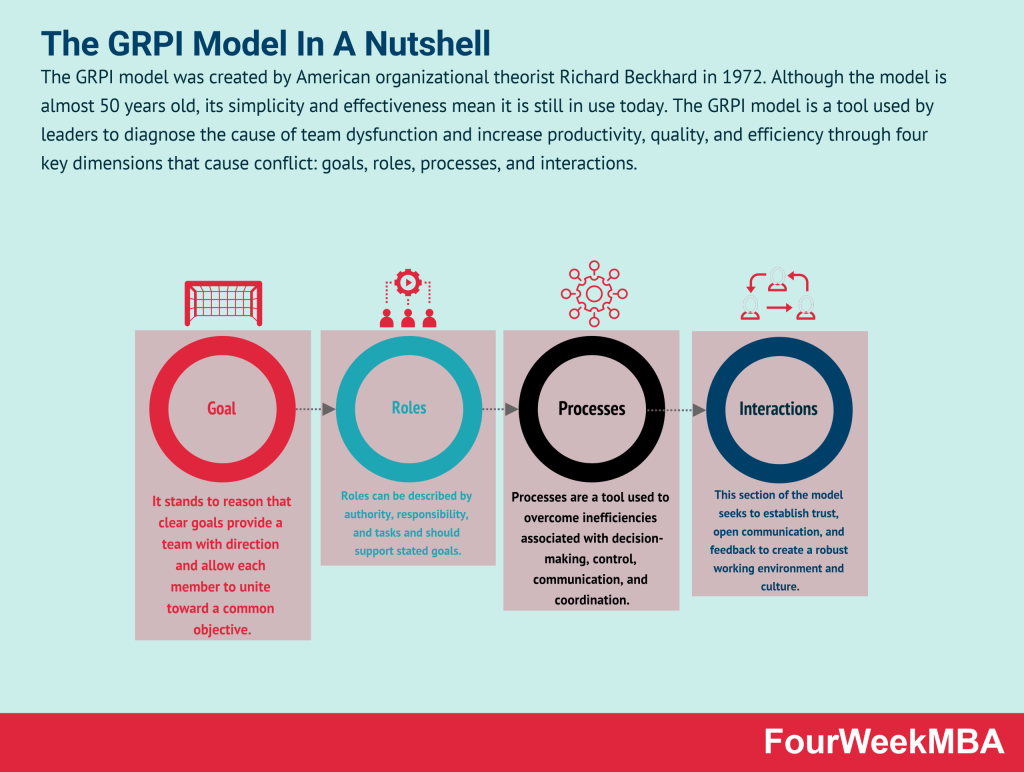
The GRPI model was created by American organizational theorist Richard Beckhard in 1972. Although the model is almost 50 years old, its simplicity and effectiveness mean it is still in use today. The GRPI model is a tool used by leaders to diagnose the cause of team dysfunction and increase productivity, quality, and efficiency through four key dimensions that cause conflict: goals, roles, processes, and interactions.
High-performance coaches work with individuals in personal and professional contexts to enable them to reach their full potential. While these sorts of coaches are commonly associated with sports, it should be noted that the act of coaching is a specific type of behavior that is also useful in business and leadership.
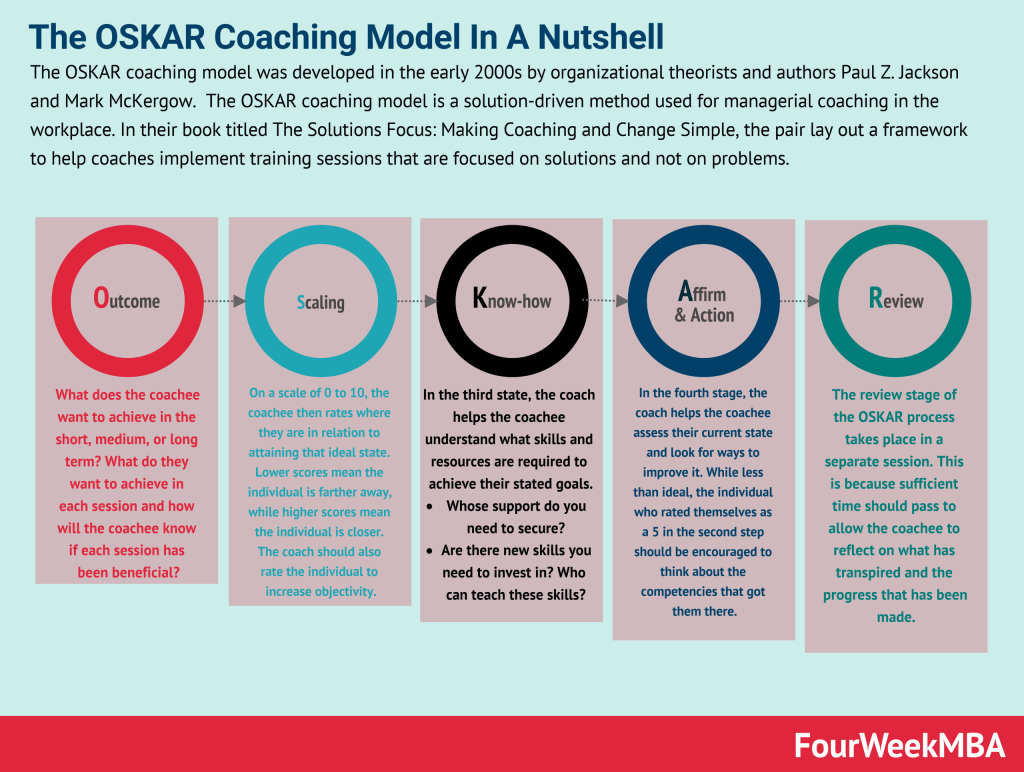
The OSKAR coaching model was developed in the early 2000s by organizational theorists and authors Paul Z. Jackson and Mark McKergow. The OSKAR coaching model is a solution-driven method used for managerial coaching in the workplace. In their book titled The Solutions Focus: Making Coaching and Change Simple, the pair layout a framework to help coaches implement training sessions that are focused on solutions and not on problems.
The training of trainers model seeks to engage master instructors in coaching new, less experienced instructors with a particular topic or skill. The training of trainers (ToT) model is a framework used by master instructors to train new instructors, enabling them to subsequently train other people in their organization.
Though no single individual can claim to have created the GROW model, writers Graham Alexander and Alan Fine together with racing car champion John Whitmore played a significant part in developing the framework during the 80s and 90s. The GROW model is a simple way to set goals and solve problems during coaching sessions through four stages: goal, reality, options, and will (way forward).
The Ulrich model helps large or complex organizations with many business units organize their human resource function. The Ulrich model was named for management coach David Ulrich after the release of his 1996 book Human Resource Champions: The Next Agenda for Adding Value and Delivering Results.
Gennaro is the creator of FourWeekMBA, which reached about four million business people, comprising C-level executives, investors, analysts, product managers, and aspiring digital entrepreneurs in 2022 alone | He is also Director of Sales for a high-tech scaleup in the AI Industry | In 2012, Gennaro earned an International MBA with emphasis on Corporate Finance and Business Strategy.