OpenAI is an artificial intelligence research laboratory that transitioned into a for-profit organization in 2019. The corporate structure is organized around two entities: OpenAI, Inc., which is a single-member Delaware LLC controlled by OpenAI non-profit, And OpenAI LP, which is a capped, for-profit organization. The OpenAI LP is governed by the board of OpenAI, Inc (the foundation), which acts as a General Partner. At the same time, Limited Partners comprise employees of the LP, some of the board members, and other investors like Reid Hoffman’s charitable foundation, Khosla Ventures, and Microsoft, the leading investor in the LP.
OpenAI’s missionis to ensure that artificial general intelligence (AGI).
As OpenAI explains, “by which we mean highly autonomous systems that outperform humans at most economically valuable work—benefits all of humanity.”
How does OpenAI corporate structure work?
OpenAI is broken down in:
OpenAI Inc., which is a single-member Delaware LLC controlled by OpenAI non-profit.
And OpenAI LP, which is a capped-profit entity.
OpenAI Inc. board is the general partner, which leads, managed, and controls the decision made by the OpenAI LP.
On the other hand, limited partners, which do have not control over the management of the LP also have a capped return of 100x on their investments.
The cap is based on agreements that are in place for each of the limited partners.
Microsoft commercial partnership
Microsoft is the leading limited partner, and it also has a commercial agreement as part of the one billion invested in 2019, which comprises the following:
Microsoft/OpenAI Azure AI supercomputing technologies.
OpenAI products are served through Microsoft Azure.
Microsoft is OpenAI’s preferred partner for commercializing new AI technologies.
In the meantime, a further partnership was closed on January 23rd, 2023, where Microsoft and OpenAI confirmed a multi-year, multi-billion agreement where Microsoft announced three main parts of this partnership:
Supercomputing at scale – Microsoft will increase our investments in the development and deployment of specialized supercomputing systems to accelerate OpenAI’s groundbreaking independent AI research. We will also continue to build out Azure’s leading AI infrastructure to help customers build and deploy their AI applications on a global scale.
New AI-powered experiences – Microsoft will deploy OpenAI’s models across our consumer and enterprise products and introduce new categories of digital experiences built on OpenAI’s technology. This includes Microsoft’s Azure OpenAI Service, which empowers developers to build cutting-edge AI applications through direct access to OpenAI models backed by Azure’s trusted, enterprise-grade capabilities and AI-optimized infrastructure and tools.
Exclusive cloud provider – As OpenAI’s exclusive cloud provider, Azure will power all OpenAI workloads across research, products and API services.
Key Highlights
History of OpenAI:
OpenAI started as an artificial intelligence research laboratory.
In 2019, it transitioned into a for-profit organization.
The organization’s structure includes two main entities: OpenAI, Inc. and OpenAI LP.
OpenAI’s Mission:
OpenAI’s mission is to ensure the development of artificial general intelligence (AGI) that benefits humanity.
AGI refers to highly autonomous systems that surpass human performance in economically valuable tasks.
Corporate Structure:
OpenAI, Inc. is a single-member Delaware LLC controlled by the OpenAI non-profit.
OpenAI LP is a capped-profit entity.
The board of OpenAI, Inc. serves as the General Partner for OpenAI LP.
Limited Partners, including employees, board members, investors like Microsoft, have capped returns and limited control.
Microsoft Partnership:
Microsoft is a leading limited partner in OpenAI.
Microsoft invested a billion dollars in 2019 and entered into a commercial agreement.
The partnership involves various aspects:
Microsoft contributes to OpenAI’s supercomputing technologies.
OpenAI products are hosted on Microsoft Azure.
Microsoft deploys OpenAI models across its products, introducing new AI-powered experiences.
Azure is OpenAI’s exclusive cloud provider, supporting research, products, and API services.
Recent Multi-Year Agreement:
In January 2023, Microsoft and OpenAI announced a multi-year, multi-billion agreement.
The agreement includes:
Microsoft’s increased investments in specialized supercomputing systems to aid OpenAI’s AI research.
Deployment of OpenAI’s models in Microsoft’s consumer and enterprise products.
Microsoft Azure as the exclusive cloud provider for OpenAI’s workloads.
Large language models (LLMs) are AI tools that can read, summarize, and translate text. This enables them to predict words and craft sentences that reflect how humans write and speak.
Prompt engineering is a natural language processing (NLP) concept that involves discovering inputs that yield desirable or useful results.
Like most processes, the quality of the inputs determines the quality of the outputs in prompt engineering. Designing effective prompts increases the likelihood that the model will return a response that is both favorable and contextual.
Developed by OpenAI, the CLIP (Contrastive Language-Image Pre-training) model is an example of a model that utilizes prompts to classify images and captions from over 400 million image-caption pairs.
OpenAI has built the foundational layer of the AI industry. With large generative models like GPT-3 and DALL-E, OpenAI offers API access to businesses that want to develop applications on top of its foundational models while being able to plug these models into their products and customize these models with proprietary data and additional AI features. On the other hand, OpenAI also released ChatGPT, developing around a freemium model. Microsoft also commercializes opener products through its commercial partnership.
OpenAI and Microsoft partnered up from a commercial standpoint. The history of the partnership started in 2016 and consolidated in 2019, with Microsoft investing a billion dollars into the partnership. It’s now taking a leap forward, with Microsoft in talks to put $10 billion into this partnership. Microsoft, through OpenAI, is developing its Azure AI Supercomputer while enhancing its Azure Enterprise Platform and integrating OpenAI’s models into its business and consumer products (GitHub, Office, Bing).
Stability AI is the entity behind Stable Diffusion. Stability makes money from our AI products and from providing AI consulting services to businesses. Stability AI monetizes Stable Diffusion via DreamStudio’s APIs. While it also releases it open-source for anyone to download and use. Stability AI also makes money via enterprise services, where its core development team offers the chance to enterprise customers to service, scale, and customize Stable Diffusion or other large generative models to their needs.
OpenAI is an artificial intelligence research laboratory that transitioned into a for-profit organization in 2019. The corporate structure is organized around two entities: OpenAI, Inc., which is a single-member Delaware LLC controlled by OpenAI non-profit, And OpenAI LP, which is a capped, for-profit organization. The OpenAI LP is governed by the board of OpenAI, Inc (the foundation), which acts as a General Partner. At the same time, Limited Partners comprise employees of the LP, some of the board members, and other investors like Reid Hoffman’s charitable foundation, Khosla Ventures, and Microsoft, the leading investor in the LP.
Airbnb follows a holacracy model, or a sort of flat organizational structure, where teams are organized for projects, to move quickly and iterate fast, thus keeping a lean and flexible approach. Airbnb also moved to a hybrid model where employees can work from anywhere and meet on a quarterly basis to plan ahead, and connect to each other.
The Amazon organizational structure is predominantly hierarchical with elements of function-based structure and geographic divisions. While Amazon started as a lean, flat organization in its early years, it transitioned into a hierarchical organization with its jobs and functions clearly defined as it scaled.
The Coca-Cola Company has a somewhat complex matrix organizational structure with geographic divisions, product divisions, business-type units, and functional groups.
Costco has a matrix organizational structure, which can simply be defined as any structure that combines two or more different types. In this case, a predominant functional structure exists with a more secondary divisional structure.
Costco’s geographic divisions reflect its strong presence in the United States combined with its expanding global presence. There are six divisions in the country alone to reflect its standing as the source of most company revenue.
Compared to competitor Walmart, for example, Costco takes more a decentralized approach to management, decision-making, and autonomy. This allows the company’s stores and divisions to more flexibly respond to local market conditions.
Dell has a functional organizational structure with some degree of decentralization. This means functional departments share information, contribute ideas to the success of the organization and have some degree of decision-making power.
eBay was until recently a multi-divisional (M-form) organization with semi-autonomous units grouped according to the services they provided. Today, eBay has a single division called Marketplace, which includes eBay and its international iterations.
Facebook is characterized by a multi-faceted matrix organizational structure. The company utilizes a flat organizational structure in combination with corporate function-based teams and product-based or geographic divisions. The flat organization structure is organized around the leadership of Mark Zuckerberg, and the key executives around him. On the other hand, the function-based teams are based on the main corporate functions (like HR, product management, investor relations, and so on).
Goldman Sachs has a hierarchical structure with a clear chain of command and defined career advancement process. The structure is also underpinned by business-type divisions and function-based groups.
Google (Alphabet) has a cross-functional (team-based) organizational structure known as a matrix structure with some degree of flatness. Over the years, as the company scaled and it became a tech giant, its organizational structure is morphing more into a centralized organization.
IBM has an organizational structure characterized by product-based divisions, enabling its strategy to develop innovative and competitive products in multiple markets. IBM is also characterized by function-based segments that support product development and innovation for each product-based division, which include Global Markets, Integrated Supply Chain, Research, Development, and Intellectual Property.
McDonald’s has a divisional organizational structure where each division – based on geographical location – is assigned operational responsibilities and strategic objectives. The main geographical divisions are the US, internationally operated markets, and international developmental licensed markets. And on the other hand, the hierarchical leadership structure is organized around regional and functional divisions.
McKinsey & Company has a decentralized organizational structure with mostly self-managing offices, committees, and employees. There are also functional groups and geographic divisions with proprietary names.
Microsoft has a product-type divisional organizational structure based on functions and engineering groups. As the company scaled over time it also became more hierarchical, however still keeping its hybrid approach between functions, engineering groups, and management.
Nestlé has a geographical divisional structure with operations segmented into five key regions. For many years, Swiss multinational food and drink company Nestlé had a complex and decentralized matrix organizational structure where its numerous brands and subsidiaries were free to operate autonomously.
Nike has a matrix organizational structure incorporating geographic divisions. Nike’s matrix structure is also present at the regional and sub-regional levels. Managerial responsibility is segmented according to business unit (apparel, footwear, and equipment) and function (human resources, finance, marketing, sales, and operations).
Patagonia has a particular organizational structure, where its founder, Chouinard, disposed of the company’s ownership in the hands of two non-profits. The Patagonia Purpose Trust, holding 100% of the voting stocks, is in charge of defining the company’s strategic direction. And the Holdfast Collective, a non-profit, holds 100% of non-voting stocks, aiming to re-invest the brand’s dividends into environmental causes.
Samsung has a product-type divisional organizational structure where products determine how resources and business operations are categorized. The main resources around which Samsung’s corporate structure is organized are consumer electronics, IT, and device solutions. In addition, Samsung leadership functions are organized around a few career levels grades, based on experience (assistant, professional, senior professional, and principal professional).
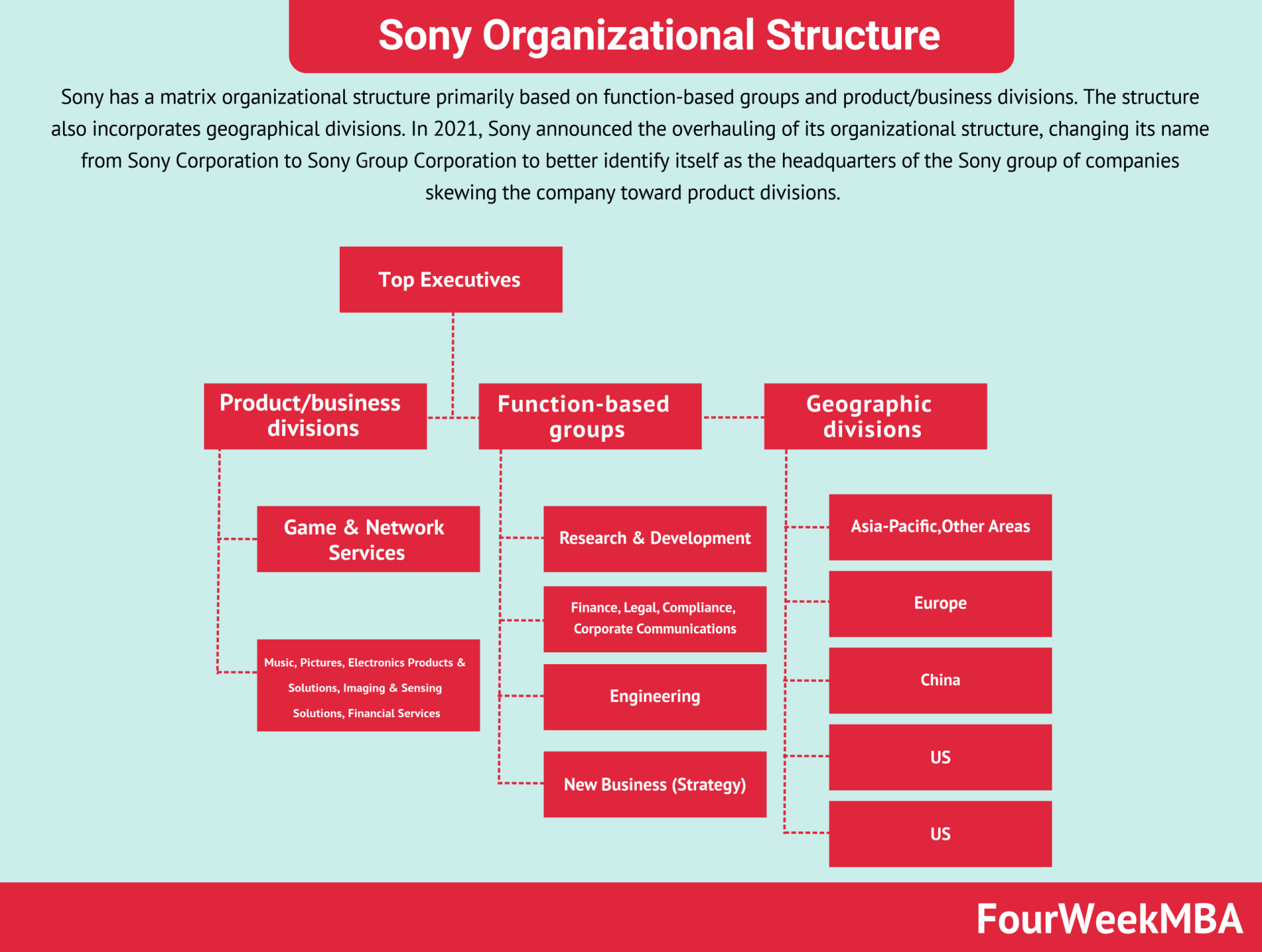
Sony has a matrix organizational structure primarily based on function-based groups and product/business divisions. The structure also incorporates geographical divisions. In 2021, Sony announced the overhauling of its organizational structure, changing its name from Sony Corporation to Sony Group Corporation to better identify itself as the headquarters of the Sony group of companies skewing the company toward product divisions.
Starbucks follows a matrix organizational structure with a combination of vertical and horizontal structures. It is characterized by multiple, overlapping chains of command and divisions.
Tesla is characterized by a functional organizational structure with aspects of a hierarchical structure. Tesla does employ functional centers that cover all business activities, including finance, sales, marketing, technology, engineering, design, and the offices of the CEO and chairperson. Tesla’s headquarters in Austin, Texas, decide the strategic direction of the company, with international operations given little autonomy.
Toyota has a divisional organizational structure where business operations are centered around the market, product, and geographic groups. Therefore, Toyota organizes its corporate structure around global hierarchies (most strategic decisions come from Japan’s headquarter), product-based divisions (where the organization is broken down, based on each product line), and geographical divisions (according to the geographical areas under management).
Walmart has a hybrid hierarchical-functional organizational structure, otherwise referred to as a matrix structure that combines multiple approaches. On the one hand, Walmart follows a hierarchical structure, where the current CEO Doug McMillon is the only employee without a direct superior, and directives are sent from top-level management. On the other hand, the function-based structure of Walmart is used to categorize employees according to their particular skills and experience.
Gennaro is the creator of FourWeekMBA, which reached about four million business people, comprising C-level executives, investors, analysts, product managers, and aspiring digital entrepreneurs in 2022 alone | He is also Director of Sales for a high-tech scaleup in the AI Industry | In 2012, Gennaro earned an International MBA with emphasis on Corporate Finance and Business Strategy.
Scroll to Top
Discover more from FourWeekMBA
Subscribe now to keep reading and get access to the full archive.