– Market Sensing is a strategic approach that involves continuously monitoring, analyzing, and interpreting market dynamics, trends, and customer preferences to
Market Intelligence
– Market Intelligence refers to the systematic collection, analysis, and dissemination of information about competitors, customers, and market trends to support
Competitive Intelligence
– Competitive Intelligence involves gathering, analyzing, and disseminating information about competitors' strategies, capabilities, and activities to understan
Customer Insights
– Customer Insights involve gathering, analyzing, and interpreting data about customers' behaviors, preferences, and needs to understand their motivations, expe
Trend Analysis
– Trend Analysis involves identifying and analyzing patterns, shifts, and changes in market dynamics, consumer behaviors, and industry trends over time to antic
Scenario Planning
– Scenario Planning is a strategic foresight technique that involves creating and analyzing multiple plausible future scenarios to anticipate uncertainties, ris
– SWOT Analysis is a strategic planning tool used to assess an organization's strengths, weaknesses, opportunities, and threats to inform strategic decision-mak
Customer Relationship Management (CRM)
– Customer Relationship Management (CRM) is a strategy and technology used to manage and analyze interactions with customers and prospects throughout the custom
Market Sensing involves understanding and monitoring market trends and consumer behavior through various methods such as surveys, focus groups, and social media monitoring. Data analysis helps identify trends and consumer preferences, providing a competitive advantage and supporting informed decision-making. However, challenges include ensuring data accuracy and adapting to changing consumer behavior. Market sensing finds applications in product development, marketing campaigns, and business expansion.
Market Research Methods:
Surveys: These involve structured questionnaires and are used to collect quantitative and qualitative data from a sample of respondents. Surveys help in understanding customer preferences, demographics, and opinions.
Focus Groups: This method involves bringing together a small group of individuals to discuss a specific product, service, or market trend. It provides qualitative insights and allows researchers to observe group dynamics.
Social Media Monitoring: Tracking and analyzing conversations, mentions, and sentiments on social media platforms like Twitter, Facebook, and Instagram. This method is particularly useful for understanding public perceptions and real-time reactions.
Competitor Analysis: Evaluating the strategies, strengths, and weaknesses of competitors in the market. It helps businesses identify gaps in the market and potential opportunities.
Data Analysis:
Trends Identification: Identifying patterns and trends within the data. This includes recognizing emerging market trends, shifts in consumer preferences, and changes in industry dynamics.
Consumer Behavior: Understanding how consumers behave and make decisions. This includes studying their buying habits, motivations, and factors influencing their choices.
Strategic Planning: Using insights from data analysis to develop and refine business strategies. Market sensing provides valuable inputs for marketing, product development, and overall business planning.
Benefits:
Competitive Advantage: By staying ahead of market trends and understanding consumer behavior, businesses can gain a competitive edge over their rivals.
Informed Decision-Making: Access to accurate and timely market insights enables informed decision-making at all levels of an organization.
Challenges:
Data Accuracy: Ensuring that the data collected is reliable and representative of the target market. Inaccurate data can lead to misguided decisions.
Changing Consumer Behavior: Adapting to the evolving preferences and behaviors of consumers can be challenging, especially in fast-paced markets.
Applications:
Product Development: Insights gained from market sensing can guide the development of new products or the enhancement of existing ones, aligning them with consumer demands.
Marketing Campaigns: Tailoring marketing strategies based on consumer preferences and market trends leads to more effective and targeted campaigns.
Business Expansion: Market sensing supports decision-making regarding entering new markets or expanding existing operations by understanding the competitive landscape and consumer needs.
Case Studies
Retail Industry:
Inventory Management: Retailers use market sensing to predict demand for products, ensuring that they have the right items in stock to meet customer needs.
Pricing Strategies: Analyzing competitor prices and customer reactions helps retailers adjust their pricing strategies to remain competitive.
Tech Startups:
User Feedback: Tech startups gather user feedback through surveys and app reviews to improve their products and enhance user experience.
Competitor Analysis: Studying the features and performance of competitors’ apps helps startups identify gaps in the market.
Automotive Industry:
Customer Surveys: Car manufacturers conduct surveys to understand consumer preferences for vehicle features and designs.
Environmental Trends: Market sensing helps automakers stay ahead by identifying trends like electric vehicle demand and sustainability concerns.
Fashion Brands:
Social Media Monitoring: Fashion brands track social media conversations to stay updated on the latest fashion trends and consumer sentiments.
Seasonal Collections: Insights from market sensing inform the design and launch of seasonal clothing collections.
Food and Beverage:
Taste Testing: Restaurants and food companies conduct taste tests to gather data on customer preferences and adjust their menus accordingly.
Health Trends: Market sensing helps identify health-conscious consumer trends, leading to the creation of healthier food options.
Financial Services:
Customer Surveys: Banks and financial institutions use surveys to understand customer satisfaction and preferences for banking services.
Investment Trends: Market sensing helps financial firms identify investment opportunities and manage risk in changing markets.
Healthcare:
Patient Feedback: Hospitals collect patient feedback to improve the quality of care and enhance patient experience.
Medical Device Development: Insights from market sensing guide the development of medical devices that address specific healthcare needs.
Travel and Tourism:
Online Reviews: Travel agencies and hotels monitor online reviews to gauge customer satisfaction and make service improvements.
Destination Trends: Market sensing helps the travel industry identify emerging travel destinations and preferences.
Real Estate:
Property Demand: Real estate agents use market sensing to determine the demand for different types of properties in specific locations.
Pricing Strategy: Insights from market sensing inform property pricing strategies to attract buyers and sellers.
E-commerce:
Product Recommendations: E-commerce platforms employ market sensing to provide personalized product recommendations based on user browsing and purchasing history.
Supply Chain Management: Insights help e-commerce companies optimize their supply chain to meet customer demands efficiently.
Key highlights of Market Sensing
Understanding Market Dynamics: Market sensing involves the systematic process of comprehending and monitoring market trends, consumer behaviors, and industry dynamics.
Diverse Research Methods: It employs a variety of research methods, including surveys, focus groups, social media monitoring, and competitor analysis, to gather valuable data.
Data Analysis for Insights: Data analysis is a crucial step, enabling the identification of trends, consumer preferences, and supporting strategic decision-making.
Competitive Advantage: Effective market sensing provides a competitive advantage by allowing businesses to respond proactively to changing market conditions.
Informed Decision-Making: It empowers organizations to make informed decisions at all levels, from product development to marketing strategies.
Challenges to Address: Market sensing faces challenges such as ensuring data accuracy and adapting to evolving consumer behavior.
Applications Across Business: It finds applications in product development, marketing campaigns, and business expansion, guiding growth and success.
Strategic Planning: Market sensing insights are integral to strategic planning, helping organizations align their goals with market realities.
Customer-Centric Approach: It promotes a customer-centric approach by focusing on understanding and meeting consumer needs and preferences.
Continuous Process: Market sensing is an ongoing process, as markets and consumer behaviors constantly evolve.
Related Frameworks, Models, or Concepts
Description
When to Apply
Market Sensing
– Market Sensing is a strategic approach that involves continuously monitoring, analyzing, and interpreting market dynamics, trends, and customer preferences to inform decision-making and drive competitive advantage. – It encompasses gathering data from various sources, such as market research, customer feedback, competitor analysis, and industry trends, to develop insights into market opportunities and threats. – Market Sensing enables organizations to adapt quickly to changing market conditions, identify emerging trends and customer needs, and capitalize on opportunities for innovation and growth.
– When seeking to understand market dynamics, trends, and customer preferences to inform strategic decision-making. – To adapt quickly to changing market conditions and capitalize on emerging opportunities for innovation and growth. – To develop a deeper understanding of customer needs and preferences to enhance product development, marketing strategies, and customer experiences.
Market Intelligence
– Market Intelligence refers to the systematic collection, analysis, and dissemination of information about competitors, customers, and market trends to support decision-making and gain competitive advantage. – It involves gathering data from internal and external sources, such as market research, competitive analysis, customer surveys, and industry reports, to generate actionable insights and inform strategic planning and execution. – Market Intelligence helps organizations identify market opportunities, assess competitive threats, and develop effective strategies for market entry, expansion, and differentiation.
– When seeking to gain insights into competitors, customers, and market trends to inform strategic decision-making. – To identify market opportunities, assess competitive threats, and develop effective strategies for market entry, expansion, and differentiation. – To stay ahead of competitors and adapt quickly to changing market conditions by leveraging actionable insights from market intelligence.
Competitive Intelligence
– Competitive Intelligence involves gathering, analyzing, and disseminating information about competitors’ strategies, capabilities, and activities to understand their strengths, weaknesses, opportunities, and threats. – It includes monitoring competitors’ products, pricing, marketing campaigns, and market positioning to identify competitive trends, benchmark performance, and anticipate competitive actions. – Competitive Intelligence enables organizations to assess their competitive position, identify gaps and opportunities, and develop strategies to gain a competitive edge in the marketplace.
– When seeking to understand competitors’ strategies, capabilities, and activities to inform strategic decision-making. – To assess the competitive landscape, identify emerging trends, and anticipate competitive actions and reactions. – To develop strategies to gain a competitive edge, differentiate from competitors, and capitalize on market opportunities and weaknesses.
Customer Insights
– Customer Insights involve gathering, analyzing, and interpreting data about customers’ behaviors, preferences, and needs to understand their motivations, expectations, and pain points. – It includes collecting data from various sources, such as customer surveys, interviews, social media, and transaction history, to develop insights into customer segments, personas, and journeys. – Customer Insights help organizations tailor products, services, and experiences to meet customer needs, enhance customer satisfaction and loyalty, and drive revenue growth and profitability.
– When seeking to understand customers’ behaviors, preferences, and needs to inform product development, marketing strategies, and customer experiences. – To tailor products, services, and experiences to meet customer needs and expectations and enhance customer satisfaction and loyalty. – To identify opportunities for innovation, upselling, and cross-selling by developing deeper insights into customer segments, personas, and journeys.
Trend Analysis
– Trend Analysis involves identifying and analyzing patterns, shifts, and changes in market dynamics, consumer behaviors, and industry trends over time to anticipate future developments and opportunities. – It includes tracking macroeconomic indicators, technological advancements, social and cultural shifts, and regulatory changes to identify emerging trends and potential disruptors. – Trend Analysis helps organizations anticipate market shifts, identify new growth opportunities, and develop proactive strategies to stay ahead of the curve and capitalize on emerging trends.
– When seeking to anticipate future developments and opportunities in market dynamics, consumer behaviors, and industry trends. – To identify emerging trends and potential disruptors that could impact the organization’s business environment. – To develop proactive strategies to capitalize on emerging trends, mitigate risks, and stay ahead of competitors in the marketplace.
Scenario Planning
– Scenario Planning is a strategic foresight technique that involves creating and analyzing multiple plausible future scenarios to anticipate uncertainties, risks, and opportunities and develop robust strategies and plans. – It involves identifying key drivers and uncertainties shaping the future, exploring alternative scenarios and their implications, and developing strategies to navigate potential challenges and capitalize on opportunities. – Scenario Planning helps organizations build resilience, flexibility, and adaptability to thrive in uncertain and volatile environments by considering a range of possible futures and preparing for multiple contingencies.
– When facing uncertainty and volatility in the business environment, such as technological disruptions, regulatory changes, or market shifts. – To anticipate potential risks, opportunities, and challenges and develop robust strategies and plans to navigate uncertainty effectively. – To build resilience, flexibility, and adaptability by considering a range of possible futures and preparing for multiple contingencies.
SWOT Analysis
– SWOT Analysis is a strategic planning tool used to assess an organization’s strengths, weaknesses, opportunities, and threats to inform strategic decision-making and planning. – It involves identifying internal strengths and weaknesses, such as resources, capabilities, and competencies, as well as external opportunities and threats, such as market trends, competitive dynamics, and regulatory changes. – SWOT Analysis helps organizations identify areas for improvement, capitalize on strengths and opportunities, mitigate weaknesses and threats, and develop strategies to achieve strategic objectives and goals.
– When seeking to assess an organization’s internal capabilities and external environment to inform strategic decision-making and planning. – To identify areas for improvement, capitalize on strengths and opportunities, and mitigate weaknesses and threats. – To develop strategies and plans to achieve strategic objectives and goals based on a comprehensive understanding of the organization’s SWOT profile.
Customer Relationship Management (CRM)
– Customer Relationship Management (CRM) is a strategy and technology used to manage and analyze interactions with customers and prospects throughout the customer lifecycle to improve customer retention, loyalty, and satisfaction. – It involves capturing and storing customer data, such as contact information, purchase history, and preferences, to personalize interactions, anticipate needs, and deliver relevant offers and experiences. – CRM helps organizations build stronger relationships with customers, increase sales and profitability, and drive business growth by providing insights into customer behaviors, preferences, and needs.
– When seeking to improve customer retention, loyalty, and satisfaction by managing and analyzing interactions throughout the customer lifecycle. – To personalize interactions, anticipate needs, and deliver relevant offers and experiences to customers based on their preferences and behaviors. – To increase sales and profitability and drive business growth by building stronger relationships with customers and providing superior customer experiences.
Value Proposition
– A Value Proposition is a statement that communicates the unique benefits and value that a product, service, or brand offers to its target customers, distinguishing it from competitors and addressing customer needs and pain points. – It involves identifying customer segments, understanding their needs and preferences, and articulating how the product or service solves their problems, fulfills their desires, or addresses their aspirations better than alternatives. – A compelling Value Proposition helps organizations attract and retain customers, differentiate from competitors, and drive demand and loyalty by clearly communicating the value they deliver.
– When seeking to communicate the unique benefits and value that a product, service, or brand offers to its target customers. – To differentiate from competitors, address customer needs and pain points, and attract and retain customers effectively. – To develop compelling messaging and positioning that resonates with target customers and drives demand and loyalty for the organization’s offerings.
A Blockchain Business Model according to the FourWeekMBA framework is made of four main components: Value Model (Core Philosophy, Core Values and Value Propositions for the key stakeholders), Blockchain Model (Protocol Rules, Network Shape and Applications Layer/Ecosystem), Distribution Model (the key channels amplifying the protocol and its communities), and the Economic Model (the dynamics/incentives through which protocol players make money). Those elements coming together can serve as the basis to build and analyze a solid Blockchain Business Model.
In an asymmetric businessmodel, the organization doesn’t monetize the user directly, but it leverages the data users provide coupled with technology, thus have a key customer pay to sustain the core asset. For example, Google makes money by leveraging users’ data, combined with its algorithms sold to advertisers for visibility.
In a business world driven by technology and digitalization, competition is much more fluid, as innovation becomes a bottom-up approach that can come from anywhere. Thus, making it much harder to define the boundaries of existing markets. Therefore, a proper business competition analysis looks at customer, technology, distribution, and financial model overlaps. While at the same time looking at future potential intersections among industries that in the short-term seem unrelated.
Technological modeling is a discipline to provide the basis for companies to sustain innovation, thus developing incremental products. While also looking at breakthrough innovative products that can pave the way for long-term success. In a sort of Barbell Strategy, technological modeling suggests having a two-sided approach, on the one hand, to keep sustaining continuous innovation as a core part of the businessmodel. On the other hand, it places bets on future developments that have the potential to break through and take a leap forward.
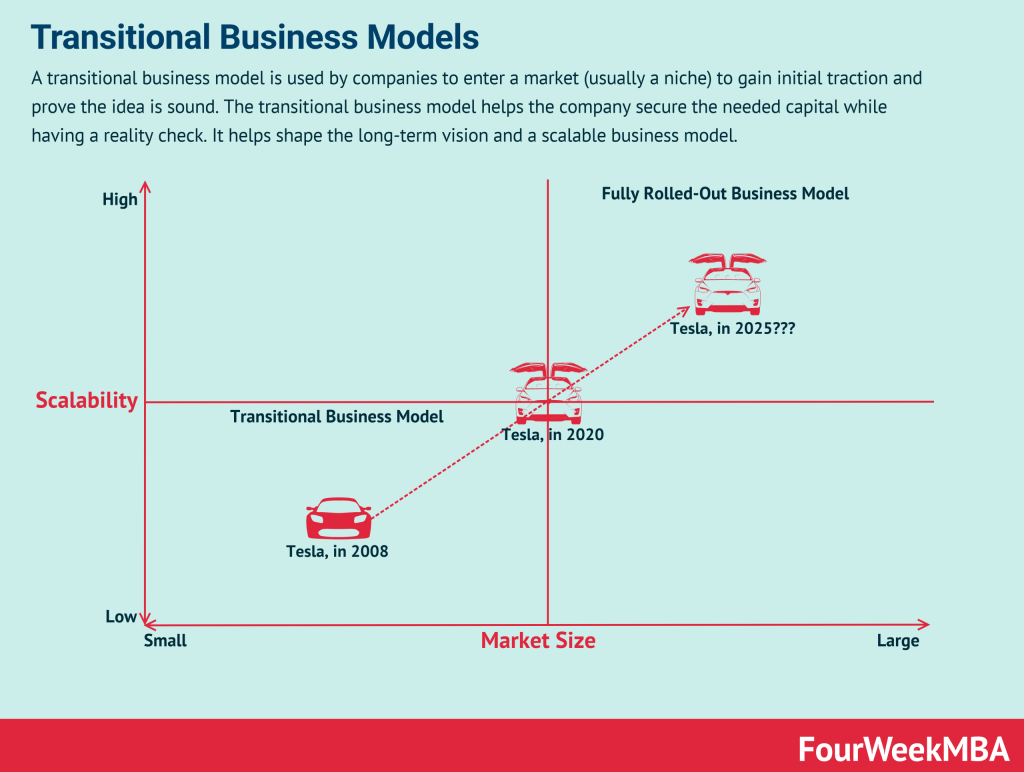
A transitional business model is used by companies to enter a market (usually a niche) to gain initial traction and prove the idea is sound. The transitional business model helps the company secure the needed capital while having a reality check. It helps shape the long-term vision and a scalable businessmodel.
The minimum viable audience (MVA) represents the smallest possible audience that can sustain your business as you get it started from a microniche (the smallest subset of a market). The main aspect of the MVA is to zoom into existing markets to find those people which needs are unmet by existing players.
Business scaling is the process of transformation of a business as the product is validated by wider and wider market segments. Business scaling is about creating traction for a product that fits a small market segment. As the product is validated it becomes critical to build a viable businessmodel. And as the product is offered at wider and wider market segments, it’s important to align product, businessmodel, and organizational design, to enable wider and wider scale.
The market expansion consists in providing a product or service to a broader portion of an existing market or perhaps expanding that market. Or yet, market expansions can be about creating a whole new market. At each step, as a result, a company scales together with the market covered.
In the FourWeekMBA growth matrix, you can apply growth for existing customers by tackling the same problems (gain mode). Or by tackling existing problems, for new customers (expand mode). Or by tackling new problems for existing customers (extend mode). Or perhaps by tackling whole new problems for new customers (reinvent mode).
In the FourWeekMBA Revenue Streams Matrix, revenue streams are classified according to the kind of interactions the business has with its key customers. The first dimension is the “Frequency” of interaction with the key customer. As the second dimension, there is the “Ownership” of the interaction with the key customer.
Revenue model patterns are a way for companies to monetize their business models. A revenue model pattern is a crucial building block of a business model because it informs how the company will generate short-term financial resources to invest back into the business. Thus, the way a company makes money will also influence its overall businessmodel.
A pricingstrategy or model helps companies find the pricing formula in fit with their business models. Thus aligning the customer needs with the product type while trying to enable profitability for the company. A good pricingstrategy aligns the customer with the company’s long term financial sustainability to build a solid businessmodel.
Gennaro is the creator of FourWeekMBA, which reached about four million business people, comprising C-level executives, investors, analysts, product managers, and aspiring digital entrepreneurs in 2022 alone | He is also Director of Sales for a high-tech scaleup in the AI Industry | In 2012, Gennaro earned an International MBA with emphasis on Corporate Finance and Business Strategy.