– A strategic management tool that provides a visual chart to describe, design, challenge, and pivot business models. – Includes nine building blocks: customer
Value Proposition Canvas
– A tool that helps ensure a product or service is positioned around what the customer values and needs. – Focuses on understanding the customer profile and the
SWOT Analysis
– A framework for identifying and analyzing the Strengths, Weaknesses, Opportunities, and Threats of a business or project.
Porter's Five Forces
– A model that analyzes an industry’s competitive forces: competitive rivalry, threat of new entrants, threat of substitutes, bargaining power of buyers, and ba
Lean Startup Methodology
– A methodology for developing businesses and products using short, iterative cycles and validated learning to reduce waste and increase efficiency.
PEST Analysis
– A framework for analyzing the Political, Economic, Social, and Technological factors that could impact a business.
Revenue Model
– Describes how a company makes money through various revenue streams. – Includes models like subscription, freemium, licensing, and advertising.
Customer Development Model
– A process for discovering and validating customer needs and building products that meet those needs. – Involves customer discovery, customer validation, custo
A business model is a holistic approach, to understanding how businesses work, and also to building a viable, and scalable business, from scratch. Business modeling, indeed, is about experimenting with the underlying assumptions around a business to make it viable quickly, thus reducing the chances of failure.
Step 1: Define the problem to solve
One of the most common mistakes, when building a business model from scratch, is to fall into the trap of looking for possible solutions, without guessing a problem.
Indeed, the first step is about finding a problem, worth solving.
A great simple tool, for guessing the problem, is Ash Maurya’s Leaner Canvas.
Once you find a problem, the next step is about guessing if there is a minimum viable audience around that problem.
Step 2: Find a minimum viable audience
Once you figured out what problem to solve.
The next question is about making sure there is an audience for that problem. It doesn’t have to be a big audience, quite the opposite.
The minimum viable audience (MVA) represents the smallest possible audience that can sustain your business as you get it started from a microniche (the smallest subset of a market). The main aspect of the MVA is to zoom into existing markets to find those people whose needs are unmet by existing players.
Initially, you want to keep it very small, why?
First, it’s easier to test, and get feedback. Second, you get less competition. Third, you are able to build a personal relationship, which helps create positive feedback loops in the product.
Once you got a minimum viable audience, it’s time to test whether they are really interested.
Step 3: Sell first, then build
When building something from scratch, it’s easy to fall into the trap of asking around people what they think.
For the sake of building a business, asking around, is not a good idea.
You need to sell. Indeed, the sale of your product carries way more information about the customer’s preferences, than anything else.
Business experiments help entrepreneurs test their hypotheses. Rather than define the problem by making too many hypotheses, a digital entrepreneur can formulate a few assumptions, design experiments, and check them against the actions of potential customers. Once measured, the impact, the entrepreneur, will be closer to defining the problem.
Key Highlights of Building a Business Model from Scratch:
Holistic Approach: A business model provides a comprehensive framework for understanding how businesses function and creating a viable and scalable business from the ground up.
Experimentation and Viability: Business modeling involves experimenting with underlying assumptions to quickly establish a viable business, thereby reducing the risk of failure.
Step 1: Define the Problem:
Identify a problem worth solving before seeking solutions.
Tools like Ash Maurya’s Leaner Canvas can aid in defining the problem.
Validate the problem’s significance before proceeding.
Step 2: Find a Minimum Viable Audience (MVA):
Identify a small, niche audience that your business can sustain initially.
Focus on individuals whose needs are not met by existing players.
Benefits of MVA: easier testing, less competition, personalized relationships.
Step 3: Sell First, Then Build:
Instead of seeking opinions, focus on making sales.
Sales reveal customer preferences through revealed preferences.
Pre-selling demonstrates genuine customer interest in your product.
Step 4: Build, Launch, and Iterate Fast:
Begin building with a simple first version.
Prioritize testing the market and gathering feedback over technical complexity.
Business advantage comes from market understanding.
Step 5: Refine and Test Assumptions:
Continuously test assumptions and hypotheses.
Challenge limiting beliefs and refine your model based on results.
Ideas that appear promising may not work, and vice versa.
Distinguish between fake feedback (compliments) and real feedback (sales, engagement).
Business Experiments:
Entrepreneurs use experiments to test hypotheses and assumptions.
Formulate a few assumptions, design experiments, and measure customer responses.
Genuine engagement, sales, and community involvement provide more valuable feedback than superficial indicators.
Problem Definition through Experimentation:
Instead of prematurely defining the problem, entrepreneurs use experiments to validate assumptions and adjust their understanding of the problem.
Experiment results guide entrepreneurs towards accurate problem definition.
Related Frameworks, Concepts, Models
Description
When to Apply
Business Model Canvas
– A strategic management tool that provides a visual chart to describe, design, challenge, and pivot business models. – Includes nine building blocks: customer segments, value propositions, channels, customer relationships, revenue streams, key resources, key activities, key partnerships, and cost structure.
– Apply when needing to develop, describe, or innovate business models. – Useful for startups and established businesses looking to pivot or optimize their strategy.
Value Proposition Canvas
– A tool that helps ensure a product or service is positioned around what the customer values and needs. – Focuses on understanding the customer profile and the value map.
– Use to align product offerings with customer needs and preferences. – Essential for developing compelling value propositions.
SWOT Analysis
– A framework for identifying and analyzing the Strengths, Weaknesses, Opportunities, and Threats of a business or project.
– Apply to assess internal and external factors affecting the business. – Useful for strategic planning and decision-making.
Porter’s Five Forces
– A model that analyzes an industry’s competitive forces: competitive rivalry, threat of new entrants, threat of substitutes, bargaining power of buyers, and bargaining power of suppliers.
– Use to understand the competitive landscape and identify strategic positions. – Essential for market analysis and strategy development.
Lean Startup Methodology
– A methodology for developing businesses and products using short, iterative cycles and validated learning to reduce waste and increase efficiency.
– Apply to start new businesses or introduce new products with a focus on rapid experimentation and customer feedback.
PEST Analysis
– A framework for analyzing the Political, Economic, Social, and Technological factors that could impact a business.
– Use to understand the macro-environmental factors affecting the business. – Essential for strategic planning and risk management.
Revenue Model
– Describes how a company makes money through various revenue streams. – Includes models like subscription, freemium, licensing, and advertising.
– Apply to determine the best ways to generate revenue and sustain the business. – Useful for financial planning and strategy.
Customer Development Model
– A process for discovering and validating customer needs and building products that meet those needs. – Involves customer discovery, customer validation, customer creation, and company building.
– Use to ensure product-market fit and reduce the risk of product failure. – Essential for startups and new product launches.
Value Chain Analysis
– A strategy tool used to analyze internal firm activities. Its goal is to recognize which activities are the most valuable (i.e., are the source of cost or differentiation advantage).
– Apply to identify and optimize value-creating activities within the business. – Useful for gaining a competitive edge.
Business Model Innovation
– The process of creating, reworking, or redesigning a business model to gain competitive advantage and deliver new value.
– Use to respond to changing market conditions and disruptive technologies. – Essential for continuous improvement and long-term sustainability.
A Blockchain Business Model according to the FourWeekMBA framework is made of four main components: Value Model (Core Philosophy, Core Values and Value Propositions for the key stakeholders), Blockchain Model (Protocol Rules, Network Shape and Applications Layer/Ecosystem), Distribution Model (the key channels amplifying the protocol and its communities), and the Economic Model (the dynamics/incentives through which protocol players make money). Those elements coming together can serve as the basis to build and analyze a solid Blockchain Business Model.
In an asymmetric businessmodel, the organization doesn’t monetize the user directly, but it leverages the data users provide coupled with technology, thus have a key customer pay to sustain the core asset. For example, Google makes money by leveraging users’ data, combined with its algorithms sold to advertisers for visibility.
In a business world driven by technology and digitalization, competition is much more fluid, as innovation becomes a bottom-up approach that can come from anywhere. Thus, making it much harder to define the boundaries of existing markets. Therefore, a proper business competition analysis looks at customer, technology, distribution, and financial model overlaps. While at the same time looking at future potential intersections among industries that in the short-term seem unrelated.
Technological modeling is a discipline to provide the basis for companies to sustain innovation, thus developing incremental products. While also looking at breakthrough innovative products that can pave the way for long-term success. In a sort of Barbell Strategy, technological modeling suggests having a two-sided approach, on the one hand, to keep sustaining continuous innovation as a core part of the businessmodel. On the other hand, it places bets on future developments that have the potential to break through and take a leap forward.
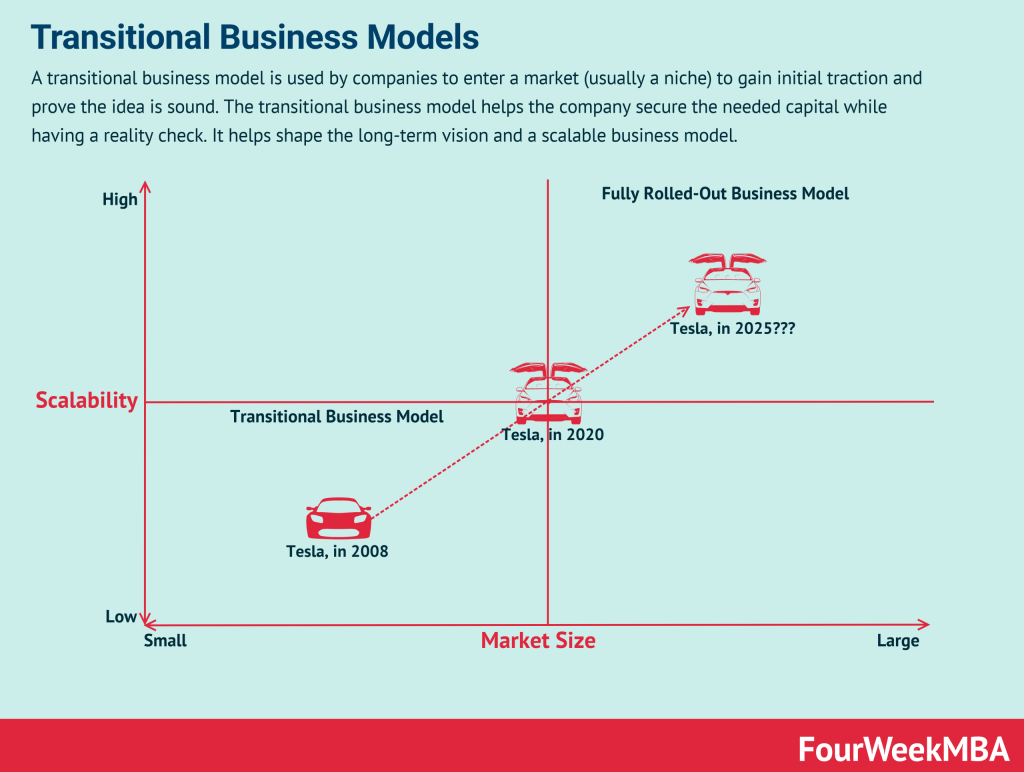
A transitional business model is used by companies to enter a market (usually a niche) to gain initial traction and prove the idea is sound. The transitional business model helps the company secure the needed capital while having a reality check. It helps shape the long-term vision and a scalable businessmodel.
The minimum viable audience (MVA) represents the smallest possible audience that can sustain your business as you get it started from a microniche (the smallest subset of a market). The main aspect of the MVA is to zoom into existing markets to find those people which needs are unmet by existing players.
Business scaling is the process of transformation of a business as the product is validated by wider and wider market segments. Business scaling is about creating traction for a product that fits a small market segment. As the product is validated it becomes critical to build a viable businessmodel. And as the product is offered at wider and wider market segments, it’s important to align product, businessmodel, and organizational design, to enable wider and wider scale.
The market expansion consists in providing a product or service to a broader portion of an existing market or perhaps expanding that market. Or yet, market expansions can be about creating a whole new market. At each step, as a result, a company scales together with the market covered.
In the FourWeekMBA growth matrix, you can apply growth for existing customers by tackling the same problems (gain mode). Or by tackling existing problems, for new customers (expand mode). Or by tackling new problems for existing customers (extend mode). Or perhaps by tackling whole new problems for new customers (reinvent mode).
In the FourWeekMBA Revenue Streams Matrix, revenue streams are classified according to the kind of interactions the business has with its key customers. The first dimension is the “Frequency” of interaction with the key customer. As the second dimension, there is the “Ownership” of the interaction with the key customer.
Revenue model patterns are a way for companies to monetize their business models. A revenue model pattern is a crucial building block of a business model because it informs how the company will generate short-term financial resources to invest back into the business. Thus, the way a company makes money will also influence its overall businessmodel.
A pricingstrategy or model helps companies find the pricing formula in fit with their business models. Thus aligning the customer needs with the product type while trying to enable profitability for the company. A good pricingstrategy aligns the customer with the company’s long term financial sustainability to build a solid businessmodel.
Gennaro is the creator of FourWeekMBA, which reached about four million business people, comprising C-level executives, investors, analysts, product managers, and aspiring digital entrepreneurs in 2022 alone | He is also Director of Sales for a high-tech scaleup in the AI Industry | In 2012, Gennaro earned an International MBA with emphasis on Corporate Finance and Business Strategy.