Solopreneurs are entrepreneurs who operate as a single individual, often using digital tools and leveraging automation to run lean businesses. They focus on microniches and can achieve significant revenue with minimal overhead.
When an individual seeks to start and grow a business independently, often in a digital or niche-focused market.
Offers independence and flexibility in business operations.
May face challenges with workload and limited resources.
SMART Goals
SMART goals are well-defined objectives that are Specific, Measurable, Achievable, Relevant, and Time-based. They are used to create clear and trackable targets in various contexts, including personal and professional goal setting.
When setting goals that need to be specific, measurable, achievable, relevant, and time-bound to increase the likelihood of success.
Provides a structured framework for goal setting and tracking.
Requires careful planning and consideration of each SMART component.
Personal Mission Statement
A personal mission statement helps individuals clarify their life’s purpose, values, and passions. It aids in setting and communicating personal goals and growth strategies.
When individuals want to define their values, beliefs, and long-term goals, fostering personal growth and decision-making.
Promotes self-awareness and aligns actions with personal values.
Crafting a meaningful mission statement may require introspection.
Elevator Pitch
An elevator pitch is a concise and engaging speech used to introduce oneself, a business, or a product quickly and effectively. It is especially important in sales and networking scenarios.
When individuals or businesses need a brief and impactful way to present themselves or their offerings to potential audiences.
Grabs attention quickly and communicates essential information.
Crafting a compelling pitch can be challenging and requires practice.
Six Thinking Hats
The Six Thinking Hats model, developed by Edward de Bono, helps individuals approach problem-solving and decision-making from different perspectives, taking into account personality types and viewpoints.
When teams want to improve their problem-solving and decision-making processes by considering various angles and minimizing biases.
Enhances creativity and encourages diverse thinking in group discussions.
May require structured facilitation to be effective in group settings.
Brand Voice
Brand voice defines how a brand communicates with its target audience, reflecting its personality traits and values. It plays a crucial role in conveying a consistent brand identity and connecting with the desired audience.
When businesses want to establish a consistent and recognizable communication style that resonates with their target audience.
Builds brand recognition and fosters a connection with the audience.
Crafting and maintaining a brand voice may require ongoing efforts.
Minimum Viable Audience
The Minimum Viable Audience (MVA) represents the smallest audience that can sustain a business. Solopreneurs often start with a MVA in a microniche, addressing the unmet needs of a small but profitable customer segment.
When launching a new business, especially in a competitive market, it’s essential to identify a niche audience that can support the initial growth.
Allows for focused marketing efforts and efficient resource allocation.
Scaling beyond the MVA may require targeting larger customer segments.
Microniche
A microniche is a subset of potential customers within a niche market. It involves identifying a highly specialized and often underserved segment of the market to establish a unique position and competitive advantage.
When businesses aim to differentiate themselves in a crowded market by targeting a specific and profitable subset of customers.
Reduces competition and allows for tailored product or service offerings.
May limit growth potential compared to broader market strategies.
Customer Segmentation
Customer segmentation is a marketing strategy that categorizes customers into sub-groups with similar characteristics. It helps businesses tailor their marketing, product development, and communication to meet the specific needs of each segment.
When organizations want to align their strategies with the diverse characteristics and preferences of their customer base.
Enhances marketing effectiveness and personalizes customer experiences.
Requires data analysis and ongoing adjustments as segments evolve.
Social Selling
Social selling is a sales approach that focuses on building relationships and trust with prospects through social media platforms. It involves engaging with potential customers before attempting to close a sale, leading to more effective sales cycles.
When sales teams want to leverage social media platforms to establish rapport and nurture relationships with prospects, ultimately improving sales outcomes.
Enhances trust and engagement, leading to more effective sales interactions.
Requires time and effort to build meaningful social connections.
AIDA Model
The AIDA model (Attention, Interest, Desire, Action) outlines the stages a customer may go through before making a purchase decision. It helps organizations structure their marketing efforts to guide potential customers along this journey.
When organizations want to design marketing campaigns and strategies that capture attention, generate interest, stimulate desire, and prompt action among their target audience.
Provides a framework for planning and optimizing marketing activities.
May oversimplify the complexities of customer decision-making processes.
Inverted Pyramid
The inverted pyramid is a journalistic style that presents information with the most critical details at the beginning, followed by less important details. It aims to grab the reader’s attention quickly and provide immediate value.
When creating news articles or content that requires engaging the audience quickly by providing essential information upfront, making it ideal for readers with limited time.
Ensures important information is conveyed immediately for maximum impact.
May not work well for all types of content or storytelling approaches.
CHAMP Methodology
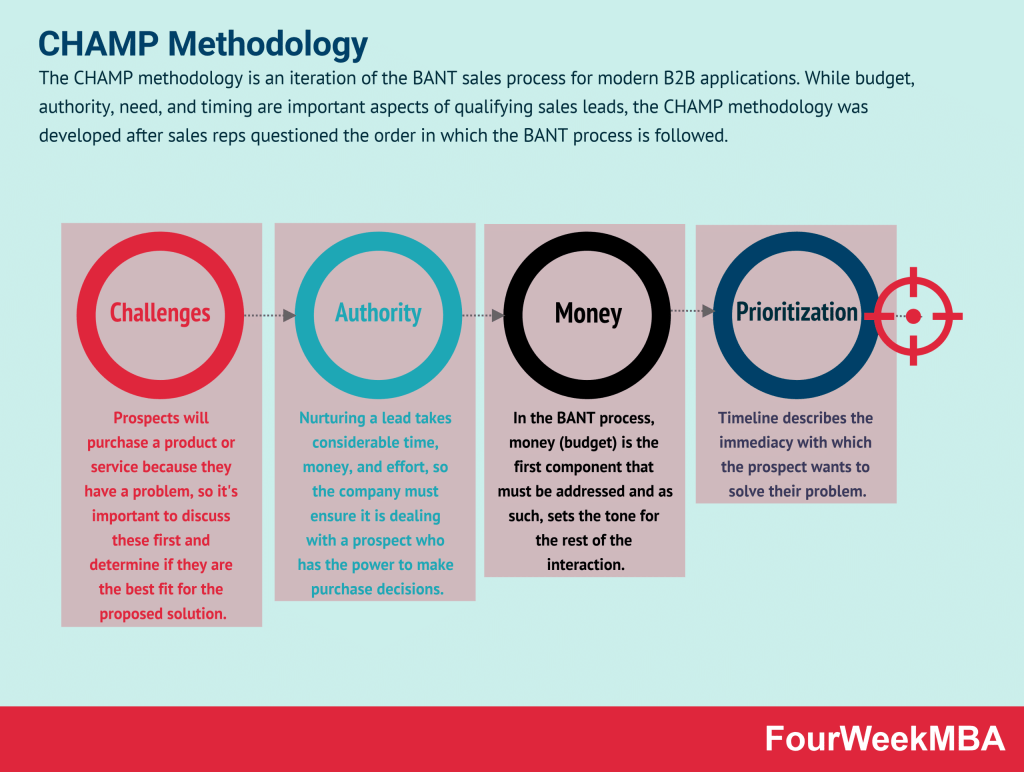
The CHAMP methodology is a sales qualification framework used in B2B sales. It stands for Challenges, Authority, Money, and Prioritization. It helps sales teams assess prospects and prioritize leads based on their readiness to make a purchase.
When B2B sales teams need to qualify leads effectively by evaluating their challenges, decision-making authority, available budget, and prioritization of their needs.
Streamlines lead qualification and improves resource allocation.
Requires training and consistent implementation for maximum effectiveness.
BANT Sales Process
The BANT sales process (Budget, Authority, Need, Timing) was created by IBM to identify prospects likely to make a purchase. It helps sales teams prioritize leads based on these four criteria, focusing resources on high-potential prospects.
When sales teams want to qualify and prioritize leads by assessing their budget, decision-making authority, needs, and timing for purchase, improving sales efficiency.
Provides a structured approach to lead qualification and resource allocation.
May not consider all factors influencing a prospect’s readiness to buy.
MEDDIC Sales Process
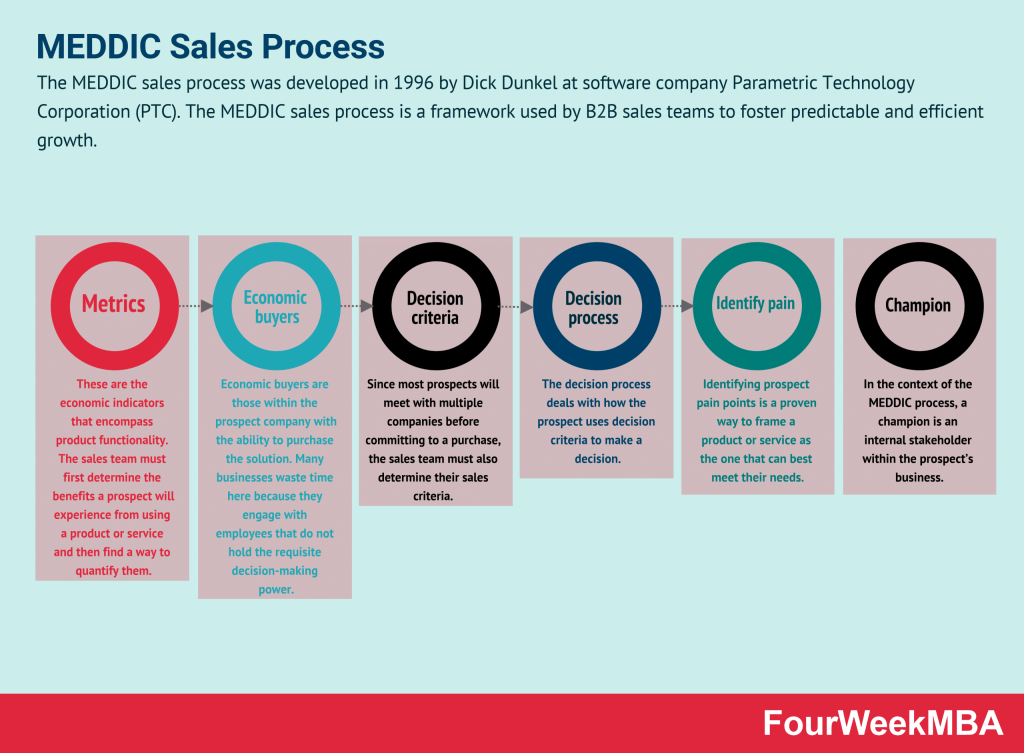
The MEDDIC sales process (Metrics, Economic Buyer, Decision Criteria, Decision Process, Identify Pain, Champion) is a framework for B2B sales teams. It helps assess the readiness of prospects by evaluating various criteria, streamlining the sales process.
When B2B sales teams want to qualify leads by examining metrics, identifying economic decision-makers, understanding decision criteria, and assessing prospects’ pain points.
Enhances lead qualification and sales efficiency in complex B2B sales environments.
Requires training and consistent implementation for maximum effectiveness.
Bullseye Framework
The Bullseye Framework helps businesses prioritize and identify the most effective marketing channels for gaining traction. It involves testing various channels to find the ones that work best and focusing resources on them for growth.
When businesses want to optimize their marketing efforts by identifying and prioritizing the most effective channels to reach their target audience and drive growth.
Efficiently allocates marketing resources based on performance data.
Requires ongoing testing and adaptation to determine channel effectiveness.
Growth Hacking
Growth hacking is a mindset and set of techniques aimed at achieving rapid growth through creative marketing strategies and experimentation. It often involves unconventional approaches to gain traction and scale quickly.
When startups or businesses seek to accelerate their growth by adopting innovative and experimental marketing strategies to attract and retain customers.
Drives rapid growth through creative and unconventional marketing tactics.
Success may be unpredictable, and not all experiments yield positive results.
Regret Minimization
The regret minimization framework helps individuals make decisions by considering their future regrets. It involves projecting oneself into the future, imagining potential regrets, and evaluating whether taking action or not taking action leads to greater regrets.
When making significant life or business decisions, individuals can use this framework to assess whether taking a particular opportunity or action aligns with their long-term aspirations and minimizes future regrets.
Encourages thoughtful decision-making by considering long-term consequences.
Relies on subjective assessment and personal preferences.
Speed-Reversibility Matrix
The Speed-Reversibility Matrix is a tool that assesses the impact and reversibility of decisions. It helps individuals and businesses make choices by categorizing them into quadrants based on the speed of execution and the ease of reversal, guiding decision-making.
When facing important decisions, this framework allows for the categorization of choices based on the urgency of implementation and the ability to reverse course if necessary.
Provides a structured approach to decision-making, considering both speed and reversibility.
May require subjective judgment in categorizing decisions accurately.
Asymmetric Betting
Asymmetric betting involves evaluating opportunities based on their potential impact and ease of reversal. It encourages taking actions with high potential impact and low reversibility, aligning with the concept of making “asymmetric bets” for significant gains.
When individuals or businesses want to identify opportunities where the potential gains significantly outweigh the potential losses and are willing to take calculated risks for substantial rewards.
Encourages strategic thinking and prioritization of high-impact opportunities.
Success may depend on accurate assessment of potential impact and reversibility.
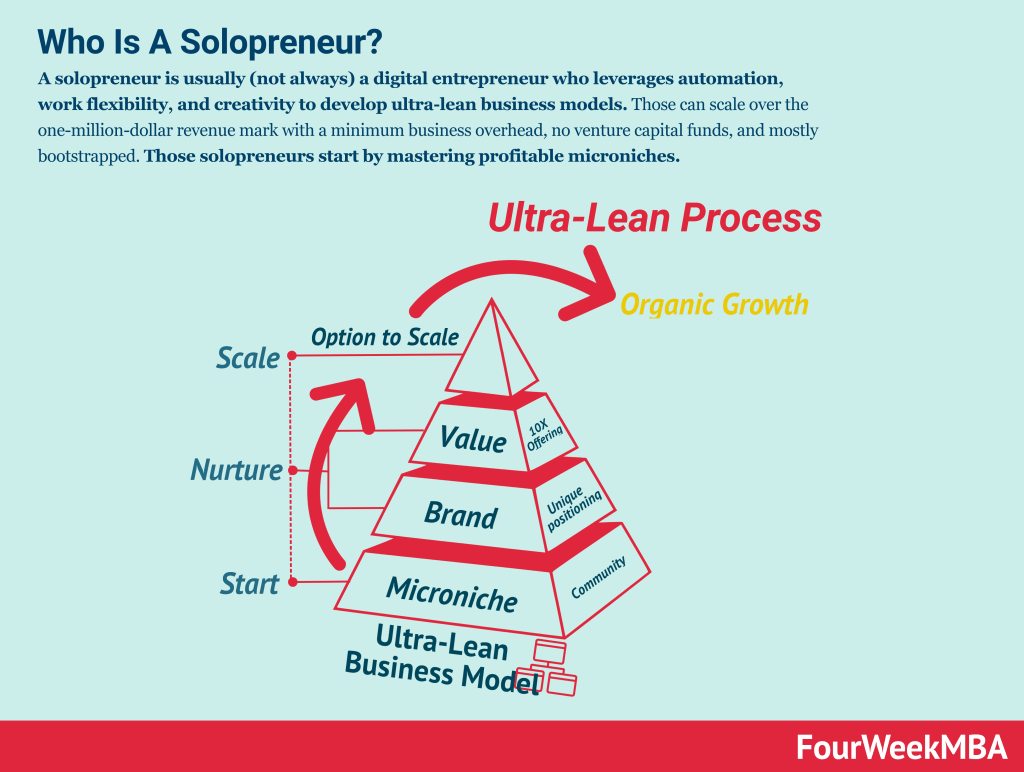
A solopreneur is usually (not always) a digital entrepreneur who leverages automation, work flexibility, and creativity to develop ultra-lean business models. Those can scale over the one-million-dollar revenue mark with a minimum business overhead, no venture capital funds, and mostly bootstrapped. Those solopreneurs start by mastering profitable microniches.
The SWOT analysis is commonly used as a strategic planning tool in business. However, it is also well suited for personal use in addressing a specific goal or problem. A personal SWOT analysis helps individuals identify their strengths, weaknesses, opportunities, and threats.
A SMART goal is any goal with a carefully planned, concise, and trackable objective. To be such a goal needs to be specific, measurable, achievable, relevant, and time-based. Bringing structure and trackability to goal setting increases the chances goals will be achieved, and it helps align the organization around those goals.
A personal mission statement clarifies what is important in life to an individual. A personal mission statement is a written statement of purpose that allows individuals to define their calling in life. It helps clarify goals, values, beliefs, or passions, communicate them, and better execute a personal growthstrategy.
An elevator pitch is a short speech that introduces an individual, business, or product. Brevity is particularly important in sales, where a pitch must be able to sell itself quickly. Brevity also demonstrates that the person making a pitch has a personal and professional aptitude and can think on their feet during unexpected situations.
The Six Thinking Hats model was created by psychologist Edward de Bono in 1986, who noted that personality type was a key driver of how people approached problem-solving. For example, optimists view situations differently from pessimists. Analytical individuals may generate ideas that a more emotional person would not, and vice versa.
The brand voice describes how a brand communicates with its target audience. The exact style of communication is based on the brand persona or the collection of personality traits and values that a brand embodies regularly, and it needs to communicate the brand’s essence to the desired target audience.
The minimum viable audience (MVA) represents the smallest possible audience that can sustain your business as you get it started from a microniche (the smallest subset of a market). The main aspect of the MVA is to zoom into existing markets to find those people which needs are unmet by existing players.
A microniche is a subset of potential customers within a niche. In the era of dominating digital super-platforms, identifying a microniche can kick off the strategy of digital businesses to prevent competition against large platforms. As the microniche becomes a niche, then a market, scale becomes an option.
Customer segmentation is a marketing method that divides the customers into sub-groups, that share similar characteristics. Thus, product, marketing, and engineering teams can center the strategy from go-to-market to product development and communication around each sub-group. Customer segments can be broken down in several ways, such as demographics, geography, psychographics, and more.
Social selling is a process of developing trust, rapport, and a relationship with a prospect to enhance the sales cycle. It usually happens through tech platforms (like LinkedIn, Twitter, Facebook, and more), which enable salespeople to engage with potential prospects before closing the sale, thus becoming more effective.
AIDA stands for attention, interest, desire, and action. That is a model that is used in marketing to describe the potential journey a customer might go through before purchasing a product or service. The AIDA model helps organizations focus their efforts when optimizing their marketing activities based on the customers’ journeys.
The inverted pyramid style is a process used in journalism which inverts the logic of the way a story is told. Rather than start from the story details, you start from a hook, which is critical to get the reader interested, thus giving it a quick pay off.
The CHAMP methodology is an iteration of the BANT sales process for modern B2B applications. While budget, authority, need, and timing are important aspects of qualifying sales leads, the CHAMP methodology was developed after sales reps questioned the order in which the BANT process is followed.
The BANT process was conceived at IBM in the 1950s as a way to quickly identify prospects most likely to make a purchase. Despite its introduction around 70 years ago, the BANT process remains relevant today and was formally adopted into IBM’s Business Agility Solution Identification Guide.
The MEDDIC sales process was developed in 1996 by Dick Dunkel at software company Parametric Technology Corporation (PTC). The MEDDIC sales process is a framework used by B2B sales teams to foster predictable and efficient growth.
The bullseye framework is a simple method that enables you to prioritize the marketing channels that will make your company gain traction. The main logic of the bullseye framework is to find the marketing channels that work and prioritize them.
The growth hackingcanvas is a tool and framework to have a set of processes that allow you to ask the right questions to generate growth ideas, consistently.
A regret minimization framework is a business heuristic that enables you to make a decision, by projecting yourself in the future, at an old age, and visualize whether the regrets of missing an opportunity would hunt you down, vs. having taken the opportunity and failed. In short, if taking action and failing feels much better than regretting it, in the long run, that is when you’re ready to go!
Another dimension of asymmetric betting is given by how impactful the idea can be to the business. When we have asymmetric bets that can have a high impact and are easy to reverse, we get to the “Jackpot” and go into an “All-In-Mode” of action! And how easy to reverse.
Key Highlights
Solopreneur:
A digital entrepreneur using automation, creativity, and flexibility.
Develops lean business models that can scale without venture capital.
Mastering profitable microniches is a common approach.
Personal SWOT Analysis:
Strategic planning tool for individuals addressing specific goals.
Identifies strengths, weaknesses, opportunities, and threats.
SMART Goals:
Goals with specific, measurable, achievable, relevant, and time-based objectives.
Increases goal achievability and organizational alignment.
Personal Mission Statement:
Written statement of life purpose, goals, values, beliefs, or passions.
Clarifies personal growthstrategy and guides decision-making.
Elevator Pitch:
Brief speech introducing an individual, business, or product.
Requires concise communication and quick impact.
Six Thinking Hats:
Developed by Edward de Bono for problem-solving.
Different colored hats represent different perspectives in problem-solving.
Brand Voice:
Defines how a brand communicates with its audience.
Reflects the brand persona and values to connect with the target audience.
Minimum Viable Audience (MVA):
Smallest audience sustaining a business, often from a microniche.
Focuses on unmet needs in existing markets.
Microniche:
Subset of potential customers within a niche market.
Effective strategy against competition from larger platforms.
Customer Segmentation:
Divides customers into sub-groups sharing similar characteristics.
Aids targeting, product development, and communication strategies.
Social Selling:
Builds rapport and trust with prospects using social platforms.
Enhances sales cycle effectiveness and engagement.
Gennaro is the creator of FourWeekMBA, which reached about four million business people, comprising C-level executives, investors, analysts, product managers, and aspiring digital entrepreneurs in 2022 alone | He is also Director of Sales for a high-tech scaleup in the AI Industry | In 2012, Gennaro earned an International MBA with emphasis on Corporate Finance and Business Strategy.