Facebook, now Meta Platforms, has completed approximately 90 acquisitions at the time of writing.
Many of these acquisitions were deemed “talent acquisitions” where a company takes over another primarily to recruit its employees and not to control its products and services. In some circles, this is a strategy known by the portmanteau term “acqui-hiring”.
Like Google’s acquisition of YouTube six years earlier, the purchase of Instagram was initially seen as exorbitant – a claim no doubt stemming from the fact that Instagram employed just 13 people before it was taken over.
Ultimately, however, the purchase has paid handsome dividends for Facebook.
Facebook purchased customer services startup Kustomer in December 2020 for around $1 billion.
Founded by Brad Birnbaum and Jeremy Suriel, Kustomer possessed CRM capabilities that would enable Facebook to bolster similar services for businesses on its platform.
We have to travel back to 2014 for Facebook’s purchase of video ad tech startup LiveRail. The deal to acquire the platform, which connects marketers to publishers on mobile and web, was estimated to be worth $400-500 million.
LiveRail’s platform featured a substantial customer base including ABC Family, Gannett, Dailymotion, and Major League Baseball.
The deal was seen as a way for Facebook to profit from the fast-growing medium of video advertising and combine its data with LiveRail to boost its ad targeting capabilities.
CTRL-labs
CTRL-labs is a neural interface startup that was acquired by Facebook in September 2019.
This made it the most substantial purchase since the acquisition of Oculus VR in 2014.
Headed by CEO and former Internet Explorer creator Thomas Reardon, the company’s core product was a wristband that could transform neuromuscular signals into commands a machine could interpret.
Face.com
At around $60 million, the purchase of Face.com was one of Facebook’s least expensive. However, it was considered one of its more important.
Face.com was an Israeli company and developer of facial recognition technology that the social media giant could use to enable users to tag others in mobile photos.
Without this capability, Facebook was losing countless opportunities to increase engagement via tagging and user suggestions.
Key takeaways:
Facebook, now Meta Platforms, has completed approximately 90 acquisitions at the time of writing. Some of these were instituted to acquire the target company’s skilled talent with control over products and services less of an immediate concern.
Facebook’s purchase of Instagram is one of its most successful, despite initial criticism that the $1 billion asking price was too much for a company with 13 employees.
Other perhaps lesser-known acquisitions include CRM developer Kustomer, video ad tech startup LiveRail, and facial recognition tech company Face.com.
Mark Zuckerberg is the largest shareholder in the company. Zuckerberg retains ownership and control of the company. Like Google, Facebook has issued two common stocks, Class A and Class B. The holders of Class B common stocks are entitled to ten votes per share, and holders of our Class A common stocks are entitled to one vote per share. Mark Zuckerberg has a voting power of 61.1%; he’s the primary decision-maker. Other individual investors comprise Sheryl Sandberg, Christopher Cox, Marc Andreessen, Peter Thiel, Dustin Moskovitz, and Eduardo Saverin.
Facebook, the main product of Meta is an attention merchant. As such, its algorithms condense the attention of over 2.91 billion monthly active users as of June 2021. Meta generated $117.9 billion in revenues, in 2021, of which $114.9 billion from advertising (97.4% of the total revenues) and over $2.2 billion from Reality Labs (the augmented and virtual reality products arm).
Facebook generated most of its revenue from advertising in 2023. Indeed, the company generated $131.95B from advertising, $1.89B billion from its reality labs segment, and over a billion in other revenue.
By September 2022, Facebook’s (Meta) employee count had peaked at 87,314. Yet, as revenue slew down for the first time in years, the company announced a layoff of 13% of its workforce, bringing the headcount to 75,964. By March 2023, Meta announced another round of layoffs, dubbed “The Year of Efficiency,” which brought the headcount down to less than 66 thousand employees. By the end of 2023, Facebook reported 67,317 employees.
In 2022, post layoffs, Facebook generated $1,535,056 per employee, compared to $1,638,586 in 2021. In 2023, as Facebook (now Meta) completed its mass layoffs, the company reported nearly $135 billion in revenue and 67,317 employees, with a $2,003,981 revenue per employee.
Facebook (Meta) gained users in 2023. In fact, in 2023, Facebook had over three billion users worldwide, of which 272 million were in Canada, 408 million were in Europe, over 1.3 billion were in Asia, and over a billion were in the rest of the world.
ARPU, or average revenue per user, is a crucial metric for attention merchants like Facebook. It assesses the ability of the platform to monetize its users. For instance, by the end of 2023, Meta’s ARPU worldwide was $13.12. In the US & Canada, it was $68.44; in Europe, it was $23.14; in Asia-Pacific, $5.52; and in the rest of the world, it was $4.50.
ARPU, or average revenue per user, is a crucial metric for attention merchants like Facebook. It assesses the ability of the platform to monetize its users. For instance, by the end of 2023, Meta’s ARPU worldwide was $13.12. In the US & Canada, it was $68.44; in Europe, it was $23.14; in Asia-Pacific, $5.52; and in the rest of the world, it was $4.50.
Facebook (Meta) revenue in 2023 increased to $134.9B, compared to $116.6B in 2022. Its profitability increased to $39.1B in 2023, compared to $23.2B in 2022 and $39.37B in 2021.
Facebook is characterized by a multi-faceted matrix organizational structure. The company utilizes a flat organizational structure in combination with corporate function-based teams and product-based or geographic divisions. The flat organizationstructure is organized around the leadership of Mark Zuckerberg, and the key executives around him. On the other hand, the function-based teams based on the main corporate functions (like HR, productmanagement, investor relations, and so on).
Instagram makes money via visual advertising. Acquired by Facebook for a billion-dollar in 2012, today, Instagram is integrated into the overall Facebook (now rebranded as Meta) business strategy. In 2018, Instagram founders Kevin Systrom and Mike Krieger left the company as Facebook pushed toward tighter integration of the two platforms. In 2022, Instagram is the most successful product still, in Meta’s portfolio.
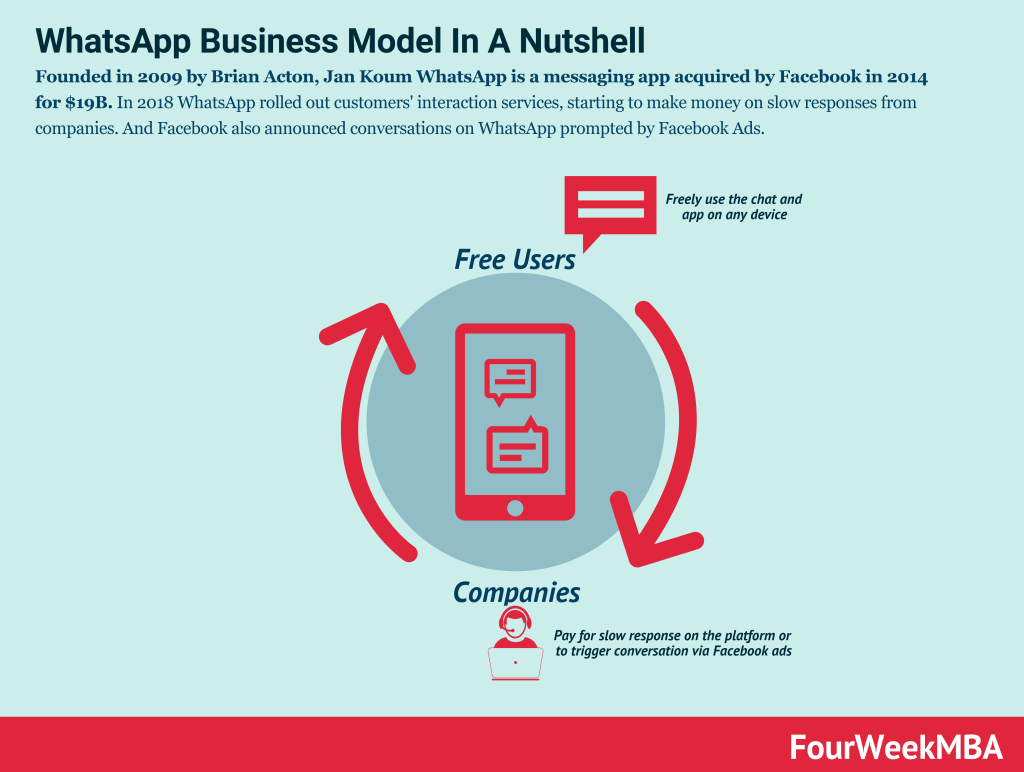
Founded in 2009 by Brian Acton, Jan Koum WhatsApp is a messaging app acquired by Facebook in 2014 for $19B. In 2018 WhatsApp rolled out customers’ interaction services, starting to make money on slow responses from companies. And Facebook also announced conversations on WhatsApp prompted by Facebook Ads.
Gennaro is the creator of FourWeekMBA, which reached about four million business people, comprising C-level executives, investors, analysts, product managers, and aspiring digital entrepreneurs in 2022 alone | He is also Director of Sales for a high-tech scaleup in the AI Industry | In 2012, Gennaro earned an International MBA with emphasis on Corporate Finance and Business Strategy.