Digital commons are freely accessible to all members of the community.
Barriers to access, such as paywalls or restrictive licenses, are minimized to promote widespread use and sharing.
Collaborative Creation:
Digital commons are created collaboratively by a diverse community of contributors.
Users contribute their expertise, resources, and insights to the collective pool of knowledge and content.
Shared Ownership:
Resources in the digital commons are considered shared assets owned by the community.
Contributors retain certain rights to their contributions while allowing others to build upon and remix their work.
Key Features of Digital Commons:
Open Licensing:
Digital commons often utilize open licenses, such as Creative Commons licenses, to govern how resources can be used, shared, and modified.
These licenses provide flexibility while ensuring attribution and respect for creators’ rights.
Collaboration Platforms:
Online platforms such as Wikimedia Commons, GitHub, and OpenStreetMap provide infrastructure for hosting and managing digital commons projects.
These platforms facilitate collaboration, version control, and community engagement.
Community Governance:
Digital commons projects may be governed by community-led organizations or decentralized governance structures.
Decision-making processes are transparent, participatory, and reflective of the community’s values and goals.
Benefits of Digital Commons:
Access to Knowledge:
Digital commons promote universal access to knowledge, education, and cultural resources.
Users can freely access and use resources for learning, research, and creative expression.
Innovation and Creativity:
By enabling collaboration and remixing of content, digital commons foster innovation and creativity.
Users can build upon existing works to create new ideas, products, and solutions.
Community Building:
Participation in digital commons projects builds a sense of belonging and community among contributors.
Users connect with like-minded individuals, share interests, and collaborate on shared goals.
Cultural Preservation:
Digital commons play a role in preserving and promoting cultural heritage, languages, and traditions.
Indigenous knowledge, historical documents, and cultural artifacts can be digitized and shared for future generations.
Challenges of Digital Commons:
Sustainability:
Ensuring the long-term sustainability of digital commons projects requires funding, infrastructure, and community support.
Balancing financial sustainability with the principles of open access and collaboration is a recurring challenge.
Quality Control:
Maintaining quality and reliability in digital commons projects can be challenging due to the decentralized nature of collaboration.
Mechanisms for peer review, moderation, and curation are necessary to ensure the accuracy and credibility of content.
Legal and Ethical Considerations:
Digital commons projects must navigate legal and ethical considerations related to copyright, licensing, and user privacy.
Resolving conflicts around intellectual property rights and addressing issues of misinformation and abuse requires careful attention.
Case Studies of Successful Digital Commons:
Wikipedia:
Wikipedia is a community-driven online encyclopedia that allows users to collaboratively create, edit, and share content.
It has become one of the largest and most widely used digital commons projects, covering a wide range of topics in multiple languages.
OpenStreetMap:
OpenStreetMap is a collaborative mapping project that enables users to create and edit maps of the world.
Contributors collect and share geographic data, which is freely available for use in applications, navigation systems, and research.
Creative Commons:
Creative Commons is a nonprofit organization that provides free, standardized licenses for creative works.
These licenses allow creators to retain copyright while granting permissions for others to use, share, and remix their works.
Conclusion:
Digital commons represent a paradigm shift in how knowledge, resources, and creativity are created, shared, and managed in the digital age. By promoting open access, collaboration, and shared ownership, digital commons projects empower individuals to contribute to a global pool of knowledge and cultural resources. While challenges such as sustainability, quality control, and legal considerations exist, the benefits in terms of universal access, innovation, and community building make digital commons a powerful model for fostering creativity, learning, and cultural exchange in our interconnected world.
Key Highlights
Digital Commons:
Refers to collectively created, shared, and managed digital resources, including software, data, and creative content.
Principles:
Open Access: Resources freely accessible to all, minimizing barriers like paywalls.
Collaborative Creation: Created by a diverse community of contributors sharing expertise.
Shared Ownership: Community-owned assets with contributors retaining certain rights.
Key Features:
Open Licensing: Utilizes licenses like Creative Commons for flexible usage.
Collaboration Platforms: Online platforms like Wikimedia Commons facilitate collaboration.
Community Governance: Decentralized decision-making reflective of community values.
Benefits:
Access to Knowledge: Promotes universal access to education, research, and cultural resources.
Innovation and Creativity: Fosters innovation by enabling collaboration and remixing of content.
Community Building: Connects contributors, fostering a sense of belonging and shared goals.
Cultural Preservation: Contributes to preserving cultural heritage and knowledge for future generations.
Challenges:
Sustainability: Ensuring long-term viability while balancing financial needs and open access principles.
Quality Control: Maintaining content accuracy and reliability in a decentralized collaboration environment.
Legal and Ethical Considerations: Navigating copyright, licensing, and privacy issues.
Case Studies:
Wikipedia: Community-driven encyclopedia covering a vast array of topics in multiple languages.
Creative Commons: Offers standardized licenses for creative works, balancing creator rights and sharing permissions.
Conclusion:
Digital Commons transform knowledge sharing and creativity, promoting openness and collaboration.
Despite challenges, the benefits in access, innovation, and community engagement make them vital in the digital age.
Related Organizational Structures
Description
Implications
Digital Commons
– Shared resources, knowledge, or cultural artifacts that are freely accessible and usable by the public. – Promotes collaboration, creativity, and innovation. – Operates on principles of openness, inclusivity, and community ownership. – Can include software, data, educational materials, and creative works.
– Access to resources and knowledge: Digital commons provide a wealth of resources and information that can be freely accessed and reused by individuals and organizations. – Innovation and creativity: Promotes collaboration and experimentation, leading to the development of new ideas, products, and solutions. – Challenges with sustainability: Requires ongoing maintenance, support, and governance to ensure the longevity and relevance of digital commons projects. – Risk of exploitation: Without proper protections or mechanisms for attribution, digital commons may be vulnerable to exploitation or misuse by individuals or entities seeking to profit from shared resources without contributing back to the community.
Open Access Publishing
– Model of scholarly publishing where research articles are made freely available to the public without paywalls or subscription fees. – Promotes accessibility, transparency, and knowledge dissemination. – Allows for wider distribution and impact of research findings.
– Accessibility and dissemination: Open access publishing makes research articles freely available to anyone with internet access, increasing visibility and impact. – Transparency and accountability: Allows for greater scrutiny and peer review of research findings, enhancing credibility and trustworthiness. – Challenges with funding: Relies on alternative funding models such as article processing charges or institutional support to cover publication costs, which may pose financial barriers for authors or institutions. – Risk of predatory practices: Open access publishing may be susceptible to predatory publishers or journals seeking to exploit authors for profit without providing adequate editorial or peer review processes.
Creative Commons Licensing
– System of licenses that enable creators to share their work with varying levels of permissions and restrictions. – Provides a flexible framework for copyright management and sharing of creative works. – Promotes collaboration, reuse, and remixing of content.
– Flexibility and customization: Creative Commons licenses allow creators to choose the permissions and conditions under which their work can be used and shared, accommodating diverse preferences and needs. – Encourages collaboration and innovation: Enables creators to share and build upon each other’s work without the need for individual permissions or negotiations, fostering a culture of creativity and openness. – Challenges with enforcement: Requires education and awareness to ensure that users understand and respect the terms of Creative Commons licenses, as violations may lead to legal disputes or infringement claims. – Risk of misuse: Misinterpretation or misuse of Creative Commons licenses may result in unintended consequences such as unauthorized commercial use or inappropriate modification of copyrighted works.
Open Educational Resources (OER)
– Educational materials that are freely available for use, remixing, and redistribution. – Include textbooks, lectures, quizzes, and other learning resources. – Promote accessibility, affordability, and innovation in education. – Can be shared and adapted to meet diverse learning needs and contexts.
– Accessibility and affordability: OER reduce barriers to education by providing free access to high-quality learning materials, making education more accessible and inclusive. – Customization and adaptation: Allows educators to tailor resources to their specific teaching objectives, student populations, or cultural contexts, fostering engagement and relevance in learning experiences. – Challenges with quality assurance: Requires mechanisms for evaluating the accuracy, relevance, and effectiveness of OER to ensure educational integrity and rigor. – Risk of fragmentation: Without central coordination or standards, the proliferation of OER may lead to fragmentation and duplication of efforts, hindering discoverability and usability for educators and learners.
Open Data Initiatives
– Efforts to make datasets and data sources freely available for access, use, and redistribution. – Promote transparency, accountability, and innovation. – Facilitate research, analysis, and decision-making. – Can include government data, scientific datasets, and corporate information.
– Transparency and accountability: Open data initiatives increase public access to information, enabling scrutiny and oversight of government activities, corporate practices, and scientific research. – Innovation and collaboration: Enables researchers, policymakers, and entrepreneurs to leverage data for new insights, solutions, and services, driving innovation and socioeconomic development. – Challenges with privacy and security: Requires safeguards and protocols to protect sensitive or personal information from unauthorized access, misuse, or disclosure, balancing openness with privacy considerations. – Risk of bias or inaccuracies: Open datasets may contain biases, errors, or limitations that can affect the reliability and validity of analyses or decisions based on the data, necessitating transparency and scrutiny in data collection, processing, and interpretation.
In a functional organizational structure, groups and teams are organized based on function. Therefore, this organization follows a top-down structure, where most decision flows from top management to bottom. Thus, the bottom of the organization mostly follows the strategy detailed by the top of the organization.
In a flat organizational structure, there is little to no middle management between employees and executives. Therefore it reduces the space between employees and executives to enable an effective communication flow within the organization, thus being faster and leaner.
Project portfolio management (PPM) is a systematic approach to selecting and managing a collection of projects aligned with organizational objectives. That is a business process of managing multiple projects which can be identified, prioritized, and managed within the organization. PPM helps organizations optimize their investments by allocating resources efficiently across all initiatives.
Harvard Business School professor Dr. John Kotter has been a thought-leader on organizational change, and he developed Kotter’s 8-step change model, which helps business managers deal with organizational change. Kotter created the 8-step model to drive organizational transformation.
The Nadler-Tushman Congruence Model was created by David Nadler and Michael Tushman at Columbia University. The Nadler-Tushman Congruence Model is a diagnostic tool that identifies problem areas within a company. In the context of business, congruence occurs when the goals of different people or interest groups coincide.
McKinsey’s Seven Degrees of Freedom for Growth is a strategy tool. Developed by partners at McKinsey and Company, the tool helps businesses understand which opportunities will contribute to expansion, and therefore it helps to prioritize those initiatives.
Mintzberg’s 5Ps of Strategy is a strategy development model that examines five different perspectives (plan, ploy, pattern, position, perspective) to develop a successful business strategy. A sixth perspective has been developed over the years, called Practice, which was created to help businesses execute their strategies.
The COSO framework is a means of designing, implementing, and evaluating control within an organization. The COSO framework’s five components are control environment, risk assessment, control activities, information and communication, and monitoring activities. As a fraud risk management tool, businesses can design, implement, and evaluate internal control procedures.
The TOWS Matrix is an acronym for Threats, Opportunities, Weaknesses, and Strengths. The matrix is a variation on the SWOT Analysis, and it seeks to address criticisms of the SWOT Analysis regarding its inability to show relationships between the various categories.
Lewin’s change management model helps businesses manage the uncertainty and resistance associated with change. Kurt Lewin, one of the first academics to focus his research on group dynamics, developed a three-stage model. He proposed that the behavior of individuals happened as a function of group behavior.
OpenAI is an artificial intelligence research laboratory that transitioned into a for-profit organization in 2019. The corporate structure is organized around two entities: OpenAI, Inc., which is a single-member Delaware LLC controlled by OpenAI non-profit, And OpenAI LP, which is a capped, for-profit organization. The OpenAI LP is governed by the board of OpenAI, Inc (the foundation), which acts as a General Partner. At the same time, Limited Partners comprise employees of the LP, some of the board members, and other investors like Reid Hoffman’s charitable foundation, Khosla Ventures, and Microsoft, the leading investor in the LP.
Airbnb follows a holacracy model, or a sort of flat organizational structure, where teams are organized for projects, to move quickly and iterate fast, thus keeping a lean and flexible approach. Airbnb also moved to a hybrid model where employees can work from anywhere and meet on a quarterly basis to plan ahead, and connect to each other.
The Amazon organizational structure is predominantly hierarchical with elements of function-based structure and geographic divisions. While Amazon started as a lean, flat organization in its early years, it transitioned into a hierarchical organization with its jobs and functions clearly defined as it scaled.
The Coca-Cola Company has a somewhat complex matrix organizational structure with geographic divisions, product divisions, business-type units, and functional groups.
Costco has a matrix organizational structure, which can simply be defined as any structure that combines two or more different types. In this case, a predominant functional structure exists with a more secondary divisional structure.
Costco’s geographic divisions reflect its strong presence in the United States combined with its expanding global presence. There are six divisions in the country alone to reflect its standing as the source of most company revenue.
Compared to competitor Walmart, for example, Costco takes more a decentralized approach to management, decision-making, and autonomy. This allows the company’s stores and divisions to more flexibly respond to local market conditions.
Dell has a functional organizational structure with some degree of decentralization. This means functional departments share information, contribute ideas to the success of the organization and have some degree of decision-making power.
eBay was until recently a multi-divisional (M-form) organization with semi-autonomous units grouped according to the services they provided. Today, eBay has a single division called Marketplace, which includes eBay and its international iterations.
Facebook is characterized by a multi-faceted matrix organizational structure. The company utilizes a flat organizational structure in combination with corporate function-based teams and product-based or geographic divisions. The flat organization structure is organized around the leadership of Mark Zuckerberg, and the key executives around him. On the other hand, the function-based teams are based on the main corporate functions (like HR, product management, investor relations, and so on).
Goldman Sachs has a hierarchical structure with a clear chain of command and defined career advancement process. The structure is also underpinned by business-type divisions and function-based groups.
Google (Alphabet) has a cross-functional (team-based) organizational structure known as a matrix structure with some degree of flatness. Over the years, as the company scaled and it became a tech giant, its organizational structure is morphing more into a centralized organization.
IBM has an organizational structure characterized by product-based divisions, enabling its strategy to develop innovative and competitive products in multiple markets. IBM is also characterized by function-based segments that support product development and innovation for each product-based division, which include Global Markets, Integrated Supply Chain, Research, Development, and Intellectual Property.
McDonald’s has a divisional organizational structure where each division – based on geographical location – is assigned operational responsibilities and strategic objectives. The main geographical divisions are the US, internationally operated markets, and international developmental licensed markets. And on the other hand, the hierarchical leadership structure is organized around regional and functional divisions.
McKinsey & Company has a decentralized organizational structure with mostly self-managing offices, committees, and employees. There are also functional groups and geographic divisions with proprietary names.
Microsoft has a product-type divisional organizational structure based on functions and engineering groups. As the company scaled over time it also became more hierarchical, however still keeping its hybrid approach between functions, engineering groups, and management.
Nestlé has a geographical divisional structure with operations segmented into five key regions. For many years, Swiss multinational food and drink company Nestlé had a complex and decentralized matrix organizational structure where its numerous brands and subsidiaries were free to operate autonomously.
Nike has a matrix organizational structure incorporating geographic divisions. Nike’s matrix structure is also present at the regional and sub-regional levels. Managerial responsibility is segmented according to business unit (apparel, footwear, and equipment) and function (human resources, finance, marketing, sales, and operations).
Patagonia has a particular organizational structure, where its founder, Chouinard, disposed of the company’s ownership in the hands of two non-profits. The Patagonia Purpose Trust, holding 100% of the voting stocks, is in charge of defining the company’s strategic direction. And the Holdfast Collective, a non-profit, holds 100% of non-voting stocks, aiming to re-invest the brand’s dividends into environmental causes.
Samsung has a product-type divisional organizational structure where products determine how resources and business operations are categorized. The main resources around which Samsung’s corporate structure is organized are consumer electronics, IT, and device solutions. In addition, Samsung leadership functions are organized around a few career levels grades, based on experience (assistant, professional, senior professional, and principal professional).
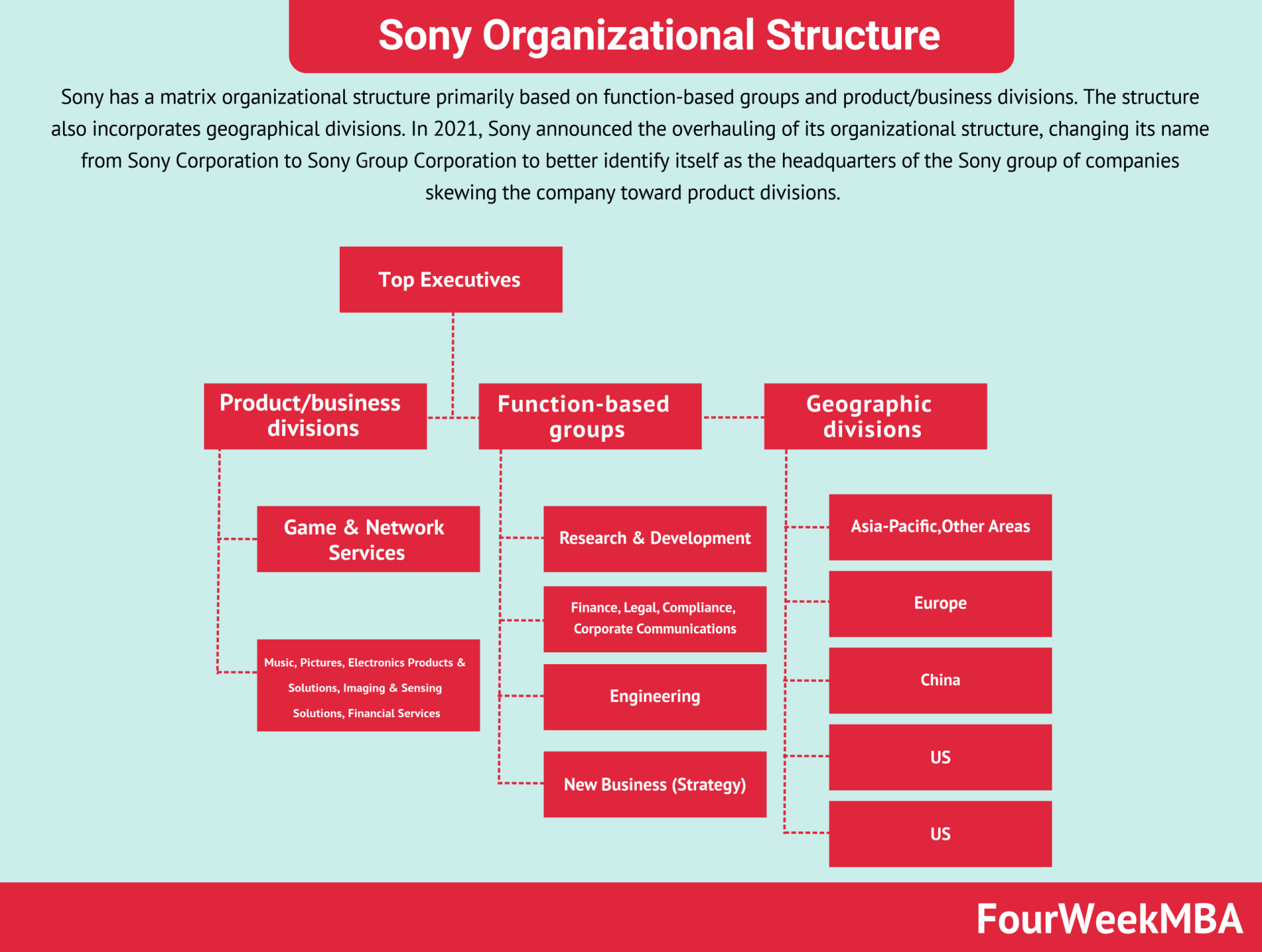
Sony has a matrix organizational structure primarily based on function-based groups and product/business divisions. The structure also incorporates geographical divisions. In 2021, Sony announced the overhauling of its organizational structure, changing its name from Sony Corporation to Sony Group Corporation to better identify itself as the headquarters of the Sony group of companies skewing the company toward product divisions.
Starbucks follows a matrix organizational structure with a combination of vertical and horizontal structures. It is characterized by multiple, overlapping chains of command and divisions.
Tesla is characterized by a functional organizational structure with aspects of a hierarchical structure. Tesla does employ functional centers that cover all business activities, including finance, sales, marketing, technology, engineering, design, and the offices of the CEO and chairperson. Tesla’s headquarters in Austin, Texas, decide the strategic direction of the company, with international operations given little autonomy.
Toyota has a divisional organizational structure where business operations are centered around the market, product, and geographic groups. Therefore, Toyota organizes its corporate structure around global hierarchies (most strategic decisions come from Japan’s headquarter), product-based divisions (where the organization is broken down, based on each product line), and geographical divisions (according to the geographical areas under management).
Walmart has a hybrid hierarchical-functional organizational structure, otherwise referred to as a matrix structure that combines multiple approaches. On the one hand, Walmart follows a hierarchical structure, where the current CEO Doug McMillon is the only employee without a direct superior, and directives are sent from top-level management. On the other hand, the function-based structure of Walmart is used to categorize employees according to their particular skills and experience.
Gennaro is the creator of FourWeekMBA, which reached about four million business people, comprising C-level executives, investors, analysts, product managers, and aspiring digital entrepreneurs in 2022 alone | He is also Director of Sales for a high-tech scaleup in the AI Industry | In 2012, Gennaro earned an International MBA with emphasis on Corporate Finance and Business Strategy.