Consensus-based decision-making is a group process that seeks a decision everyone can accept, rather than one a simple majority prefers. Quaker business meetings work this way, seeking the “sense of the meeting” without voting. The internet’s standards body, the IETF, works by “rough consensus and running code”, a phrase from computer scientist David Clark‘s 1992 plenary talk.
The consensus loop
Frame
Put one clear proposal on the table
↻
Hear
Draw out every view, especially objections
↻
Amend
Change the proposal to address the objections
↻
Test
Check whether anyone still has a serious objection
The goal is not that everyone loves it, but that no serious objection is left unanswered.
The group looks for unresolved objections rather than counting heads, so minority concerns are addressed, not outvoted.
02
Rough, not unanimous
Requiring full unanimity lets one person block everything; rough consensus allows some dissent once objections have been considered.
03
A facilitator reads the room
Someone neutral summarises where the group stands and records the decision in words everyone can check.
04
Fallbacks are agreed in advance
Groups decide beforehand what happens if consensus cannot be reached, such as a vote or a named decider.
Where you see it today
Internet standards
The IETF uses humming instead of hand-counting to sense agreement. Its own guidance, RFC 7282 (Resnick, 2014), warns that the process had drifted toward majority rule and argues that rough consensus means addressing objections, not counting them.
AI as mediator
Researchers trained an AI to draft group statements from participants’ opinions and critiques (Tessler et al., 2024, Science). Participants preferred its statements to those written by human mediators, and groups often converged on a shared view; the result was replicated in a virtual citizens’ assembly with a representative UK sample.
Bridging on social platforms
X’s Community Notes shows a note only when it is found helpful by contributors from different perspectives, not just by many contributors. The ranking algorithm looks for agreement across viewpoints, a form of consensus built into software.
Enterprise AI decisions
Choices about AI tools touch legal, security, IT and every business unit, and waiting for full consensus can stall them. One alternative is consent: a proposal goes ahead unless someone raises a reasoned objection, which keeps the safeguard without the veto.
Consensus vs other decision rules
Full consensus
How the decision is madeEveryone agrees or can live with it
Works best whenSmall groups and decisions that need wide buy-in
Rough consensus
How the decision is madeNo serious objection remains unaddressed
Works best whenExpert communities such as standards bodies
Consent
How the decision is madeGo ahead unless someone has a reasoned objection
Works best whenTeams that need speed with safeguards
Majority vote
How the decision is madeThe option with most votes wins
Works best whenLarge groups and clear-cut choices
Single decider
How the decision is madeOne named person decides after consulting
Works best whenUrgent or highly specialised calls
How to use it
Agree the fallback before you start: what happens if consensus is not reached by a set date.
Ask for objections, not opinions: "Is there anything you cannot live with, and why?"
Write the proposal down and amend it in front of the group so changes are visible.
Use an AI assistant to summarise each position and draft a compromise statement, then let the group edit it.
Keep consensus for decisions that need buy-in; use a single decider for reversible or urgent ones.
The Business Engineer lens
AI can speed consensus up by drafting options and summarising positions, but it cannot supply the buy-in that makes consensus worth the time. The Business Engineer’s dual-engine framework looks at how companies combine top-down direction with bottom-up adoption, which is where that buy-in is won or lost.
A process in which a group seeks a decision that all members can accept, by addressing objections rather than outvoting them.
What does rough consensus mean?
It means no serious objection remains unaddressed, even if not everyone agrees; the IETF uses it to avoid both majority rule and a single person's veto.
Is consensus the same as unanimity?
No. Unanimity needs everyone to agree; consensus needs everyone to be able to accept the decision, and rough consensus allows some recorded dissent.
Can AI help groups reach consensus?
Research suggests it can help: an AI mediator tested in 2024 drafted group statements that participants preferred to those of human mediators, though people still have to own the decision.
Our earlier explainer follows below, cleaned up and reformatted for mobile.
BUSINESS CONCEPT
Consensus-Based Decision-Making
Consensus-based decision-making is a collaborative process in which a group or team strives to reach a collective agreement or consensus on a particular issue, proposal, or decision. Unlike traditional decision-making methods that rely on majority vote or hierarchical authority, consensus decision-making prioritizes inclusivity and aims to address the concerns and preferences of all participants.
Key Components
Benefits of Consensus-Based Decision-Making
The adoption of consensus-based decision-making offers a wide range of benefits for groups and organizations:
The Consensus-Based Decision-Making Process
Consensus-based decision-making typically follows a structured process:
Challenges of Consensus-Based Decision-Making
While consensus-based decision-making has several advantages, it also presents challenges:
Consensus-Based Decision-Making in Action
Several organizations and groups have successfully implemented consensus-based decision-making:
Conclusion
Consensus-based decision-making is a powerful approach to foster collaboration, inclusivity, and collective agreement within groups and organizations.
Strengths
✓Enhanced Collaboration: Collaboration is at the core of consensus-based decision-making, fostering teamwork and synergy among participants.
✓Inclusivity and Diversity: It values diverse perspectives and ensures that decisions are made with the input of all stakeholders.
✓Higher Commitment: Participants are more likely to commit to and support decisions in which they have had a say.
✓Conflict Resolution: Consensus-based processes encourage constructive conflict resolution, leading to stronger relationships and creative…
✓Improved Decision Quality: Multiple perspectives are considered, leading to more well-rounded and informed decisions.
✓Empowerment: Participants feel empowered and engaged when they are involved in decision-making processes.
Limitations
✗Inclusivity: All stakeholders or participants are invited to contribute to the decision-making process.
✗Active Listening: Participants actively listen to each other, valuing diverse perspectives and viewpoints.
✗Shared Responsibility: Everyone shares the responsibility for the final decision and its outcomes.
✗Mutual Agreement: The goal is to reach mutual agreement or consent, rather than simply a majority vote.
✗Conflict Resolution: Disagreements and conflicts are seen as opportunities for exploration and resolution, rather than as obstacles.
✗Transparency: The decision-making process is transparent and open to scrutiny by all participants.
Real-World Examples
AirbnbAmazonAppleCoca-ColaCostcoEbay
Quick Answers
What are the benefits of consensus-based decision-making?
The adoption of consensus-based decision-making offers a wide range of benefits for groups and organizations:
What is the consensus-based decision-making process?
Consensus-based decision-making typically follows a structured process:
What are the challenges of consensus-based decision-making?
While consensus-based decision-making has several advantages, it also presents challenges:
Key Insight
Consensus-based decision-making is a powerful approach to foster collaboration, inclusivity, and collective agreement within groups and organizations. Its principles prioritize diversity of thought, active listening, and shared responsibility, leading to higher commitment and improved decision quality.
Exec Package + Claude OS Master Skill | Business Engineer Founding Plan
FourWeekMBA x Business Engineer | Updated 2026
Consensus-based decision-making is a collaborative process in which a group or team strives to reach a collective agreement or consensus on a particular issue, proposal, or decision. Unlike traditional decision-making methods that rely on majority vote or hierarchical authority, consensus decision-making prioritizes inclusivity and aims to address the concerns and preferences of all participants.
Key Principles of Consensus-Based Decision-Making
Consensus-based decision-making is guided by several key principles:
Inclusivity: All stakeholders or participants are invited to contribute to the decision-making process.
Active Listening: Participants actively listen to each other, valuing diverse perspectives and viewpoints.
Shared Responsibility: Everyone shares the responsibility for the final decision and its outcomes.
Mutual Agreement: The goal is to reach mutual agreement or consent, rather than simply a majority vote.
Conflict Resolution: Disagreements and conflicts are seen as opportunities for exploration and resolution, rather than as obstacles.
Transparency: The decision-making process is transparent and open to scrutiny by all participants.
Benefits of Consensus-Based Decision-Making
The adoption of consensus-based decision-making offers a wide range of benefits for groups and organizations:
Enhanced Collaboration: Collaboration is at the core of consensus-based decision-making, fostering teamwork and synergy among participants.
Inclusivity and Diversity: It values diverse perspectives and ensures that decisions are made with the input of all stakeholders.
Higher Commitment: Participants are more likely to commit to and support decisions in which they have had a say.
Conflict Resolution: Consensus-based processes encourage constructive conflict resolution, leading to stronger relationships and creative solutions.
Improved Decision Quality: Multiple perspectives are considered, leading to more well-rounded and informed decisions.
Empowerment: Participants feel empowered and engaged when they are involved in decision-making processes.
The Consensus-Based Decision-Making Process
Consensus-based decision-making typically follows a structured process:
Define the Issue: Clearly define the problem, issue, or decision to be addressed.
Gather Information: Collect relevant information and insights from all participants.
Generate Ideas: Encourage participants to generate creative solutions or proposals.
Discuss and Clarify: Engage in open and transparent discussions to clarify ideas, concerns, and viewpoints.
Identify Concerns: Ask participants to identify their concerns or reservations about the proposed decision.
Modify and Refine: Adapt the proposal based on feedback and concerns until a consensus is reached.
Final Decision: Once consensus is achieved, finalize the decision and outline the next steps.
Challenges of Consensus-Based Decision-Making
While consensus-based decision-making has several advantages, it also presents challenges:
Time-Consuming: The process can be time-consuming, especially when dealing with complex issues or large groups.
Resistance to Change: Some individuals may resist consensus-based approaches, particularly in hierarchical or authoritarian settings.
Risk of Compromise: In the pursuit of consensus, there is a risk of compromising the best possible solution in favor of the most agreeable one.
Skilled Facilitation: Effective facilitation is crucial to ensure that the process remains fair, inclusive, and focused.
Consensus-Based Decision-Making in Action
Several organizations and groups have successfully implemented consensus-based decision-making:
Cooperative Businesses: Many worker cooperatives and democratic enterprises use consensus-based decision-making to ensure that all worker-owners have a say in the business’s direction.
Community Organizations: Community groups, such as neighborhood associations and activist organizations, often employ consensus-based processes to make decisions that affect their members.
Nonprofits: Nonprofit organizations, where inclusivity and stakeholder involvement are critical, often use consensus-based approaches for decision-making.
Conclusion
Consensus-based decision-making is a powerful approach to foster collaboration, inclusivity, and collective agreement within groups and organizations. Its principles prioritize diversity of thought, active listening, and shared responsibility, leading to higher commitment and improved decision quality.
While it may present challenges related to time, resistance, and the risk of compromise, consensus-based decision-making remains a valuable tool for groups that prioritize teamwork, inclusivity, and empowerment. As organizations and communities continue to recognize the benefits of this approach, it is likely to play an increasingly significant role in shaping how decisions are made and executed in various settings.
Key Highlights
Key Principles of Consensus-Based Decision-Making:
Inclusivity: All stakeholders or participants are invited to contribute to the decision-making process, ensuring diverse perspectives are heard and considered.
Active Listening: Participants actively listen to each other, valuing diverse perspectives and viewpoints, which fosters understanding and empathy.
Shared Responsibility: Everyone shares the responsibility for the final decision and its outcomes, promoting accountability and collective ownership.
Mutual Agreement: The goal is to reach mutual agreement or consent, rather than simply a majority vote, emphasizing collaboration and compromise.
Conflict Resolution: Disagreements and conflicts are seen as opportunities for exploration and resolution, rather than as obstacles, promoting constructive dialogue and problem-solving.
Transparency: The decision-making process is transparent and open to scrutiny by all participants, building trust and fostering a culture of openness and honesty.
Benefits:
Enhanced Collaboration: Collaboration is at the core of consensus-based decision-making, fostering teamwork and synergy among participants, leading to more creative and effective solutions.
Inclusivity and Diversity: It values diverse perspectives and ensures that decisions are made with the input of all stakeholders, resulting in decisions that are more representative and equitable.
Higher Commitment: Participants are more likely to commit to and support decisions in which they have had a say, leading to greater buy-in and enthusiasm for implementation.
Conflict Resolution: Consensus-based processes encourage constructive conflict resolution, leading to stronger relationships and creative solutions, rather than fostering resentment or division.
Improved Decision Quality: Multiple perspectives are considered, leading to more well-rounded and informed decisions that take into account a wider range of factors and potential consequences.
Empowerment: Participants feel empowered and engaged when they are involved in decision-making processes, leading to increased motivation and satisfaction.
Consensus-Based Decision-Making Process:
Define the Issue: Clearly define the problem, issue, or decision to be addressed to ensure all participants understand the context and scope.
Gather Information: Collect relevant information and insights from all participants to ensure a comprehensive understanding of the issue and potential solutions.
Generate Ideas: Encourage participants to generate creative solutions or proposals, fostering innovation and out-of-the-box thinking.
Discuss and Clarify: Engage in open and transparent discussions to clarify ideas, concerns, and viewpoints, promoting understanding and alignment.
Identify Concerns: Ask participants to identify their concerns or reservations about the proposed decision, addressing potential obstacles or objections early on.
Modify and Refine: Adapt the proposal based on feedback and concerns until a consensus is reached, ensuring that all participants are satisfied with the final decision.
Final Decision: Once consensus is achieved, finalize the decision and outline the next steps, ensuring clarity and accountability moving forward.
Challenges:
Time-Consuming: The process can be time-consuming, especially when dealing with complex issues or large groups, requiring patience and commitment from all participants.
Resistance to Change: Some individuals may resist consensus-based approaches, particularly in hierarchical or authoritarian settings, necessitating education and advocacy to overcome resistance.
Risk of Compromise: In the pursuit of consensus, there is a risk of compromising the best possible solution in favor of the most agreeable one, requiring careful balance and negotiation.
Skilled Facilitation: Effective facilitation is crucial to ensure that the process remains fair, inclusive, and focused, requiring trained facilitators who can manage group dynamics and guide discussions effectively.
Consensus-Based Decision-Making in Action:
Cooperative Businesses: Many worker cooperatives and democratic enterprises use consensus-based decision-making to ensure that all worker-owners have a say in the business’s direction, fostering a sense of ownership and empowerment.
Community Organizations: Community groups, such as neighborhood associations and activist organizations, often employ consensus-based processes to make decisions that affect their members, ensuring that decisions are made with the input of those directly affected.
Nonprofits: Nonprofit organizations, where inclusivity and stakeholder involvement are critical, often use consensus-based approaches for decision-making, aligning with their values of democracy and social justice.
Consensus-Based Decision-Making
Description– A decision-making process that aims to achieve agreement or consent among all members of a group. – Consensus-based decision-making involves open discussion, active listening, and collaborative problem-solving to reach a solution acceptable to all participants. – It values inclusivity, transparency, and respect for diverse perspectives, fostering ownership and commitment to the decision outcome. – Consensus-based approaches may include techniques such as brainstorming, deliberation, and consensus building exercises.
When to ApplyTeam decision-making, conflict resolution, group projects, organizational governance, community initiatives
Delphi Method
Description– A structured forecasting technique that involves iterative rounds of surveys or questionnaires administered to a panel of experts. – The Delphi Method seeks to achieve consensus on complex issues by anonymously collecting and aggregating individual opinions, providing feedback between rounds, and refining responses until convergence is reached. – It enables experts to share insights, explore uncertainties, and forecast future trends or outcomes collaboratively.
When to ApplyStrategic planning, policy development, technology forecasting, risk assessment, market research
Nominal Group Technique (NGT)
Description– A structured group process used to generate, prioritize, or evaluate ideas or solutions. – The Nominal Group Technique involves individual idea generation followed by round-robin sharing and discussion to clarify and refine ideas. – Participants then independently rank or vote on the ideas, and results are aggregated to identify the most preferred options. – NGT combines individual creativity with group consensus-building, providing a structured approach to decision-making that minimizes biases and encourages equal participation.
When to ApplyProblem-solving workshops, brainstorming sessions, requirements gathering, prioritization exercises, quality improvement initiatives
Multi-Criteria Decision Analysis (MCDA)
Description– A decision-making framework that evaluates alternatives based on multiple criteria or factors, considering their relative importance and trade-offs. – Multi-Criteria Decision Analysis involves structuring the decision problem, defining criteria and alternatives, weighting criteria, and applying decision rules or models to generate rankings or scores for each alternative. – It provides a systematic approach to complex decision-making, enabling stakeholders to assess and compare options objectively and transparently.
When to ApplyProject selection, risk management, resource allocation, environmental planning, policy analysis
Consensus Mapping
Description– A participatory technique used to visualize and prioritize ideas, issues, or preferences among a group of stakeholders. – Consensus Mapping typically involves group discussion, idea generation, and categorization, followed by collaborative mapping or ranking of ideas on a visual display. – It helps identify common ground, surface areas of agreement or disagreement, and prioritize actions or solutions based on shared goals or values. – Consensus Mapping fosters inclusive decision-making and builds consensus by integrating diverse perspectives and insights.
When to ApplyStakeholder engagement, strategic planning, community development, conflict resolution, requirements elicitation
Structured Dialogic Design (SDD)
Description– A facilitated approach to collaborative problem-solving and decision-making that integrates systems thinking, dialogue, and design principles. – Structured Dialogic Design involves structured conversations among diverse stakeholders to explore complex issues, understand underlying systems dynamics, and co-create innovative solutions. – It employs visual mapping, group modeling, and consensus-building techniques to facilitate shared understanding and agreement on action plans or policies. – SDD emphasizes participatory processes, collective intelligence, and holistic problem-solving.
When to ApplyPolicy development, organizational change, community planning, stakeholder engagement, strategic foresight
Integrated Decision-Making (IDM)
Description– A holistic approach to decision-making that considers multiple perspectives, values, and impacts across social, economic, and environmental dimensions. – Integrated Decision-Making involves analyzing trade-offs, synergies, and dependencies among various options to identify win-win solutions or strategies that optimize outcomes. – It promotes collaboration among stakeholders, disciplines, and sectors to address complex challenges and achieve sustainable development goals. – IDM aims to balance short-term priorities with long-term sustainability and resilience considerations.
When to ApplySustainable development, urban planning, natural resource management, climate adaptation, corporate social responsibility (CSR)
Collaborative Governance
Description– A model of governance that emphasizes collaboration, inclusivity, and shared decision-making among government, civil society, and private sector stakeholders. – Collaborative Governance involves multi-stakeholder partnerships, networks, or forums that work collectively to address public issues or deliver services. – It enables stakeholders to co-create policies, programs, and solutions, fostering trust, accountability, and social innovation. – Collaborative Governance empowers communities to participate in decision-making processes and shape their own futures.
When to ApplyPublic policy development, community planning, public-private partnerships (PPPs), social services delivery, urban regeneration
Participatory Budgeting
Description– A democratic process that engages citizens in allocating public resources and deciding budget priorities. – Participatory Budgeting involves community members in identifying needs, proposing projects, and voting on how public funds should be spent. – It promotes transparency, accountability, and citizen empowerment, enabling local communities to have a direct impact on budget decisions and public investments. – Participatory Budgeting enhances civic engagement, social cohesion, and government legitimacy.
When to ApplyLocal governance, public finance, community development, municipal budgeting, grassroots democracy
Public Deliberation
Description– A structured process of inclusive dialogue and deliberation that enables citizens to discuss complex issues, explore diverse perspectives, and reach informed decisions. – Public Deliberation involves facilitated discussions, deliberative forums, or citizen assemblies where participants engage in respectful debate, exchange ideas, and weigh trade-offs to address public concerns or policy challenges. – It fosters democratic values, civic education, and collective decision-making, enriching public discourse and governance.
When to ApplyPolicy-making, community engagement, public consultations, civic education, conflict resolution
In a functional organizational structure, groups and teams are organized based on function. Therefore, this organization follows a top-down structure, where most decision flows from top management to bottom. Thus, the bottom of the organization mostly follows the strategy detailed by the top of the organization.
In a flat organizational structure, there is little to no middle management between employees and executives. Therefore it reduces the space between employees and executives to enable an effective communication flow within the organization, thus being faster and leaner.
Project portfolio management (PPM) is a systematic approach to selecting and managing a collection of projects aligned with organizational objectives. That is a business process of managing multiple projects which can be identified, prioritized, and managed within the organization. PPM helps organizations optimize their investments by allocating resources efficiently across all initiatives.
Harvard Business School professor Dr. John Kotter has been a thought-leader on organizational change, and he developed Kotter’s 8-step change model, which helps business managers deal with organizational change. Kotter created the 8-step model to drive organizational transformation.
The Nadler-Tushman Congruence Model was created by David Nadler and Michael Tushman at Columbia University. The Nadler-Tushman Congruence Model is a diagnostic tool that identifies problem areas within a company. In the context of business, congruence occurs when the goals of different people or interest groups coincide.
McKinsey’s Seven Degrees of Freedom for Growth is a strategy tool. Developed by partners at McKinsey and Company, the tool helps businesses understand which opportunities will contribute to expansion, and therefore it helps to prioritize those initiatives.
Mintzberg’s 5Ps of Strategy is a strategy development model that examines five different perspectives (plan, ploy, pattern, position, perspective) to develop a successful business strategy. A sixth perspective has been developed over the years, called Practice, which was created to help businesses execute their strategies.
The COSO framework is a means of designing, implementing, and evaluating control within an organization. The COSO framework’s five components are control environment, risk assessment, control activities, information and communication, and monitoring activities. As a fraud risk management tool, businesses can design, implement, and evaluate internal control procedures.
The TOWS Matrix is an acronym for Threats, Opportunities, Weaknesses, and Strengths. The matrix is a variation on the SWOT Analysis, and it seeks to address criticisms of the SWOT Analysis regarding its inability to show relationships between the various categories.
Lewin’s change management model helps businesses manage the uncertainty and resistance associated with change. Kurt Lewin, one of the first academics to focus his research on group dynamics, developed a three-stage model. He proposed that the behavior of individuals happened as a function of group behavior.
OpenAI is an artificial intelligence research laboratory that transitioned into a for-profit organization in 2019. The corporate structure is organized around two entities: OpenAI, Inc., which is a single-member Delaware LLC controlled by OpenAI non-profit, And OpenAI LP, which is a capped, for-profit organization. The OpenAI LP is governed by the board of OpenAI, Inc (the foundation), which acts as a General Partner. At the same time, Limited Partners comprise employees of the LP, some of the board members, and other investors like Reid Hoffman’s charitable foundation, Khosla Ventures, and Microsoft, the leading investor in the LP.
Airbnb follows a holacracy model, or a sort of flat organizational structure, where teams are organized for projects, to move quickly and iterate fast, thus keeping a lean and flexible approach. Airbnb also moved to a hybrid model where employees can work from anywhere and meet on a quarterly basis to plan ahead, and connect to each other.
The Amazon organizational structure is predominantly hierarchical with elements of function-based structure and geographic divisions. While Amazon started as a lean, flat organization in its early years, it transitioned into a hierarchical organization with its jobs and functions clearly defined as it scaled.
The Coca-Cola Company has a somewhat complex matrix organizational structure with geographic divisions, product divisions, business-type units, and functional groups.
Costco has a matrix organizational structure, which can simply be defined as any structure that combines two or more different types. In this case, a predominant functional structure exists with a more secondary divisional structure.
Costco’s geographic divisions reflect its strong presence in the United States combined with its expanding global presence. There are six divisions in the country alone to reflect its standing as the source of most company revenue.
Compared to competitor Walmart, for example, Costco takes more a decentralized approach to management, decision-making, and autonomy. This allows the company’s stores and divisions to more flexibly respond to local market conditions.
Dell has a functional organizational structure with some degree of decentralization. This means functional departments share information, contribute ideas to the success of the organization and have some degree of decision-making power.
eBay was until recently a multi-divisional (M-form) organization with semi-autonomous units grouped according to the services they provided. Today, eBay has a single division called Marketplace, which includes eBay and its international iterations.
Facebook is characterized by a multi-faceted matrix organizational structure. The company utilizes a flat organizational structure in combination with corporate function-based teams and product-based or geographic divisions. The flat organization structure is organized around the leadership of Mark Zuckerberg, and the key executives around him. On the other hand, the function-based teams are based on the main corporate functions (like HR, product management, investor relations, and so on).
Goldman Sachs has a hierarchical structure with a clear chain of command and defined career advancement process. The structure is also underpinned by business-type divisions and function-based groups.
Google (Alphabet) has a cross-functional (team-based) organizational structure known as a matrix structure with some degree of flatness. Over the years, as the company scaled and it became a tech giant, its organizational structure is morphing more into a centralized organization.
IBM has an organizational structure characterized by product-based divisions, enabling its strategy to develop innovative and competitive products in multiple markets. IBM is also characterized by function-based segments that support product development and innovation for each product-based division, which include Global Markets, Integrated Supply Chain, Research, Development, and Intellectual Property.
McDonald’s has a divisional organizational structure where each division – based on geographical location – is assigned operational responsibilities and strategic objectives. The main geographical divisions are the US, internationally operated markets, and international developmental licensed markets. And on the other hand, the hierarchical leadership structure is organized around regional and functional divisions.
McKinsey & Company has a decentralized organizational structure with mostly self-managing offices, committees, and employees. There are also functional groups and geographic divisions with proprietary names.
Microsoft has a product-type divisional organizational structure based on functions and engineering groups. As the company scaled over time it also became more hierarchical, however still keeping its hybrid approach between functions, engineering groups, and management.
Nestlé has a geographical divisional structure with operations segmented into five key regions. For many years, Swiss multinational food and drink company Nestlé had a complex and decentralized matrix organizational structure where its numerous brands and subsidiaries were free to operate autonomously.
Nike has a matrix organizational structure incorporating geographic divisions. Nike’s matrix structure is also present at the regional and sub-regional levels. Managerial responsibility is segmented according to business unit (apparel, footwear, and equipment) and function (human resources, finance, marketing, sales, and operations).
Patagonia has a particular organizational structure, where its founder, Chouinard, disposed of the company’s ownership in the hands of two non-profits. The Patagonia Purpose Trust, holding 100% of the voting stocks, is in charge of defining the company’s strategic direction. And the Holdfast Collective, a non-profit, holds 100% of non-voting stocks, aiming to re-invest the brand’s dividends into environmental causes.
Samsung has a product-type divisional organizational structure where products determine how resources and business operations are categorized. The main resources around which Samsung’s corporate structure is organized are consumer electronics, IT, and device solutions. In addition, Samsung leadership functions are organized around a few career levels grades, based on experience (assistant, professional, senior professional, and principal professional).
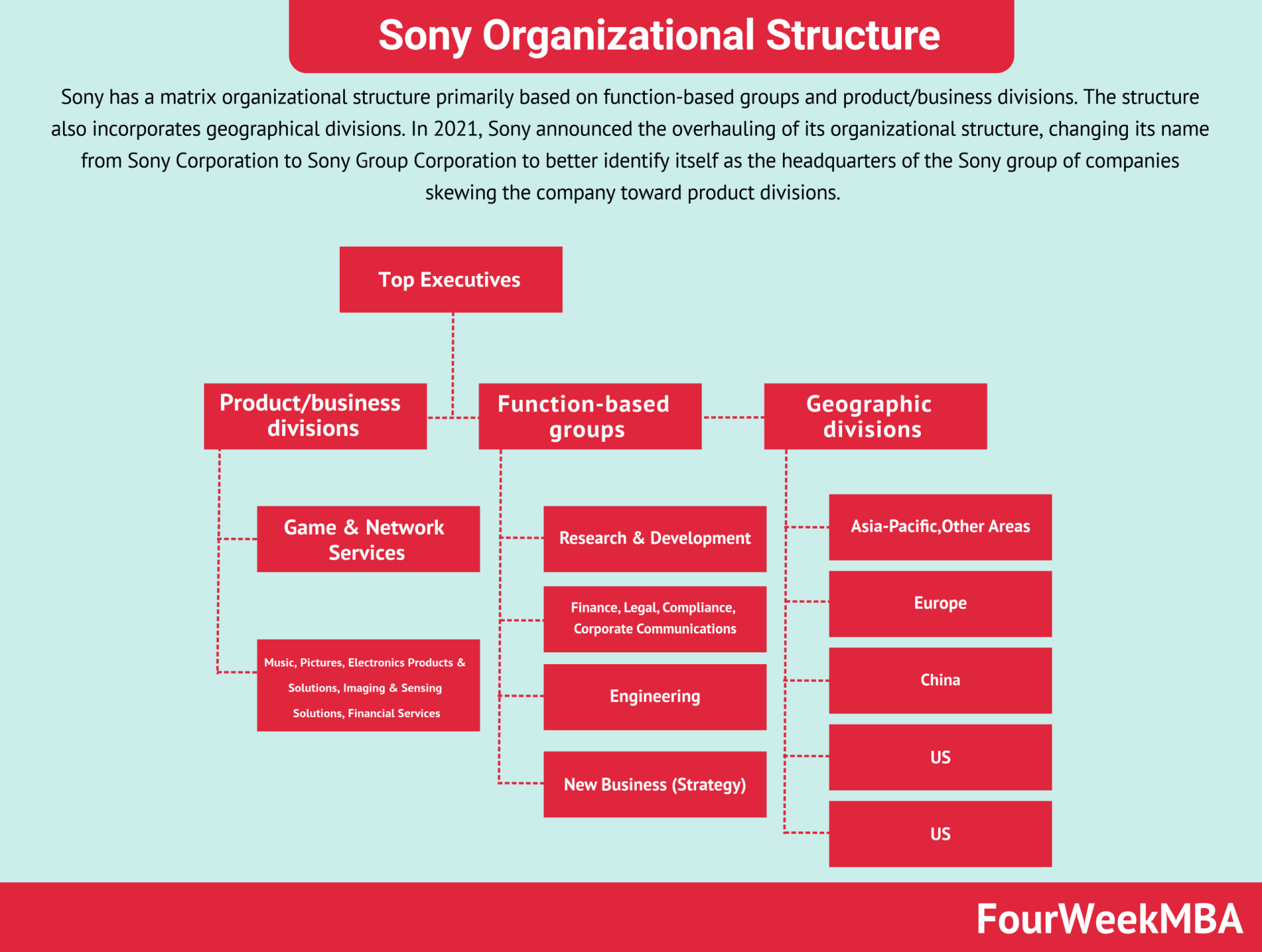
Sony has a matrix organizational structure primarily based on function-based groups and product/business divisions. The structure also incorporates geographical divisions. In 2021, Sony announced the overhauling of its organizational structure, changing its name from Sony Corporation to Sony Group Corporation to better identify itself as the headquarters of the Sony group of companies skewing the company toward product divisions.
Starbucks follows a matrix organizational structure with a combination of vertical and horizontal structures. It is characterized by multiple, overlapping chains of command and divisions.
Tesla is characterized by a functional organizational structure with aspects of a hierarchical structure. Tesla does employ functional centers that cover all business activities, including finance, sales, marketing, technology, engineering, design, and the offices of the CEO and chairperson. Tesla’s headquarters in Austin, Texas, decide the strategic direction of the company, with international operations given little autonomy.
Toyota has a divisional organizational structure where business operations are centered around the market, product, and geographic groups. Therefore, Toyota organizes its corporate structure around global hierarchies (most strategic decisions come from Japan’s headquarter), product-based divisions (where the organization is broken down, based on each product line), and geographical divisions (according to the geographical areas under management).
Walmart has a hybrid hierarchical-functional organizational structure, otherwise referred to as a matrix structure that combines multiple approaches. On the one hand, Walmart follows a hierarchical structure, where the current CEO Doug McMillon is the only employee without a direct superior, and directives are sent from top-level management. On the other hand, the function-based structure of Walmart is used to categorize employees according to their particular skills and experience.
Consensus-based decision-making is a collaborative process in which a group or team strives to reach a collective agreement or consensus on a particular issue, proposal, or decision. Unlike traditional decision-making methods that rely on majority vote or hierarchical authority, consensus decision-making prioritizes inclusivity and aims to address the concerns and preferences of all participants.
What are the key components of Consensus-Based Decision-Making?
The key components of Consensus-Based Decision-Making include Benefits of Consensus-Based Decision-Making, The Consensus-Based Decision-Making Process, Challenges of Consensus-Based Decision-Making, Consensus-Based Decision-Making in Action, Conclusion. Benefits of Consensus-Based Decision-Making: The adoption of consensus-based decision-making offers a wide range of benefits for groups and organizations:
Gennaro Cuofano is a CRO and tech executive who has worked in AI since late 2015, starting with bringing NLP, natural-language generation, voice and chatbot products to the marketing industry. His background is in law and finance: he holds a Master's degree in Law and an International MBA with an emphasis on corporate finance (LUISS Business School and the University of San Diego, 2012), and worked as a financial analyst at a real-estate investment firm in San Diego and as an assistant controller. His work focuses on business model strategy, business engineering and, more broadly, structural analysis: how companies make money, read from their own filings. He created FourWeekMBA and leads research there and at The Business Engineer, his newsletter on AI and business strategy, with over 95,000 subscribers and more than 1,000 published analyses. His writing has also appeared on Entrepreneur, HackerNoon and Search Engine People. Find him on LinkedIn and Substack. See how we source.
Scroll to Top
Discover more from FourWeekMBA
Subscribe now to keep reading and get access to the full archive.