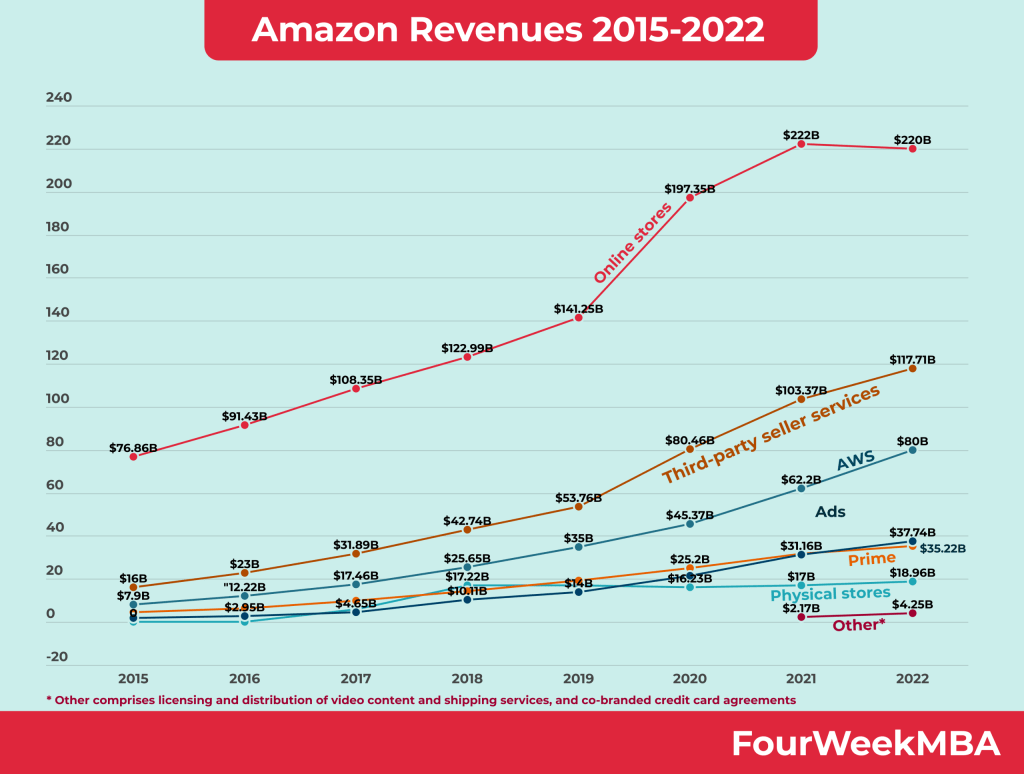
Amazon AWS (cloud) is the most successful business segment within Amazon, and it generated over $90 billion in revenues in 2023, with over $24 billion in net profits compared to $80 billion in revenues in 2022 and almost $23 billion in operating profit. And over $62 billion in revenues in 2021 and $18.5 billion in net profits.
Paradigm shifts can be compelling when a breakthrough moment comes.
And the dot-com bubble, a survive-or-die moment, defined Amazon for the next twenty-five years.
Also, from this paradigm shift, as an effect, of making difficult decisions, you might stumble upon gild mines!
In the case of Amazon, that was the transition, in the early 2000s, from e-commerce to platform business models.
Or in short, the mindset shifted, from selling its own products to becoming an enabler for other e-commerce businesses to sell on top of Amazon.
The giant of cloud
Today AWS is the major player in the cloud industry.
In 2022, Amazon AWS passed $80, Microsoft intelligent cloud netted $75 billion, and Alphabet’s (Google) Cloud Business was over $26 billion unit within Alphabet.
While AWS has helped Amazon stay relevant in the last ten years. Gong forward, the cloud business is for sure a critical element for the AI rage, which is happening as we speak.
In fact, within AWS, Amazon has built a high-performance computing platform, able to train deep neural nets.
For some context, AI models like Stable Difussion have been built on top of Amazon AWS supercomputer.
Amazon is subdivided into three operating profit segments: North America, International, and AWS. Amazon AWS is the most profitable segment, with almost $23 billion in operating profit in 2022. While Both the North American and International segments run at negative operating losses, with $2 billion and $7.74 billion in operating losses, respectively, in 2022.
Indeed, if you were to remove AWS from Amazon, you would get a company that loses more than ten billion a year.
Amazon was not profitable once AWS was removed in 2022. In fact, Amazon, without AWS generated $10.6 billion in operating losses. While Amazon, without AWS, generated $12.2. billion operating income.
Amazon has a diversified business model. In 2022 Amazon posted over $514 billion in revenues, while it posted a net loss of over $2.7 billion. Online stores contributed almost 43% of Amazon revenues. The remaining was generated by Third-party Seller Services, and Physical Stores. While Amazon AWS, Subscription Services, and Advertising revenues play a significant role within Amazon as fast-growing segments.
Amazon’s mission statement is to “serve consumers through online and physical stores and focus on selection, price, and convenience.” Amazon’s vision statement is “to be Earth’s most customer-centric company, where customers can find and discover anything they might want to buy online, and endeavors to offer its customers the lowest possible prices.”
In the Amazon Shareholders’ Letter for 2018, Jeff Bezos analyzed the Amazon business model, and it also focused on a few key lessons that Amazon as a company has learned over the years. These lessons are fundamental for any entrepreneur, of small or large organization to understand the pitfalls to avoid to run a successful company!
Amazon has a business model with many moving parts. The e-commerce platform generated $220 billion in 2022, followed by third-party stores services which generated over $117 billion; Amazon AWS, which generated over $80 billion; Amazon advertising which generated almost $38 billion and Amazon Prime, which generated over $35 billion, and physical stores which generated almost $19 billion.
The Amazon Working Backwards Method is a product development methodology that advocates building a product based on customer needs. The Amazon Working Backwards Method gained traction after notable Amazon employee Ian McAllister shared the company’s product development approach on Quora. McAllister noted that the method seeks “to work backward from the customer, rather than starting with an idea for a product and trying to bolt customers onto it.”
The Amazon Flywheel or Amazon Virtuous Cycle is a strategy that leverages customer experience to drive traffic to the platform and third-party sellers. That improves the selection of goods, and Amazon further improves its cost structure to decrease prices that spins the flywheel.
In a letter to shareholders in 2016, Jeff Bezos addressed a topic he had been thinking about quite profoundly in the last decades as he led Amazon: Day 1. As Jeff Bezos put it, “Day 2 is stasis. He was followed by irrelevance and followed by excruciating, painful decline. Followed by death. And that is why it is always Day 1.”
AWS generated $128.7 billion in revenue in 2025, up 20% from $107.6 billion in 2024. AWS crossed the $100 billion annual revenue mark in 2024, making it the largest cloud provider by revenue. Its annualized run rate entering 2026 is $142 billion.
How fast is AWS growing?
AWS revenue grew 20% year-over-year in 2025, accelerating from 19% growth in 2024. Q4 2025 saw 24% growth — the fastest in 13 quarters — driven by AI workloads. From just $3.1 billion in 2013, AWS has grown 41x to $128.7 billion, representing one of the most remarkable growth stories in tech.
How important is AWS to Amazon’s profitability?
AWS is the profit engine of Amazon. In 2024, AWS generated $39.8 billion in operating income — accounting for about 57% of Amazon’s total operating income despite being only ~18% of revenue. This high-margin cloud business effectively subsidizes Amazon’s lower-margin retail operations.
Gennaro is the creator of FourWeekMBA, which reached about four million business people, comprising C-level executives, investors, analysts, product managers, and aspiring digital entrepreneurs in 2022 alone | He is also Director of Sales for a high-tech scaleup in the AI Industry | In 2012, Gennaro earned an International MBA with emphasis on Corporate Finance and Business Strategy.