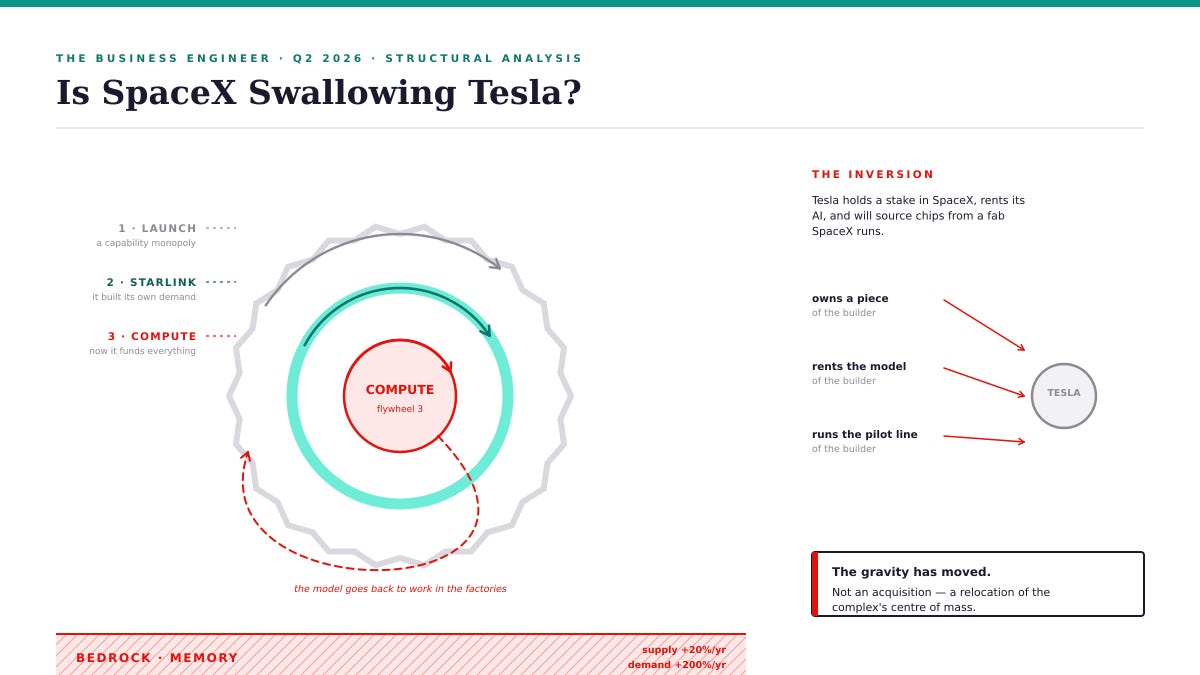
SpaceX has secured more than $15 billion in NASA and U.S. government contracts over the past decade, a revenue foundation that Tesla — despite posting $97.7 billion in full-year 2023 revenue — simply cannot replicate. The contrast between these two Elon Musk enterprises has never been sharper, and investors are beginning to ask a harder question: are SpaceX and Tesla actually competing with each other for the one resource neither company can manufacture more of?
Tesla operates as a consumer hardware and energy ecosystem business. It generates revenue through vehicle sales, software subscriptions, and an expanding energy storage division that posted $6 billion in revenue in 2023, up 54% year-over-year. The model depends on brand loyalty, manufacturing scale, and continuous iteration of products that millions of individual buyers purchase directly.
Source: The Business Engineer
SpaceX is structurally the opposite. Its business runs on sovereign clients — NASA, the Department of Defense, and foreign governments — alongside the Starlink broadband network, which now serves more than 2 million active subscribers across 70 countries. According to analysis by The Business Engineer, SpaceX and Tesla are not synergistic siblings but structural rivals disguised as a portfolio, competing for the same finite resource: Elon Musk’s strategic attention, engineering talent, and capital allocation decisions.
The Talent and Capital Pressure Point
SpaceX’s last reported private valuation reached $180 billion, briefly surpassing Tesla’s market capitalization during periods of Tesla’s stock turbulence in late 2023 and early 2024. That valuation milestone is not symbolic — it signals where institutional money believes long-term value is accumulating.
Tesla, meanwhile, faces intensifying competition from BYD, which overtook it as the world’s best-selling electric vehicle manufacturer in Q4 2023, and from legacy automakers including Ford and General Motors aggressively scaling their EV platforms. The competitive pressure on Tesla demands exactly the kind of sustained executive focus and engineering investment that SpaceX is simultaneously pulling in the opposite direction.
Where Musk’s Attention Actually Goes
Public statements, capital raises, and product announcement cadences suggest a subtle but measurable tilt. SpaceX completed 98 launches in 2023, a company record, while Starship — the fully reusable heavy-lift system that underpins SpaceX’s long-term Mars and lunar ambitions — consumed enormous engineering bandwidth following its first integrated flight tests. Tesla’s Cybertruck, by contrast, launched years behind schedule and has faced early production challenges.
The divergence raises a legitimate governance concern for Tesla shareholders. A publicly traded company whose CEO is simultaneously running a privately held competitor for his own strategic bandwidth is an unusual arrangement, and one that proxy advisors and institutional investors are increasingly scrutinizing.
The Question Wall Street Needs to Answer
Both companies carry genuine transformational potential — SpaceX in redefining sovereign space infrastructure, Tesla in accelerating global energy transition. But the logic of a unified “Musk portfolio” as a coherent strategy grows harder to defend when the underlying business model architectures pull in opposite directions and feed on the same scarce inputs.
The real question facing analysts, investors, and the broader market is not which company is more valuable today — it is whether Elon Musk can continue to serve as the strategic axis for both, or whether the structural tension between SpaceX and Tesla will eventually force a choice that reshapes the future of one, or both, of the most closely watched companies in the world.
FULL ANALYSIS
Read the Complete Deep Dive
This article is based on a comprehensive analysis by The Business Engineer. Get the full breakdown with charts, data, and strategic frameworks.
Gennaro is the creator of FourWeekMBA, which reached about four million business people, comprising C-level executives, investors, analysts, product managers, and aspiring digital entrepreneurs in 2022 alone | He is also Director of Sales for a high-tech scaleup in the AI Industry | In 2012, Gennaro earned an International MBA with emphasis on Corporate Finance and Business Strategy.
Scroll to Top
Discover more from FourWeekMBA
Subscribe now to keep reading and get access to the full archive.