SpaceX’s $210 Billion Valuation Is Now Reshaping How Tesla Operates From the Inside Out
SpaceX crossed a $210 billion private valuation in late 2024, making it not just the most valuable aerospace company on the planet, but quietly the most operationally influential force inside Elon Musk’s broader corporate empire — including Tesla.
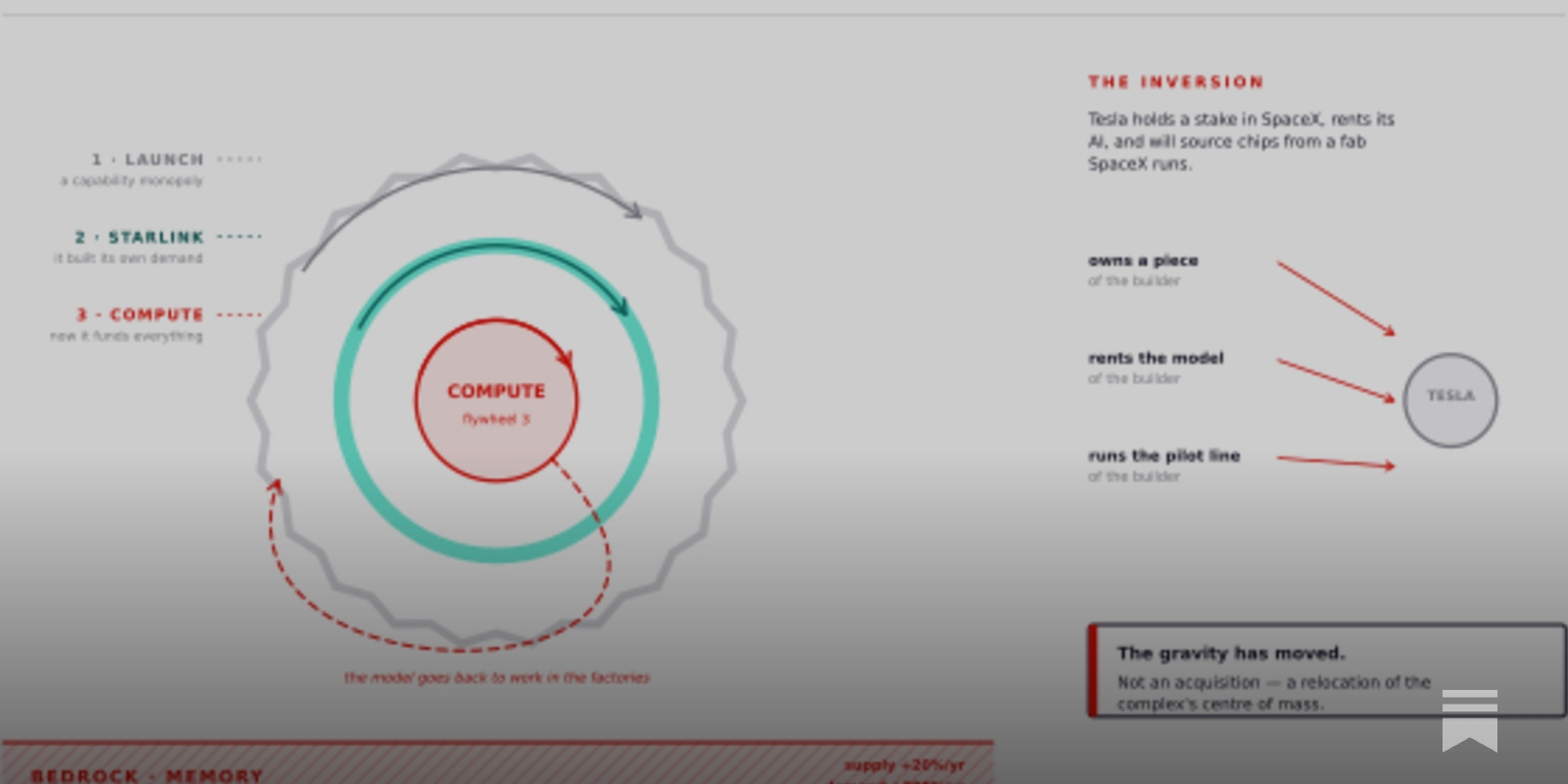
That influence is no longer theoretical. According to analysis by The Business Engineer, the structural mechanics of SpaceX’s businessmodel — built on reusable infrastructure, long-duration government contracts, and an almost cult-like mission-driven talent pipeline — are now functioning as the silent benchmark against which Tesla’s own organizational identity is being measured and, in some cases, restructured.
Source: The Business Engineer
The Architecture of Absorption
SpaceX generates revenue across at least three distinct long-cycle contract streams: NASA’s Artemis program, Department of Defense launch contracts, and Starlink’s commercial broadband subscriptions, which surpassed 3 million active users globally in 2024. These are not transactional revenue lines. They are multi-year commitments that fund engineering iteration rather than quarterly earnings management.
Tesla, by contrast, operates inside a brutally short feedback loop. The electric vehicle market forces quarterly delivery numbers, margin disclosures, and real-time pricingcompetition against BYD, Rivian, and a resurgent General Motors EV division. Tesla reported a 9% drop in vehicle deliveries in the first quarter of 2024 — its first annual quarterly decline in years — exposing just how exposed the company is to consumer demand cycles that SpaceX will never face.
That structural asymmetry matters enormously when one CEO runs both companies simultaneously.
Talent Flows in One Direction
When organizational gravity shifts, talent is always the first signal. SpaceX’s recruitment model attracts engineers who self-select around a mission framing — planetary survival, infrastructure at civilizational scale — rather than product-market fit or stock compensation benchmarks. That psychological profile produces a workforce willing to accept lower base pay in exchange for perceived historical significance.
Tesla once owned that same narrative. The “accelerating the world’s transition to sustainable energy” mission carried genuine cultural weight inside Silicon Valley hiring circles for nearly a decade. Today, with SpaceX employing more than 13,000 people and Starship conducting its seventh integrated flight test in early 2025, the mission gravity has visibly shifted orbital lanes.
Senior engineering talent is increasingly reporting SpaceX as their primary Musk-ecosystem destination of choice — a structural recruitment problem Tesla has no obvious counterplay for inside its current businessmodel.
Reusability as the Master Template
SpaceX’s core competitive advantage is not rockets. It is the reusable infrastructure doctrine — the idea that capital-intensive assets should be designed from day one to generate compounding returns across multiple use cycles rather than single deployments. The Falcon 9 booster has now been reflown more than 20 times on individual units, collapsing per-launch costs below any Boeing or Arianespace competitor.
That same doctrine is now surfacing inside Tesla’s operational language around manufacturing, particularly around the Gigapress casting system and the company’s ambitions around autonomous robotaxi infrastructure through its Cybercab program. The design philosophy is SpaceX’s. The application is Tesla’s. The origin of the mental model is not accidental.
When one founder’s company becomes the cultural and operational benchmark inside a second founder’s company, the weaker brand identity does not merge — it gets absorbed, regardless of what the org chart says.
The strategic question investors and executives across the EV and aerospace sectors now face is a blunt one: if SpaceX continues scaling its infrastructure footprint while Tesla struggles to defend delivery volumes against Chinese and legacy automaker competition, at what valuation crossover point does Tesla stop being Elon Musk’s flagship company — and start being SpaceX’s terrestrial division?
FULL ANALYSIS
Read the Complete Deep Dive
This article is based on a comprehensive analysis by The Business Engineer. Get the full breakdown with charts, data, and strategic frameworks.
Gennaro is the creator of FourWeekMBA, which reached about four million business people, comprising C-level executives, investors, analysts, product managers, and aspiring digital entrepreneurs in 2022 alone | He is also Director of Sales for a high-tech scaleup in the AI Industry | In 2012, Gennaro earned an International MBA with emphasis on Corporate Finance and Business Strategy.
Scroll to Top
Discover more from FourWeekMBA
Subscribe now to keep reading and get access to the full archive.