The Business Model Nobody Sees Behind TSMC and NVIDIA’s AI Dominance
TSMC’s capital expenditure guidance of $38 to $42 billion for 2025 sent analysts scrambling for downgrade rationale — but that reaction may be the most expensive misread in semiconductor investing right now.
The conventional interpretation is straightforward: TSMC is overspending into an uncertain demand cycle. The more consequential interpretation is the opposite. TSMC is not chasing AI demand. It is controlling the rate at which that demand can be fulfilled — a structurally different business operating on a logic that most market participants are not pricing correctly.
Source: The Business Engineer
Rationing as a Business Model
TSMC currently commands roughly 90% of the world’s most advanced chip fabrication capacity, with its 3-nanometer and 2-nanometer nodes serving as the physical chokepoint for every AI accelerator that matters. NVIDIA, Apple, AMD, and Qualcomm all route through the same foundry. That is not a vendor relationship. That is a supply architecture with TSMC as the single policy-setting node.
According to analysis by The Business Engineer, this is precisely why the market misreads both TSMC and NVIDIA as hardware businesses. They are not selling components into a market. They are structurally rationing access to a capability that no competitor can replicate at scale within a viable commercial timeframe.
Intel’s foundry ambitions, despite $100 billion in planned domestic investment, remain at least two to three process generations behind TSMC’s leading-edge nodes. Samsung’s yield issues on advanced nodes have pushed major customers back toward TSMC rather than away from it. The competitive threat is real on paper. It is not real in production.
Why NVIDIA’s Fabless Model Depends on TSMC’s Rationing
NVIDIA’s fabless structure is widely framed as an asset — lean, capital-light, scalable. That framing is incomplete. NVIDIA’s gross margins, which held above 74% in its most recent fiscal year, are not purely a product of chip design excellence. They are partially a product of the supply constraint that TSMC imposes on the entire ecosystem.
When TSMC rations capacity, it concentrates pricing power upstream at NVIDIA’s level. Competitors like AMD and emerging players such as Cerebras or Groq cannot simply design around NVIDIA’s CUDA advantage — they also cannot access equivalent manufacturing capacity at equivalent volume or lead times. TSMC’s capex is, in effect, NVIDIA’s competitive moat by proxy.
NVIDIA’s data center revenue reached $47.5 billion in fiscal year 2024, a figure that would be structurally impossible without TSMC’s capacity discipline holding the supply curve tighter than demand.
The Agentic Inflection Makes This More Acute, Not Less
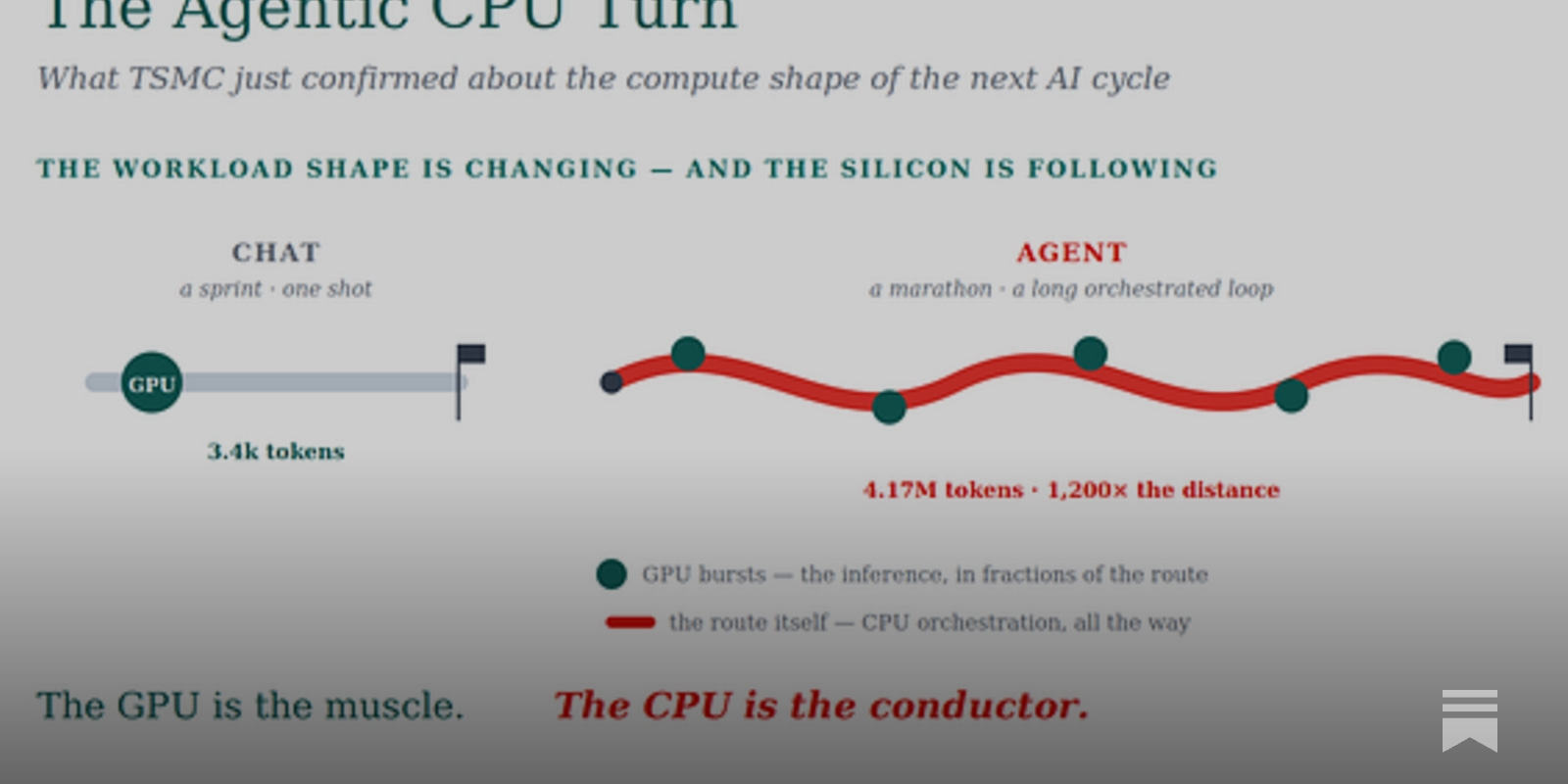
The shift toward agentic AI — systems running continuous, multi-step reasoning tasks rather than discrete inference calls — is expected to increase per-workload compute intensity by an estimated factor of ten or more over current generative AI benchmarks. That changes the demand calculus entirely.
TSMC’s capex is not overspending. It is pre-positioning for a demand curve that the market has not yet fully modeled, while simultaneously ensuring that no competitor can absorb enough capacity to break the rationing dynamic that makes both TSMC and NVIDIA structurally irreplaceable.
The real strategic question investors should be asking is not whether TSMC is spending too much — it is whether any government, rival foundry, or hyperscaler-led chip initiative can break the rationing architecture before agentic AI cements it permanently into the global compute stack.
FULL ANALYSIS
Read the Complete Deep Dive
This article is based on a comprehensive analysis by The Business Engineer. Get the full breakdown with charts, data, and strategic frameworks.
Gennaro is the creator of FourWeekMBA, which reached about four million business people, comprising C-level executives, investors, analysts, product managers, and aspiring digital entrepreneurs in 2022 alone | He is also Director of Sales for a high-tech scaleup in the AI Industry | In 2012, Gennaro earned an International MBA with emphasis on Corporate Finance and Business Strategy.
Scroll to Top
Discover more from FourWeekMBA
Subscribe now to keep reading and get access to the full archive.