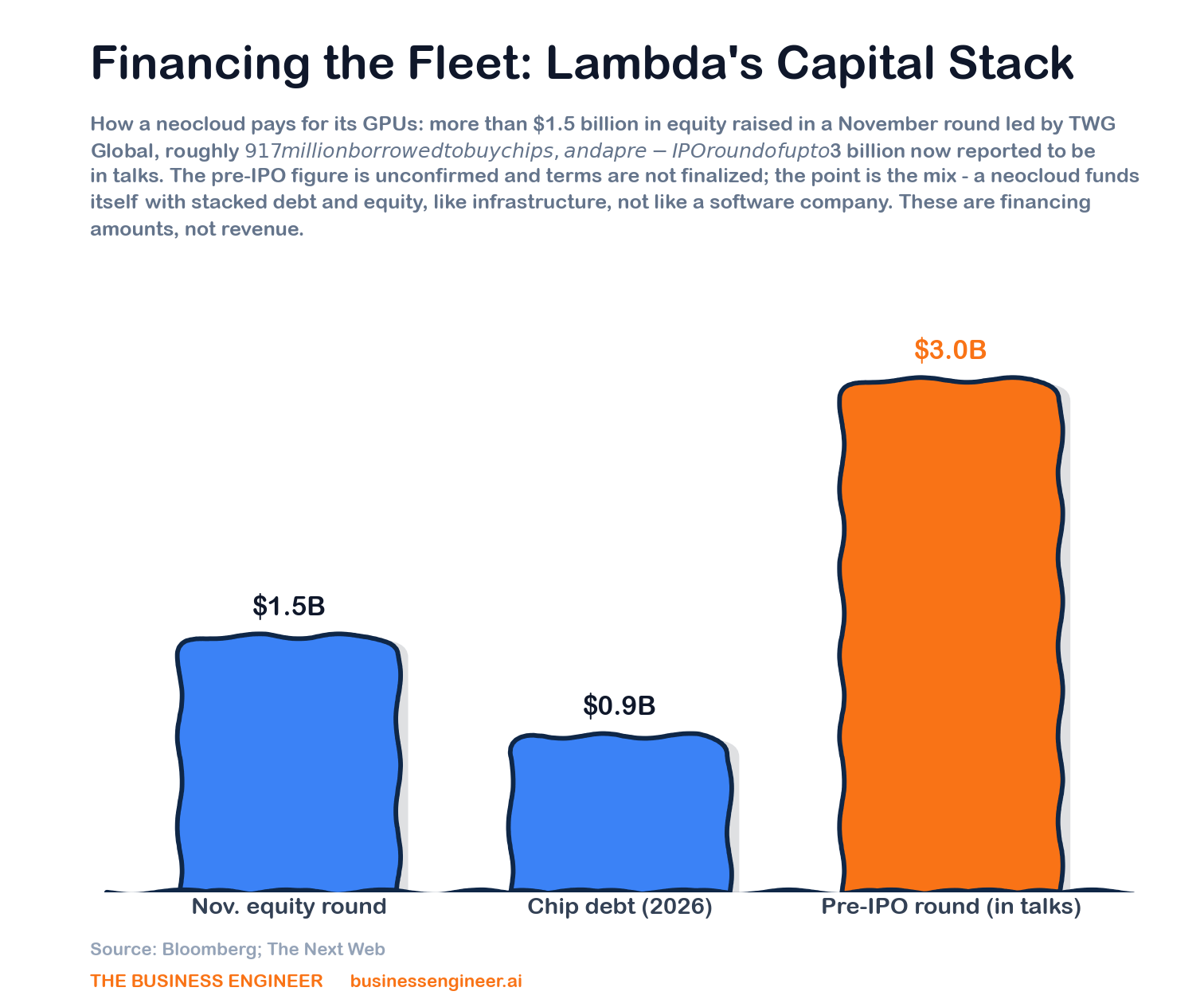
As reported by Bloomberg (via Investing.com) and The Next Web. These are ongoing funding talks; deal terms have not been finalized and Lambda has not confirmed them.
The Nvidia-backed AI cloud provider is stacking equity, chip debt, and a reported pre-IPO raise — a capital structure that tells you exactly what kind of business a neocloud actually is.
Lambda’s Capital Stack — As Reported
November 2025 — Equity Round
Lambda raises more than $1.5 billion in equity led by TWG Global. Backers include Nvidia, ARK Invest, Andra Capital, Scott Hassan’s SGW, and Andrej Karpathy. (This is the funding round amount, not a revenue figure.)
Prior to 2026 — Chip Debt
Lambda borrows approximately $917 million, ring-fenced specifically for GPU acquisition — infrastructure debt, not operating capital.
August 2026 — Pre-IPO Round (Reported, Not Confirmed)
Bloomberg reports Lambda in talks to raise up to $3 billion at a valuation of $12 billion or more, potentially ahead of a 2027 IPO. Terms are not finalized. Lambda has not confirmed any of this.
As reported by Bloomberg on August 24, 2026 — and picked up by Investing.com and The Next Web — Lambda, the Nvidia-backed AI cloud provider, is in talks to raise as much as $3 billion at a valuation of up to $12 billion or more in a pre-IPO round that could position the company for a public listing in 2027. Every number in that sentence carries the same caveat: these are reported talks, the terms are not finalized, Lambda has not confirmed them, and the size, the valuation, and the IPO timing are all possibilities, not commitments. The deal can move in any direction or not close at all.
Lambda is a neocloud: it buys graphics processors and rents access to them, sitting between the chip manufacturers and the enterprises or developers who need compute. To build its fleet, it raised more than $1.5 billion in a November 2025 equity round led by TWG Global — that figure is the funding round, not a revenue number and should not be read as one — with Nvidia, ARK Invest, Andra Capital, Scott Hassan’s SGW, Andrej Karpathy, and others participating. Separately, it borrowed approximately $917 million specifically to purchase chips. The reported $3 billion pre-IPO raise would be the third layer on top of those two.
The round’s size and the IPO timeline get the headlines. The structure of the financing is the more durable story. A software company raises a modest seed or Series A and, if it works, prints cash from near-zero marginal cost. Lambda is layering equity on top of ring-fenced chip debt on top of another equity tranche — a capital architecture that looks nothing like software and a great deal like infrastructure project finance. That gap is where the real analysis lives.
The key insight: The way Lambda is financing itself — layered debt and equity to acquire depreciating hardware, backed by the chip vendor whose demand it helps create — is a direct readout of what a neocloud actually is: a spread business financed like real estate or a power plant, not a software company. The capital stack is the business model made visible.
Read the shape, not just the numbers. To build a fleet of GPUs to rent out, Lambda has raised more than $1.5 billion in equity (a November round led by TWG Global, with Nvidia among the backers), borrowed roughly $917 million specifically to buy chips, and is now — per Bloomberg — in talks for a pre-IPO round of up to $3 billion at a valuation of $12 billion or more that could precede a 2027 listing. The last of those is unconfirmed and its terms are not set. What the stack shows is the nature of the business: a neocloud finances itself with layered debt and equity, the way you fund infrastructure, because it is a capital-intensive spread business — not a software company. These are financing amounts, not revenue, and the model’s unit economics at scale remain unproven. Sources: Bloomberg; The Next Web.
The Structural Read
The neocloud model is a spread business. The margin — to the extent there is one — is the difference between what capital and chips cost and what customers will pay to rent compute. Buy or borrow to acquire GPUs at one price, rent them out at another, and the gap between those two numbers is the entire business. That structure explains why Lambda finances itself the way it does: like any spread business, it needs cheap and plentiful capital to acquire the asset before it can earn the spread. The cost of capital is not a footnote here. It is the primary input, the same way a mortgage rate is the primary input for a leveraged real-estate investor.
The risk profile follows directly. A software company’s marginal cost approaches zero; once the code is written, each additional user is nearly free. A neocloud’s spread can compress from three directions simultaneously: if GPU prices fall as newer chips arrive and strand the existing fleet; if financing costs rise as rates move or credit conditions tighten; or if utilization dips because demand softens or customers shift to alternatives. The unit economics of this model are genuinely unproven at Lambda’s reported scale, and the combination of expensive hardware, leverage, and rapid chip-generation cycles is not a theoretical risk — it is the central operating challenge for every company in this category.
Every dollar Lambda raises is deployed to widen the asset base on which it earns that spread. Equity raises the floor; chip debt buys the inventory; utilization determines whether the spread stays open or closes. All three levers move independently, and all three can move against you at once. That is the bet the capital stack is making.
Nvidia’s position in Lambda’s cap table is the second structural signal, and arguably the more important one. Nvidia is an investor in the neoclouds — Lambda here, and separately CoreWeave, Nebius, and others — that purchase its chips at scale. Capital flows out of Nvidia and returns, indirectly, as demand for Nvidia hardware. This is the demand flywheel we mapped in detail with the Nvidia–Perplexity investment and demand flywheel piece: the chip vendor de-risks its own demand by seeding the buyers of its chips with capital, which keeps the buildout moving, which keeps chip orders flowing. It works until it doesn’t, and its single point of failure is concentration on one supplier. Every neocloud that accepts Nvidia capital and buys Nvidia chips is deepening that dependency in both directions.
The pre-IPO structure completes the picture. Lambda is not raising $3 billion (reported, not confirmed) to fund operations in the conventional sense. It is scaling its rentable fleet as large as capital markets will allow before a listing, joining a window that CoreWeave has already opened and that appears to be closing as macro conditions evolve. The equity round, the chip debt, and the pre-IPO raise are all the same strategic move executed in sequence: assemble as much compute capacity as financing will support, then take it public while demand for AI infrastructure is sufficiently hot to support the valuation. The window logic is as important as the capital logic.
“The neocloud sits in the infrastructure layer of the AI value chain — above the chip fabs, below the model labs and application builders. Its leverage is compute access; its vulnerability is that the layer above and below it are both controlled by parties with more pricing power.”
Three Implications
IMPLICATION 1 — FOR NEOCLOUD INVESTORS
Valuing Lambda like a software company — on revenue multiples or growth rates — misreads the model. The right analogy is infrastructure or real-estate investment: the question is whether the spread between cost of capital plus depreciation and rental rates stays positive at scale, and whether utilization holds. The reported $12 billion-plus valuation (not confirmed, not finalized) only makes sense if you model sustained high utilization and stable or declining GPU costs. Both assumptions deserve scrutiny in a market where Nvidia ships new chip generations on an accelerating cadence.
IMPLICATION 2 — FOR THE NEOCLOUD IPO WAVE
CoreWeave’s public listing opened the window; Lambda’s reported pre-IPO positioning suggests others see the same closing logic. The 2026–27 period may represent a narrow band in which AI infrastructure demand is strong enough and public-market appetite for capital-intensive compute businesses is sufficient to support these valuations. Companies that do not reach scale before that window shifts will face a harder path to liquidity. The race is not just for compute — it is for timing.
IMPLICATION 3 — FOR THE NVIDIA DEPENDENCY QUESTION
Nvidia’s dual role — as chip supplier and equity investor in the neoclouds that buy those chips — concentrates systemic risk in ways that are easy to understate when the flywheel is spinning. If demand for AI compute softens, or if a viable alternative GPU supplier emerges, or if the neoclouds over-build relative to actual enterprise absorption, the feedback runs in reverse. Lambda, CoreWeave, Nebius, and Nvidia are all exposed to the same utilization variable from different angles. That concentration is not a reason to dismiss the model; it is the risk that any serious analysis has to price in explicitly.
Business Engineer Framework
The AI Value Chain — Where Neoclouds Actually Sit
Lambda’s capital structure only makes sense when you can see the full nine-layer AI stack — who captures margin at each layer, where the pricing power concentrates, and why infrastructure players finance differently from model labs or application builders. The AI Value Chain map makes that structure legible, and it is the right lens for reading every neocloud move that follows this one.
Lambda’s reported $3 billion pre-IPO raise — unconfirmed, terms not finalized, timeline uncertain — is worth reading not for the number but for what the number reveals about the model: this is an infrastructure spread business that must stack equity on debt on more equity to acquire depreciating hardware before it can earn a margin, backed by the chip vendor whose revenue it helps create, racing to go public before the window on AI infrastructure valuations narrows. That may be a winning bet. Demand for rentable compute is real, the Nvidia flywheel is genuinely powerful, and the public market has already shown it will value this category. But the spread can compress, the chips will age, the financing costs are not free, and the unit economics at this scale remain unproven. The honest frame is not that Lambda is the infrastructure company AI needs — it is that Lambda is making a large, structured, time-sensitive wager on capital markets and utilization holding, and the capital stack it has assembled is the most legible expression of that wager available.
Gennaro Cuofano is a CRO and tech executive who has worked in AI since late 2015, starting with bringing NLP, natural-language generation, voice and chatbot products to the marketing industry. His background is in law and finance: he holds a Master's degree in Law and an International MBA with an emphasis on corporate finance (LUISS Business School and the University of San Diego, 2012), and worked as a financial analyst at a real-estate investment firm in San Diego and as an assistant controller. His work focuses on business model strategy, business engineering and, more broadly, structural analysis: how companies make money, read from their own filings. He created FourWeekMBA and leads research there and at The Business Engineer, his newsletter on AI and business strategy, with over 95,000 subscribers and more than 1,000 published analyses. His writing has also appeared on Entrepreneur (for example, How to Digitize a Family Business in Europe) and HackerNoon. Find him on LinkedIn and Substack. See how we source.