The Information, echoed by Reuters, reports Nvidia is in talks to invest multiple billions in the AI answer-engine at a discussed valuation above $30 billion — and the structural logic tells you more than the number does.
NVIDIA × PERPLEXITY — KEY REPORTED MILESTONES
Early 2026
Perplexity’s reported annualized revenue sits below $250M; Nvidia already holds an equity stake from a prior round.
Mid-2026
Nvidia closes a deal with Poolside structured as a roughly $6B non-exclusive technology license plus ~$1B investment and talent — its first public investment-plus-licensing hybrid.
August 2026 (reported)
The Information reports Nvidia is in talks to invest multiple billions in Perplexity at a discussed valuation above $30B — up more than 50% from roughly $20B about a year ago. Perplexity declined to comment; Nvidia did not respond.
Reported alongside
The Information also reports Nvidia considered a technology licensing deal as part of the same discussions — the same hybrid structure used with Poolside.
The Information, with Reuters echoing the report, says Nvidia is in discussions to invest multiple billions of dollars in Perplexity as part of an equity round that would value the company at more than $30 billion. That figure is a discussed target, not a finalized valuation — the reporting is sourced to people familiar with the talks, Perplexity declined to comment, and Nvidia did not respond. Treat this as an active negotiation, not a closed deal; terms at this stage routinely change or dissolve.
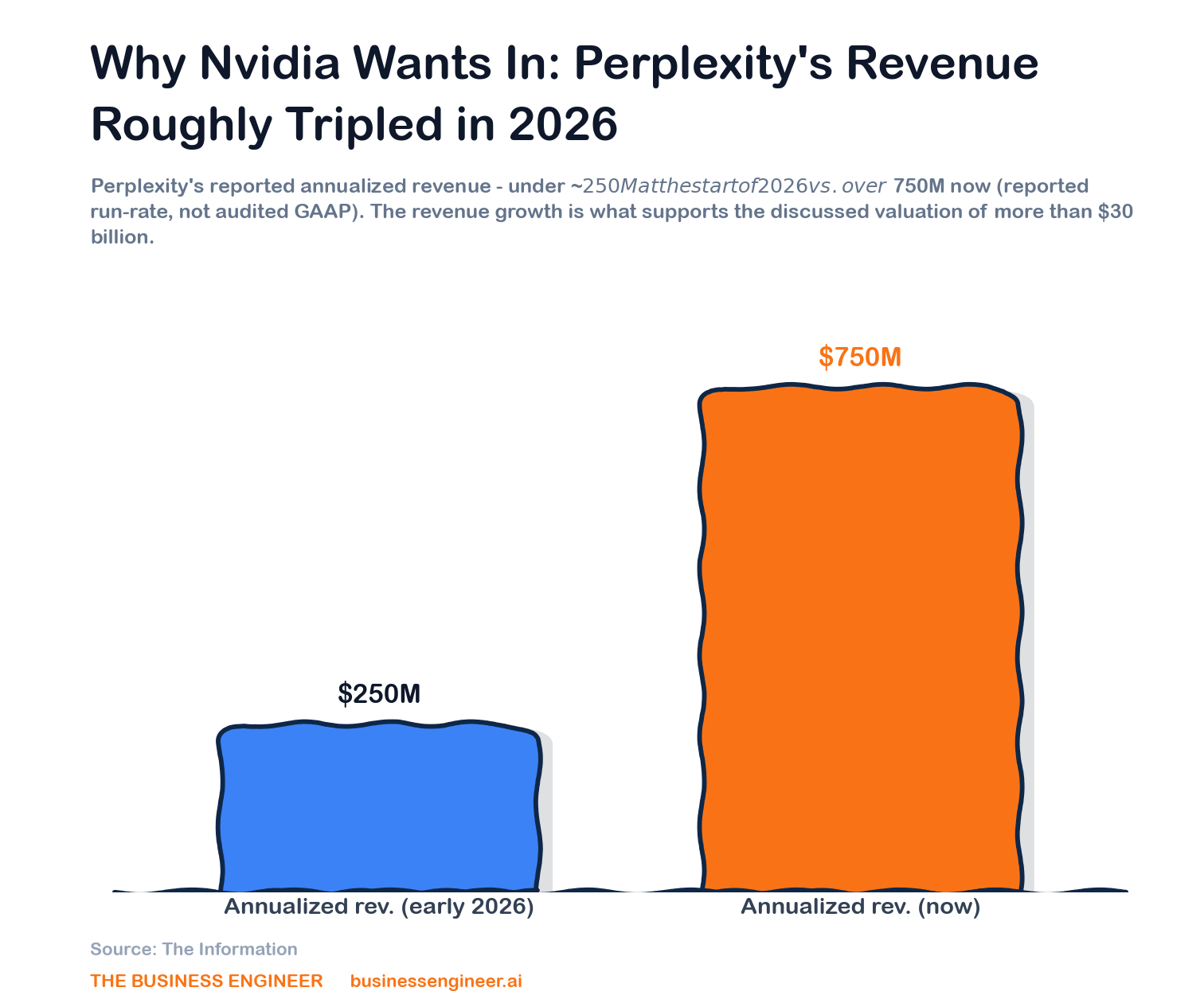
The growth context behind the valuation discussion is real, with the same caveat that applies to all private-company reporting: Perplexity’s annualized revenue has risen to more than $750 million from below $250 million at the start of the year. That is a roughly threefold increase in under twelve months. But annualized run-rate is not booked revenue — it extrapolates a recent period rather than recording a full year — and these figures arrive without the scrutiny of a public filing. The momentum is genuine; the precision is provisional.
Nvidia already holds a stake in Perplexity from an earlier round, so this would be a deepening, not an entry. The Information additionally reports that Nvidia weighed a technology licensing arrangement alongside the equity investment — the same investment-plus-licensing structure it deployed in its deal with Poolside.
PERPLEXITY — REPORTED ANNUALIZED REVENUE (2026)
Start of 2026<$250M
August 2026 (reported)>$750M
Reported annualized run-rate, not audited GAAP revenue. Source: The Information.
The key insight: Every Perplexity query is tokens, and tokens are GPUs. Backing the app is backing the meter — which means Nvidia is not just investing in a company, it is investing in a source of demand for its own chips, at the consumer edge of the AI stack.
What is driving Nvidia’s reported interest is growth: Perplexity’s annualized revenue has risen from under about $250 million at the start of 2026 to over roughly $750 million now, a rough tripling in months. Read these as reported annualized run-rate figures, not audited results – annualized revenue extrapolates a recent period and is not the same as booked GAAP revenue. That trajectory is what supports a discussed valuation of more than $30 billion, itself up more than 50% from about $20 billion a year ago – a talks figure, not a closed round. Source: The Information.
The Structural Read
Pull back from the deal mechanics and the shape is unmistakable. Nvidia now holds positions across nearly the entire AI stack — frontier labs, cloud providers, open-model efforts, orbital data centers, and, if this closes, a mass-market consumer search challenger. The common thread is not diversification; it is demand-seeding. Nvidia recycles chip revenue into the ecosystem that buys chips, and each layer it backs generates more inference workload that flows back down to compute, where Nvidia captures it. That is the invest-in-your-complement’s-demand pattern, and Perplexity is its most visible consumer-facing expression yet.
The Poolside deal established the template: a non-exclusive technology license paired with an equity check, structured so Nvidia embeds itself into a partner’s product without a full acquisition and without consolidating the risk onto its own balance sheet. The reported Perplexity discussions follow the same architecture. If the licensing element closes alongside the investment, Nvidia gains a hook inside the product layer — not just a financial return — that is harder to unwind than a shareholding alone.
BE Framework — Map of AI / Nvidia Is Everywhere
“Read generously, it is a flywheel: seed the demand, sell the picks, compound. Read skeptically, it is circular financing — a dominant supplier underwriting its own customers’ ability to buy from it. Both readings are true at once, which is exactly why it is worth watching rather than cheering or dismissing.”
The honest framing holds both. Strategic investors backing their own customers is ordinary behavior; Intel Capital did it for decades. What makes the Nvidia version worth examining is the scale, the concentration, and the speed — and the fact that the same company setting inference-chip prices also holds equity in companies whose economics depend on keeping inference-chip costs manageable. That tension is structural, not scandalous, and it is our analytical framing, not a claim in either report.
The Perplexity bet specifically is a wager that the AI answer-engine is a durable product category: an AI-native challenger to Google search whose revenue has roughly tripled in under a year, and a hedge for Nvidia in the search-and-agents war regardless of which of the major players — OpenAI, Google, or an insurgent — ultimately captures the most distribution. Perplexity faces real competitive pressure from both, and both are folding answer-style results into products with vastly more existing users. It also faces ongoing publisher and legal scrutiny over its content-sourcing practices. The revenue momentum is real; the category durability is unresolved.
Three Implications
IMPLICATION 1 — THE LICENSING TWIST MATTERS MORE THAN THE VALUATION
A pure equity check is a financial bet. A technology license paired with equity is architectural — it embeds Nvidia’s stack into Perplexity’s product in a way that persists beyond any eventual share sale. If the licensing element is confirmed, watch for it to show up in Perplexity’s inference infrastructure and model optimization choices over the next 12–18 months. That is the Poolside playbook applied at consumer scale.
IMPLICATION 2 — THE FLYWHEEL HAS A STRESS TEST BUILT IN
The demand-seeding model works as long as inference costs keep falling slower than revenue grows. If open-weight models continue to commoditize inference — as the Vercel open-weight volume-spend barbell dynamic suggests — the marginstructure for inference-hungry apps like Perplexity improves, but the per-query GPU spend that makes Nvidia’s demand-seeding rational also compresses. Nvidia’s flywheel depends on volume growth outpacing per-unit price decline. So far it has. That is the number to watch.
IMPLICATION 3 — THE $30B DISCUSSION PRICE IS A CATEGORY SIGNAL, NOT JUST A COMPANY SIGNAL
A valuation above $30 billion for an AI answer-engine that is not yet profitable — and faces Google and OpenAI as direct competitors — is a claim that the category is large enough to sustain a third player at scale. If Nvidia, with its unique vantage point on inference demand, is willing to anchor that valuation, it is functionally a vote that AI-native search is not a feature that gets absorbed into existing products, but a durable destination. Whether that vote proves correct is a separate question; that it is being cast at all reshapes how every search-adjacent AI investment gets priced next.
Business Engineer Framework
The Map of AI — Nvidia Is Everywhere
The Map of AI tracks 200+ companies across 9 layers of the stack — from silicon to consumer applications. The Nvidia-Perplexity talks illustrate what happens when a single company holds positions at the compute layer, the model layer, and now the consumer application layer simultaneously: the map starts to look less like a competitive landscape and more like a controlled ecosystem. Understanding where each move sits in that map is how you separate the signal from the valuation noise.
What The Information is reporting is talks, not a close — the valuation is discussed, the revenue is annualized, and nothing is signed — but the pattern it describes is already confirmed by Poolside and a dozen earlier Nvidia bets: the most important company in AI compute has decided the safest use of its chip revenue is to fund the demand for more chips, and it is now doing that at every layer of the stack, including the one where ordinary users type questions into a search box. Whether that is a flywheel or a circular-financing concern depends on your vantage point; the honest answer is it is both, and the next twelve months of inference-cost curves and Perplexity user growth will tell you which reading was more right.
Gennaro is the creator of FourWeekMBA, which reached about four million business people, comprising C-level executives, investors, analysts, product managers, and aspiring digital entrepreneurs in 2022 alone | He is also Director of Sales for a high-tech scaleup in the AI Industry | In 2012, Gennaro earned an International MBA with emphasis on Corporate Finance and Business Strategy.
Scroll to Top
Discover more from FourWeekMBA
Subscribe now to keep reading and get access to the full archive.