

Based on reporting by The Wall Street Journal, Bloomberg, The Information, and Newcomer.
The chip leader is spending billions not to win the model layer — but to make sure no one else captures it either.
What Happened
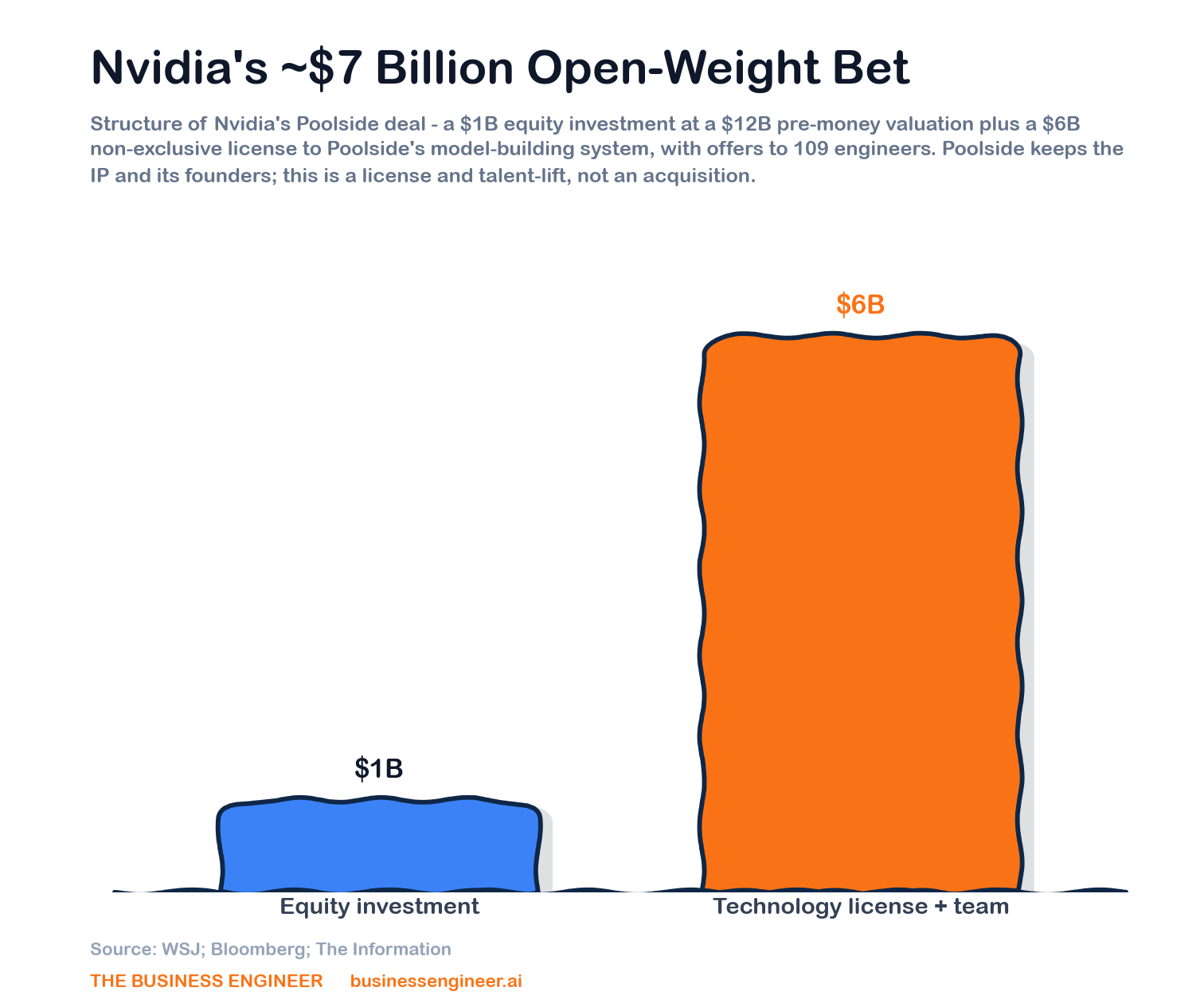
First reported by Newcomer on August 20 — a credit Bloomberg’s own headline acknowledges — and subsequently confirmed by Bloomberg, The Information, and the Wall Street Journal, the deal was disclosed not through an official Nvidia statement but through a letter Poolside sent to its own investors. The terms: Nvidia pays $6 billion for a non-exclusive license to Poolside’s “Model Factory,” the system that underpins Poolside’s open-weight Laguna coding models, plus a $1 billion equity investment at a $12 billion pre-money valuation. It is also making offers to 109 of Poolside’s engineers.
The stated intent, per that investor letter, is to absorb the talent and the model-building system into Nvidia’s Nemotron open-model line — an effort that has existed since 2023 but has not reached the frontier tier occupied by DeepSeek or Kimi K3 — with an ambition to build a leading open-weight model that also challenges closed US labs like OpenAI and Anthropic. That ambition is reported intent stated in Poolside’s own communication to investors, not a benchmark result or a shipped model.
Critically: this is not an acquisition. The license is non-exclusive, which means Poolside retains its IP and can license the Model Factory to others. Founders Eiso Kant, Jason Warner (former GitHub CTO), and Margarida Garcia stay with the company. Poolside continues as an independent entity. The distinction between “license plus talent-lift” and “acquisition” is not a technicality — it is structurally load-bearing, for reasons discussed below.
The key insight: Nvidia is not trying to win the model layer. It is trying to make the model layer cheap, open, and contested enough that the value of any individual model never exceeds the value of the compute needed to run it. That is a different goal — and it explains nearly every structural choice in this deal.
The Structural Read
The Business Engineer lens here is commoditize your complement, a strategic principle that runs through the open-vs-closed playbook: own the scarce layer, then fund and accelerate commoditization of the layer that sits above it. Nvidia’s scarce layer is compute — GPUs that no one can replicate at scale in the near term. The layer above it, models, is abundant and getting more so. The rational move for a company in Nvidia’s position is not to win the model race but to ensure the model layer stays cheap, interchangeable, and hungry for inference cycles.
Every powerful open-weight model released into the world is, from Nvidia’s perspective, a demand-creation event: more inference, more chips, more revenue. A world in which one closed lab captures dominant economics from the model layer is a world in which a toll booth sits between Nvidia and end demand. The way you prevent that toll booth is by funding open alternatives until no single model is scarce enough to price like one. That is the through-line from the Open vs. Closed Meta-Framework — close the scarce layer, open the abundant one — and it maps cleanly onto Nvidia’s structural position in the AI stack.
BE Framework · Commoditize Your Complement
Own the scarce layer. Open the abundant one.
When models become cheap and interchangeable, every model that runs is a reason to buy more chips. Nvidia does not need to build the best model. It needs to ensure no single model becomes valuable enough to extract the economics that should flow to compute. Funding open-weight alternatives is the mechanism — and the $6 billion license fee is the price of that insurance policy.
Nvidia hedges every battleground at once. It continues selling compute to OpenAI, Anthropic, and the hyperscalers. Now it also seeds an open-weight challenger to those same labs. The “competing with your best customers” tension is real — and worth naming explicitly — but Nvidia’s position is that whoever wins the model war still runs on its hardware. It can afford to back all sides because the chip layer captures value regardless of which model wins. The framing of “Nvidia turns on its customers” overstates a strategy that is really about not depending on any single one of them.
The demand-side answer. This move is also a direct response to the signal visible in the Vercel AI Gateway data we analyzed earlier this month, where open-weight models captured a record share of token volume — with a substantial share of that volume flowing to Chinese models. Nvidia’s interest is in a US and Western open-weight champion running on its chips, not in ceding the open lane to DeepSeek or Kimi K3 by default. Poolside’s Model Factory is a bet on capturing that volume with an Nvidia-tuned alternative. Context from Alibaba’s full-stack AI flywheel makes clear how fast Chinese labs are compressing the open-weight tier from the other direction.
The licensing playbook as antitrust architecture. The deal’s structure — a large non-exclusive license combined with a talent-lift that leaves the target technically independent — is now a recognizable pattern. Microsoft used a version of it with Inflection. Google with Character. Amazon with Adept. Here it is deployed by the most antitrust-scrutinized company in tech, and the non-exclusive license form is not incidental: it is part of how a deal this large, by a company this dominant, avoids the merger review that a straight acquisition would attract. The “license, not acquisition” framing is a legal and structural feature, not a rounding error. This move also layers onto Nvidia’s parallel push up the stack into agentic harnesses covered in our AVO analysis and the Map of AI Redrawn.
What to Hold Lightly
The “most powerful open model in the world” is an ambition stated in Poolside’s letter to its own investors — not a benchmark, not a shipped result. Nemotron has existed since 2023 without reaching the frontier tier occupied by DeepSeek-R2 or Kimi K3. Closing that gap requires hard, capital-intensive training work that the Model Factory system and 109 engineers make possible but do not guarantee.
Poolside’s roots are specifically in coding models — Laguna is a coding model — so the sweeping “compete across all of open AI” framing is broader than the underlying asset actually is. The commoditize-the-complement reading is our analytical frame, not Nvidia’s stated rationale. And the market’s early reaction was ambivalent: NVDA ended the week approximately 5% lower, a reminder that a $7 billion outlay on reported intent rather than a shipped product is not, by itself, a catalyst. The Anthropic compute strategy context from our Salek / TPU piece is worth keeping in view: closed labs are actively reducing their GPU dependency, which sharpens Nvidia’s incentive to commoditize the model layer before that dynamic matures.
Three Implications
IMPLICATION 1 · THE OPEN-WEIGHT TIER GETS BETTER-CAPITALIZED FAST
With Nvidia’s compute economics and Poolside’s Model Factory behind Nemotron, the gap between open-weight and closed frontier models narrows on a faster timeline — not because Nvidia is guaranteed to produce the best model, but because it can afford to iterate longer and louder than any startup. The pressure on OpenAI and Anthropic to justify closed-model premiums increases structurally.
IMPLICATION 2 · THE LICENSING PLAYBOOK IS NOW STANDARD ANTITRUST ARCHITECTURE
Every major AI platform company has now run a version of this structure: large license, talent absorb, target stays independent. Regulators who want to scrutinize AI consolidation face a structural gap — these deals are designed to not be acquisitions. The Poolside deal, executed by the most-scrutinized company in tech, is the clearest stress-test of that gap yet. How regulators respond will define the rules for the next wave of AI M&A.
IMPLICATION 3 · THE CHINESE OPEN-WEIGHT LANE IS NOW ACTIVELY CONTESTED
DeepSeek and Kimi K3 currently dominate the open-weight tier in raw capability. Nvidia’s move names them explicitly as the competitive target and funds a US-and-Western alternative tuned to run on its hardware. This is not just a commercial decision — it is an industrial-policy bet that the open-weight layer should have a Western champion. Whether the Model Factory system is sufficient to close that gap in coding benchmarks, let alone across broader capability domains, is the open question that will resolve over the next 12–18 months.


