Agentic AI describes AI systems in which a language model directs its own steps and tool use to reach a goal, instead of answering one prompt at a time. Anthropic’s widely cited definition (December 2024) separates workflows, where models follow predefined code paths, from agents, where the model decides how to accomplish the task; the reason-then-act loop behind many agents was set out in the ReAct paper (Yao et al., 2022). The human moves from steering every step to being looped in for approval.
In a chat assistant the human prompts each step. In an agent the human sets a goal and the model plans, acts and checks its own work, returning for feedback or final approval.
02
Tools turn text into action
Agents call tools: web search, code execution, company databases and other software. The ReAct paper showed that interleaving reasoning with actions improves results on question answering and decision-making tasks (Yao et al., 2022).
Production agents run inside a harness that manages memory, tools, permissions and cost. Anthropic recommends starting with the simplest workflow and adding agent autonomy only when it is needed (Anthropic, 2024).
04
Pricing follows the work
Because agents run many model calls per task, vendors are moving from per-seat subscriptions to consumption: customers pay for tokens, credits or agent runs.
Where you see it today
Cloud platforms sell agent infrastructure
Amazon said in its Q3 2026 results that tens of thousands of customers use Bedrock AgentCore, its managed service for running agents, and that they deployed 2x more agents in Q3 than in the prior three quarters combined. Total Bedrock token volume grew nearly 17x year on year.
Seats give way to consumption
Microsoft CEO Satya Nadella told investors on 28 October 2026 that its business model is expanding from per-seat subscriptions to include consumption. The number of Copilot customers consuming credits through usage-based billing grew over 75 percent in the quarter, and over 50 million agents are now in its Agent 365 registry.
On the same call Microsoft said agents now open more than a third of all pull requests on GitHub, and agent-generated pull requests increased 6x over the past six months.
Amazon previewed Strands Box, an open source sandbox to set rules for agent behaviour, and claims its Strands harness lowers the cost of agent tasks by 32% versus other harnesses on the same models. Microsoft introduced execution containers to govern agents on Windows.
Agentic AI vs related ideas
Chat assistant
Who directs the stepsThe human, prompt by prompt
ExampleAsking a chatbot to draft an email
Workflow
Who directs the stepsPredefined code paths
ExampleA fixed pipeline that classifies tickets then drafts replies
ExampleA coding agent that opens a pull request for review
Multi-agent system
Who directs the stepsSeveral models coordinating
ExampleOne agent plans, others search and write
Robotic process automation
Who directs the stepsHand-written rules
ExampleScripts that copy data between screens
How to use it
Start with a workflow; give the model autonomy only for steps where fixed rules keep failing.
Define the checkpoints where a human is looped in, such as before money moves or code ships.
Measure cost per completed task, not cost per seat; agents can run many model calls per job.
Give agents the narrowest tools and permissions that do the job, and log every action.
If you sell software, test consumption or outcome pricing next to seats before customers ask.
The Business Engineer lens
Agents turn software from a tool people operate into labour that consumes compute, which moves revenue from seats to tokens and sends demand straight into cloud capex. The Business Engineer watches where the meter sits: whoever owns the harness and the billing relationship captures the margin.
AI systems in which a language model directs its own steps and tool use to complete a goal, with a human approving at checkpoints rather than prompting every step.
What is the difference between an AI workflow and an AI agent?
In a workflow the model follows predefined code paths; in an agent the model decides how to accomplish the task and which tools to use.
How are companies using agents today?
For coding, customer service, research and operations; Microsoft says agents now open more than a third of all pull requests on GitHub.
The complete explainer, cleaned up and reformatted for mobile.
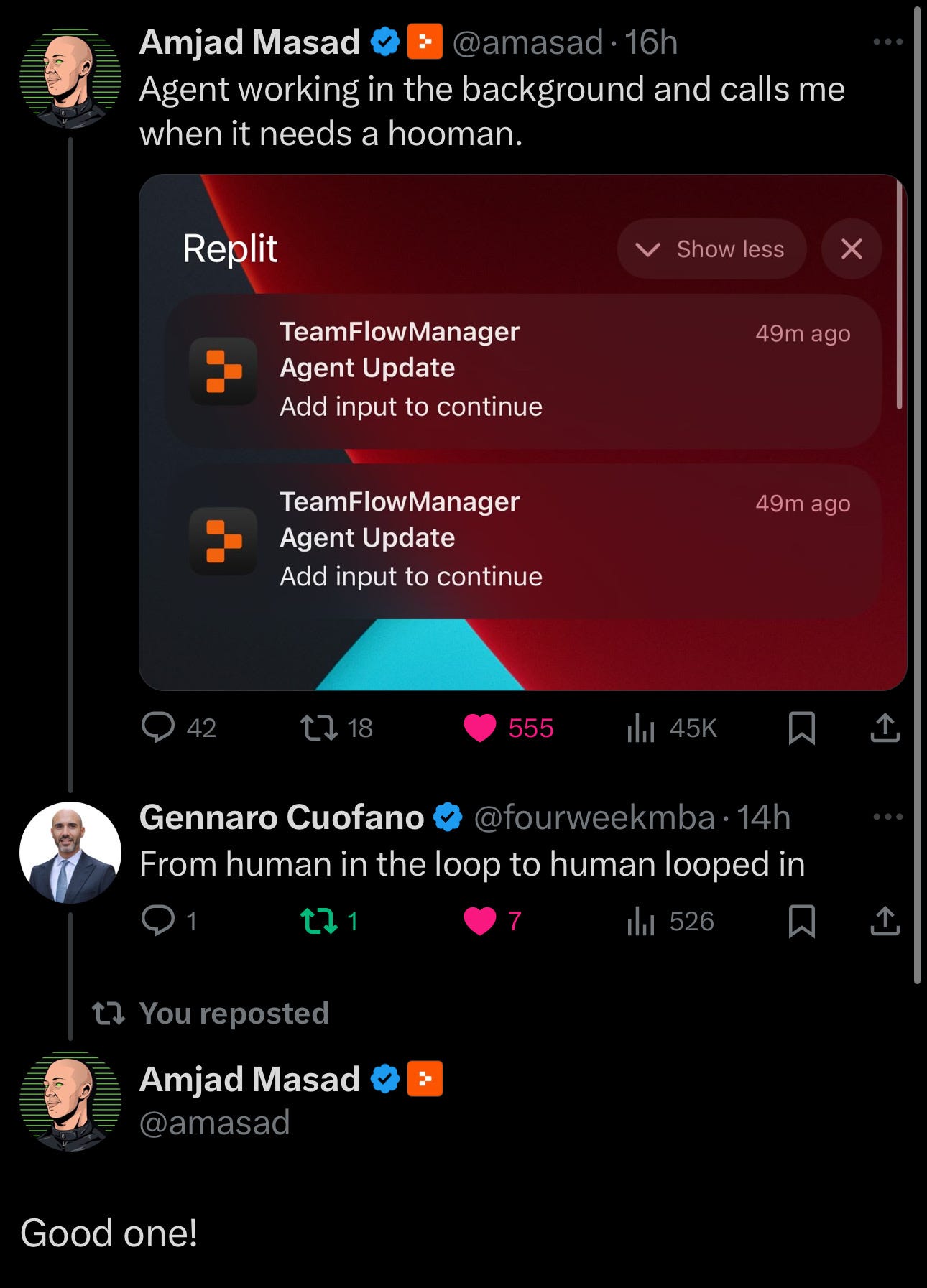
In just about two and a half years, we’re assisting a further reshaping of the AI industry as we finally moved past the point where an AI needs continuous prompting to complete a task.
In what we can now call human-looped-in AI.
As in my reply to Amjad, founder of Replit, we moved from human-in-the-loop to human-looped-in.
That’s a further paradigm shift.
Or from a place where the human is instrumental in the AI to initiate a task and for the human to prompt its way through getting that complete to a place where the human only gets “looped in” by the AI (working in the background) whether to provide feedback on an intermediary work done or simply feedback on a final executed work.
From human-in-the-loop AI to human-looped-in AI
In human-in-the-loop AI, humans prompt the system to travel from point A to point B, guiding each step with explicit instructions.
In contrast, human-looped-in-AI empowers the agent to independently complete the entire cycle of tasks, with human involvement limited to providing strategic feedback or final approval.
This approach leverages the AI agent’s autonomy to manage complex operations while incorporating human oversight to guarantee quality and correctness.
Ultimately, it creates a more efficient, collaborative workflow between man and machine.
This model transforms conventional roles, ensuring AI completes tasks autonomously while humans carefully review outcomes.
This multi-step agent completes tasks, reports, and research that would have taken an analyst anywhere between a couple of hours to a few days to complete!
This is part of a much wider paradigm shift.
A platform shift is a fundamental transformation where incumbents initially leverage established distribution moats for short-term advantage in emerging markets but eventually struggle to adapt.
As new technology paradigms disrupt old business models, rapid shifts expose vulnerabilities, forcing companies to evolve or risk losing competitive dominance in dynamic cycles continuously.
Let’s review some of the key concepts that make this happen in the first place.
The Incumbent Paradox
The incumbent paradox (where the incumbent gets a leg up in the short-term, which loses effectiveness slowly, then quite suddenly) acts as a short-term distribution moat, allowing an incumbent to gain an early advantage in a newly developing market during a platform shift.
That’s a period of major confusion among the practitioners and onlookers, as it’ll prevail the narrative of “the new tech is just making incumbents richer and more dominant.”
Yet, that is only temporary. Indeed, as the platform shift happens, the tech incumbent will actually be the most challenged in making a core transition of a business model that is quite fit with the previous paradigm.
In this phase, the incumbent leverages its distributionstrength to get a leg up, and it works!
Until distribution on the old paradigm, “slowly, then quite suddenly,” no longer works as a moat.
The Crossover Point
Thus, once the shift gains momentum, the gap between the old and new market widens rapidly, and the new distributionmodel takes control.
At that stage, the incumbent loses its competitive moat unless it has successfully adapted to dominate the new paradigm and platform.
The Platform Shift Dilemma says that moats that have worked for decades suddenly don’t.
Many incumbents are going through this in a very weird time window, where in the next decade, many of these might lose their core moats.
This dynamic, much slower in other industries, is instead the norm in a tech-driven business world.
Non-Linear Market Dynamics
The boundaries in the tech world are quite blurred as new markets develop continuously, and it’s tough to predict which one will be the next one that will eat them all while expanding on top.
Therefore, as a company operating in the tech industry, you must continuously transition your business model as you place bets on the future.
Indeed, the tech industry is super competitive; that’s what Andy Grove meant with the title of his book “Only the Paranoid Survive.”
Technology, which seems such a cool sector today, is also quite a wild ride, where the first-mover, in most cases, doesn’t make it to the other end of a market it opened in the first place.
It’s also a place where, in new markets, co-opetition is the rule, as technology markets operate with very complex dynamics and blurred boundaries where friend and enemy turn into “frenemies.”
When the future market gets dominated by startups turned into incumbents that benefit from winner-take-all, make the rule of the game until a new technology paradigm eats up the whole industry to go full cycle again.
That’s a key lesson to remember in the world of AI as it develops!
Recap: In This Issue
We’re looking just now at the emergence of a new AI shift (multi-step agents). Indeed, in human-in-the-loop AI, humans prompt the system to travel from point A to point B, guiding each step with explicit instructions.
In contrast, human-looped-in-AI empowers the agent to independently complete the entire cycle of tasks, with human involvement limited to providing strategic feedback or final approval.
Platform Shift: A platform shift is a fundamental transformation where incumbents use established distribution moats for a short-term advantage in emerging markets but eventually struggle to adapt as new technology paradigms disrupt old business models.
This advantage is temporary—initial strength fades as the market evolves, leaving incumbents vulnerable when the old distributionmodel no longer serves as an effective moat.
The Crossover Point:
As the shift gains momentum, the gap between old and new market models widens rapidly.
Incumbents lose their competitive edge unless they successfully transition to and dominate the new paradigm, marking the critical crossover point.
Platform Shift Dilemma:
Moats that have protected incumbents for decades can suddenly vanish in the face of disruptive changes.
This leaves companies in a challenging situation where adaptation is essential or they risk losing their market dominance.
Non-Linear Market Dynamics:
In the tech world, market boundaries are constantly shifting as new markets emerge.
Competition is highly unpredictable, and co-opetition—where competitors both collaborate and compete—is the norm.
Rapid, non-linear shifts mean that today’s first movers often don’t survive in the long run, with startups turning into dominant players until another disruptive cycle begins.
Dynamic Cycles of Dominance:
The tech industry undergoes continuous cycles where new paradigms disrupt the status quo, forcing incumbents to evolve or be overtaken.
This creates an environment where constant evolution is required to maintain competitive dominance.
With massive ♥️ Gennaro Cuofano, The Business Engineer
This is part of an Enterprise AI series to tackle many of the day-to-day challenges you might face as a professional, executive, founder, or investor in the current AI landscape.
Gennaro Cuofano is a CRO and tech executive who has worked in AI since late 2015, starting with bringing NLP, natural-language generation, voice and chatbot products to the marketing industry. His background is in law and finance: he holds a Master's degree in Law and an International MBA with an emphasis on corporate finance (LUISS Business School and the University of San Diego, 2012), and worked as a financial analyst at a real-estate investment firm in San Diego and as an assistant controller. His work focuses on business model strategy, business engineering and, more broadly, structural analysis: how companies make money, read from their own filings. He created FourWeekMBA and leads research there and at The Business Engineer, his newsletter on AI and business strategy, with over 95,000 subscribers and more than 1,000 published analyses. His writing has also appeared on Entrepreneur (for example, How to Digitize a Family Business in Europe) and HackerNoon. Find him on LinkedIn and Substack. See how we source.