Program management is a systematic approach to managing multiple related projects involving planning, organizing, monitoring, and controlling all aspects of the program to meet strategic goals by delivering value through coordinated efforts.
Aspect
Explanation
Definition
Program Management is a strategic approach to managing a group of related projects and initiatives within an organization. It involves coordinating and overseeing multiple projects that are interconnected and collectively contribute to achieving specific strategic objectives. Program management ensures alignment with the organization’s goals and helps optimize resources, mitigate risks, and deliver benefits efficiently. It focuses on the big picture and the interconnectedness of projects rather than managing them in isolation. Program managers are responsible for planning, executing, and monitoring programs to ensure successful outcomes.
Key Concepts
– Project Interdependencies: Recognizing that projects within a program often depend on one another and that their success contributes to the overall program’s success. – Strategic Alignment: Ensuring that the program’s goals align with the organization’s strategic objectives and priorities. – Resource Optimization: Efficiently allocating and managing resources, including budgets, personnel, and materials, across multiple projects. – Risk Management: Identifying, assessing, and mitigating risks that may affect the program’s success. – Benefits Realization: Focusing on delivering the expected benefits and value outlined in the program’s business case.
Characteristics
– Holistic Approach: Program management takes a holistic view, considering how projects interact and contribute to overarching goals. – Governance: Programs often have dedicated governance structures to ensure alignment with strategic objectives. – Complexity: Programs are typically complex, involving various stakeholders, resources, and objectives. – Longer Duration: Programs may span a longer duration than individual projects, aligning with the organization’s strategic timeline. – Multiple Projects: They involve multiple projects or initiatives, each with its own scope and objectives.
Implications
– Strategic Alignment: Program management ensures that projects are aligned with the organization’s strategic direction, maximizing their impact. – Resource Efficiency: It optimizes the utilization of resources, avoiding duplication of efforts and resource shortages. – Risk Mitigation: By recognizing interdependencies and risks, program management allows for proactive risk mitigation. – Benefits Delivery: Focus on benefits realization ensures that the organization achieves the desired outcomes. – Stakeholder Engagement: Effective communication and engagement with stakeholders are crucial for program success.
Advantages
– Strategic Alignment: Programs align projects with organizational strategies, ensuring that efforts contribute to overarching goals. – Resource Optimization: Efficient resource allocation minimizes waste and maximizes value. – Risk Management: Proactive risk identification and mitigation reduce project setbacks. – Benefits Realization: Emphasis on delivering tangible benefits justifies investments. – Improved Decision-Making: Program managers provide decision-makers with a comprehensive view of progress and challenges.
Drawbacks
– Complexity: Managing multiple projects simultaneously can be challenging and complex. – Resource Demands: Programs may require significant resources, both in terms of personnel and budget. – Communication Overhead: Effective communication across multiple projects and stakeholders can be resource-intensive. – Scope Creep: Managing interdependencies can lead to scope changes and added complexity. – Change Management: Program success often requires significant organizational change management efforts.
Applications
– Large-Scale Projects: In industries like construction and aerospace, program management is used to oversee complex, multi-component projects. – Information Technology: IT organizations use program management for software development, system implementations, and infrastructure upgrades. – Healthcare: Managing healthcare initiatives, such as electronic health record (EHR) implementations, falls under program management. – Public Sector: Governments use program management to execute public infrastructure projects and social programs. – Product Development: Companies managing multiple products or product lines often employ program management to ensure coordination.
Programs can be broadly categorized into two types:
Operational programs, which focus on improving existing operations such as customer service or product development;
And transformational programs, which involve introducing new products/services or changing existing ones such as launching a new website platform or restructuring an organization’s IT infrastructure.
Planning and Organizing Projects
A program manager must be able to plan out projects from start to finish. This includes setting goals for the project, breaking down tasks into manageable chunks that can be delegated to team members or outsourced if necessary.
They must also have an understanding of the timeline needed for each task so that they can ensure deadlines are met without sacrificing quality.
Managing Resources and Budgets
Program managers need to have a good handle on resource allocation so that they can maximize efficiency while minimizing costs.
They should understand how much money needs to be spent on different aspects of the project such as labor costs or materials needed for production.
Additionally, they should know when it’s best to outsource certain tasks in order to save time or money depending on the situation at hand.
Monitoring Progress and Quality Assurance
Program managers need to keep track of progress throughout all stages of development in order make sure everything is running smoothly according to schedule with no major issues arising unexpectedly during production cycles.
Additionally, they should also monitor the overall quality of work being done by team members or contractors hired for specific tasks in order ensure that all deliverables meet standards set by stakeholders before launch date arrives.
Risk Management and Problem Solving
Lastly, but certainly not least important is risk management which requires program managers to anticipate potential risks associated with each stage of development before it happens rather than after something has gone wrong due to unforeseen circumstances beyond their control such as natural disasters.
In addition, problem solving skills are essential because there will always be unexpected problems that arise even after careful planning due to human error.
Therefore, having the ability to think quickly and come up with solutions under pressure is key for the success of any given project especially those involving tight deadlines, complex requirements, and high stakes in terms of financial investments.
As a program manager, it is essential to understand the responsibilities and duties of this role in order to successfully manage projects within a startup.
The next heading will discuss how to develop effective strategies for successful project management.
Processes Involved in Program Management
Program management is a process that involves the coordination of multiple projects and resources to achieve a common goal.
It requires planning, organizing, monitoring progress, and managing risks in order to ensure successful completion of the project.
The processes involved in program management are essential for any organization looking to reach its objectives efficiently and effectively.
Establishing Goals and Objectives
Establishing goals and objectives is an important step in program management as it provides direction for the entire project team.
Goals should be specific, measurable, achievable, relevant, time-bound (SMART) so that everyone understands what needs to be accomplished.
A SMART goal is any goal with a carefully planned, concise, and trackable objective. To be such a goal needs to be specific, measurable, achievable, relevant, and time-based. Bringing structure and trackability to goal setting increases the chances goals will be achieved, and it helps align the organization around those goals.
Additionally, objectives should also be established which will help guide decision making throughout the course of the project.
Defining Scope and Requirements
Defining scope helps set expectations for all stakeholders by outlining what activities are included or excluded from the project’s scope statement.
This includes defining deliverables such as products or services that need to be produced during execution phase of the program along with requirements such as quality standards or performance metrics needed for successful completion of each task within those deliverables.
Developing strategies for execution allows organizations to plan how they will execute their programs while taking into account available resources such as personnel skillsets or budget constraints, timeline restrictions, and external dependencies.
Teams can then use these strategies when executing tasks associated with their respective programs, ensuring efficient use of available resources while still achieving desired outcomes on time without compromising quality standards set forth at the outset stage of each program initiative.
Program management is a complex process that requires careful planning and execution.
The next heading will focus on how to effectively manage the resources needed for successful program implementation.
Program Management Vs. Project Management
Product managers are responsible for overseeing the management lifecycle of a product. This encompasses product teams, product strategy, and the product roadmap. Project managers, on the other hand, must plan, execute, monitor, and ensure the successful completion of organizational projects. In other words, they execute the product development plan formulated by the product manager.
While project management focuses on reaching specific goals based on specific projects, the program manager can help achieve multiple projects, with border and conflicting goals within an organization.
Program Management Vs. Product Management
Product management has become a key role within most organizations and startups as it combines product development with experimentation to create a successful product in the market. Product management requires a combination of strategic thinking, problem-solving skills, and a relentless focus on customer needs and delivering the right product at the right time. Top product managers use a customer obsession approach to build and launch successful products.
A product manager is focused on making sure to help teams within organizations to develop valuable products, in line with the company’s growth objectives.
While the program manager needs to be able to potentially help launch multiple products, as part of parallel projects with broader goals within the organization.
Examples of Successful Program Management Projects
NASA’s Apollo 11 Mission
NASA’s Apollo 11 Mission is one of the most successful program management projects in history.
The mission was launched on July 16, 1969 and successfully landed two astronauts on the moon four days later.
The project required extensive planning, organization, and coordination to ensure its success.
It involved a team of over 400,000 people from 20 different countries working together to achieve this incredible feat.
The Panama Canal Expansion Project
The Panama Canal Expansion Project was another example of an effective program management project that took place between 2007 and 2016.
This massive undertaking included widening the existing canal to accommodate larger ships as well as building new locks for them to pass through safely.
To complete this task, a team of engineers had to work with local governments and communities while managing resources such as land acquisition, budgeting, construction materials procurement, environmental protection measures and more.
The London 2012 Olympic Games Project
The London 2012 Olympic Games Project was a successful program management endeavor, involving thousands of people from around the world.
Every aspect of the event was carefully planned out by dedicated professionals who worked tirelessly behind-the-scenes to ensure that events at various venues across London ran smoothly and transportation services for visitors were coordinated effectively.
This once-in-a-lifetime experience provided an unforgettable experience for athletes and spectators alike.
Program management projects can be complex and challenging, but when executed properly they can result in amazing successes.
This article will now discuss the skills and qualifications needed to become a successful program manager.
What are the three skills of a program manager?
Planning
A program manager is responsible for creating and managing a plan that outlines the goals, objectives, resources, timeline and budget of a project.
This includes developing strategies to ensure successful completion of the project within the given constraints.
Communication
An effective communication strategy starts with a clear brand identity, by defining clear boundaries and compromises your brand will not take in the marketplace. Based on that, understanding, whether context, formats, and scale are in line with your business message to prevent a loss of identity.
Program managers must be able to effectively communicate with stakeholders throughout all stages of the project in order to keep everyone informed and on track.
They must also be able to identify potential issues early on so they can take corrective action before it’s too late.
Leadership
Leadership styles encompass the behavioral qualities of a leader. These qualities are commonly used to direct, motivate, or manage groups of people. Some of the most recognized leadership styles include Autocratic, Democratic, or Laissez-Faire leadership styles.
Program managers need strong leadership skills in order to motivate team members, manage conflicts between stakeholders, make decisions quickly when needed and provide guidance throughout the entire process from start to finish.
Key Takeaways
In conclusion, program management is a critical role in the success of any organization.
It requires an understanding of project management processes and responsibilities as well as a commitment to meeting deadlines and delivering results.
Program managers are responsible for overseeing multiple projects at once, ensuring that they all meet their goals on time and within budget.
By taking the time to understand how program management works, you can become an invaluable asset to your team or organization.
With dedication and hard work, you can help ensure successful program management outcomes for your company’s future growth!
Key Highlights:
Program Management Definition:
Program management involves a systematic approach to managing multiple related projects to meet strategic goals.
It encompasses planning, organizing, monitoring, and controlling to deliver value through coordinated efforts.
Types of Programs:
Operational programs focus on improving existing operations.
Transformational programs involve introducing new products/services or changing existing ones.
Program Manager Responsibilities:
Planning projects from start to finish, setting goals and timelines.
Managing resources and budgets efficiently.
Monitoring progress and ensuring quality assurance.
Identifying and managing risks, problem-solving skills are vital.
Processes in Program Management:
Establishing SMART goals and objectives.
Defining scope and requirements, ensuring expectations are clear.
Developing execution strategies based on available resources.
Coordinating multiple projects and resources for successful completion.
Program Management vs. Project Management:
Program management handles multiple projects with broader goals.
Project management focuses on specific projects with defined goals.
Program Management vs. Product Management:
Product management involves creating and launching successful products.
Program management can involve launching multiple products as part of broader initiatives.
Examples of Successful Program Management Projects:
NASA’s Apollo 11 Mission.
The Panama Canal Expansion Project.
The London 2012 Olympic Games Project.
Skills of a Program Manager:
Planning: Developing and managing project plans.
Communication: Effective communication with stakeholders.
Leadership: Motivating teams, conflict management, and decision-making.
Conclusion:
Program management is essential for achieving strategic goals through coordinated project efforts.
It requires a combination of skills in planning, communication, and leadership.
Understanding program management processes can lead to successful outcomes and organizational growth.
A Blockchain Business Model according to the FourWeekMBA framework is made of four main components: Value Model (Core Philosophy, Core Values and Value Propositions for the key stakeholders), Blockchain Model (Protocol Rules, Network Shape and Applications Layer/Ecosystem), Distribution Model (the key channels amplifying the protocol and its communities), and the Economic Model (the dynamics/incentives through which protocol players make money). Those elements coming together can serve as the basis to build and analyze a solid Blockchain Business Model.
In an asymmetric businessmodel, the organization doesn’t monetize the user directly, but it leverages the data users provide coupled with technology, thus have a key customer pay to sustain the core asset. For example, Google makes money by leveraging users’ data, combined with its algorithms sold to advertisers for visibility.
In a business world driven by technology and digitalization, competition is much more fluid, as innovation becomes a bottom-up approach that can come from anywhere. Thus, making it much harder to define the boundaries of existing markets. Therefore, a proper business competition analysis looks at customer, technology, distribution, and financial model overlaps. While at the same time looking at future potential intersections among industries that in the short-term seem unrelated.
Technological modeling is a discipline to provide the basis for companies to sustain innovation, thus developing incremental products. While also looking at breakthrough innovative products that can pave the way for long-term success. In a sort of Barbell Strategy, technological modeling suggests having a two-sided approach, on the one hand, to keep sustaining continuous innovation as a core part of the businessmodel. On the other hand, it places bets on future developments that have the potential to break through and take a leap forward.
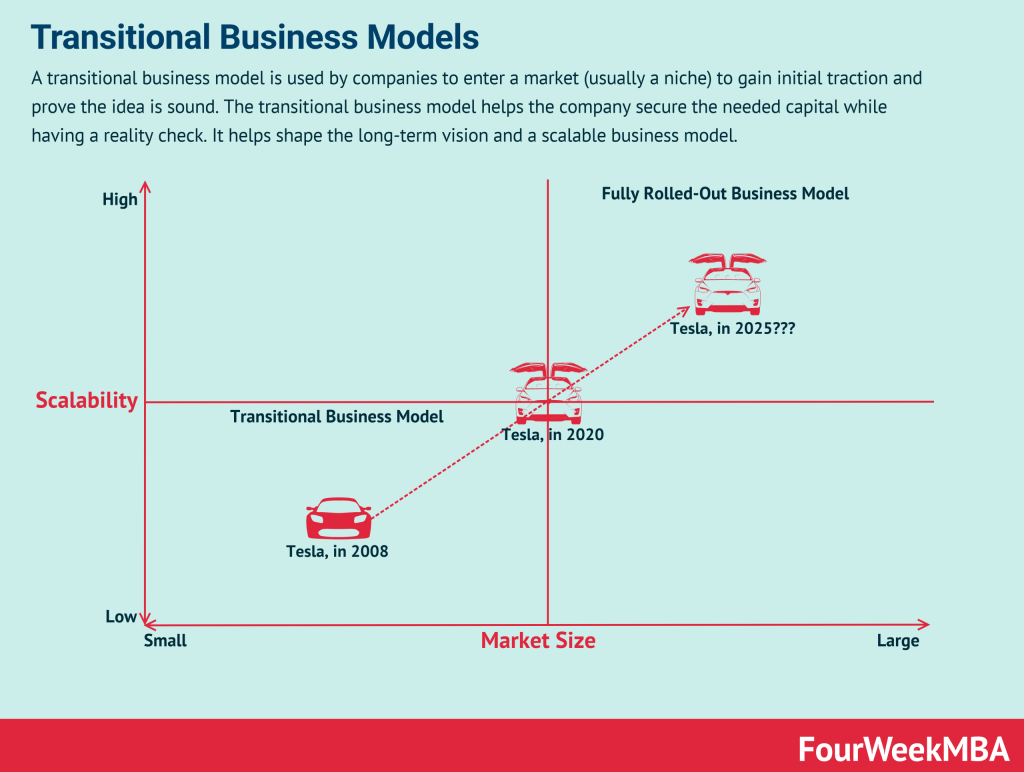
A transitional business model is used by companies to enter a market (usually a niche) to gain initial traction and prove the idea is sound. The transitional business model helps the company secure the needed capital while having a reality check. It helps shape the long-term vision and a scalable businessmodel.
The minimum viable audience (MVA) represents the smallest possible audience that can sustain your business as you get it started from a microniche (the smallest subset of a market). The main aspect of the MVA is to zoom into existing markets to find those people which needs are unmet by existing players.
Business scaling is the process of transformation of a business as the product is validated by wider and wider market segments. Business scaling is about creating traction for a product that fits a small market segment. As the product is validated it becomes critical to build a viable businessmodel. And as the product is offered at wider and wider market segments, it’s important to align product, businessmodel, and organizational design, to enable wider and wider scale.
The market expansion consists in providing a product or service to a broader portion of an existing market or perhaps expanding that market. Or yet, market expansions can be about creating a whole new market. At each step, as a result, a company scales together with the market covered.
In the FourWeekMBA growth matrix, you can apply growth for existing customers by tackling the same problems (gain mode). Or by tackling existing problems, for new customers (expand mode). Or by tackling new problems for existing customers (extend mode). Or perhaps by tackling whole new problems for new customers (reinvent mode).
In the FourWeekMBA Revenue Streams Matrix, revenue streams are classified according to the kind of interactions the business has with its key customers. The first dimension is the “Frequency” of interaction with the key customer. As the second dimension, there is the “Ownership” of the interaction with the key customer.
Revenue model patterns are a way for companies to monetize their business models. A revenue model pattern is a crucial building block of a business model because it informs how the company will generate short-term financial resources to invest back into the business. Thus, the way a company makes money will also influence its overall businessmodel.
A pricing strategy or model helps companies find the pricing formula in fit with their business models. Thus aligning the customer needs with the product type while trying to enable profitability for the company. A good pricing strategy aligns the customer with the company’s long term financial sustainability to build a solid businessmodel.
Gennaro is the creator of FourWeekMBA, which reached about four million business people, comprising C-level executives, investors, analysts, product managers, and aspiring digital entrepreneurs in 2022 alone | He is also Director of Sales for a high-tech scaleup in the AI Industry | In 2012, Gennaro earned an International MBA with emphasis on Corporate Finance and Business Strategy.