A positive-sum game is a situation in which the players’ combined gains exceed their combined losses, so the total value grows and more than one side can come out ahead. It is one kind of non-zero-sum game, the category game theory sets against zero-sum games, where one player can only gain what another loses. Game theory was given its first general mathematical form by John von Neumann and Oskar Morgenstern in 1944.
Drawing by The Business Engineer.
How it works
01
Value is created, not just moved
Trade, specialisation and shared tools can leave every party better off than before. The total payoff is larger than what the players started with.
02
Splitting still matters
A bigger pie does not guarantee a fair share. Players can still bargain hard over how the extra value is divided.
03
Trust sustains it
In a one-off deal, each side may be tempted to grab. When the same players meet again, reciprocity makes cooperation pay, as Axelrod and Hamilton showed with the repeated prisoner's dilemma (Axelrod and Hamilton, 1981).
04
Defection can turn it negative
If players stop trusting each other, the same situation can end with everyone worse off, as in a price war or an arms race.
Where you see it today
Open-weight AI models
Meta releases its Llama models openly. In a July 2024 letter, Mark Zuckerberg argued that open-source AI is good for developers, for Meta and for the world (Zuckerberg, 2024). It is a positive-sum pitch; rivals that sell closed models see the trade-offs differently.
Shared standards for AI agents
In November 2024 Anthropic released the Model Context Protocol as an open standard for connecting AI systems to data sources (Anthropic, 2024). One connector built to a shared standard can serve many AI apps, so tool makers and model makers both gain from a larger market.
Teaching machines to cooperate
Researchers at DeepMind and elsewhere proposed Cooperative AI: AI research on problems in which agents seek ways to jointly improve their welfare (Dafoe et al., 2020). As AI agents start to negotiate and transact with each other, whether they find the positive-sum outcome becomes a design question.
Partners who also compete
Brandenburger and Nalebuff argued that business is not only about winning and losing and that firms can create value together while competing to capture it (Brandenburger and Nalebuff, 1995). AI labs and cloud providers that invest in each other while competing for the same customers are a current example.
Positive-sum game and related ideas
Positive-sum game
What happens to total valueGrows; several players can gain
Business exampleTwo firms co-develop a standard both can sell into
Zero-sum game
What happens to total valueFixed; one side's gain is the other's loss
Business exampleSplitting a fixed bonus pool
Negative-sum game
What happens to total valueShrinks; most players lose
Business exampleA price war that wipes out margins for everyone
Prisoner's dilemma
What happens to total valueCould grow, but self-interest pushes both to defect
Business exampleRivals who both overspend on ads to match each other
Coopetition
What happens to total valueGrown together, then contested
Business exampleCompetitors that share a supplier or platform
How to use it
Before negotiating the split, ask what would make the total deal larger for both sides.
Separate value creation from value capture in your plan, and decide how the extra value will be divided.
Prefer repeated, visible relationships with partners: reciprocity is easier to sustain when you will meet again.
Check whether a shared standard or open interface would grow your market more than a closed one would.
Watch for signs that a positive-sum deal is turning negative, such as price matching or hoarding of shared resources.
The Business Engineer lens
AI markets mix both games: compute and talent are contested, while standards, open models and ecosystems can grow the market for everyone. The Business Engineer asks which layer of the stack is a growing pie and which is a fixed one before choosing to cooperate or compete.
A situation in which the players' combined gains exceed their combined losses, so the total value grows and more than one side can benefit.
What is the difference between a zero-sum and a positive-sum game?
In a zero-sum game one player can only gain what another loses; in a positive-sum game cooperation can enlarge the total, so several players can gain.
Is business a positive-sum game?
Often, but not always. Voluntary trade usually creates value for both sides, while a price war can make an industry negative-sum.
How does AI relate to positive-sum games?
Open standards and open models aim to grow the whole market, and researchers study how to build AI agents that find cooperative, mutually beneficial outcomes.
The complete explainer, cleaned up and reformatted for mobile.
FourWeekMBABusiness EngineerAt a glance
Unlike zero-sum games, where one participant's gain is precisely balanced by another participant's loss, positive-sum games provide a framework for scenarios where cooperation can result in overall benefits for all involved parties.
A positive-sum game refers to a scenario in which the total gains and losses among all participants result in a net increase in value.
Resource Expansion: Positive-sum games often involve resource expansion, where the available resources or value are not fixed but can be increased through cooperation, innovation, and synergy.
Fostering positive-sum games offers numerous benefits, enhancing collaboration, innovation, and overall success.
Layout refreshed 6 October 2026. The article text below is unchanged.
Why it mattersFrom the article
Understanding and fostering positive-sum games is crucial for enhancing collaboration, innovation, and overall success in various fields, including business, economics, and international relations.
By understanding the key components, methods, benefits, and challenges of positive-sum games, organizations and individuals can develop effective strategies to enhance collaboration, drive innovation, and achieve mutual success.
Implementing best practices such as building trust and relationships, aligning goals and incentives, facilitating effective communication, promoting transparency, and encouraging flexibility can help maximize the benefits of positive-sum games.
Positive-sum games are a fundamental concept in game theory, a branch of mathematics and economics that studies strategic interactions among rational decision-makers.
Key Components
What is a Positive-sum Game?
A positive-sum game refers to a scenario in which the total gains and losses among all participants result in a net increase in value.
Importance of Positive-sum Games
Understanding and fostering positive-sum games is crucial for enhancing collaboration, innovation, and overall success in various fields, including business, economics, and…
Components of Positive-sum Games
Positive-sum games involve several key components that contribute to mutual benefit and value creation.
Methods to Foster Positive-sum Games
Several methods can be used to foster positive-sum games effectively, each offering different strategies and tools.
Benefits of Positive-sum Games
Fostering positive-sum games offers numerous benefits, enhancing collaboration, innovation, and overall success.
Challenges of Fostering Positive-sum Games
Despite its benefits, fostering positive-sum games presents several challenges that need to be managed for successful implementation.
Best Practices for Fostering Positive-sum Games
Implementing best practices can help effectively manage and overcome challenges, maximizing the benefits of positive-sum games.
Future Trends in Positive-sum Games
Several trends are likely to shape the future of positive-sum games and their applications.
Strengths
✓Fostering positive-sum games offers numerous benefits, enhancing collaboration, innovation, and overall success.
✓Market Positioning: Enhances market positioning through cooperative strategies.
✓Strategic Alliances: Builds strategic alliances that strengthen competitive advantage.
Limitations
✗Despite its benefits, fostering positive-sum games presents several challenges that need to be managed for successful…
Real-World Examples
AirbnbAmazonAppleCoca-ColaCostcoEbay
Key Insight
Understanding and fostering positive-sum games is crucial for enhancing collaboration, innovation, and overall success in various fields, including business, economics, and international relations.
Exec Package + Claude OS Master Skill | Business Engineer Founding Plan
FourWeekMBA x Business Engineer | Updated 2026
Positive-sum games are a fundamental concept in game theory, a branch of mathematics and economics that studies strategic interactions among rational decision-makers. Unlike zero-sum games, where one participant’s gain is precisely balanced by another participant’s loss, positive-sum games provide a framework for scenarios where cooperation can result in overall benefits for all involved parties.
Key principles and components of positive-sum games include:
Cooperation and Collaboration: Positive-sum games encourage cooperation and collaboration among participants. Instead of viewing others as adversaries, participants recognize the potential for mutual gain through joint efforts.
Value Creation: In positive-sum games, participants have the opportunity to create value collectively. By combining their resources, knowledge, and efforts, they can achieve outcomes that are superior to what any single participant could attain on their own.
Win-Win Outcomes: The hallmark of positive-sum games is the possibility of win-win outcomes. These outcomes occur when all participants experience gains without any suffering losses. Such situations exemplify the idea that success need not come at the expense of others.
Resource Expansion: Positive-sum games often involve resource expansion, where the available resources or value are not fixed but can be increased through cooperation, innovation, and synergy.
Long-Term Perspective: Participants in positive-sum games tend to adopt a long-term perspective, focusing on sustainable solutions and lasting partnerships rather than short-term gains at the expense of others.
What is a Positive-sum Game?
A positive-sum game refers to a scenario in which the total gains and losses among all participants result in a net increase in value. Unlike zero-sum games, where one participant’s gain is another’s loss, positive-sum games allow for mutual gains through cooperation, collaboration, and innovation.
Key Characteristics of a Positive-sum Game
Mutual Benefit: All participants can achieve beneficial outcomes.
Collaboration: Emphasis on collaboration and cooperation to achieve shared goals.
Value Creation: Total value is increased, benefiting all parties involved.
Importance of Positive-sum Games
Understanding and fostering positive-sum games is crucial for enhancing collaboration, innovation, and overall success in various fields, including business, economics, and international relations.
Enhancing Collaboration
Synergy: Encourages synergy and collaborative efforts, leading to better outcomes.
Conflict Reduction: Reduces conflicts and promotes harmonious interactions among participants.
Driving Innovation
Shared Resources: Pooling resources and knowledge to drive innovation and creativity.
Win-Win Solutions: Finding win-win solutions that benefit all parties involved.
Promoting Success
Sustainable Growth: Promotes sustainable growth by creating value for all stakeholders.
Competitive Advantage: Provides a competitive advantage through cooperative strategies.
Components of Positive-sum Games
Positive-sum games involve several key components that contribute to mutual benefit and value creation.
1. Cooperation
Joint Efforts: Participants work together to achieve common goals.
Resource Sharing: Sharing resources, information, and expertise to maximize benefits.
2. Communication
Open Dialogue: Encouraging open and transparent communication among participants.
Feedback Mechanisms: Establishing feedback mechanisms to address concerns and improve collaboration.
3. Trust
Trust Building: Building trust among participants to facilitate cooperation and mutual benefit.
Reliability: Ensuring reliability and commitment to shared goals.
4. Incentives
Aligned Incentives: Aligning incentives to ensure that all participants benefit from the collaboration.
Reward Systems: Implementing reward systems to recognize and encourage contributions.
Methods to Foster Positive-sum Games
Several methods can be used to foster positive-sum games effectively, each offering different strategies and tools.
1. Collaborative Planning
Joint Planning Sessions: Conduct joint planning sessions to align goals and strategies.
Consensus Building: Use consensus-building techniques to ensure all participants are on board.
2. Resource Pooling
Shared Resources: Pool resources, such as knowledge, technology, and capital, to achieve shared goals.
Collective Bargaining: Use collective bargaining to negotiate better terms and conditions for all parties.
3. Strategic Partnerships
Partnership Development: Develop strategic partnerships to leverage complementary strengths.
Joint Ventures: Create joint ventures to pursue mutually beneficial projects.
4. Incentive Alignment
Performance-based Incentives: Implement performance-based incentives to encourage cooperation and collaboration.
Shared Rewards: Design reward systems that distribute benefits equitably among participants.
5. Effective Communication
Regular Meetings: Hold regular meetings to discuss progress, address issues, and share insights.
Transparent Reporting: Ensure transparent reporting of activities and outcomes to build trust and accountability.
Benefits of Positive-sum Games
Fostering positive-sum games offers numerous benefits, enhancing collaboration, innovation, and overall success.
Enhanced Collaboration
Teamwork: Promotes teamwork and collaborative efforts to achieve common goals.
Conflict Resolution: Reduces conflicts and fosters harmonious relationships among participants.
Increased Innovation
Creative Solutions: Encourages creative problem-solving and innovative solutions.
Resource Optimization: Maximizes resource utilization through shared efforts.
Sustainable Success
Long-term Growth: Promotes long-term growth and sustainability by creating value for all stakeholders.
Mutual Gains: Ensures mutual gains and shared success among participants.
Competitive Advantage
Market Positioning: Enhances market positioning through cooperative strategies.
Strategic Alliances: Builds strategic alliances that strengthen competitive advantage.
Challenges of Fostering Positive-sum Games
Despite its benefits, fostering positive-sum games presents several challenges that need to be managed for successful implementation.
Coordination Difficulties
Complex Coordination: Coordinating efforts among multiple participants can be complex and time-consuming.
Alignment Issues: Aligning goals, incentives, and strategies among diverse participants.
Trust Building
Initial Skepticism: Overcoming initial skepticism and building trust among participants.
Consistency: Ensuring consistent and reliable behavior to maintain trust.
Resource Allocation
Fair Distribution: Ensuring fair distribution of resources, benefits, and rewards.
Resource Constraints: Managing resource constraints and limitations.
Communication Barriers
Effective Communication: Ensuring effective communication and information sharing among participants.
Misunderstandings: Addressing misunderstandings and miscommunications promptly.
Best Practices for Fostering Positive-sum Games
Implementing best practices can help effectively manage and overcome challenges, maximizing the benefits of positive-sum games.
Build Trust and Relationships
Trust-building Activities: Engage in trust-building activities to foster mutual trust and respect.
Reliability: Demonstrate reliability and commitment to shared goals.
Align Goals and Incentives
Shared Vision: Develop a shared vision and common goals to align efforts.
Incentive Structures: Design incentive structures that align with the interests of all participants.
Facilitate Effective Communication
Communication Channels: Establish clear communication channels to facilitate information sharing.
Open Dialogue: Encourage open dialogue and active listening to address concerns and build consensus.
Promote Transparency
Transparent Processes: Ensure transparency in decision-making processes and activities.
Regular Updates: Provide regular updates on progress and outcomes to maintain trust and accountability.
Encourage Flexibility
Adaptability: Encourage adaptability and flexibility to adjust strategies and approaches as needed.
Responsive Planning: Use responsive planning to address changing conditions and emerging opportunities.
Future Trends in Positive-sum Games
Several trends are likely to shape the future of positive-sum games and their applications.
Digital Collaboration
Online Platforms: Leveraging online collaboration platforms to facilitate remote and virtual teamwork.
Digital Tools: Using digital tools and technologies to enhance communication and coordination.
Sustainability and Social Responsibility
Sustainable Practices: Integrating sustainability and social responsibility into collaborative efforts.
Ethical Considerations: Promoting ethical practices and shared values.
Global Collaboration
Cross-Border Partnerships: Developing cross-border partnerships to leverage global opportunities.
Cultural Sensitivity: Enhancing cultural sensitivity and understanding in international collaborations.
Innovation Ecosystems
Innovation Networks: Creating innovation networks and ecosystems to drive collective innovation.
Collaborative Research: Engaging in collaborative research and development initiatives.
Data-Driven Collaboration
Data Sharing: Leveraging data sharing and analytics to inform collaborative efforts.
Insight Generation: Using data-driven insights to optimize collaboration and decision-making.
Conclusion
A positive-sum game is a scenario where all participants can benefit and create value through cooperation, collaboration, and innovation. By understanding the key components, methods, benefits, and challenges of positive-sum games, organizations and individuals can develop effective strategies to enhance collaboration, drive innovation, and achieve mutual success. Implementing best practices such as building trust and relationships, aligning goals and incentives, facilitating effective communication, promoting transparency, and encouraging flexibility can help maximize the benefits of positive-sum games.
In a functional organizational structure, groups and teams are organized based on function. Therefore, this organization follows a top-down structure, where most decision flows from top management to bottom. Thus, the bottom of the organization mostly follows the strategy detailed by the top of the organization.
In a flat organizational structure, there is little to no middle management between employees and executives. Therefore it reduces the space between employees and executives to enable an effective communication flow within the organization, thus being faster and leaner.
Project portfolio management (PPM) is a systematic approach to selecting and managing a collection of projects aligned with organizational objectives. That is a business process of managing multiple projects which can be identified, prioritized, and managed within the organization. PPM helps organizations optimize their investments by allocating resources efficiently across all initiatives.
Harvard Business School professor Dr. John Kotter has been a thought-leader on organizational change, and he developed Kotter’s 8-step change model, which helps business managers deal with organizational change. Kotter created the 8-step model to drive organizational transformation.
The Nadler-Tushman Congruence Model was created by David Nadler and Michael Tushman at Columbia University. The Nadler-Tushman Congruence Model is a diagnostic tool that identifies problem areas within a company. In the context of business, congruence occurs when the goals of different people or interest groups coincide.
McKinsey’s Seven Degrees of Freedom for Growth is a strategy tool. Developed by partners at McKinsey and Company, the tool helps businesses understand which opportunities will contribute to expansion, and therefore it helps to prioritize those initiatives.
Mintzberg’s 5Ps of Strategy is a strategy development model that examines five different perspectives (plan, ploy, pattern, position, perspective) to develop a successful business strategy. A sixth perspective has been developed over the years, called Practice, which was created to help businesses execute their strategies.
The COSO framework is a means of designing, implementing, and evaluating control within an organization. The COSO framework’s five components are control environment, risk assessment, control activities, information and communication, and monitoring activities. As a fraud risk management tool, businesses can design, implement, and evaluate internal control procedures.
The TOWS Matrix is an acronym for Threats, Opportunities, Weaknesses, and Strengths. The matrix is a variation on the SWOT Analysis, and it seeks to address criticisms of the SWOT Analysis regarding its inability to show relationships between the various categories.
Lewin’s change management model helps businesses manage the uncertainty and resistance associated with change. Kurt Lewin, one of the first academics to focus his research on group dynamics, developed a three-stage model. He proposed that the behavior of individuals happened as a function of group behavior.
OpenAI is an artificial intelligence research laboratory that transitioned into a for-profit organization in 2019. The corporate structure is organized around two entities: OpenAI, Inc., which is a single-member Delaware LLC controlled by OpenAI non-profit, And OpenAI LP, which is a capped, for-profit organization. The OpenAI LP is governed by the board of OpenAI, Inc (the foundation), which acts as a General Partner. At the same time, Limited Partners comprise employees of the LP, some of the board members, and other investors like Reid Hoffman’s charitable foundation, Khosla Ventures, and Microsoft, the leading investor in the LP.
Airbnb follows a holacracy model, or a sort of flat organizational structure, where teams are organized for projects, to move quickly and iterate fast, thus keeping a lean and flexible approach. Airbnb also moved to a hybrid model where employees can work from anywhere and meet on a quarterly basis to plan ahead, and connect to each other.
The Amazon organizational structure is predominantly hierarchical with elements of function-based structure and geographic divisions. While Amazon started as a lean, flat organization in its early years, it transitioned into a hierarchical organization with its jobs and functions clearly defined as it scaled.
The Coca-Cola Company has a somewhat complex matrix organizational structure with geographic divisions, product divisions, business-type units, and functional groups.
Costco has a matrix organizational structure, which can simply be defined as any structure that combines two or more different types. In this case, a predominant functional structure exists with a more secondary divisional structure.
Costco’s geographic divisions reflect its strong presence in the United States combined with its expanding global presence. There are six divisions in the country alone to reflect its standing as the source of most company revenue.
Compared to competitor Walmart, for example, Costco takes more a decentralized approach to management, decision-making, and autonomy. This allows the company’s stores and divisions to more flexibly respond to local market conditions.
Dell has a functional organizational structure with some degree of decentralization. This means functional departments share information, contribute ideas to the success of the organization and have some degree of decision-making power.
eBay was until recently a multi-divisional (M-form) organization with semi-autonomous units grouped according to the services they provided. Today, eBay has a single division called Marketplace, which includes eBay and its international iterations.
Facebook is characterized by a multi-faceted matrix organizational structure. The company utilizes a flat organizational structure in combination with corporate function-based teams and product-based or geographic divisions. The flat organization structure is organized around the leadership of Mark Zuckerberg, and the key executives around him. On the other hand, the function-based teams are based on the main corporate functions (like HR, product management, investor relations, and so on).
Goldman Sachs has a hierarchical structure with a clear chain of command and defined career advancement process. The structure is also underpinned by business-type divisions and function-based groups.
Google (Alphabet) has a cross-functional (team-based) organizational structure known as a matrix structure with some degree of flatness. Over the years, as the company scaled and it became a tech giant, its organizational structure is morphing more into a centralized organization.
IBM has an organizational structure characterized by product-based divisions, enabling its strategy to develop innovative and competitive products in multiple markets. IBM is also characterized by function-based segments that support product development and innovation for each product-based division, which include Global Markets, Integrated Supply Chain, Research, Development, and Intellectual Property.
McDonald’s has a divisional organizational structure where each division – based on geographical location – is assigned operational responsibilities and strategic objectives. The main geographical divisions are the US, internationally operated markets, and international developmental licensed markets. And on the other hand, the hierarchical leadership structure is organized around regional and functional divisions.
McKinsey & Company has a decentralized organizational structure with mostly self-managing offices, committees, and employees. There are also functional groups and geographic divisions with proprietary names.
Microsoft has a product-type divisional organizational structure based on functions and engineering groups. As the company scaled over time it also became more hierarchical, however still keeping its hybrid approach between functions, engineering groups, and management.
Nestlé has a geographical divisional structure with operations segmented into five key regions. For many years, Swiss multinational food and drink company Nestlé had a complex and decentralized matrix organizational structure where its numerous brands and subsidiaries were free to operate autonomously.
Nike has a matrix organizational structure incorporating geographic divisions. Nike’s matrix structure is also present at the regional and sub-regional levels. Managerial responsibility is segmented according to business unit (apparel, footwear, and equipment) and function (human resources, finance, marketing, sales, and operations).
Patagonia has a particular organizational structure, where its founder, Chouinard, disposed of the company’s ownership in the hands of two non-profits. The Patagonia Purpose Trust, holding 100% of the voting stocks, is in charge of defining the company’s strategic direction. And the Holdfast Collective, a non-profit, holds 100% of non-voting stocks, aiming to re-invest the brand’s dividends into environmental causes.
Samsung has a product-type divisional organizational structure where products determine how resources and business operations are categorized. The main resources around which Samsung’s corporate structure is organized are consumer electronics, IT, and device solutions. In addition, Samsung leadership functions are organized around a few career levels grades, based on experience (assistant, professional, senior professional, and principal professional).
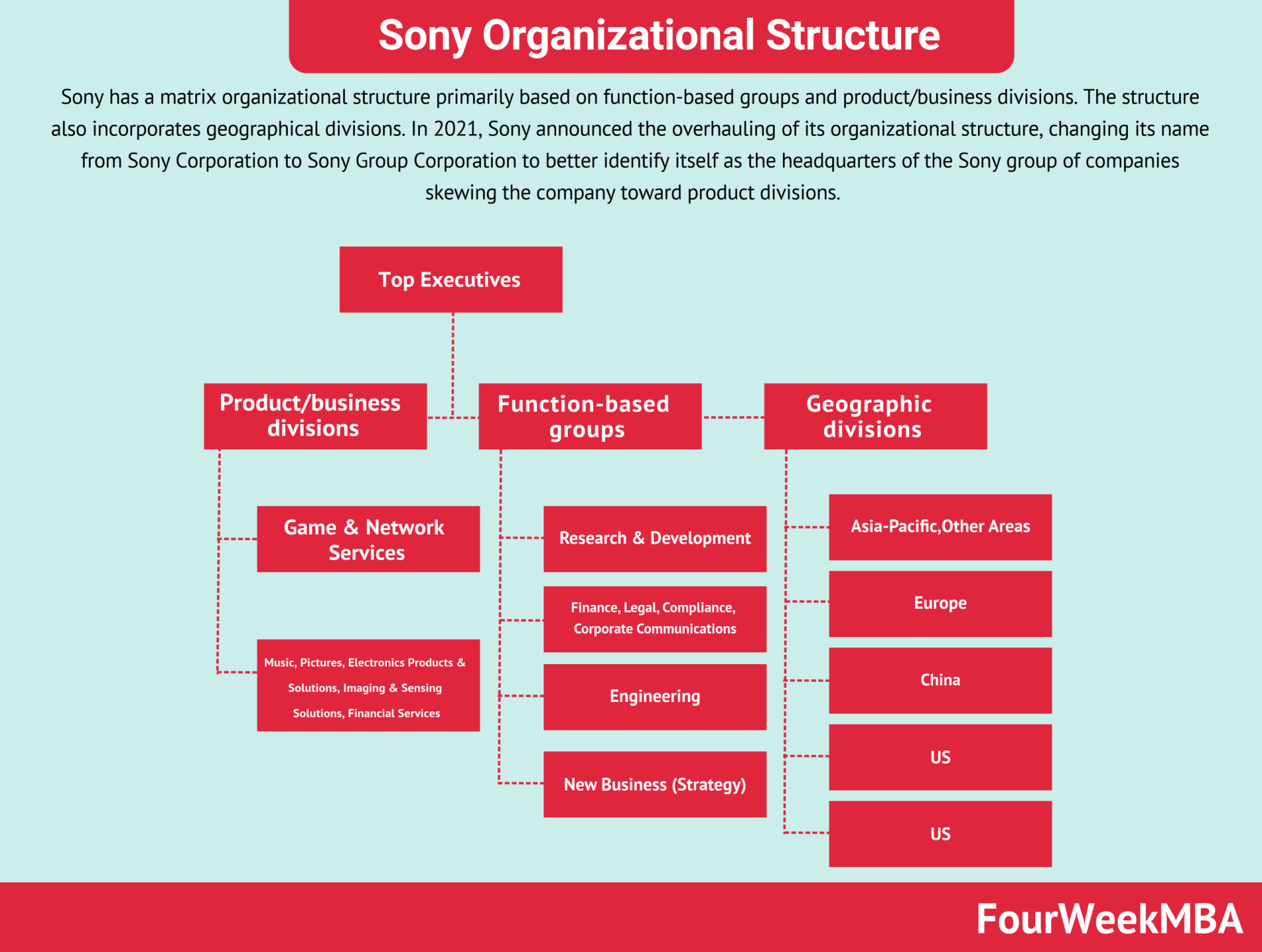
Sony has a matrix organizational structure primarily based on function-based groups and product/business divisions. The structure also incorporates geographical divisions. In 2021, Sony announced the overhauling of its organizational structure, changing its name from Sony Corporation to Sony Group Corporation to better identify itself as the headquarters of the Sony group of companies skewing the company toward product divisions.
Starbucks follows a matrix organizational structure with a combination of vertical and horizontal structures. It is characterized by multiple, overlapping chains of command and divisions.
Tesla is characterized by a functional organizational structure with aspects of a hierarchical structure. Tesla does employ functional centers that cover all business activities, including finance, sales, marketing, technology, engineering, design, and the offices of the CEO and chairperson. Tesla’s headquarters in Austin, Texas, decide the strategic direction of the company, with international operations given little autonomy.
Toyota has a divisional organizational structure where business operations are centered around the market, product, and geographic groups. Therefore, Toyota organizes its corporate structure around global hierarchies (most strategic decisions come from Japan’s headquarter), product-based divisions (where the organization is broken down, based on each product line), and geographical divisions (according to the geographical areas under management).
Walmart has a hybrid hierarchical-functional organizational structure, otherwise referred to as a matrix structure that combines multiple approaches. On the one hand, Walmart follows a hierarchical structure, where the CEO (John Furner since 1 February 2026) is the only employee without a direct superior, and directives are sent from top-level management. On the other hand, the function-based structure of Walmart is used to categorize employees according to their particular skills and experience.
Gennaro Cuofano is a CRO and tech executive who has worked in AI since late 2015, starting with bringing NLP, natural-language generation, voice and chatbot products to the marketing industry. His background is in law and finance: he holds a Master's degree in Law and an International MBA with an emphasis on corporate finance (LUISS Business School and the University of San Diego, 2012), and worked as a financial analyst at a real-estate investment firm in San Diego and as an assistant controller. His work focuses on business model strategy, business engineering and, more broadly, structural analysis: how companies make money, read from their own filings. He created FourWeekMBA and leads research there and at The Business Engineer, his newsletter on AI and business strategy, with over 95,000 subscribers and more than 1,000 published analyses. His writing has also appeared on Entrepreneur (for example, How to Digitize a Family Business in Europe) and HackerNoon. Find him on LinkedIn and Substack. See how we source.
Scroll to Top
Discover more from FourWeekMBA
Subscribe now to keep reading and get access to the full archive.