The Method of Loci is a mnemonic strategy for memorizing information. The Method of Loci gets its name from the word “loci”, which is the plural of locus – meaning location or place. It is a form of memorization where an individual places information they want to remember along with points of an imaginary journey. By retracing the same route through the journey, the individual can recall the information in a specific order. For this reason, many consider this memory tool a location-based mnemonic.
The method of loci mnemonic technique is one of the oldest still in use today. The technique, which is also one of the most researched and versatile, was used as early as 477 BC by the Greek poet Simonides of Ceos.
In short, the learner visualizes a familiar room or route inside a building and then mentally attributes information to familiar objects or locations.
As the individual imagines themselves following a path or entering a room, each object or location enables them to recall specific pieces of information.
The linking system
Similar to the method of loci is the linking system technique. Here, the learner must create a story that connects pieces of information with each piece resulting in recollection of the next.
Imagine that Wendy has an important presentation tomorrow and needs to remember to bring the following items to work: laptop, reading glasses, pointer, brochures, and cue cards.
Wendy uses the linking system to develop a short story that will help her remember these items: Wendy’s laptop puts on its reading glasses and uses a pointer to illustrate brochures and cue cards.
Acronyms and acrostics
Acronyms are one of the easiest mnemonic techniques to understand. For example, the HOMES acronym is used to remember all five of the North American Great Lakes:
Huron.
Ontario.
Michigan.
Erie, and
Superior.
Acrostics are similar to acronyms but use a phrase or complete sentence is used to recall information instead of a word.
The most common of these, which we touched on in the introduction, is the acrostic that deals with the number and order of planetary bodies.
Derivations of the phrase “My Very Educated Mother Just Sent Us Nine Pizzas” contain the first letter of each planet.
Chunking
Chunking is a technique where the individual breaks down information into smaller chunks.
This is commonly employed to remember long numbers such as those associated with phone numbers, social security accounts, bank accounts, and even passwords.
Making connections is about connecting new information with something the individual already knows or is familiar with.
This versatile technique is a type of elaborative rehearsal which, like chunking, can result in more information stored in long-term memory.
Consider Tony, a businessman who attends a networking function with a tendency to forget people’s names.
When Tony is introduced to Nancy, for example, he can memorize her name by associating it with an observation.
Tony notices that Nancy is somewhat reserved and shy, so he decides to call her “Nervous Nancy” in his mind to remember her name should the two ever cross paths in the future.
Key takeaways:
Mnemonic techniques, also known as mnemonic devices, describe various ways in which an individual can memorize ideas with patterns.
In use as early as 477 BC, the method of loci mnemonic technique is one of the oldest still in use today. It involves visualizing a familiar room or route inside a building and then mentally attributing information to familiar objects or locations.
Other common mnemonic techniques include acronyms, acrostics, chunking, and making connections.
Key Highlights
Mnemonic Techniques: Mnemonic techniques, or mnemonic devices, help individuals remember information by using patterns and associations.
Method of Loci:
One of the oldest and most researched mnemonic techniques.
Involves placing information along an imaginary journey through familiar locations.
By retracing the route, individuals can recall information in a specific order.
Used since ancient times, with Greek poet Simonides of Ceos as an early user.
Linking System:
Connects pieces of information in a story, each piece triggering recall of the next.
Useful for remembering lists or sequences of items.
Example: Creating a story that connects items like a laptop, reading glasses, pointer, brochures, and cue cards.
Acronyms and Acrostics:
Acronyms use the initial letters of items to create a memorable word.
Acrostics use a phrase or sentence where the first letter of each word corresponds to the items being remembered.
Useful for memorizing lists or orders.
Example: “HOMES” acronym for the Great Lakes, or acrostic for planetary order.
Chunking:
Breaks down information into smaller, manageable chunks.
Effective for remembering long numbers, sequences, and data.
Research suggests it aids long-term memory.
Making Connections:
Associates new information with existing knowledge or familiar concepts.
Enhances elaborative rehearsal and retention.
Example: Associating a person’s name with an observation or characteristic to remember it.
The Method of Loci is a mnemonic strategy for memorizing information. The Method of Loci gets its name from the word “loci”, which is the plural of locus – meaning location or place. It is a form of memorization where an individual places information they want to remember along with points of an imaginary journey. By retracing the same route through the journey, the individual can recall the information in a specific order. For this reason, many consider this memory tool a location-based mnemonic.
The Feynman Technique is a mental model and strategy for learning something new and committing it to memory. It is often used in exam preparation and for understanding difficult concepts. Physicist Richard Feynman elaborated this method, and it’s a powerful technique to explain anything.
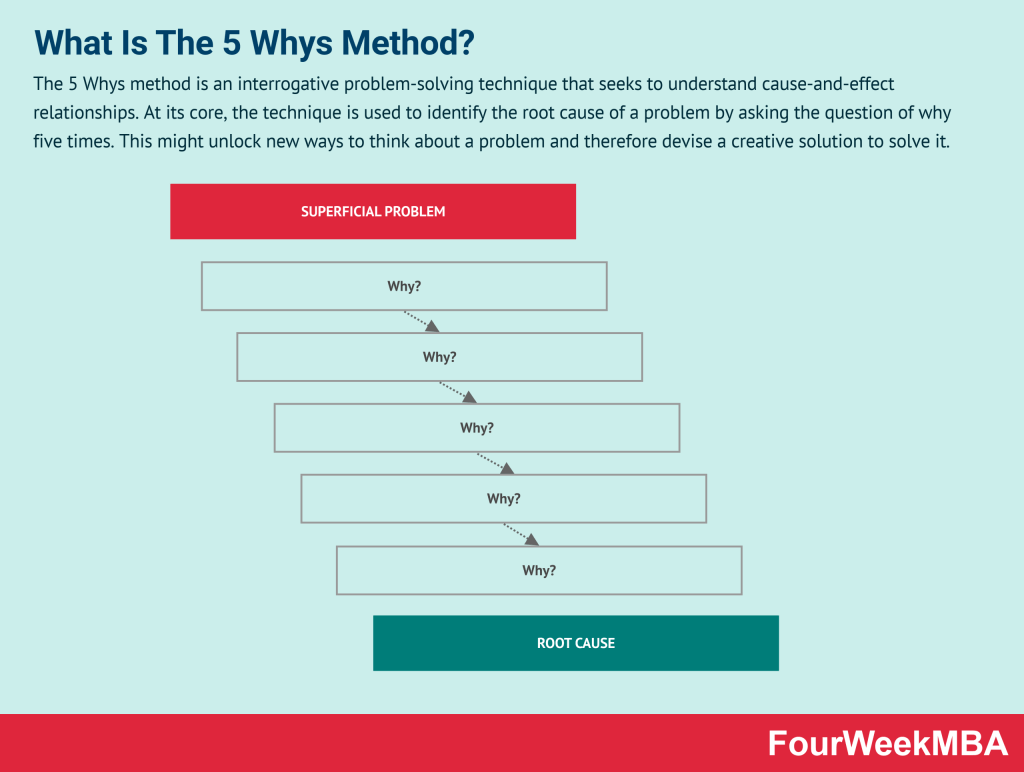
The 5 Whys method is an interrogative problem-solving technique that seeks to understand cause-and-effect relationships. At its core, the technique is used to identify the root cause of a problem by asking the question of why five times. This might unlock new ways to think about a problem and therefore devise a creative solution to solve it.
Gennaro is the creator of FourWeekMBA, which reached about four million business people, comprising C-level executives, investors, analysts, product managers, and aspiring digital entrepreneurs in 2022 alone | He is also Director of Sales for a high-tech scaleup in the AI Industry | In 2012, Gennaro earned an International MBA with emphasis on Corporate Finance and Business Strategy.