Michale Jordan is a billionaire but doesn’t own the Jordan brand, which is part of Nike. Yet, he gets 5% royalties on Jordan’s sales. For instance, as of May 31, 2023, Nike had endorsement contract obligations of $7.6 billion, of which over $330 million were to be paid out to Michael Jordan as royalties on the sales of Jordan in 2023 (the company made over 6$ billion in sales in that year). We estimated that between 2018 and 2023 alone, Nike paid (or is paying) Michael Jordan over one billion dollars in royalties for Jordan’s brand sales.
Category
Details
Full Name
Michael Jeffrey Jordan
Date of Birth
February 17, 1963
Place of Birth
Brooklyn, New York, USA
Nationality
American
Education
Attended University of North Carolina at Chapel Hill (did not graduate initially, later completed his degree)
Early Career
Star basketball player at the University of North Carolina, Drafted by the Chicago Bulls in 1984
Positions
Former professional basketball player, Principal owner and chairman of the Charlotte Hornets, Businessman and entrepreneur
Net Worth
Estimated over $2 billion
Business Milestones
– 1984: Signed endorsement deal with Nike, leading to the creation of the iconic Air Jordan sneaker line. – 1996: Starred in the movie “Space Jam,” boosting his global brand recognition. – 1997: Launched Jordan Brand, a subsidiary of Nike, which has become a highly successful and influential brand in sports and fashion. – 2000: Acquired a stake in the Washington Wizards and became president of basketball operations, marking his entry into team management. – 2006: Bought a minority stake in the Charlotte Bobcats (now Hornets), increasing his involvement in NBA team ownership. – 2010: Became the majority owner of the Charlotte Hornets, making him the first former NBA player to become the majority owner of a league franchise. – 2015: Became the first billionaire athlete, largely due to the success of the Jordan Brand and his business ventures. – 2020: Announced a $100 million donation over 10 years to organizations dedicated to ensuring racial equality, social justice, and greater access to education. – 2021: Jordan Brand reached $4.7 billion in revenue, continuing to grow its influence in sports and fashion. – 2022: Expanded his business portfolio with investments in various sectors, maintaining his status as one of the most successful athlete-entrepreneurs.
In 1984, Michael Jordan was an emergent athlete about to play for the NBA.
Nike was, instead, trying to become a prominent brand in the sports industry, which Adidas dominated.
Back then, when Nike closed the deal with Jordan, the company expected to sell, but a few million pairs turned into a multi-billion dollar empire by 2022.
Which, by 2022, generated more than $5 billion in revenue.
Jordan follows a demand generation businessmodel, where its iconic brand works as a propeller for the sale of its footwear and apparel, which in 2022 generated more than $5 billion in revenue for Nike, or more than 10% of its total revenue.
If that’s not enough, the Jordan brand also drives up the popularity of overall Nike’s empire.
Thus enabling Nike to spur sales of all its related shoe brands beyond apparel and clothing!
History of the deal between Nike and Michael Jordan
The partnership between Nike and Michael Jordan is one of the most successful and enduring in the history of sports marketing.
The deal, struck in 1984, came when Jordan was an NBA rookie, and Nike was a minor player in the athletic footwear market.
Below, we’ll explain how this deal played out and some of the events before and since.
Rookie season
Jordan was on the lookout for an endorsement deal after he left college to enter the NBA draft in 1984.
At the time, his manager ProServ encouraged shoe companies to develop a signature line of shoes in which Jordan could possess equity.
Jordan was ultimately drafted by the Chicago Bulls and was keen to partner with Adidas. This seemed like an obvious choice since Adidas was an established company and had enjoyed success in basketball with its Superstar and Pro Model shoes.
Also in favor of the German brand was that Jordan already wore a pair of its shoes.
However, Jordan’s mother Deloris encouraged him to meet with other suitors and at least hear them out. One of these suitors was Nike.
Nike enters the fray
Nike entered the fray as a young and emerging company that was mostly associated with long-distance running. In Jordan, it saw an opportunity to break into the basketball market and the company was willing to pay up to achieve this objective.
The negotiations between Jordan’s agent, David Falk, and the interested parties were intense and extremely competitive.
Adidas did not meet Falk’s financial demands, while Converse, another suitor, felt the proposal would not work with NBA stars Magic Johnson, Julius Erving, and Larry Bird already contracted.
Nike emerges victorious
True to its brand, Nike emerged victorious with then-director Rob Strasser determined to land Jordan with a deal no other company could match.
The initial offer was $250,000 per year for five years plus royalties on every pair of shoes sold. This was a significant amount of money in 1984 – especially for a rookie who had yet to prove himself in the NBA.
Eventually, Jordan and Nike settled on a record-breaking $2.5 million over five years. Included in the deal were a $500,000 bonus and a 50/50 split of the profits from future shoe sales.
Jordan wears Nikes in the NBA
The Nike Air Jordans made their debut on November 17, 1984, and were immediately controversial. Nike designed the shoes to reflect the red and black colors of the Chicago Bulls, but NBA rules stipulated that match shoes could only be white.
Jordan was fined $5,000 every time he wore them but continued to do so in any case.
Nike’s gamble on Jordan ultimately paid off in the first year after he was voted as a member of the Eastern Conference All-Star team and All-NBA Second Team. He also won rookie of the year.
The Air Jordan 1 was released to consumers in the spring of 1985.
In the popular 2020 TV miniseries The Last Dance, Falk reflected on the deal:
“The irony of the Air Jordan deal, it’s probably the best deal I’ve ever made and it’s probably the worst deal I’ve ever made because no one had a clue – including Nike – that you could sell $100 million worth of shoes for a rookie in his first year.”
The deal remains a lucrative one for both Nike and Jordan today.
Over the years, many others have tried to replicate Jordan’s success. Among these attempts, the closest was Kanye West’s Yeezy!
The collaboration started in 2015 when Kanye West and Adidas got together to create Yeezy’s line.
Yeezy was a fashion brand that arose from a collaboration between German sportswear company Adidas and entrepreneur and music artist Kanye West. While Yeezy inspired a multitude of other brands in the fashion industry and earned revenue in the billions, the collaboration between West and Adidas ended abruptly in October 2022.
Over the years, Yeezy has become an iconic brand over the years, yet the collaboration ended abruptly in 2022.
Revenue in 2019 was $23.64 billion.
Revenue in 2020 decreased to $18.43 billion.
Revenue increased in 2021 to $21.23 billion and further increased in 2022 to $22.51 billion.
Like Jordan’s contribution to Nike, Yeezy was generating about 10% of Adidas’ revenue by 2022 (about $240 million).
Yet, the break between Adidas and Kanye West shows how difficult it is to replicate a partnership like the Jordan-Nike, not only from a product standpoint but also from a business/interests standpoint.
Key takeaways
The partnership between Nike and Michael Jordan is one of the most successful and enduring in the history of sports marketing. But it is easy to overlook the fact that at the time, Jordan was a rookie and Nike a largely unproven company.
In 1984, Sports management company ProServ encouraged shoe companies to develop a signature line of shoes in which Jordan could possess equity. The younger and smaller Nike beat out suitors such as Adidas and Converse with a deal they could not match.
Nike’s gamble in Jordan ultimately paid off in the first year after he was voted as a member of the Eastern Conference All-Star team and All-NBA Second Team. He also won rookie of the year. Sales of the Air Jordan 1s also surpassed the company’s expectations.
Key highlights
Michael Jordan’s Royalties: Michael Jordan is a billionaire who doesn’t own the Jordan brand, which is a part of Nike. However, he receives 5% royalties on the sales of Jordan products. Between 2018-2022, Nike paid him almost one billion dollars in royalties.
Jordan’s Impact on Nike’s Sales: The Jordan brand, established in 1984 when Michael Jordan was an emerging NBA player, has become a key driver of Nike’s sales. The brand generated over $5 billion in revenue for Nike in 2022, contributing more than 10% of its total revenue. The popularity of the Jordan brand also boosts the sales of Nike’s other shoe brands and products.
Demand Generation Model: Jordan follows a demand generation business model, using its iconic brand to propel the sales of its footwear and apparel. This strategy has been highly successful, turning Jordan into a multi-billion dollar empire within Nike.
History of the Nike-Jordan Deal: The partnership between Nike and Michael Jordan, established in 1984, is one of the most successful in sports marketing history. Despite being a rookie NBA player, Jordan’s agent negotiated a groundbreaking deal with Nike, which included a $2.5 million contract over five years, royalties, and a 50/50 split of future shoe sales profits.
Nike’s Gamble Pays Off: Nike’s investment in the Air Jordan line paid off remarkably. The Air Jordan 1s, launched in 1985, exceeded expectations in sales and popularity, solidifying Michael Jordan’s status as a superstar in the NBA.
Yeezy and Replicating Success: Kanye West’s collaboration with Adidas to create the Yeezy line attempted to replicate the success of the Jordan brand. While Yeezy became iconic and generated substantial revenue for Adidas, the collaboration ended abruptly in 2022, highlighting the difficulty of replicating the Jordan-Nike partnership’s success.
Key Takeaways: The partnership between Michael Jordan and Nike is remarkable for its success despite Jordan’s rookie status and Nike’s relative newness. The decision to invest in Jordan’s brand paid off handsomely, and the Air Jordan line became a cultural phenomenon, with sales surpassing all expectations.
The Knight family owns Nike. Indeed, the top individual shareholder is Travis A. Knight, son of Philip Knight, co-founder of Nike, with a 7% stake in Class A stocks and a 2.7% stake in Class B stocks. On the other hand, the Knight family also controls the company tightly through their Trusts and an LLC called Swoosh (the Nike logo’s shape is a “swoosh”). Through individual shares, Swoosh LLC, and Travis Knight’s irrevocable trust, the Knight family controls over 97.1% of Class A and 21.4% of Class B stocks.
Nike follows a wholesale strategy combined with a very strong direct distribution. The company makes money primarily from footwear. As of 2022, over 62% of revenues came from footwear and 29% from apparel. The most successful Nike brand is the Jordan Brand, which in 2022 generated $5.2 billion in revenue. Nike is the master of demand creation and generation through its influencer campaigns, where athletes become an inspiration for everyday people.
Nike leverages both a wholesale and direct distributionstrategy. Indeed, while still in 2022, most sales come from wholesale distribution, in reality, since 2020, Nike has been ramping up its direct distribution through its NIKE stores and e-commerce platform (SNKRS).
Nike generated most of its revenue from footwear. Indeed, in 2022, Nike generated over $29 billion in revenue from footwear, over $13.5 billion in apparel, $2.35 billion in equipment, and over $1.6 billion from the Converse brand.
Nike generated over $47.7 billion in revenue and over $6 billion in net profits in 2022, compared to over $44.5 billion in revenue and almost $5.8 billion in 2021.
Nike’s vision is “To bring inspiration and innovation to every athlete in the world.” At the same time, its mission statement is to “do everything possible to expand human potential. We do that by creating groundbreaking sports innovations, by making our products more sustainably, by building a creative and diverse global team, and by making a positive impact in communities where we live and work.”
Jordan follows a demand generation business model, where its iconic brand works as a propeller for the sale of its footwear and apparel, that in 2022 generated more than $5 billion in revenue for Nike or more than 10% of its total revenue.
Converse is an independent brand part of Nike’s family of brands. Indeed, Converse generated $2.35 billion in revenue in 2022. And like Nike, it follows an heave Wholesale distributionstrategy, where most of its sales are made, through footwear. However, Converse follows also a direct distribution approach where it sells directly via its monobrand stores.
By 2022, most of Tesla’s shares are still owned by Elon Musk, among the company’s co-founders and the CEO. Elon Musk is the top individual investor, with a 23.5% stake in the company. At current rates, this is valued at around $145-50 billion, making Elon Musk one of the wealthiest men on earth. In addition, Musk also holds a significant stake in Twitter and SpaceX, which makes him worth anywhere between $180-90 billion.
Bernard Arnault’s wealth is around $203 billion. Indeed Arnault is the CEO and chairman of the luxury goods conglomerate LVMH Moët Hennessy Louis Vuitton, a massive luxury group that generated over €79 billion in revenue ($83 billion) in 2022, spanning across wines, fashion, cosmetics, and retail. The Arnault family group owns 48.18% of the capital for LVMH with 63.9% voting power, making Bernard Arnault the principal owner and decision-maker. His stake is worth over $203 billion.
Warren Buffett is an American investor, business tycoon, and philanthropist. Known as the “Oracle of Omaha,” Buffett is best known for his strict adherence to value investing and frugality despite his immense wealth. Warren Buffet owns an investment firm, Berkshire Hathaway. He owns 238,624 Class A shares which gives him control over the company. His stake in the company is valued at over $100 billion.
Jeff Bezos’ net worth is primarily based on his ownership stake in Amazon. Indeed, as of 2023, Bezos owned a 12.7% stake in Amazon, worth over $120 billion.
Tim Cook’s net worth is primarily comprised of his Apple stocks. As of 2023, he owned 3,279,898 worth about $480 million at the current rate. However, Tim Cook has sold part of his Apple stocks over the years for hundreds of millions of dollars, making him a billionaire.
Bill Gates was the co-founder and former CEO of Microsoft until 2000, and he was on the board of Microsoft until 2020. However, over the years, Gates sold various stakes in Microsoft and diversified away from it. As of 2019, Gates had a 1.34% stake in Microsoft, which he might still own, valued at about $25 billion.
As of 2022, Satya Nadella had 763,518, valued at $190 million at Microsoft’s current market value. Nadella also got a $2.5 million base salary in 2022, plus $42.27 million in stock awards and over $10 million in non-stock incentives. Nadella sold hundreds of millions of dollars of Microsoft stocks in the last ten years, making him a centi-millionaire. In 2022, 96% of Nadella’s salary was performance-based, whereas only 4% comprised a base salary.
Larry Page co-founded Google (now Alphabet) and Sergey Brin. He controls the company tightly via a dual share ownership structure (made of Class A and B stocks). Alphabet is worth over a trillion dollars, valuing Larry Page’s stake in the company at around $70 billion.
Sergey Brin co-founded Google (now Alphabet) together with Larry Page. He controls the company tightly via a dual share ownership structure (made of Class A and B stocks). Alphabet is worth over a trillion dollars, valuing Sergey Brin’s stake at around $66 billion.
Mark Zuckerberg is the co-founder and principal shareholder of Facebook (now Meta), in which he owns a controlling stake worth over $68 billion. Thus Mark Zucberkerbs’ net worth is around $68 billion in 2023.
Eduardo Luiz Saverin is a billionaire entrepreneur and angel investor. He co-founded Facebook with Mark Zuckerberg; he was later ousted. Yet later on, Facebook settled a lawsuit with Saverin giving him a good chunk of the company’s stock, now worth over ten billion dollars. Thus, Eduardo Saverin’s net worth is around $10.45 billion in 2023.
While Larry Ellison is a shareholder in various tech companies (such as Tesla), his primary wealth comes from his ownership stake in the company he founded, Oracle. He owns almost 43% of the company’s stock, valued at over $100 billion, making him among the wealthiest people on earth.
Howard Schultz’s net worth is over $2.2 billion. Indeed, he is the founder of Starbucks and a major institutional shareholder, with 1.88% ownership of the company, valued at over $2.2 billion at the current market value, making him a billionaire.
Daniel Ek is one of the founders and one of the principal shareholders of Spotify. Indeed, in 2023 with 16.5% of Spotify’s shares, he’s worth around $3.7 billion.
The Pinault family is the main shareholder behind the Kering Group luxury empire, with a stake of 41.7%, valued around €30 billion, thus $32-33 billion. The Kering Group owns iconic brands like Gucci, Yves Saint Laurent and Bottega Veneta.
Pierre Omidyar is a technology entrepreneur andPierre Omidyar is a technology entrepreneur and founder of eBay. As of 2020, before he stepped down from the company’s board of directors, he still owned 4.69% of the company’s stocks, valued at over one billion dollars. Yet, over the years, he sold a good chunk of his stocks, making him a billionaire. founder of eBay. As of 2020, before he stepped down from the company’s board of directors, he still owned 4.69% of the company’s stocks, valued at over one billion dollars. Yet, over the years, he sold a good chunk of his stocks, making him a billionaire.
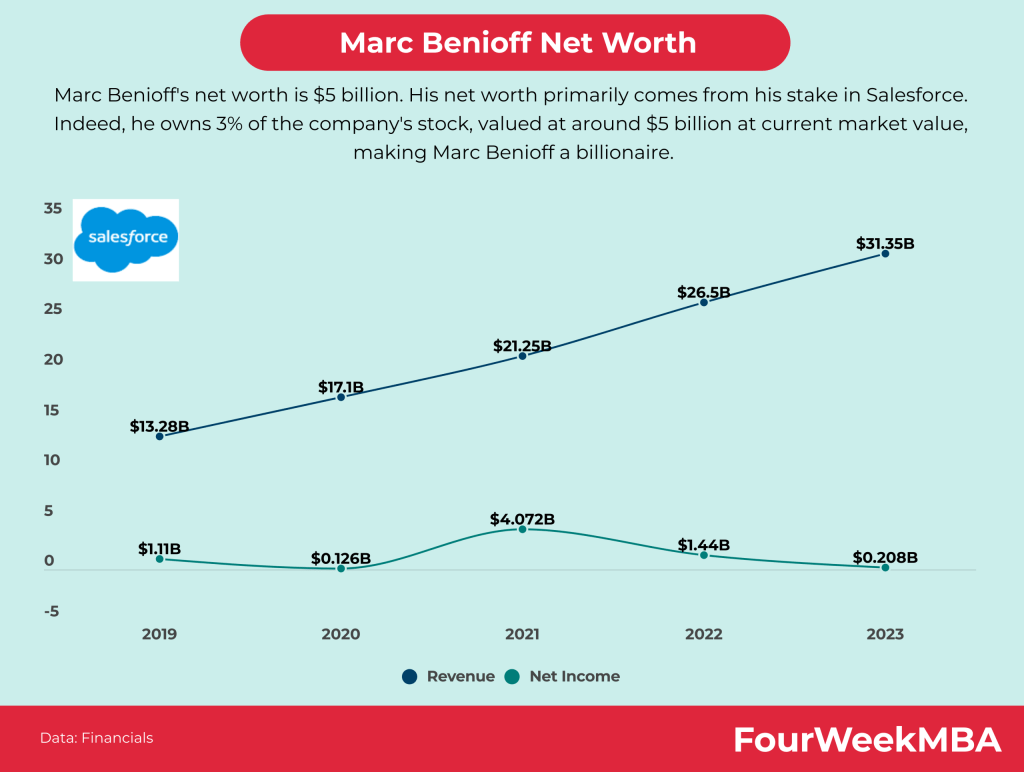
Marc Benioff’s net worth is $5 billion. His net worth primarily comes from his stake in Salesforce. Indeed, he owns 3% of the company’s stock, valued at around $5 billion at current market value, making Marc Benioff a billionaire.
Reed Hastings is the co-founder, former CEO, and now executive chairman of Netflix. He’s also one of the major shareholders, with 1.7% ownership in the company, valued at $2.4 billion at the current rate.
Evan Thomas Spiegel is the co-founder and CEO of Snapchat. He’s also the main shareholder. Indeed, he both owns and controls Snapchat, and his stake in the company is currently valued at around $3 billion.
Brian Chesky is an industrial designer and businessman who is also Airbnb’s co-founder and current CEO. Since the company was founded in 2007, Chesky has been in charge of it, amassing a net worth of about $10 billion, thanks to his shares in the company.
Phil Knight, the founder of Nike, controls the company via a personal stake of shares for 7% ownership, plus the shares held via the family’s owned Swoosh, LLC, in addition to the shares in possession of his son’s Trust. Phil Knight directly controls a significant stake in Nike’s Class A and B shares, valued at over $40 billion.
Michale Jordan is a billionaire but doesn’t own the Jordan brand, which is part of Nike. Yet, he gets 5% royalties on the sales of Jordan. For instance, as of May 31, 2022, Nike had endorsement contract obligations of $7.6 billion, of which over $250 million were to be paid out to Michael Jordan as royalties on the sales of Jordan in 2022 (the company made over 5$ billion in sales in that year). We estimated that between 2018-2022 alone, Nike paid (or is paying) Michael Jordan almost one billion dollars in royalties for Jordan’s brand sales.
Kevin Plank is Under Armour’s primary owner and founder, of which he’s also chairman. His stake in the company is worth over a billion dollars at current market value, making him a billionaire.
Gennaro is the creator of FourWeekMBA, which reached about four million business people, comprising C-level executives, investors, analysts, product managers, and aspiring digital entrepreneurs in 2022 alone | He is also Director of Sales for a high-tech scaleup in the AI Industry | In 2012, Gennaro earned an International MBA with emphasis on Corporate Finance and Business Strategy.