Instagram’s story reads like a fairy tale. The app took only 8 weeks to develop before it was launched in 2010 and had amassed 1 million users in the first two months. The number of users increased to 10 million within a year and 1 billion by June 2018.
The year is 2009, and Stanford University graduate Kevin Systrom is working at the travel recommendation start-up Nextstop. Systrom, a connoisseur of Kentucky whiskeys, developed a mobile app called Burbn in his spare time.
The app lets users check in at certain locations, post pictures of meet-ups with friends, and earn points for socializing. In March 2010, Systrom had a chance encounter with venture capitalists at a function for Silicon Valley start-up Hunch. After meeting with Andreessen Horowitz and Baseline Ventures, Systrom received $500,000 in seed funding and quit his job to focus on Burbn full-time.
Once released, Burbn’s myriad features confused users and the app was unsuccessful. Systrom stuck at it, however, and hired programmer Mike Krieger to help him analyze how Burbn’s users were interacting with the platform. The pair found that while most did not care for the check-in feature, they did love the ability to share photos with others.
Burbn becomes Instagram
Based on this and the fact that Burbn was too similar to platforms like Foursquare, Systrom and Krieger renamed the app Instagram. The simple, photo-sharing app for mobile devices was named after a portmanteau of “instant camera” and “telegram”.
Instagram’s development was based on two primary competitors. Hipstamatic had popular features but it was hard to share photos there. On Facebook, it was much easier to share photos – but the platform’s iPhone app features were poor in comparison.
Systrom and Krieger saw an opportunity to slip in between the two and build an app that made social photo-sharing simple. They discarded all of Burbn’s unnecessary features except the ability to upload photos and like or comment on them.
Launch and subsequent funding
Instagram was launched for iOS on October 6, 2010, and some 25,000 users joined on the first day. Hashtags were introduced in January 2011, with the founders encouraging users to ensure they were both specific and relevant to make photos stand out to like-minded individuals.
The platform secured a Series A funding round worth $7 million in February. The round, which valued the company at $25 million, involved investors such as Jack Dorsey and Benchmark Capital. Series B funding worth $50 million followed in April 2012, as did the first version for Android devices.
Various features were added in the Version 2.0 release of the app. These included optional borders, instant tilt-shift, one-click rotation, and high-resolution photographs.
Facebook acquisition
Four days after the Series B round of funding and with the company valued at $500 million, Instagram was acquired by Facebook in a $1 billion cash and stock deal. The deal was finalized in September 2012 after approval from both the Federal Trade Commission (FTC) and Britain’s Office of Fair Trading.
At the time of the deal, Zuckerberg noted that Facebook was “committed to building and growing Instagram independently.” In any case, Systrom earned around $400 million from the sale. In the years that followed, Instagram adopted a more minimalist look and added various other features such as stories, videos, direct messages, and IG TV.
Key takeaways:
Instagram’s story reads like a fairy tale. The app took only 8 weeks to develop before it was launched in 2010 and had amassed 1 million users in the first two months and 1 billion by the middle of 2018.
Kevin Systrom developed the predecessor of Instagram in 2009. Then known as Burbn, the app enabled users to share photos and locations with others and earn points for hanging out with friends. Ultimately, however, Burbn had too many features and users found its purpose confusing.
When Systrom secured $500,000 in seed funding, he hired programmer Mike Krieger to help him analyze how users were interacting with the platform. The pair identified that the popularity of the photo-sharing feature justified building a standalone app later known as Instagram.
Mark Zuckerberg is the largest shareholder in the company. Zuckerberg retains ownership and control of the company. Like Google, Facebook has issued two common stocks, Class A and Class B. The holders of Class B common stocks are entitled to ten votes per share, and holders of our Class A common stocks are entitled to one vote per share. Mark Zuckerberg has a voting power of 61.1%; he’s the primary decision-maker. Other individual investors comprise Sheryl Sandberg, Christopher Cox, Marc Andreessen, Peter Thiel, Dustin Moskovitz, and Eduardo Saverin.
Facebook, the main product of Meta is an attention merchant. As such, its algorithms condense the attention of over 2.91 billion monthly active users as of June 2021. Meta generated $117.9 billion in revenues, in 2021, of which $114.9 billion from advertising (97.4% of the total revenues) and over $2.2 billion from Reality Labs (the augmented and virtual reality products arm).
Facebook generated most of its revenue from advertising in 2023. Indeed, the company generated $131.95B from advertising, $1.89B billion from its reality labs segment, and over a billion in other revenue.
By September 2022, Facebook’s (Meta) employee count had peaked at 87,314. Yet, as revenue slew down for the first time in years, the company announced a layoff of 13% of its workforce, bringing the headcount to 75,964. By March 2023, Meta announced another round of layoffs, dubbed “The Year of Efficiency,” which brought the headcount down to less than 66 thousand employees. By the end of 2023, Facebook reported 67,317 employees.
In 2022, post layoffs, Facebook generated $1,535,056 per employee, compared to $1,638,586 in 2021. In 2023, as Facebook (now Meta) completed its mass layoffs, the company reported nearly $135 billion in revenue and 67,317 employees, with a $2,003,981 revenue per employee.
Facebook (Meta) gained users in 2023. In fact, in 2023, Facebook had over three billion users worldwide, of which 272 million were in Canada, 408 million were in Europe, over 1.3 billion were in Asia, and over a billion were in the rest of the world.
ARPU, or average revenue per user, is a crucial metric for attention merchants like Facebook. It assesses the ability of the platform to monetize its users. For instance, by the end of 2023, Meta’s ARPU worldwide was $13.12. In the US & Canada, it was $68.44; in Europe, it was $23.14; in Asia-Pacific, $5.52; and in the rest of the world, it was $4.50.
ARPU, or average revenue per user, is a crucial metric for attention merchants like Facebook. It assesses the ability of the platform to monetize its users. For instance, by the end of 2023, Meta’s ARPU worldwide was $13.12. In the US & Canada, it was $68.44; in Europe, it was $23.14; in Asia-Pacific, $5.52; and in the rest of the world, it was $4.50.
Facebook (Meta) revenue in 2023 increased to $134.9B, compared to $116.6B in 2022. Its profitability increased to $39.1B in 2023, compared to $23.2B in 2022 and $39.37B in 2021.
Facebook is characterized by a multi-faceted matrix organizational structure. The company utilizes a flat organizational structure in combination with corporate function-based teams and product-based or geographic divisions. The flat organizationstructure is organized around the leadership of Mark Zuckerberg, and the key executives around him. On the other hand, the function-based teams based on the main corporate functions (like HR, productmanagement, investor relations, and so on).
Instagram makes money via visual advertising. Acquired by Facebook for a billion-dollar in 2012, today, Instagram is integrated into the overall Facebook (now rebranded as Meta) business strategy. In 2018, Instagram founders Kevin Systrom and Mike Krieger left the company as Facebook pushed toward tighter integration of the two platforms. In 2022, Instagram is the most successful product still, in Meta’s portfolio.
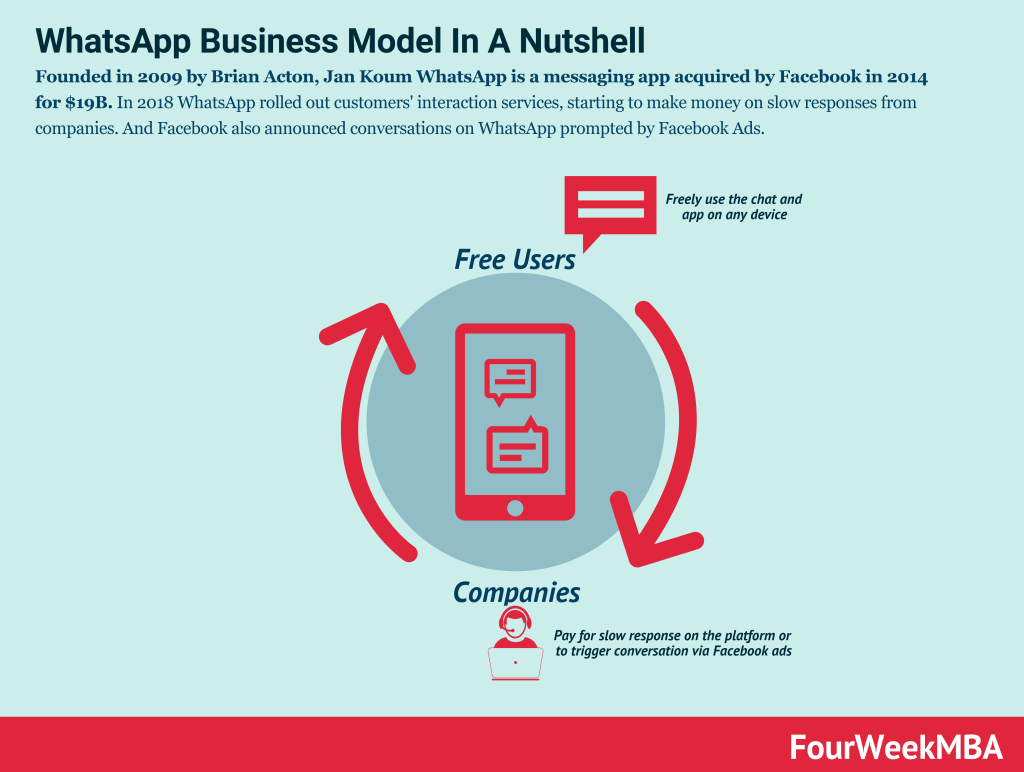
Founded in 2009 by Brian Acton, Jan Koum WhatsApp is a messaging app acquired by Facebook in 2014 for $19B. In 2018 WhatsApp rolled out customers’ interaction services, starting to make money on slow responses from companies. And Facebook also announced conversations on WhatsApp prompted by Facebook Ads.
Gennaro is the creator of FourWeekMBA, which reached about four million business people, comprising C-level executives, investors, analysts, product managers, and aspiring digital entrepreneurs in 2022 alone | He is also Director of Sales for a high-tech scaleup in the AI Industry | In 2012, Gennaro earned an International MBA with emphasis on Corporate Finance and Business Strategy.