Figma’s business model centers around providing collaborative design solutions through a cloud-based platform. Their value lies in enabling real-time collaboration, offering powerful web-based design tools, and facilitating version control and prototyping. Figma adopts a distributionmodel with freemium and subscription plans, targeting both individual users and enterprise customers. Revenue is generated through subscription fees, enterprise licensing, and integration partnerships with other design tools.
Business Model Element
Analysis
Implications
Examples
Value Proposition
Figma’s value proposition centers around collaborative design and prototyping. Key elements of its value proposition include: – Cloud-Based Collaboration: Real-time collaboration on design projects from anywhere. – Browser Compatibility: Works seamlessly across various platforms and devices. – Design and Prototyping Tools: Provides a comprehensive set of design and prototyping features. – Version Control: Tracks changes and allows users to revert to previous versions. – Developer Handoff: Facilitates design-to-development handoff through code inspection tools. Figma empowers designers and teams to work efficiently and collaboratively on design projects, streamlining the design process.
Offers a cloud-based, collaborative design platform accessible from anywhere. Ensures cross-platform compatibility and accessibility. Provides a full suite of design and prototyping tools in one platform. Enhances version control and simplifies design-to-development handoff. Attracts designers and teams looking for efficient and collaborative design solutions. Fosters creativity and productivity through its features.
– Real-time collaboration on design projects. – Cross-platform compatibility and accessibility. – Comprehensive design and prototyping tools. – Version control and design-to-development handoff. – Attracts designers and teams seeking efficiency and collaboration. – Fosters creativity and productivity through its features.
Customer Segments
Figma serves various customer segments, including: 1. Graphic Designers: Individual designers creating visual content. 2. UX/UI Designers: Professionals designing user interfaces and experiences. 3. Product Design Teams: Teams working on digital product design and development. 4. Marketing Teams: Teams creating marketing collateral and visual assets. 5. Development Teams: Developers collaborating with designers for UI/UX. Figma caters to a diverse range of design professionals and teams.
Focuses on a broad audience of design professionals and teams with varying needs. Customizes features to suit the requirements of graphic designers, UX/UI designers, product design teams, marketing teams, and development teams. Enhances collaboration and communication among cross-functional teams. Provides a versatile platform for different design and prototyping projects. Engages with a wide range of users across industries.
– Serving a diverse range of design professionals and teams. – Customizing features for various design needs. – Enhancing collaboration and communication among cross-functional teams. – Providing a versatile platform for different design projects. – Engaging with users across multiple industries.
Distribution Strategy
Figma’s distribution strategy revolves around its cloud-based platform, web app, and mobile app. Users can access Figma’s design tools and collaborate in real time through their web browsers or mobile devices. Additionally, Figma offers a desktop application for Mac and Windows. The platform also collaborates with design communities, universities, and organizations to expand its user base. Figma’s free plan allows users to experience its features before committing to paid plans.
Utilizes a cloud-based platform accessible through web browsers and mobile devices. Offers a desktop application for Mac and Windows users. Collaborates with design communities, universities, and organizations to expand its user base. Attracts users through a free plan, allowing them to experience its features. Prioritizes accessibility, cross-device compatibility, and user engagement.
– Cloud-based platform accessible through web browsers and mobile devices. – Desktop application for Mac and Windows users. – Collaboration with design communities and organizations. – Attracts users through a free plan for feature exploration. – Prioritizes accessibility, cross-device compatibility, and user engagement.
Revenue Streams
Figma generates revenue primarily through subscription plans and enterprise licensing. Its primary revenue streams include: 1. Subscription Plans: Monthly and annual subscription plans for individual designers and teams. 2. Enterprise Licensing: Customized licensing options for large organizations. 3. Educational Plans: Special pricing and features for educational institutions. 4. Plugin Marketplace: Revenue-sharing model with plugin developers. Figma’s revenue is derived from individual and team subscriptions, customized enterprise solutions, partnerships with educational institutions, and plugin marketplace fees.
Relies on subscription revenue from individual designers and teams. Offers customized enterprise solutions for large organizations. Collaborates with educational institutions to provide specialized plans. Generates fees through a revenue-sharing model with plugin developers in the marketplace. Diversifies revenue streams to cater to different customer segments.
– Subscription revenue from individual designers and teams. – Customized enterprise solutions for large organizations. – Collaboration with educational institutions for specialized plans. – Fees generated through a revenue-sharing model with plugin developers. – Diversifies revenue streams to cater to different customer segments.
Marketing Strategy
Figma’s marketing strategy includes online advertising, content marketing, community engagement, and partnerships. The platform promotes its features through online advertisements, blog articles, tutorials, and case studies. Figma fosters an active design community through forums and user-generated content. It collaborates with universities and organizations to promote its educational plans. Additionally, partnerships with other design and development tools enhance its reach.
Utilizes online advertisements, content marketing, and case studies to showcase its features. Engages with a vibrant design community through forums and user-generated content. Collaborates with universities and organizations to promote educational plans. Partners with other design and development tools to expand its user base. Prioritizes user education, engagement, and partnerships for growth and visibility.
– Online advertisements, content marketing, and case studies. – Engagement with a vibrant design community through forums. – Collaboration with universities and organizations for educational plans. – Partnerships with other design and development tools. – Prioritizes user education, engagement, and partnerships for growth and visibility.
Organization Structure
Figma operates as a technology company with a focus on design and collaboration tools. Its organizational structure includes teams dedicated to product development, engineering, marketing, sales, customer support, and partnerships. Product development teams work on enhancing design features and collaboration tools. Engineering teams focus on platform reliability and scalability. Marketing and sales teams promote Figma’s offerings. Customer support ensures user satisfaction. Partnerships teams collaborate with other organizations to enhance Figma’s integrations.
Employs specialized teams for product development, engineering, marketing, sales, customer support, and partnerships. Prioritizes continuous improvement of design and collaboration features. Ensures platform reliability and scalability. Promotes Figma’s offerings through effective marketing and sales efforts. Focuses on user satisfaction through robust customer support. Collaborates with other organizations to expand its integrations and reach.
– Specialized teams for product development and engineering. – Ensures platform reliability and scalability. – Promotes offerings through marketing and sales efforts. – Focuses on user satisfaction through customer support. – Collaborates with other organizations for integrations and reach.
Competitive Advantage
Figma’s competitive advantage lies in its cloud-based, real-time collaboration, cross-platform accessibility, comprehensive design tools, and active design community. Cloud-Based Collaboration: Enables real-time collaboration from anywhere. Cross-Platform Accessibility: Works seamlessly on various devices and platforms. Comprehensive Design Tools: Offers a wide range of design and prototyping features. Active Design Community: Fosters knowledge sharing and collaboration. Figma stands out as a versatile, collaborative, and accessible design platform.
Derives a competitive advantage from: – Real-time cloud-based collaboration. – Cross-platform accessibility and compatibility. – A comprehensive set of design and prototyping tools. – An active design community that fosters knowledge sharing. Stands out as a versatile, collaborative, and accessible design platform.
– Real-time cloud-based collaboration. – Cross-platform accessibility and compatibility. – A comprehensive set of design and prototyping tools. – An active design community that fosters knowledge sharing. – Stands out as a versatile, collaborative, and accessible design platform.
Adobe generated most of its revenue (93%) from subscriptions in 2022. Indeed, the company generated $16.39 billion in subscriptionrevenue in 2022 compared to $686 million from services, and $532 million from product
Adobe generates most of its revenue from subscriptions. The subscriptionbusiness consists of digital media, digital experiences, and publishing & advertising. Indeed, in 2022, Adobe generated $12.38 billion in digital media, $3.88 billion in digital experiences, and $123 million from publishing & advertising.
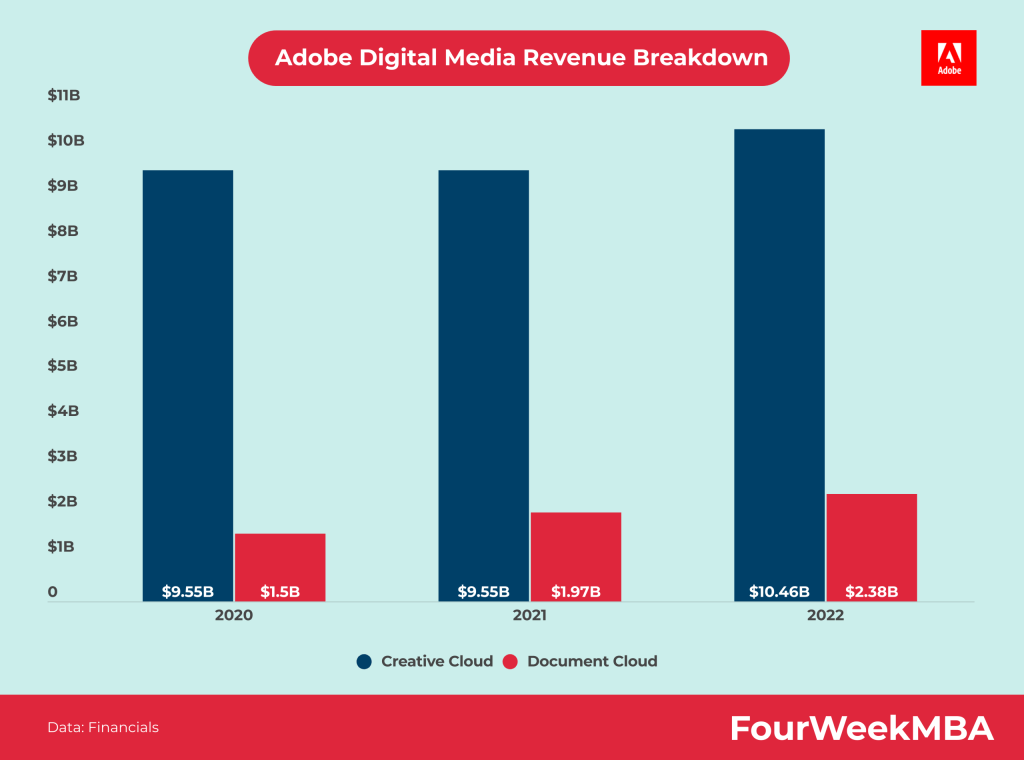
The Adobe digital media business consists of two segments: creative cloud and document cloud. In 2022, Adobe generated $10.46 billion from creative cloud vs. $2.38 from document cloud.
Adobe has a cost structure skewed toward subscriptions, which carry a high gross margin compared to other segments. Indeed, subscriptions generate most of the revenue for Adobe, and in 2022, for instance, on $17.6 billion in revenue, $2.16 in cost of revenue, and $15.44 in gross margins.
Adobe spent $4.97 billion in sales and marketing expenses in 2022, which represented 28% of its total revenue. Compared to $4.32 billion in 2021, which represented 27% of its total revenue.
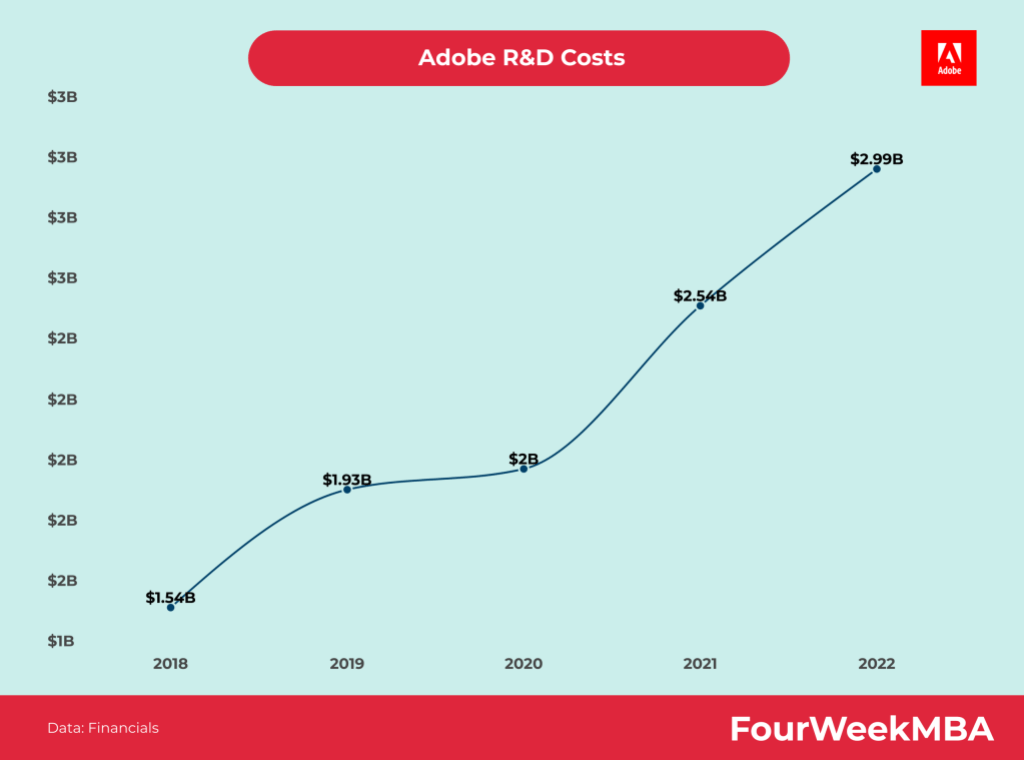
Adobe spent $2.99 billion in R&D expenses in 2022, which represented 17% of its total revenue, vs. $2.54 billion in 2021, which represented 16% of its total revenue.
Gennaro is the creator of FourWeekMBA, which reached about four million business people, comprising C-level executives, investors, analysts, product managers, and aspiring digital entrepreneurs in 2022 alone | He is also Director of Sales for a high-tech scaleup in the AI Industry | In 2012, Gennaro earned an International MBA with emphasis on Corporate Finance and Business Strategy.