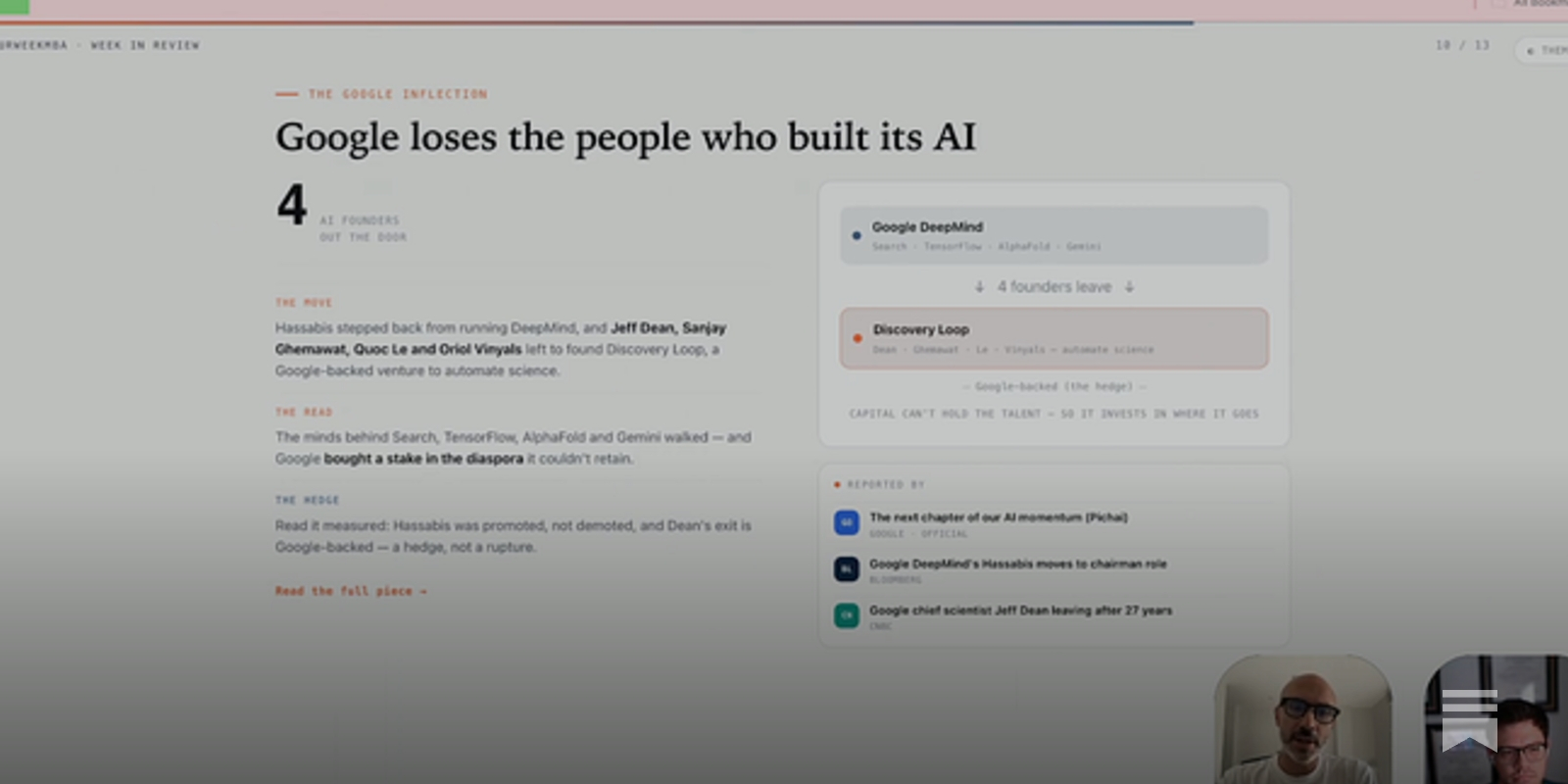
At least 12 senior researchers and engineers have departed Google DeepMind and Google Brain in the past 18 months, and Wall Street is beginning to ask whether this is a human resources problem — or a structural collapse of the most valuable business model in artificial intelligence.
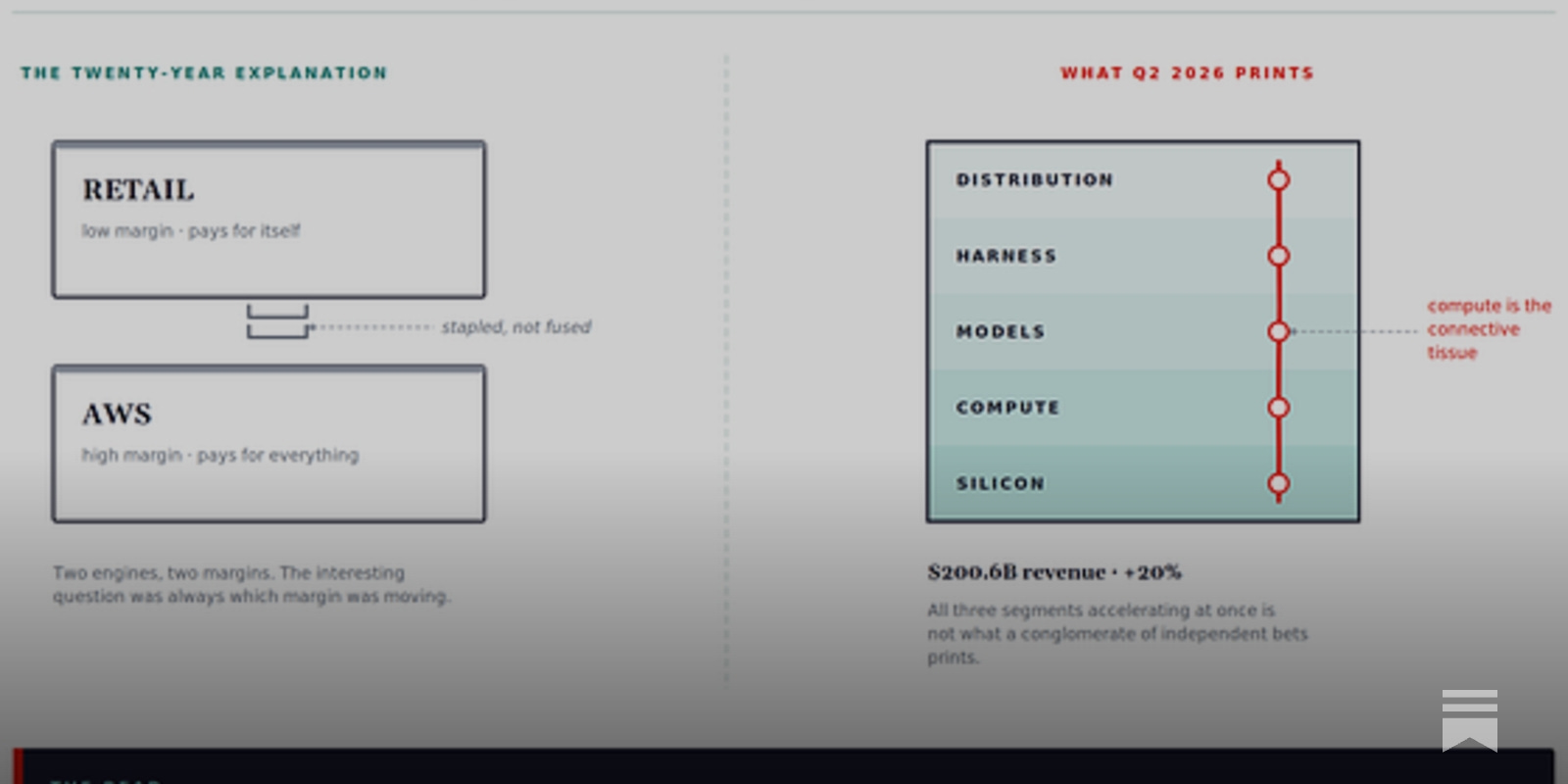
Google’s competitive moat was never just search or cloud. It was vertical integration: proprietary compute through TPUs, foundational model development through DeepMind, and distribution through a consumer and enterprise ecosystem reaching over 3 billion users. Lose one layer, and the stack weakens. Lose the people who built that layer, and the stack may not recover.
Source: The Business Engineer
That is precisely what the talent exodus signals. When researchers of this caliber leave Google, they do not disappear. They join or found competing labs, often backed by institutional capital willing to build independent infrastructure from scratch. The knowledge walks out the door — and so does the competitive architecture it was designed to protect.
Where the Talent Goes Matters More Than That It Left
Departing Google researchers have surfaced at organizations including Mistral, Cohere, and a growing number of well-capitalized AI startups that have collectively raised more than $40 billion in venture funding since 2023. Each new lab that reaches frontier capability is a lab that needs compute, tooling, and infrastructure — but does not need Google to provide it.
That fragmentation is the story NVIDIA should be watching most carefully, according to analysis by The Business Engineer. In a consolidated AI market dominated by two or three full-stack players, NVIDIA’s role as a neutral infrastructure provider is constrained. In a fragmented market with dozens of competitive labs, NVIDIA becomes the indispensable picks-and-shovels layer — the one company every competing faction still needs.
NVIDIA Is Already Positioning for Exactly This Scenario
NVIDIA’s deepening partnership with SpaceX — which is expanding its own AI and compute ambitions — is not an isolated deal. It reflects a broader strategic posture: NVIDIA is cementing relationships with entities that operate outside the traditional hyperscaler orbit. SpaceX represents a class of customer that neither Google, Microsoft, nor Amazon controls.
NVIDIA’s data center revenue reached $47.5 billion in fiscal year 2024, a figure that would have seemed implausible three years ago. With its Blackwell architecture now in deployment, the company is not waiting to see how the lab landscape consolidates. It is building revenue across every faction simultaneously.
Google Still Has Time — But the Window Is Narrowing
Google is not out of the race. Gemini Ultra benchmarks remain competitive with GPT-4 class models, and Google’s 90,000-employee engineering organization still represents one of the deepest talent reservoirs in technology. The company’s TPU infrastructure also gives it cost-per-token advantages that external labs cannot easily replicate.
But cost advantages mean little if the researchers who understand how to exploit them have moved on. Google has spent more than $15 billion on AI-related capital expenditure in recent quarters — investment that assumes the full-stack model holds together.
The strategic question the industry now faces is whether Google can rebuild its talent density fast enough to defend vertical integration — or whether the AI supercycle has already entered a phase where no single lab dominates, and the only guaranteed winner is the company selling infrastructure to all of them.
FULL ANALYSIS
Read the Complete Deep Dive
This article is based on a comprehensive analysis by The Business Engineer. Get the full breakdown with charts, data, and strategic frameworks.
Gennaro Cuofano is a CRO and tech executive who has worked in AI since late 2015, starting with bringing NLP, natural-language generation, voice and chatbot products to the marketing industry. His background is in law and finance: he holds a Master's degree in Law and an International MBA with an emphasis on corporate finance (LUISS Business School and the University of San Diego, 2012), and worked as a financial analyst at a real-estate investment firm in San Diego and as an assistant controller. His work focuses on business model strategy, business engineering and, more broadly, structural analysis: how companies make money, read from their own filings. He created FourWeekMBA and leads research there and at The Business Engineer, his newsletter on AI and business strategy, with over 95,000 subscribers and more than 1,000 published analyses. His writing has also appeared on Entrepreneur, HackerNoon and Search Engine People. Find him on LinkedIn and Substack. See how we source.
Scroll to Top
Discover more from FourWeekMBA
Subscribe now to keep reading and get access to the full archive.