Porter’s Five Forces is a model that helps organizations to gain a better understanding of their industries and competition. Published for the first time by Professor Michael Porter in his book “Competitive Strategy” in the 1980s. The model breaks down industries and markets by analyzing them through five forces
You can use the Ansoff Matrix as a strategic framework to understand what growthstrategy is more suited based on the market context. Developed by mathematician and business manager Igor Ansoff, it assumes a growthstrategy can be derived by whether the market is new or existing, and the product is new or existing.
The Blitzscaling business model canvas is a model based on the concept of Blitzscaling, which is a particular process of massive growth under uncertainty, and that prioritizes speed over efficiency and focuses on market domination to create a first-scaler advantage in a scenario of uncertainty.
Business analysis is a research discipline that helps driving change within an organization by identifying the key elements and processes that drive value. Business analysis can also be used in Identifying new business opportunities or how to take advantage of existing business opportunities to grow your business in the marketplace.
A gap analysis helps an organization assess its alignment with strategic objectives to determine whether the current execution is in line with the company’s mission and long-term vision. Gap analyses then help reach a target performance by assisting organizations to use their resources better. A good gap analysis is a powerful tool to improve execution.
The business model canvas is a framework proposed by Alexander Osterwalder and Yves Pigneur in Busines Model Generation enabling the design of business models through nine building blocks comprising: key partners, key activities, value propositions, customer relationships, customer segments, critical resources, channels, cost structure, and revenue streams.
The lean startup canvas is an adaptation by Ash Maurya of the business model canvas by Alexander Osterwalder, which adds a layer that focuses on problems, solutions, key metrics, unfair advantage based, and a unique value proposition. Thus, starting from mastering the problem rather than the solution.
A digital channel is a marketing channel, part of a distributionstrategy, helping an organization to reach its potential customers via electronic means. There are several digital marketing channels, usually divided into organic and paid channels. Some organic channels are SEO, SMO, email marketing. And some paid channels comprise SEM, SMM, and display advertising.
A blue ocean is a strategy where the boundaries of existing markets are redefined, and new uncontested markets are created. At its core, there is valueinnovation, for which uncontested markets are created, where competition is made irrelevant. And the cost-value trade-off is broken. Thus, companies following a blue ocean strategy offer much more value at a lower cost for the end customers.
Key Highlights
Porter’s Five Forces: Developed by Michael Porter, this model analyzes industries and markets through five forces, helping organizations understand their competitive landscape and industry dynamics.
Ansoff Matrix: Created by Igor Ansoff, the Ansoff Matrix provides a strategic framework to determine growth strategies based on whether the market and product are new or existing.
Blitzscaling Canvas: Based on the concept of Blitzscaling, this model emphasizes rapid growth and market domination under uncertainty to gain a first-scaler advantage.
Business Analysis Framework: Business analysis helps organizations identify key elements and processes that drive value, enabling them to identify new business opportunities and improve execution.
Gap Analysis: Gap analysis assesses alignment with strategic objectives and helps organizations reach target performance by utilizing resources more effectively.
Business Model Canvas: Proposed by Osterwalder and Pigneur, this framework designs business models using nine building blocks, including key partners, value propositions, customer segments, and revenue streams.
Lean Startup Canvas: An adaptation of the business model canvas by Ash Maurya, it focuses on problems, solutions, key metrics, unfair advantage, and unique value propositions, emphasizing understanding problems before solutions.
Digital Marketing Channels: Digital marketing channels are distribution strategies using electronic means to reach potential customers, including organic channels like SEO and paid channels like SEM and SMM.
Blue Ocean Strategy: This strategy redefines existing markets and creates uncontested markets through value innovation, offering more value at a lower cost to customers and making competition irrelevant.
Strategy/Concept
Description
When to Use
Advantages
Drawbacks
Porter’s Five Forces
Analyzes industry competitiveness using five key forces.
When evaluating the competitive landscape of an industry or making strategic decisions related to market positioning and entry.
Provides a structured framework to assess industry dynamics and competitive threats.
May oversimplify complex industry dynamics and not account for rapid changes.
Ansoff Matrix
Helps choose growth strategies based on market and product considerations.
When planning business growth and expansion strategies, especially when considering new markets or products.
Offers a clear framework for strategic decision-making and growth planning.
May not address all factors influencing strategic decisions, such as resource constraints.
Blitzscaling Canvas
Focuses on rapid, uncertain growth and market domination strategies.
In situations where the primary goal is to achieve massive growth quickly, even at the expense of efficiency, to gain a competitive advantage.
Prioritizes speed and market dominance, which can be essential in certain fast-paced markets.
Not suitable for all businesses, particularly those requiring stable and efficient growth.
Business Analysis Framework
Aids in understanding key elements and processes driving value.
When seeking to drive change within an organization, identifying new business opportunities, or improving existing operations to enhance market growth.
Helps organizations identify areas for improvement and align resources with strategic objectives.
May require extensive data collection and analysis, which can be resource-intensive.
Gap Analysis
Evaluates alignment with strategic objectives and resource optimization.
When assessing an organization’s performance relative to its strategic goals and seeking to bridge the gap between current and desired outcomes.
Identifies areas of misalignment and resource inefficiencies, facilitating targeted improvements.
Effectiveness depends on the accuracy of initial strategic objectives and data quality.
Business Model Canvas
Provides a framework for designing and analyzing business models.
When developing or refining a business model, exploring new revenue streams, or assessing the components of an existing business model.
Offers a visual and comprehensive overview of key business elements, promoting structured model design and innovation.
May oversimplify complex business dynamics and interactions, requiring detailed analysis.
Lean Startup Canvas
Adapts the business model canvas to focus on problems, solutions, and metrics.
When launching a startup or innovating within an existing organization, emphasizing problem-solving, value proposition, and metric-driven decision-making.
Guides startups in validating assumptions and achieving product-market fit before scaling.
May not provide a complete view of all business model elements, particularly revenue streams.
Digital Marketing Circle
Examines digital marketing channels for reaching potential customers.
In digital marketing planning, when choosing the most effective channels for customer acquisition, considering organic and paid options.
Helps organizations prioritize digital channels based on their target audience and goals, improving marketing effectiveness.
Requires ongoing monitoring and adjustment of channel strategies in a dynamic digital landscape.
Blue Ocean Strategy
Focuses on creating uncontested markets through value innovation.
When seeking to redefine industry boundaries, reduce competition, and offer unique value propositions, especially in mature or highly competitive markets.
Encourages innovation and differentiation by exploring uncharted market spaces, leading to sustained growth.
Requires a deep understanding of customer needs and a willingness to challenge industry norms.
In the 1970s, Bruce D. Henderson, founder of the Boston Consulting Group, came up with The Product Portfolio (aka BCG Matrix, or Growth-share Matrix), which would look at a successful business product portfolio based on potential growth and market shares. It divided products into four main categories: cash cows, pets (dogs), question marks, and stars.
First proposed by accounting academic Robert Kaplan, the balanced scorecard is a management system that allows an organization to focus on big-picture strategic goals. The four perspectives of the balanced scorecard include financial, customer, business process, and organizational capacity. From there, according to the balanced scorecard, it’s possible to have a holistic view of the business.
The PESTEL analysis is a framework that can help marketers assess whether macro-economic factors are affecting an organization. This is a critical step that helps organizations identify potential threats and weaknesses that can be used in other frameworks such as SWOT or to gain a broader and better understanding of the overall marketing environment.
Businesses use scenario planning to make assumptions on future events and how their respective business environments may change in response to those future events. Therefore, scenario planning identifies specific uncertainties – or different realities and how they might affect future business operations. Scenario planning attempts at better strategic decision making by avoiding two pitfalls: underprediction, and overprediction.
A SWOT Analysis is a framework used for evaluating the business’s Strengths, Weaknesses, Opportunities, and Threats. It can aid in identifying the problematic areas of your business so that you can maximize your opportunities. It will also alert you to the challenges your organization might face in the future.
In the FourWeekMBA growth matrix, you can apply growth for existing customers by tackling the same problems (gain mode). Or by tackling existing problems, for new customers (expand mode). Or by tackling new problems for existing customers (extend mode). Or perhaps by tackling whole new problems for new customers (reinvent mode).
A comparable company analysis is a process that enables the identification of similar organizations to be used as a comparison to understand the business and financial performance of the target company. To find comparables you can look at two key profiles: the business and financial profile. From the comparable company analysis it is possible to understand the competitive landscape of the target organization.
A Blockchain Business Model according to the FourWeekMBA framework is made of four main components: Value Model (Core Philosophy, Core Values and Value Propositions for the key stakeholders), Blockchain Model (Protocol Rules, Network Shape and Applications Layer/Ecosystem), Distribution Model (the key channels amplifying the protocol and its communities), and the Economic Model (the dynamics/incentives through which protocol players make money). Those elements coming together can serve as the basis to build and analyze a solid Blockchain Business Model.
In a business world driven by technology and digitalization, competition is much more fluid, as innovation becomes a bottom-up approach that can come from anywhere. Thus, making it much harder to define the boundaries of existing markets. Therefore, a proper business competition analysis looks at customer, technology, distribution, and financial model overlaps. While at the same time looking at future potential intersections among industries that in the short-term seem unrelated.
Technological modeling is a discipline to provide the basis for companies to sustain innovation, thus developing incremental products. While also looking at breakthrough innovative products that can pave the way for long-term success. In a sort of Barbell Strategy, technological modeling suggests having a two-sided approach, on the one hand, to keep sustaining continuous innovation as a core part of the business model. On the other hand, it places bets on future developments that have the potential to break through and take a leap forward.
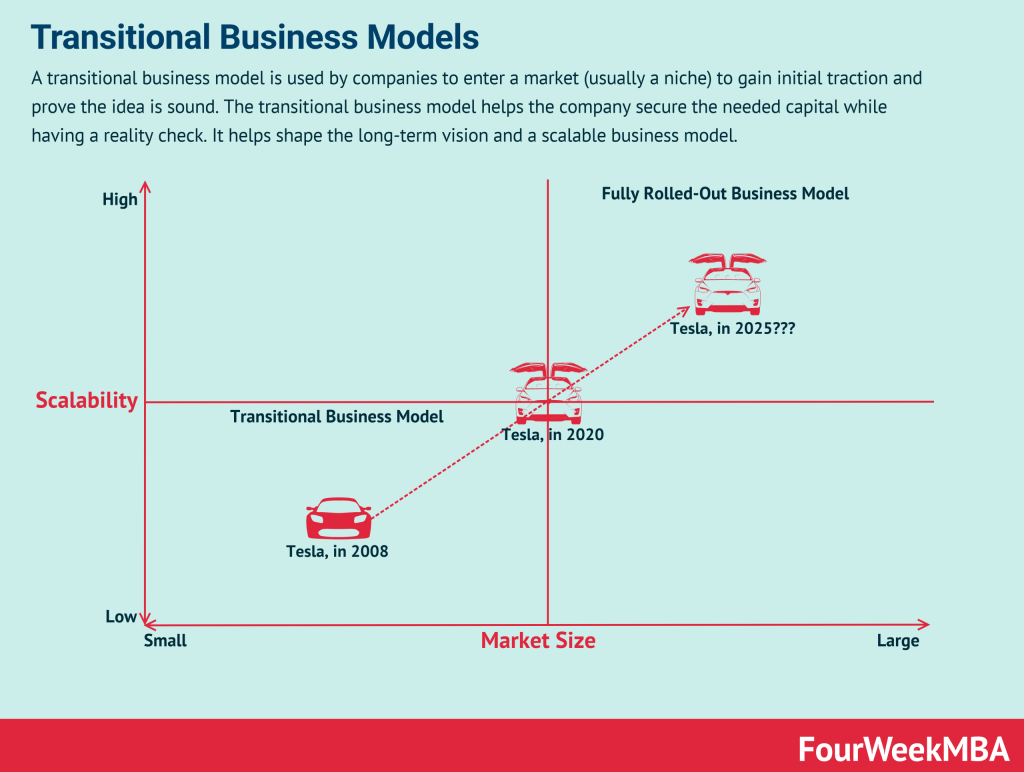
A transitional business model is used by companies to enter a market (usually a niche) to gain initial traction and prove the idea is sound. The transitional business model helps the company secure the needed capital while having a reality check. It helps shape the long-term vision and a scalable business model.
The minimum viable audience (MVA) represents the smallest possible audience that can sustain your business as you get it started from a microniche (the smallest subset of a market). The main aspect of the MVA is to zoom into existing markets to find those people which needs are unmet by existing players.
Business scaling is the process of transformation of a business as the product is validated by wider and wider market segments. Business scaling is about creating traction for a product that fits a small market segment. As the product is validated it becomes critical to build a viable business model. And as the product is offered at wider and wider market segments, it’s important to align product, business model, and organizational design, to enable wider and wider scale.
The market expansion consists in providing a product or service to a broader portion of an existing market or perhaps expanding that market. Or yet, market expansions can be about creating a whole new market. At each step, as a result, a company scales together with the market covered.
In the FourWeekMBA growth matrix, you can apply growth for existing customers by tackling the same problems (gain mode). Or by tackling existing problems, for new customers (expand mode). Or by tackling new problems for existing customers (extend mode). Or perhaps by tackling whole new problems for new customers (reinvent mode).
In the FourWeekMBA Revenue Streams Matrix, revenue streams are classified according to the kind of interactions the business has with its key customers. The first dimension is the “Frequency” of interaction with the key customer. As the second dimension, there is the “Ownership” of the interaction with the key customer.
Revenue model patterns are a way for companies to monetize their business models. A revenue model pattern is a crucial building block of a business model because it informs how the company will generate short-term financial resources to invest back into the business. Thus, the way a company makes money will also influence its overall business model.
Strategy/Concept
Description
When to Use
Advantages
Drawbacks
BCG Matrix
Evaluates a product portfolio based on growth potential and market share.
When assessing and managing a range of products or business units, determining their strategic positions in terms of growth and market share.
Provides a visual framework for portfolio analysis, aiding in resource allocation and decision-making.
May oversimplify complex market dynamics and not consider external factors.
Balanced Scorecard
Offers a management system with four perspectives to focus on strategic goals.
When an organization aims to align its activities with its long-term strategic objectives, improve performance, and track progress across various aspects of the business.
Provides a comprehensive view of performance by considering financial, customer, process, and capacity perspectives.
Implementation can be resource-intensive, and metrics may not capture the full complexity of operations.
PEST Analysis
Evaluates macro-economic factors affecting an organization.
When assessing the external environment, identifying potential threats, and understanding the broader market context that can impact business operations.
Helps organizations identify factors beyond their control that may influence decision-making and planning.
May not provide actionable insights without further analysis and integration into strategic planning.
Scenario Planning
Considers alternative future scenarios to inform strategic decisions.
In situations where uncertainties or external factors can significantly impact an organization’s future, enabling proactive planning and adaptation.
Prepares organizations for multiple possible futures, helping them avoid the pitfalls of underprediction and overprediction.
Requires the creation and analysis of multiple scenarios, which can be time-consuming and resource-intensive.
SWOT Analysis
Evaluates internal strengths and weaknesses and external opportunities and threats.
When conducting a comprehensive analysis of a business, identifying areas of competitive advantage and challenges, and formulating strategic plans based on internal and external factors.
Offers a structured framework for examining key aspects of a business, aiding in strategy development and risk mitigation.
Can be subjective and may not capture all relevant factors, leading to potential oversights.
Growth Matrix
Provides four growth modes for existing and new customers and problems.
When planning growth strategies and product development, choosing the appropriate mode based on the target audience and market context.
Offers a flexible framework for tailoring growth strategies to different customer segments and business goals.
Implementation may require clear customer segmentation and a deep understanding of market dynamics.
Comparable Analysis Framework
Identifies similar organizations for benchmarking.
When analyzing the financial and business performance of a target company or industry peers to gain insights into market dynamics and competitive positioning.
Enables organizations to make informed decisions by comparing their performance to relevant competitors and industry benchmarks.
Requires access to reliable data on comparable companies and industries, which may be limited or incomplete.
FourWeekMBA Business Strategy Toolbox
Offers various tools and frameworks for business strategy.
When seeking to explore and apply different business strategy concepts and models, tailoring strategies to specific business contexts, and fostering innovation and growth.
Provides a range of strategic tools and frameworks to address diverse business challenges and opportunities.
Choosing the most suitable tool or framework for a specific situation may require expertise and analysis.
Tech Business Model Framework
Analyzes tech business models based on key components.
When developing or evaluating tech-focused business models, considering value propositions, technology, distribution, and financial aspects to drive innovation and growth.
Provides a structured framework for understanding and designing tech business models, fostering innovation and scalability.
Effectiveness may vary based on the complexity of the tech landscape and market dynamics.
Blockchain Business Model Framework
Analyzes blockchain business models using core components.
When exploring blockchain-based business opportunities, assessing value models, blockchain protocols, distribution channels, and economic incentives to drive adoption and success.
Offers a comprehensive framework for understanding blockchain business models, enabling strategic planning and alignment with blockchain principles.
Requires a deep understanding of blockchain technology and its potential applications, which may be limited.
Business Competition Analysis
Considers competition within the fluid and technology-driven market.
When analyzing market competition in technology-driven industries, taking into account customer, technology, distribution, and financial model overlaps, and identifying future intersections among seemingly unrelated industries.
Provides insights into dynamic and evolving competition patterns in technology-driven markets, guiding strategic decisions and market positioning.
Requires ongoing monitoring and adaptation as technology and competition continue to evolve.
Technological Modeling
Supports incremental and breakthrough innovation in product development.
When aiming to sustain innovation and develop both incremental and breakthrough products, maintaining a balanced approach that accounts for short-term and long-term success.
Promotes a structured approach to innovation and product development, combining continuous improvement with future-oriented breakthroughs.
Effectiveness depends on the organization’s capacity for innovation and its ability to balance short-term and long-term goals.
Transitional Business Models
Facilitates market entry, traction, and validation for startups.
When launching a startup or entering a new market, using a transitional business model to gain initial traction, secure funding, validate the business idea, and shape a scalable long-term strategy.
Provides a practical approach for startups to navigate initial challenges, secure resources, and refine their business models while pursuing market entry.
Requires careful planning and adaptation to transition from a temporary business model to a scalable, long-term strategy.
Minimum Viable Audience
Focuses on identifying a small, viable audience for a startup.
When launching a startup or micro-niche product, identifying the smallest audience segment that can sustain the business during its initial stages, allowing for targeted marketing and growth.
Enables startups to validate their ideas and products with a specific audience, reducing the risk of broad-scale failure and optimizing resource allocation.
Success hinges on accurately identifying the minimum viable audience and effectively addressing its needs and preferences.
Business Scaling
Guides the transformation of a validated product for wider markets.
When a startup has achieved product-market fit within a niche segment, planning for scalability by aligning product, business model, and organizational design to expand into broader market segments.
Provides a structured approach to scale a business while maintaining alignment with evolving customer needs and market dynamics, ensuring sustainable growth.
Requires careful execution and coordination across product development, operations, and marketing to maintain consistency and quality at scale.
Market Expansion
Involves expanding a product or service to broader or new markets.
When seeking to grow a business by reaching a larger portion of an existing market or entering entirely new markets, adapting strategies and offerings to address diverse customer segments.
Allows organizations to tap into new growth opportunities, diversify revenue streams, and leverage existing capabilities to capture a larger market share and expand their presence.
Expansion efforts may involve different challenges and risks, requiring thorough market research and adaptation to local conditions.
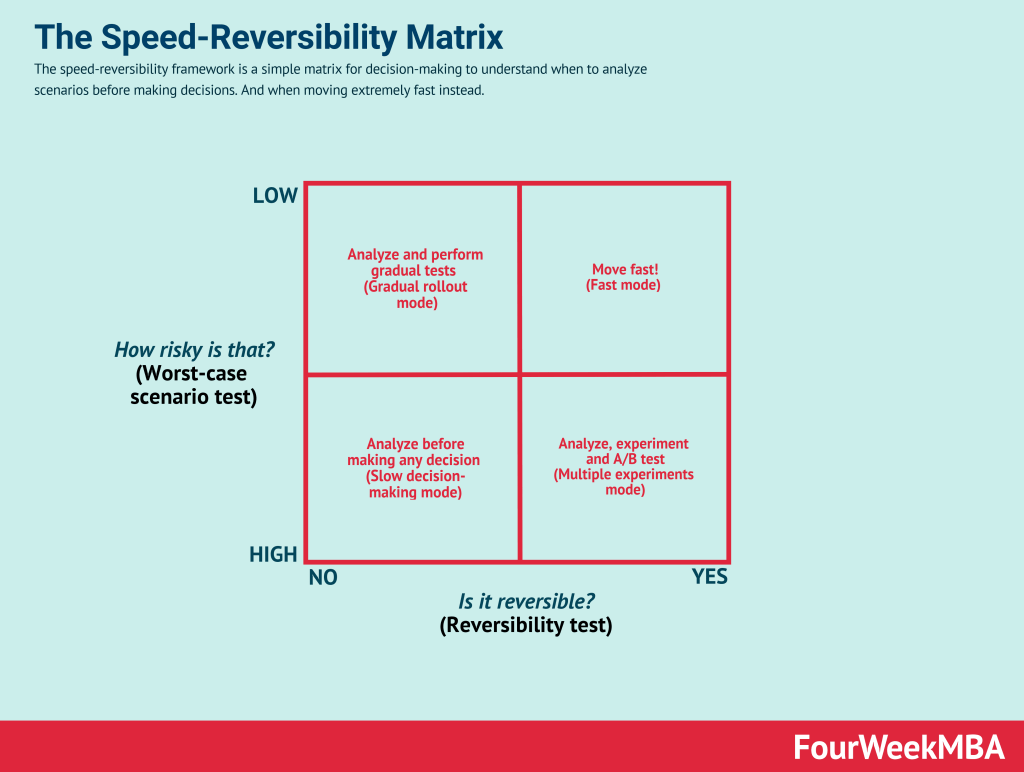
Speed-Reversibility
Considers the speed and reversibility of strategic decisions.
When evaluating strategic options, assessing the potential impact and speed of execution, while also considering the reversibility of decisions in case they do not yield the desired outcomes.
Helps organizations make informed strategic choices by weighing the potential benefits of quick actions against the ability to pivot or reverse decisions if necessary.
Requires a balance between speed and reversibility, as overly cautious or slow decisions can hinder competitiveness, while irreversible actions may carry significant risks.
Growth Matrix (Reiterated)
Provides four growth modes for existing and new customers and problems.
When planning growth strategies and product development, choosing the appropriate mode based on the target audience and market context.
Offers a flexible framework for tailoring growth strategies to different customer segments and business goals.
Implementation may require clear customer segmentation and a deep understanding of market dynamics.
Revenue Streams (Reiterated)
Classifies revenue streams based on interaction frequency and ownership.
When analyzing revenue generation methods and customer interactions, categorizing revenue streams to understand their characteristics and optimize revenue models.
Helps organizations tailor their revenue generation strategies to customer behavior and interaction patterns, optimizing profitability.
Effective implementation requires accurate data on customer interactions and revenue sources.
Revenue Model (Reiterated)
Defines patterns for monetizing a business model.
When shaping the financial aspects of a business model, considering revenue model patterns to determine how the company generates short-term financial resources and sustains its operations.
Offers a structured approach to designing revenue models that align with business objectives and enhance financial sustainability.
Effectiveness may vary based on the industry, market conditions, and evolving customer preferences.
What are the key components of Nine Simple Strategy Frameworks To Grow Your Business?
The key components of Nine Simple Strategy Frameworks To Grow Your Business include Porter's Five Forces, Ansoff Matrix, Blitzscaling Canvas, Business Analysis Framework, Gap Analysis. Porter's Five Forces: Analyzes industry competitiveness using five key forces.
Gennaro is the creator of FourWeekMBA, which reached about four million business people, comprising C-level executives, investors, analysts, product managers, and aspiring digital entrepreneurs in 2022 alone | He is also Director of Sales for a high-tech scaleup in the AI Industry | In 2012, Gennaro earned an International MBA with emphasis on Corporate Finance and Business Strategy.
Scroll to Top
Discover more from FourWeekMBA
Subscribe now to keep reading and get access to the full archive.