The STAR method is an interview technique that is used to answer behavioral interview questions. The STAR method is a technique that an interviewee can use to help prepare for behavioral or situational interview questions that assess important skills. STAR is an acronym comprised of four factors that make the question answering framework: situation, task, action, and result.
STAR Method Element
Description
Implications
Key Characteristics
Examples
Applications
Situation (S)
Describe the specific situation or context in which the experience or challenge occurred.
– Provides context for the interviewer. – Sets the stage for the forthcoming story. – Helps the interviewer understand the scenario.
– Clearly defined context or circumstances.
– “In my previous role as a customer service representative at XYZ Company…” – “During a team project in college…” – “At my previous job, we faced a challenging situation…”
– Job Interviews: Use to respond to behavioral interview questions about past experiences. – Performance Reviews: Share examples of your work to demonstrate accomplishments. – Presentations: Structure stories to engage and inform the audience. – Problem-Solving: Analyze past situations to identify effective strategies.
Task (T)
Explain the specific task or responsibility you were assigned within the given situation.
– Highlights your role and responsibilities. – Provides clarity on what was expected of you. – Sets the stage for the upcoming action and result.
– Clearly defined tasks, goals, or objectives.
– “My task was to improve customer satisfaction by addressing their concerns and resolving issues.” – “I was responsible for leading a team of five members to complete a critical project on time.” – “The task at hand was to analyze market trends and propose a new marketing strategy.”
– Job Interviews: Showcase your role and responsibilities in past experiences. – Project Management: Define tasks and responsibilities within project teams. – Goal Setting: Clarify objectives and responsibilities when setting goals. – Performance Metrics: Align tasks with key performance indicators.
Action (A)
Detail the actions you took to address the situation and accomplish the assigned task.
– Demonstrates your skills, competencies, and decision-making. – Illustrates how you approached challenges. – Highlights your proactive efforts.
– Specific actions, steps, or strategies employed.
– “I initiated a comprehensive analysis of customer feedback data…” – “I conducted regular team meetings to ensure everyone was aligned and on track.” – “I researched industry trends, conducted surveys, and collaborated with the marketing team to develop a new campaign.”
– Job Interviews: Elaborate on the actions you took to handle specific situations or challenges. – Leadership Development: Assess leadership skills and decision-making abilities. – Process Improvement: Identify actions to optimize workflows and processes. – Problem-Solving: Analyze actions to determine their effectiveness in addressing issues.
Result (R)
Share the outcomes and results achieved as a direct result of your actions and efforts.
– Quantify achievements wherever possible. – Emphasize the positive impact of your actions. – Highlight the value you brought to the situation.
– Measurable results, achievements, or outcomes.
– “As a result, customer satisfaction ratings increased by 20% within six months.” – “Our project was completed two weeks ahead of schedule and under budget.” – “The new marketing campaign led to a 30% increase in website traffic and a 15% rise in sales.”
– Job Interviews: Showcase the positive results of your actions and contributions. – Performance Evaluations: Document and discuss accomplishments and their impact. – Business Presentations: Use data-driven results to support your proposals and initiatives. – Continuous Improvement: Assess outcomes to identify areas for further enhancement.
The method has important implications for behavioral interviewing. This is a form of interviewing where questions are asked about past behavior and how it contributed to overcoming challenging work situations.
The STAR method is ideal for anyone who has difficulty answering these questions using real-world examples. It can be used to demonstrate competency in a range of skills relating to problem-solving, creativity, public speaking, teamwork, and perseverance.
Using the STAR method
STAR is an acronym comprised of four factors that make the question answering framework.
Here is a look at each.
S – Situation
Start by sharing the context in which you faced and then overcame a challenge. Context should preferably relate to relevant work experience. But for those with less job experience, referencing academic achievements or volunteer work is also useful.
Brevity is very important in setting the context. Only share what is required to adequately set the context for the interviewer.
T – Task
In other words, what role or responsibility did you hold in your chosen situation? What task did you have to complete?
Tasks most often relate to hitting sales targets and resolving conflict. Again, it is vital to be succinct and avoid superfluous detail.
A – Action
What specific actions did your task entail? How did you overcome the challenge or handle the situation? This answer should be in-depth because it largely determines how suitable you are for similar roles.
Define the steps you took to achieve success, even if working as part of a team. While it may be tempting to describe the collective actions of the team, you must maintain a focus on the role that you played as part of the team.
R – Result
Lastly, explain the outcome(s) generated by the action taken. Outcomes may take the form of accomplishments, but it never hurts to mention what you learned as a result of the challenge itself.
Preparing for a job interview using the STAR method
With an understanding of how to structure questions, it is time to get more specific on the potential questions that may be asked.
To prepare, follow these steps:
Review the job description. What sorts of challenges may arise during a typical workday? Evaluating the required or relevant skills may yield important clues.
Review general, evergreen interview questions. Most interviewers will ask at least one question about time management, stress, or working under pressure.
Write out past experiences. Using the STAR method as a guide, articulate past instances where a challenge was met and overcome.
Read each experience out loud. Does it sound coherent? Is it concise? Does it address a required or relevant skill? Refine until you can speak about each experience confidently without referring to your notes.
Drawbacks of the STAR Method
Potential for Overscripted Responses:
Prepared Answers: Candidates might prepare rehearsed answers using the STAR method, which may not always reflect their true capabilities or experiences.
Lack of Spontaneity: Over-reliance on this structure could lead to responses that lack spontaneity and authenticity.
Limited Depth of Insight:
Surface-Level Information: While the STAR method provides a structured response, it might not delve deeply into the nuances of a candidate’s experience or thought process.
Misses Non-Scenario-Based Skills: The method is focused on specific situations and might not capture broader competencies or potential for growth.
Risk of Misinterpretation:
Dependent on Candidate’s Articulation Skills: The effectiveness of the method relies heavily on the candidate’s ability to articulate experiences clearly and concisely, which may disadvantage those with weaker communication skills.
Subjectivity in Evaluation: Interviewers may subjectively interpret the relevance or success of the actions and results described by the candidate.
Focus on Past Performance:
Not Always Indicative of Future Success: The STAR method focuses on past experiences, which may not always be reliable indicators of future performance or adaptability in different roles or environments.
When to Use the STAR Method
Suitable Scenarios:
Behavioral Interviews: Particularly useful in behavioral interviews where understanding how a candidate has handled past situations is crucial.
Assessing Specific Competencies: Effective for evaluating specific competencies or skills relevant to the job.
Strategic Application:
Standardizing Interviews: Can be used to standardize interviews across candidates, ensuring that each candidate is evaluated on similar criteria.
Training Interviewers: Useful for training new interviewers in conducting structured and fair interviews.
How to Use the STAR Method
Implementing the Technique:
Situation: The candidate describes a specific situation relevant to the question.
Task: They detail the tasks involved in that situation.
Action: The candidate explains the actions they took to address the situation.
Result: They describe the outcomes or results of those actions.
Best Practices:
Encourage Specifics: Prompt candidates to provide specific examples rather than general descriptions.
Probe Deeper: Follow up with questions that probe deeper into the candidate’s thought process and decision-making.
Combine with Other Methods: Use the STAR method in conjunction with other interview techniques to get a well-rounded view of the candidate.
What to Expect from Implementing the STAR Method
Structured and Focused Interviews:
Consistency in Responses: Provides a consistent structure for candidates to respond to behavioral questions.
Focused Discussions: Helps keep responses focused and relevant to the question.
Impact on Candidate Evaluation:
Insight into Past Behaviors: Offers valuable insights into how candidates have behaved in past professional situations.
Standardized Evaluation: Facilitates more standardized evaluation of candidates based on their responses.
Potential Limitations:
Varied Candidate Performance: Some candidates might excel in the STAR format, while others might struggle, which could influence their evaluation irrespective of their actual job suitability.
Requires Skilled Interviewing: Effective use of the STAR method requires skilled interviewing to extract meaningful insights and avoid rehearsed responses.
Case Studies
Question: Can you give an example of a time when you had to overcome a challenging situation within a team project?
S (Situation): In my previous job, I was part of a cross-functional team tasked with launching a new product.
T (Task): My role was to coordinate between the marketing and engineering teams to ensure a smooth product launch.
A (Action): When communication breakdowns occurred between the teams, I initiated regular status meetings, created a shared project timeline, and facilitated open discussions to address concerns.
R (Result): As a result, the project launched on time with minimal hiccups, and the teams learned the importance of clear communication and collaboration.
Question: Describe a situation where you demonstrated strong problem-solving skills.
S: During my internship at a startup, we faced a critical software bug just days before a major demo.
T: I was responsible for the demo’s technical aspects and ensuring a flawless presentation.
A: I quickly analyzed the bug’s source, collaborated with the development team to fix it, and tested the solution rigorously.
R: Thanks to the quick action, we successfully resolved the bug, the demo went smoothly, and the potential client was impressed by our professionalism.
Question: Tell me about a time when you had to adapt to a change in a project’s scope.
S: In my current role, our client unexpectedly expanded the project’s scope, requiring additional features.
T: I was the project manager responsible for keeping the project on track.
A: I promptly assessed the impact of the changes on timelines and resources. I rearranged the team’s tasks, communicated the adjustments, and ensured everyone understood the new priorities.
R: Despite the scope increase, we delivered the project within the revised timeframe, demonstrating our team’s adaptability and dedication to meeting client needs.
Question: Can you share an experience where you had to lead a team through a high-pressure situation?
S: In my previous position, our team faced a looming deadline for a critical client presentation.
T: I was the team lead responsible for coordinating the presentation’s content and delivery.
A: I organized extra work sessions, delegated tasks based on team members’ strengths, and provided clear guidance. I also remained available for support and feedback.
R: The presentation was a success, and our team’s ability to work cohesively under pressure strengthened our reputation as reliable problem-solvers.
Question: Describe a situation where your communication skills positively influenced the outcome of a project.
S: While working on a group project in college, our team struggled to agree on a design direction.
T: I took on the role of team communicator and mediator.
A: I scheduled regular meetings to facilitate discussions, ensured that everyone’s ideas were heard, and synthesized our discussions into a cohesive designplan.
R: By fostering open communication, we developed a stronger design that incorporated diverse perspectives, leading to a higher grade and improved collaboration within the team.
Key takeaways:
The STAR method is a means of preparing for behavioral questions that will be asked in a job interview.
The STAR method is an acronym of four components vital to a thoughtful answer: situation, task, action, and result.
Preparing for an interview using the STAR method involves reviewing job requirements and common behavioral interview questions. Interview answers that are relevant to the position can then be formulated and refined.
Key Highlights of the STAR Method:
Behavioral Interview Technique: The STAR method is used to answer behavioral interview questions that focus on past experiences and how they relate to specific skills and competencies.
Components of STAR: STAR is an acronym that stands for Situation, Task, Action, and Result. These four components form a structured framework for answering questions.
Implications for Behavioral Interviewing: The STAR method is particularly effective for behavioral interviews, which probe into your past behaviors and actions in various situations, showcasing your abilities and suitability for the job.
Skill Demonstration: The STAR method allows you to demonstrate a wide range of skills, including problem-solving, teamwork, communication, creativity, and perseverance.
Agile leadership is the embodiment of agile manifesto principles by a manager or management team. Agile leadership impacts two important levels of a business. The structural level defines the roles, responsibilities, and key performance indicators. The behavioral level describes the actions leaders exhibit to others based on agile principles.
Adaptive leadership is a model used by leaders to help individuals adapt to complex or rapidly changing environments. Adaptive leadership is defined by three core components (precious or expendable, experimentation and smart risks, disciplined assessment). Growth occurs when an organization discards ineffective ways of operating. Then, active leaders implement new initiatives and monitor their impact.
Developed by business consultants Kenneth Blanchard and Paul Hersey in the 1960s, delegative leadership is a leadership style where authority figures empower subordinates to exercise autonomy. For this reason, it is also called laissez-faire leadership. In some cases, this type of leadership can lead to increases in work quality and decision-making. In a few other cases, this type of leadershipneeds to be balanced out to prevent a lack of direction and cohesiveness of the team.
Distributed leadership is based on the premise that leadership responsibilities and accountability are shared by those with the relevant skills or expertise so that the shared responsibility and accountability of multiple individuals within a workplace, bulds up as a fluid and emergent property (not controlled or held by one individual). Distributed leadership is based on eight hallmarks, or principles: shared responsibility, shared power, synergy, leadership capacity, organizational learning, equitable and ethical climate, democratic and investigative culture, and macro-community engagement.
Micromanagement is about tightly controlling or observing employees’ work. Although in some cases, this management style might be understood, especially for small-scale projects, generally speaking, micromanagement has a negative connotation mainly because it shows a lack of trust and freedom in the workplace, which leads to adverse outcomes.
Maslow’s Hierarchy of Needs was developed by American psychologist Abraham Maslow. His hierarchy, often depicted in the shape of a pyramid, helped explain his research on basic human needs and desires. In marketing, the hierarchy (and its basis in psychology) can be used to market to specific groups of people based on their similarly specific needs, desires, and resultant actions.
The Eisenhower Matrix is a tool that helps businesses prioritize tasks based on their urgency and importance, named after Dwight D. Eisenhower, President of the United States from 1953 to 1961, the matrix helps businesses and individuals differentiate between the urgent and important to prevent urgent things (seemingly useful in the short-term) cannibalize important things (critical for long-term success).
Moonshot thinking is an approach to innovation, and it can be applied to business or any other discipline where you target at least 10X goals. That shifts the mindset, and it empowers a team of people to look for unconventional solutions, thus starting from first principles, by leveraging on fast-paced experimentation.
The theory was developed by psychologist Edwin Locke who also has a background in motivation and leadership research. Locke’s goal-setting theory of motivation provides a framework for setting effective and motivating goals. Locke was able to demonstrate that goal setting was linked to performance.
Herzberg’s two-factor theory argues that certain workplace factors cause job satisfaction while others cause job dissatisfaction. The theory was developed by American psychologist and businessmanagement analyst Frederick Herzberg. Until his death in 2000, Herzberg was widely regarded as a pioneering thinker in motivational theory.
The term lessons learned refers to the various experiences project team members have while participating in a project. Lessons are shared in a review session which usually occurs once the project has been completed, with any improvements or best practices incorporated into subsequent projects.
Growth engineering is a systematic, technical approach to the improvement of conversion and the user experience. Combined with business engineering it helps business people build valuable companies from scratch.
Retrospective analyses are held after a project to determine what worked well and what did not. They are also conducted at the end of an iteration in Agile project management. Agile practitioners call these meetings retrospectives or retros. They are an effective way to check the pulse of a project team, reflect on the work performed to date, and reach a consensus on how to tackle the next sprint cycle.
Andy Grove, helped Intel become among the most valuable companies by 1997. In his years at Intel, he conceived a management and goal-setting system, called OKR, standing for “objectives and key results.” Venture capitalist and early investor in Google, John Doerr, systematized in the book “Measure What Matters.”
Cog’s ladder is a model of group development. The ladder was created in 1972 by Procter & Gamble employee George Charrier to help management at the company understand how teams worked to make them more efficient. Cog’s ladder is a model of group formation and behavior that is used to help businesses understand how a team can work to achieve its goals.
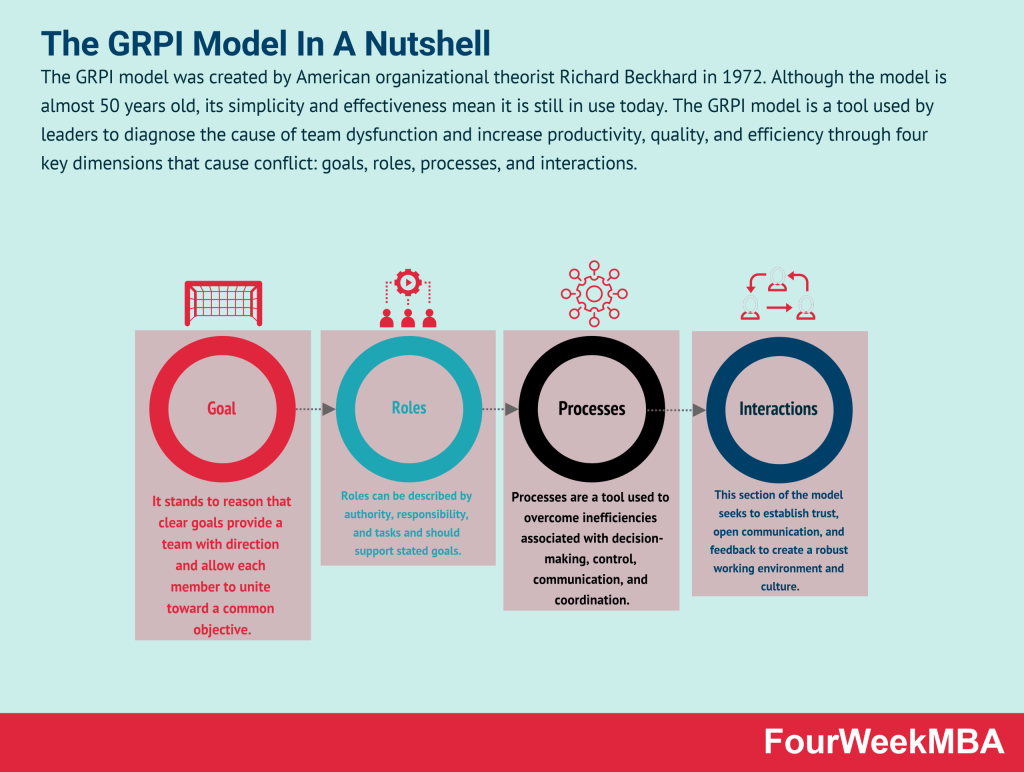
The GRPI model was created by American organizational theorist Richard Beckhard in 1972. Although the model is almost 50 years old, its simplicity and effectiveness mean it is still in use today. The GRPI model is a tool used by leaders to diagnose the cause of team dysfunction and increase productivity, quality, and efficiency through four key dimensions that cause conflict: goals, roles, processes, and interactions.
High-performance coaches work with individuals in personal and professional contexts to enable them to reach their full potential. While these sorts of coaches are commonly associated with sports, it should be noted that the act of coaching is a specific type of behavior that is also useful in business and leadership.
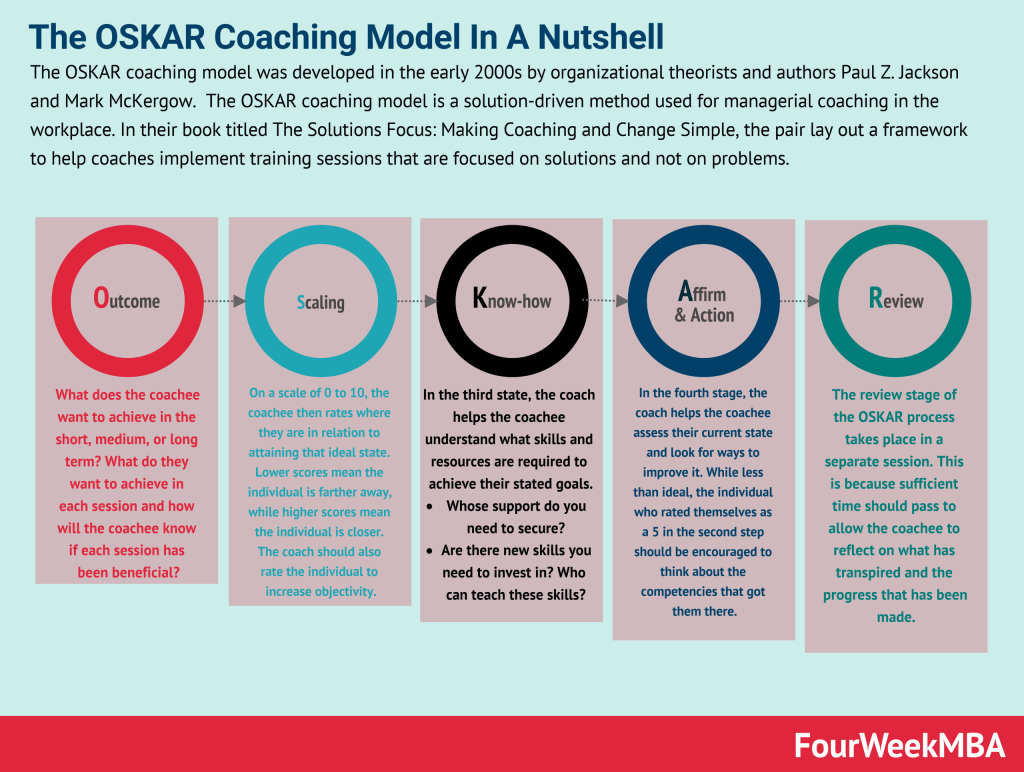
The OSKAR coaching model was developed in the early 2000s by organizational theorists and authors Paul Z. Jackson and Mark McKergow. The OSKAR coaching model is a solution-driven method used for managerial coaching in the workplace. In their book titled The Solutions Focus: Making Coaching and Change Simple, the pair layout a framework to help coaches implement training sessions that are focused on solutions and not on problems.
The training of trainers model seeks to engage master instructors in coaching new, less experienced instructors with a particular topic or skill. The training of trainers (ToT) model is a framework used by master instructors to train new instructors, enabling them to subsequently train other people in their organization.
Though no single individual can claim to have created the GROW model, writers Graham Alexander and Alan Fine together with racing car champion John Whitmore played a significant part in developing the framework during the 80s and 90s. The GROW model is a simple way to set goals and solve problems during coaching sessions through four stages: goal, reality, options, and will (way forward).
The Ulrich model helps large or complex organizations with many business units organize their human resource function. The Ulrich model was named for management coach David Ulrich after the release of his 1996 book Human Resource Champions: The Next Agenda for Adding Value and Delivering Results.
Gennaro is the creator of FourWeekMBA, which reached about four million business people, comprising C-level executives, investors, analysts, product managers, and aspiring digital entrepreneurs in 2022 alone | He is also Director of Sales for a high-tech scaleup in the AI Industry | In 2012, Gennaro earned an International MBA with emphasis on Corporate Finance and Business Strategy.